When customers search Google for a product, they may see product listings containing information such as an image, product name, price and store.
For an ecommerce business, getting products into eligible Google shopping experiences can create another way for potential customers to discover the online store.
But products do not appear simply because they exist on an ecommerce website.
A typical process is:
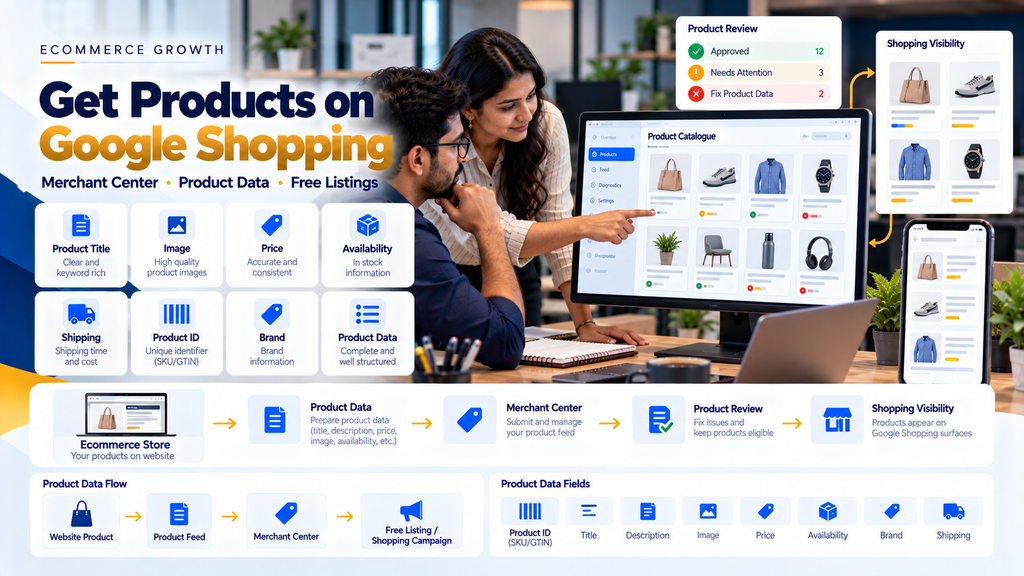
Ecommerce Website → Product Data → Google Merchant Center → Product Processing → Eligible Google Shopping Experiences
Businesses need to prepare their ecommerce website, provide accurate product information, configure Merchant Center and resolve applicable product or account issues.
This guide explains how to get ecommerce products listed on Google Shopping, including free listings, product data, Merchant Center, shipping, product identifiers, website requirements and ongoing optimization.
What Is Google Shopping?
Google shopping experiences allow customers to discover products using structured ecommerce information such as product images, titles, prices, availability and store information.
For ecommerce businesses, product visibility on Google can involve both free and paid opportunities depending on eligibility, country, product type and configuration.
Can Ecommerce Products Be Listed on Google for Free?
Eligible ecommerce products can participate in Google’s free product listing opportunities in supported countries, including India.
This is different from running paid Shopping advertising.
However, creating a Merchant Center account does not guarantee that every product will appear.
The products, product data, ecommerce website and business must meet applicable requirements and policies.
Free Listings vs Shopping Ads
| Free Product Listings | Shopping Ads |
|---|---|
| No advertising payment required for the free listing placement itself | Paid advertising |
| Managed through Merchant Center product data | Uses Merchant Center product information with applicable advertising setup |
| Products must meet applicable eligibility requirements | Products and campaigns must meet applicable advertising requirements |
| Visibility is not guaranteed | Ad impressions and results are not guaranteed |
| Can complement ecommerce SEO | Can complement SEO and free listings |
What Do You Need Before Listing Products?
Before trying to submit products, prepare the ecommerce foundation.
A practical checklist includes:
- A functional ecommerce website
- HTTPS
- Clear business information
- Contact information
- Product pages
- Accurate product prices
- Accurate availability
- Product images
- Functional purchase journey
- Shipping information
- Return/refund information
- Merchant Center account
- Structured product data or another supported product-data source
Complete Google Shopping Listing Process
A useful workflow is:
Prepare Website → Create Merchant Center → Verify Website → Add Products → Configure Shipping & Returns → Review Product Issues → Fix Errors → Eligible Products → Monitor Listings
Step 1: Prepare Your Ecommerce Website
The destination website matters just as much as the product data.
A product listing should lead customers to a relevant, functional ecommerce product page.
Use HTTPS
The ecommerce website should operate over secure HTTPS connections.
Make the Store Functional
Customers should be able to browse the products and complete the intended purchase journey.
Provide Business Information
Clearly communicate who operates the ecommerce website.
Provide Contact Information
Customers should have genuine ways to contact the business.
Publish Shipping Information
Explain applicable shipping costs, regions and delivery conditions accurately.
Publish Return and Refund Information
Make the actual business policy available to customers rather than copying a generic policy that does not represent the store.
Step 2: Create Google Merchant Center
Merchant Center is the central system used to provide and manage ecommerce product information for eligible Google shopping experiences.
If you have not configured it yet, read Google Merchant Center Setup for Ecommerce Businesses.
Use the Actual Business Information
Merchant information should represent the real business operating the ecommerce store.
Use Business-Controlled Access
The ecommerce business should retain appropriate ownership and administrative access rather than leaving the entire account permanently under an external developer’s personal login.
Step 3: Add and Verify the Ecommerce Website
Merchant Center needs to associate the merchant with the website customers will visit.
Enter the Correct Store URL
Use the actual ecommerce website where the products can be viewed and purchased.
Complete the Available Verification Process
Follow the current website verification process provided for the account and website configuration.
Maintain Domain Control
The business should maintain control of its domain and related digital assets.
Step 4: Choose How to Add Products
Products can be provided to Merchant Center through supported product-data methods.
The appropriate method depends on the ecommerce platform and catalogue.
Option 1: Ecommerce Platform Integration
Supported ecommerce platform integrations can simplify product synchronization.
Option 2: Product Data File
Product information can be prepared in a supported file format and supplied to Merchant Center.
Option 3: Automated Product Data
Depending on the website and Merchant Center configuration, supported automated methods may help Google discover or update product information.
Option 4: API Integration
Custom and large ecommerce systems may use supported APIs to manage product data programmatically.
Which Product Submission Method Should You Use?
| Store Type | Possible Approach |
|---|---|
| Small ecommerce catalogue | Supported integration or manageable product file |
| WooCommerce | Compatible integration/plugin or custom feed |
| Shopify | Supported Shopify integration |
| Custom ecommerce website | Product feed or API-based integration |
| Large catalogue | Automated product-data synchronization |
| ERP-connected ecommerce | Structured synchronization from the authoritative product source |
Step 5: Provide the Required Product Information
Google uses submitted product attributes to understand products and determine their eligibility for relevant experiences.
Requirements can vary depending on product type, country and destination.
Common important attributes include:
- Product ID
- Title
- Description
- Product URL
- Image URL
- Availability
- Price
- Condition
- Brand where applicable
- GTIN or other identifiers where applicable
- Variant information where applicable
- Shipping information where applicable
Step 6: Create Stable Product IDs
Each submitted product needs an appropriate product identifier within the product-data system.
Keep IDs Stable
Do not unnecessarily change product IDs every time the feed is regenerated.
Use Unique IDs
Different products or applicable variants should not accidentally share the same internal listing ID.
Step 7: Optimize Product Titles
The product title helps describe exactly what is being sold.
Identify the Product Clearly
Customers should understand the item without decoding marketing language.
Include Important Attributes Naturally
Depending on the product, useful information may include:
- Brand
- Product type
- Model
- Colour
- Size
- Material
- Capacity
Avoid Keyword Stuffing
Do not repeatedly insert the same product keyword into the title.
Avoid Unnecessary Promotional Language
Keep product titles focused on accurately identifying the item.
Step 8: Write Accurate Product Descriptions
The product description should explain the actual item.
Describe the Product
Explain what the customer is purchasing.
Include Important Characteristics
Relevant materials, specifications, uses or features can be included when accurate.
Avoid Unrelated Search Keywords
Do not insert popular keywords that have nothing to do with the product.
Keep Information Consistent
The submitted description should not materially misrepresent the destination product page.
Step 9: Use High-Quality Product Images
Product images are an important part of shopping-oriented discovery.
Make the Product Clear
The primary product should be easy to identify.
Use Suitable Image Quality
Avoid unnecessarily blurry or poorly cropped main product images.
Use Accessible Image URLs
Product-data systems need to access the submitted image.
Avoid Misleading Images
Do not show a different product from the item being sold.
Avoid Promotional Main Images That Violate Applicable Requirements
Product imagery should follow the current Merchant Center image requirements.
Step 10: Submit the Correct Product Price
The price submitted to Merchant Center should correspond to the price customers can actually purchase the product for according to applicable requirements.
A good data architecture is:
Pricing Source → Ecommerce Website → Merchant Center
Match Landing-Page Pricing
Do not submit one price while showing a materially different applicable price on the destination page.
Match Checkout Pricing
The product’s applicable pricing should remain consistent through the intended purchase journey.
Synchronize Price Changes
Stores with frequently changing prices should consider automated updates rather than relying entirely on occasional manual uploads.
Step 11: Keep Product Availability Accurate
Availability is another important product attribute.
Supported values depend on current product-data specifications and can include states such as in stock, out of stock, preorder or backorder.
Match the Product Page
If Merchant Center says a product is available, the destination page should accurately reflect that status.
Match Checkout
Customers should not repeatedly reach checkout only to discover that supposedly available products cannot actually be purchased.
Automate Inventory Where Necessary
Large or rapidly changing catalogues may benefit from inventory synchronization.
Step 12: Add Brand and Product Identifiers Correctly
Product identifiers can help distinguish commercial products accurately.
Brand
Provide the actual product brand where applicable.
GTIN
If a legitimate GTIN has been assigned and the attribute is applicable, submit the correct value.
Do Not Invent GTINs
A random number is not a substitute for a legitimate product identifier.
Manufacturer Part Information
Use applicable manufacturer identifiers accurately where required or relevant.
Step 13: Handle Product Variants Correctly
Products may be available in multiple variations.
For example:
T-Shirt → Black / Blue → S / M / L / XL
Variant product data should accurately describe the item the customer will reach.
Use Appropriate Variant Relationships
Related variants should be grouped according to applicable product-data requirements.
Submit Variant-Specific Information
Where relevant, each variant may require its own:
- Product URL
- Image
- Price
- Availability
- Colour
- Size
Avoid Sending Every Variant as an Unrelated Product
Maintain the intended relationship between variants where the specification requires it.
Step 14: Configure Shipping Correctly
Shipping information is particularly important for ecommerce businesses targeting customers in India.
The shipping information submitted or configured should represent what customers actually experience.
Shipping Cost
Configure applicable charges accurately.
Shipping Regions
Only represent regions the business actually serves.
Delivery Expectations
Use realistic handling and transit information based on the business’s actual fulfilment process.
Keep Checkout Consistent
Unexpected shipping differences at checkout can create both customer and data-quality problems.
Read Shipping and Courier API Integration for Ecommerce Websites.
Step 15: Configure Return Information
Customers should be able to understand the business’s real return and refund conditions.
Publish the Policy on the Website
Make the applicable policy accessible to customers.
Keep Merchant Information Consistent
Do not configure return information that contradicts the actual ecommerce policy.
Avoid Generic Copied Policies
The published policy should reflect the real business process.
Step 16: Make Sure Product Landing Pages Work
A product-data feed cannot compensate for a poor destination page.
Product Must Match the Listing
The landing page should represent the product the customer selected.
Price Must Be Clear
Customers should be able to identify the applicable product price.
Availability Must Be Clear
Communicate whether the product can currently be purchased.
Add-to-Cart or Purchase Journey Must Work
If the product is available for online purchase, the relevant ecommerce functionality should work correctly.
Mobile Experience Must Work
Product pages should remain usable for customers visiting on smartphones.
Step 17: Add Product Structured Data
Structured product information on the ecommerce website can help machines understand details such as product offers.
Depending on the implementation, relevant structured information can include:
- Product
- Offer
- Price
- Currency
- Availability
- Condition
- Product identifiers
Keep Structured Data Consistent
A useful architecture is:
Product Database → Visible Product Page + Structured Data + Merchant Center
The three outputs should not provide contradictory information.
Step 18: Submit Products to Merchant Center
Once the product data source is configured, Merchant Center can process the submitted products.
Do not assume that successful upload means every item is immediately eligible to appear.
Review Product Status
Check whether products are active, limited, pending, need attention or have other reported issues according to the current Merchant Center interface.
Review Individual Issues
Use the issue details provided by Merchant Center to understand why a product needs attention.
Step 19: Fix Product Data Problems
Common issues can include:
- Missing required attributes
- Incorrect product identifiers
- Price mismatch
- Availability mismatch
- Image issues
- Variant-data problems
- Landing-page problems
- Shipping configuration problems
- Website quality or functionality issues
- Policy-related issues
Step 20: Fix the Source of the Problem
Do not repeatedly edit Merchant Center manually if the wrong information is coming from the ecommerce platform.
For example:
ERP → Ecommerce Website → Product Feed → Merchant Center
If the ERP or ecommerce database contains the wrong price, fix the authoritative data source or synchronization logic.
Step 21: Make Products Eligible for Free Listings
Eligible products can participate in supported free product listing opportunities.
The exact visibility depends on eligibility, product data, applicable policies and Google’s systems.
Provide Complete Product Data
Submit applicable required attributes.
Maintain Accurate Information
Keep price, stock and other changing information current.
Maintain a Functional Store
The ecommerce website should provide a professional and usable customer experience.
Follow Applicable Policies
Products and business practices should comply with relevant Merchant Center requirements.
Step 22: Understand That Eligibility Is Not Guaranteed Visibility
This distinction is important.
Product Submitted ≠ Guaranteed Listing
Product Approved / Eligible ≠ Guaranteed Impression
Impression ≠ Guaranteed Click
Click ≠ Guaranteed Sale
Merchant Center is part of the product-discovery infrastructure, not a guaranteed sales system.
Step 23: Improve Product Data Quality
Once products are eligible, continue improving the quality and accuracy of the catalogue.
Improve Product Titles
Make titles descriptive without stuffing keywords.
Improve Product Descriptions
Include useful and accurate product information.
Improve Images
Use clear product-focused imagery.
Add Relevant Attributes
Provide useful product attributes such as size, colour or other applicable information.
Improve Product Classification
Organize products accurately within the ecommerce catalogue and applicable product-data structure.
Step 24: Optimize the Product Page for Organic Search Too
Getting a product into Merchant Center should not replace product-page SEO.
The product page itself can also be optimized for organic search discovery.
That includes:
- Product title
- Product description
- URL
- H1
- Images
- ALT text
- Structured data
- Internal links
- Product specifications
- Mobile usability
- Page speed
Read Ecommerce Product Page SEO: How to Rank Products on Google.
Step 25: Optimize Ecommerce Categories
Product visibility should also be supported by a logical website structure.
A scalable architecture is:
Homepage → Category → Subcategory → Product
Read Ecommerce Category Page SEO: Complete Optimization Guide.
Step 26: Keep Price and Inventory Synchronized
For ecommerce businesses with changing stock or pricing, synchronization becomes important.
Define the Source of Truth
Determine which system controls:
- Product data
- Price
- Stock
- Images
- SKU
- Brand
- Product identifiers
Example Architecture
ERP / Product Database → Ecommerce Website → Merchant Center
Avoid Conflicting Integrations
Multiple plugins or applications should not independently send contradictory versions of the same product information.
Step 27: Monitor Merchant Center Regularly
Ecommerce catalogues are dynamic.
New products are added.
Prices change.
Inventory changes.
Products are discontinued.
Images change.
Shipping rules can change.
Therefore, Merchant Center should be monitored after the initial setup.
Review Product Visibility
Understand which products are currently eligible or appearing in applicable destinations.
Review Products Needing Attention
Investigate errors and warnings according to their impact.
Review Systemic Problems
If thousands of products share the same error, investigate the underlying feed or integration logic before editing items individually.
How to List WooCommerce Products on Google Shopping
WooCommerce stores can use compatible integrations or custom product-data solutions to provide products to Merchant Center.
1. Clean the WooCommerce Product Catalogue
Review titles, descriptions, images, SKUs, prices, stock, brands and identifiers.
2. Configure Merchant Center
Complete the relevant business and website setup.
3. Choose an Appropriate Integration
Use a supported method appropriate for the catalogue.
4. Map Product Attributes
Ensure WooCommerce fields correspond correctly to Merchant Center product attributes.
5. Review Variations
Check size, colour and other variation data.
6. Synchronize Products
Send the catalogue through the selected product-data method.
7. Review Issues
Do not assume the plugin has configured every product correctly.
Read WooCommerce Website Development for Businesses in Erode.
How to List Shopify Products on Google Shopping
Shopify businesses can use supported integrations to connect product information with Merchant Center.
1. Review Shopify Product Data
Clean inaccurate or incomplete catalogue information before synchronization.
2. Configure Merchant Center
Complete the required business and website setup.
3. Connect the Supported Integration
Use the integration appropriate for the current Shopify and Merchant Center setup.
4. Review Product Variants
Make sure variant-specific information is accurate.
5. Review Shipping
Ensure shipping configuration reflects the actual store.
6. Monitor Product Issues
Synchronization does not eliminate the need for ongoing Merchant Center monitoring.
How to List Products From a Custom Ecommerce Website
Custom ecommerce stores may require a more controlled integration.
A possible architecture is:
Product Database → Feed Generator / API Layer → Merchant Center
Product Mapping
Map internal product fields to the required external attributes.
Validation
Validate required fields before submitting products.
Synchronization
Update changing product data at an appropriate frequency.
Error Logging
Store failed synchronization information so administrators can investigate problems.
Retry Logic
Temporary integration failures should be handled carefully without creating conflicting or duplicate product records.
Product Feed Optimization
Getting products submitted is the first step.
Product-feed optimization focuses on making the submitted data complete, accurate and useful.
Title Optimization
Use descriptive product names containing relevant product information naturally.
Description Optimization
Explain the product accurately.
Product Type
Use a logical product taxonomy.
Images
Provide strong product imagery that meets applicable requirements.
Identifiers
Submit accurate identifiers when they apply.
Variants
Represent product variants correctly.
Google Shopping for Ecommerce Businesses in India
India is among the supported countries for Google’s free product listing opportunities.
Indian ecommerce businesses should still ensure that their website, product data, currency, pricing, shipping and other applicable information meet current Merchant Center requirements.
Google Shopping for Ecommerce Businesses in Erode
Ecommerce businesses in Erode can use Merchant Center as one component of a broader product-discovery strategy when their products and business model are eligible.
This can be relevant for businesses selling products online from Erode, Perundurai, Bhavani, Anthiyur, Chennimalai, Gobichettipalayam, Sathyamangalam, Modakkurichi, Kavindapadi, Kodumudi, Nambiyur and surrounding areas.
The important point is that the strategy does not need separate duplicate Merchant Center product pages for every town.
The ecommerce website should provide accurate product and business information while shipping configuration communicates where products can actually be delivered.
Google Shopping + Ecommerce SEO
Merchant Center and ecommerce SEO can work together.
A broader visibility architecture can be:
Google Organic Search → Category / Product Pages
+
Google Shopping Experiences → Product Listings → Product Pages
+
Useful Ecommerce Content → Category / Product Pages
All paths eventually depend on the quality of the ecommerce website.
Google Shopping + Conversion Optimization
Getting more product visibility does not automatically fix a weak ecommerce purchase journey.
The full journey is:
Product Discovery → Product Page → Add to Cart → Checkout → Payment → Order
Businesses should therefore improve product visibility and conversion experience together.
Read How to Increase Ecommerce Conversion Rate for Online Stores.
Google Shopping + Abandoned Cart Recovery
Some visitors who discover products may add items to their cart without completing the purchase.
Where appropriate and compliant with applicable consent and communication requirements, ecommerce businesses can build a cart-recovery process.
Read Abandoned Cart Recovery Strategies for Ecommerce Businesses.
Common Reasons Products May Not Appear
- Merchant Center setup is incomplete
- Website verification problems
- Missing required product data
- Incorrect product identifiers
- Price mismatch
- Availability mismatch
- Image issues
- Product variant problems
- Shipping configuration problems
- Landing-page problems
- Website functionality issues
- Policy-related issues
- Product still being processed
- Product is not eligible for the intended destination
- Product is eligible but is not currently being shown
Google Shopping Product Listing Checklist
- Ecommerce website completed
- HTTPS enabled
- Business details accurate
- Contact information available
- Shipping information published
- Return/refund information published
- Checkout tested
- Merchant Center created
- Website verified
- Product-data source configured
- Product IDs unique and stable
- Titles accurate
- Descriptions accurate
- Product URLs working
- Images accessible
- Price accurate
- Availability accurate
- Condition configured where applicable
- Brand accurate where applicable
- GTIN/identifiers accurate where applicable
- Variants mapped correctly
- Shipping configured
- Return information reviewed
- Product issues checked
- Free-listing eligibility/status reviewed
- Ongoing product synchronization monitored
Common Google Shopping Mistakes
- Assuming products appear automatically because they are on the website
- Uploading incomplete product data
- Keyword stuffing product titles
- Using inaccurate descriptions
- Using poor-quality or misleading images
- Submitting outdated prices
- Submitting outdated inventory
- Inventing GTIN values
- Incorrectly mapping product variants
- Ignoring shipping configuration
- Using inconsistent return information
- Sending customers to broken product pages
- Using multiple conflicting feed plugins
- Ignoring Merchant Center product issues
- Assuming an eligible product is guaranteed to appear
- Assuming free listings guarantee sales
- Ignoring ecommerce product-page SEO
- Ignoring category-page architecture
- Failing to monitor product data after initial setup
How Greap Technologies Can Help
Greap Technologies can help ecommerce businesses build the technical foundation required for product discovery rather than treating Google Shopping as a one-time feed upload.
Depending on the ecommerce platform and requirements, services can include:
- Merchant Center setup assistance
- Ecommerce website readiness review
- Product-data configuration
- Product-feed setup
- WooCommerce product-feed integration
- Shopify product synchronization
- Custom ecommerce product integration
- Product attribute mapping
- Variant mapping
- Price synchronization
- Inventory synchronization
- Shipping configuration review
- Product issue investigation
- Product structured data
- Ecommerce product-page SEO
- Ecommerce category-page SEO
- Technical ecommerce SEO
- Website speed optimization
- Ecommerce conversion optimization
Explore Greap Technologies Ecommerce Development Services, SEO Services or visit Greap Technologies.
Recommended Ecommerce Product Visibility Strategy
A scalable ecommerce strategy can connect:
Product Database
↓
Ecommerce Website
↓
Product Pages + Category Pages
↓
Product SEO + Structured Data + Merchant Center Product Data
↓
Organic Search + Eligible Free Product Listings + Paid Shopping Opportunities Where Appropriate
↓
Product Discovery
↓
Product Page → Cart → Checkout → Payment → Order
Conclusion
Learning how to get ecommerce products listed on Google Shopping starts with understanding that Google needs more than a product URL.
A reliable process connects:
Ecommerce Website → Accurate Product Data → Merchant Center → Product Processing → Eligibility → Ongoing Monitoring
The ecommerce website needs to be functional and transparent.
Product titles need to accurately identify products.
Images need to represent the products clearly.
Prices and availability need to remain consistent.
Product identifiers and variants need to be handled correctly where applicable.
Shipping and return information need to reflect the real customer experience.
Businesses should then monitor Merchant Center for product issues and fix the underlying data source whenever possible.
Merchant Center should also be connected with the wider ecommerce strategy, including product SEO, category SEO, structured data, shipping integration, website performance and conversion optimization.
Most importantly, submitting or qualifying a product does not guarantee that it will appear in Google Shopping results, receive clicks or generate sales.
The objective is to create accurate, useful and technically reliable product information that gives eligible products the opportunity to participate in relevant Google shopping experiences.
Need Help Getting Your Ecommerce Products on Google?
If you have a WooCommerce, Shopify or custom ecommerce website and need help preparing Merchant Center, product feeds, product data, structured data or ecommerce SEO, Greap Technologies can review your existing setup and identify the technical work required.
Discuss Your Google Shopping Setup
Frequently Asked Questions
1. How do I get my ecommerce products listed on Google Shopping?
Prepare a functional ecommerce website, create and configure Merchant Center, verify the website, provide accurate product data through a supported method, configure applicable shipping and return information, and resolve any product or account issues reported by Merchant Center.
2. Can I list products on Google Shopping for free?
Eligible products can participate in Google’s supported free product listing opportunities. India is currently among the supported countries. Eligibility and participation do not guarantee that every product will appear for every search.
3. Do I need Google Merchant Center?
Merchant Center is the main platform used to manage product information for Google’s shopping-oriented merchant experiences. The exact onboarding and data-source method can vary depending on the ecommerce platform.
4. What information does Google need about a product?
Requirements vary, but commonly important attributes include a product ID, title, product URL, image, price and availability, along with other applicable information such as condition, brand, product identifiers and variant attributes.
5. Why are my products not appearing on Google Shopping?
Possible causes include incomplete setup, missing product information, price or availability mismatches, image issues, incorrect identifiers, shipping problems, landing-page problems, policy issues or processing status. An eligible product also is not guaranteed to receive an impression.
6. Can WooCommerce products be listed on Google Shopping?
Yes. WooCommerce product data can be supplied to Merchant Center through an appropriate supported integration, feed or custom workflow. The catalogue and resulting Merchant Center issues should still be reviewed carefully.
7. Can Shopify products appear on Google Shopping?
Eligible Shopify products can be synchronized through supported integration methods. Accurate product, variant, pricing, inventory and shipping information remains important.
8. Does Google Shopping require GTIN?
Product identifier requirements depend on the product. Where a legitimate GTIN has been assigned and is required, businesses should submit the correct identifier rather than creating a false value.
9. Why does Google say my product price does not match?
A mismatch can occur when submitted product data, website pricing, structured data or checkout pricing are inconsistent. Trace the price from its authoritative source through the ecommerce website and Merchant Center integration.
10. How quickly will my products appear on Google?
There is no universal guaranteed time for a product to begin appearing. Product data needs to be processed and eligibility requirements need to be met, and an eligible product is not guaranteed to receive visibility for a particular search.
11. Is Google Shopping the same as ecommerce SEO?
No. Ecommerce SEO focuses on organic visibility of product, category and content pages. Merchant Center provides structured product information for eligible shopping experiences. They can be used together as part of a broader ecommerce visibility strategy.
12. Does listing products on Google Shopping guarantee sales?
No. Product eligibility or visibility cannot guarantee clicks or sales. Ecommerce results also depend on product demand, pricing, competition, product information, website experience, shipping, customer trust and the checkout journey.