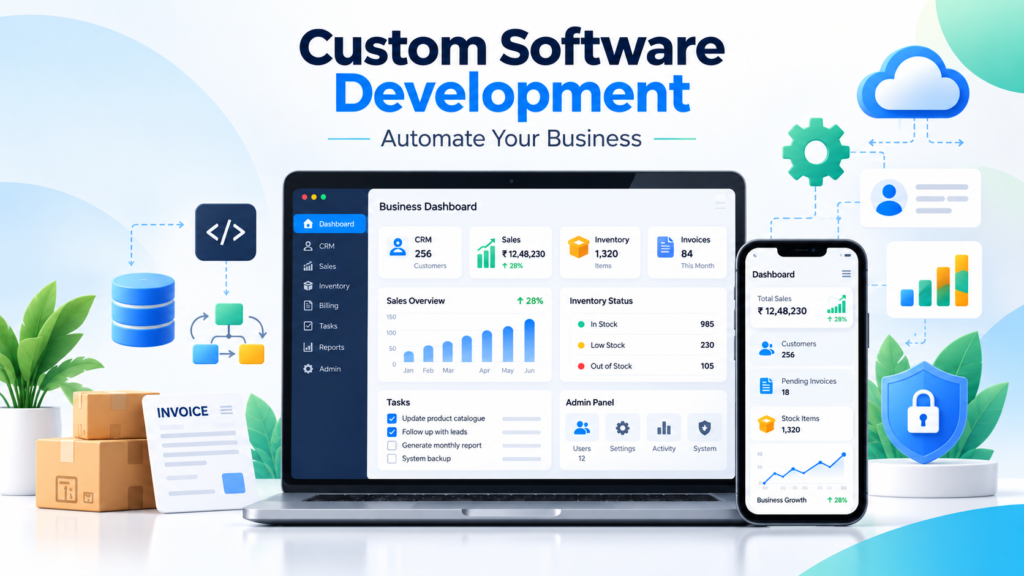
Custom software development for businesses in Erode is becoming increasingly valuable for companies that want to reduce manual work, centralize business data, improve team productivity and manage operations through a more structured digital system.
Many growing businesses still depend on notebooks, Excel sheets, WhatsApp messages, manual follow-ups and multiple disconnected applications to manage everyday work. These methods may be manageable when the business is small, but as operations grow, they can lead to missed follow-ups, duplicate data, reporting difficulties, stock confusion and slower decision-making.
A custom business software solution can bring important processes into one centralized system. Instead of forcing your team to change its complete workflow for generic software, the system can be planned around your business process, departments, customer journey, reporting requirements and future growth.
At Greap Technologies, we provide business-focused software development solutions for companies in Erode, including CRM systems, ERP software, billing applications, inventory management systems, admin panels, reporting dashboards, web applications, automation systems and API integrations.
Why Custom Software Development for Businesses in Erode Is Important
Every business operates differently.
A textile manufacturer, retail shop, hospital, school, construction company, real estate business, logistics company and service provider may all need software, but their workflows are completely different.
Generic software may contain features your team never uses while missing functions that are essential to your actual operation.
Custom software can be designed to support the exact process your business follows.
A business software system can help you:
- Manage leads and customers
- Track enquiries and sales follow-ups
- Manage quotations
- Create bills and invoices
- Track payments
- Manage inventory and stock
- Track orders and deliveries
- Manage suppliers or vendors
- Store business information centrally
- Generate operational reports
- Reduce repetitive manual work
- Improve team coordination
- Track staff activity
- Automate notifications and reminders
- Make faster business decisions
For growing businesses, custom software is not simply another IT tool. It can become the central system through which important business operations are managed.
What Is Custom Business Software Development?
Custom software development is the process of designing and developing a digital application specifically around the requirements of a business.
Instead of purchasing one fixed software package and adapting your entire operation around it, custom development starts by understanding questions such as:
- How does the business currently work?
- Which tasks are handled manually?
- Which departments use the system?
- What information needs to be recorded?
- Which approvals are required?
- What reports does management need?
- Which external tools should be integrated?
- Which processes can be automated?
- What permissions should each user have?
The final software can then be structured around those requirements.
Custom software can be developed for:
- Internal business management
- Lead and CRM management
- Billing and invoicing
- Inventory control
- Purchase management
- Order processing
- Production management
- Employee management
- Customer portals
- Admin panels
- Reporting dashboards
- Workflow automation
- Booking systems
- Dealer or distributor portals
- Web applications
- Mobile application backends
When Does a Business Need Custom Software?
Not every business needs custom software immediately. Ready-made software can be suitable when requirements are straightforward.
Custom development becomes more valuable when you repeatedly face operational problems that standard tools cannot solve properly.
You May Need Custom Software If:
- Your team manages important work using multiple Excel sheets
- Customer information is stored across different phones and WhatsApp chats
- Sales staff frequently miss follow-ups
- You prepare business reports manually
- You cannot see real-time stock information
- Different departments maintain duplicate data
- Your current software does not match your workflow
- You need custom approval processes
- You need role-based access for different employees
- You repeatedly enter the same data into multiple systems
- You need software integrations
- Your business has grown beyond manual management
Who Can Use Custom Software Development in Erode?
Business software development can support companies across a wide range of industries.
1. Retail Businesses
Retailers can use custom software for billing, POS operations, inventory management, customer information, purchases, sales reports, offers and online-order management.
2. Manufacturing Companies
Manufacturing businesses may need software for raw-material tracking, production stages, purchase management, warehouse stock, finished products, suppliers, quality control and dispatch management.
Businesses with more complex manufacturing workflows can also explore our manufacturing software solutions.
3. Textile Businesses
Textile manufacturers, garment businesses, fabric suppliers and wholesalers can manage products, colours, sizes, stock, orders, customers, dealers and wholesale enquiries through customized software.
4. Hospitals and Clinics
Healthcare businesses may need appointment systems, doctor schedules, patient enquiry management, billing, reporting and operational dashboards.
5. Schools and Colleges
Educational institutions can manage admission enquiries, student records, fees, attendance, notices, staff, courses and parent communication.
6. Real Estate Businesses
Real estate companies can use software to manage property enquiries, customer follow-ups, site visits, listings, projects, agents and sales pipelines.
7. Logistics and Transport Businesses
Logistics businesses may need systems for vehicle management, delivery status, driver assignments, customer updates, billing and operational reports.
8. Construction Companies
Construction businesses can manage project enquiries, quotations, site updates, material requirements, vendors, payments and project progress.
9. Finance and Service Businesses
Service-based organizations can use CRM and workflow systems to manage enquiries, customer documentation, assigned staff, follow-up status, payments and reports.
10. Ecommerce Businesses
Online businesses may need custom admin dashboards, inventory systems, order workflows, courier integrations, customer support tools and analytics dashboards.
11. Startups and SaaS Businesses
Startups can build MVPs, SaaS platforms, customer portals, dashboards, subscription systems and workflow applications.
For product-focused requirements, explore our startup software solutions.
Major Benefits of Custom Software Development
1. Reduce Manual Work
Repeated manual tasks consume employee time and increase the chance of mistakes.
Custom business software can automate or simplify activities such as:
- Lead capture
- Lead assignment
- Follow-up reminders
- Quotation creation
- Invoice generation
- Payment reminders
- Stock alerts
- Order status updates
- Customer notifications
- Report generation
- Approval workflows
2. Centralize Business Information
When information is spread across notebooks, WhatsApp chats, spreadsheets, emails and different applications, management becomes difficult.
A centralized system can bring together:
- Customers
- Leads
- Products
- Orders
- Payments
- Invoices
- Inventory
- Employees
- Vendors
- Tasks
- Reports
3. Improve Business Visibility for Owners
Business owners often depend on staff updates to understand what is happening across departments.
A management dashboard can provide a faster view of information such as:
- Today’s new enquiries
- Pending follow-ups
- Current sales pipeline
- Outstanding payments
- Current stock
- Pending orders
- Employee activity
- Monthly sales
- Customer acquisition trends
4. Improve Customer Follow-Up
Missed follow-ups can directly affect sales.
A custom CRM system can track:
- New leads
- Lead source
- Customer requirement
- Assigned salesperson
- Follow-up date
- Last conversation
- Quotation status
- Lead stage
- Converted leads
- Lost leads
Greap Technologies also provides dedicated CRM and ERP development services for businesses that need more structured customer and operational management.
5. Support Business Growth
A properly planned custom system can be expanded as the business grows.
For example, a business may initially launch with:
- Customer management
- Lead tracking
- Basic reporting
Later, additional modules can be introduced for:
- Billing
- Inventory
- Purchasing
- Customer login
- Mobile applications
- Automations
- Payment integrations
- Advanced analytics
6. Generate Better Reports
Structured data makes reporting much easier than manually combining multiple spreadsheets.
Useful reports can include:
- Sales reports
- Lead reports
- Customer reports
- Order reports
- Payment reports
- Purchase reports
- Inventory reports
- Employee performance reports
- Monthly comparison reports
7. Improve Team Productivity
A structured business system gives employees clarity about assigned work, deadlines and current status.
Productivity features can include:
- Role-based login
- Task assignment
- Follow-up reminders
- Status tracking
- Internal notes
- Notifications
- Approvals
- Performance reports
8. Improve Data Access and Control
Custom software can be designed with different levels of access so employees only see information relevant to their responsibilities.
Security and control features can include:
- Secure authentication
- Password hashing
- Role-based access control
- Permission management
- Activity logs
- Input validation
- Backup procedures
- Session management
Types of Business Software Greap Technologies Can Develop
1. CRM Software Development
CRM software helps businesses organize leads, customers, communication and sales activities.
A custom CRM can include:
- Lead management
- Customer database
- Lead-source tracking
- Sales pipeline
- Follow-up reminders
- Quotation tracking
- Notes
- Team assignment
- Lead stages
- Sales reports
2. ERP Software Development
ERP systems connect multiple operational functions through one centralized platform.
Custom ERP modules can include:
- Sales management
- Purchase management
- Inventory
- Production
- Vendor management
- HR management
- Finance overview
- Reports
- Management dashboard
3. Billing and Invoice Software
Billing software can simplify invoice creation and payment tracking.
Features can include:
- Customer records
- Product or service records
- Invoice creation
- Tax fields where applicable
- Payment status
- Receipt generation
- Printable invoices
- Daily sales reports
- Monthly reports
4. Inventory Management Software
Inventory software gives businesses better visibility over available stock.
Features can include:
- Product stock
- SKU management
- Stock inward
- Stock outward
- Low-stock alerts
- Suppliers
- Purchase records
- Sales records
- Warehouse tracking
- Stock reports
5. Admin Panel Development
Custom admin panels can be developed for websites, ecommerce platforms, mobile applications and business systems.
Admin features can include:
- User management
- Content management
- Product management
- Order management
- Enquiry management
- Banner management
- Reports
- Settings
- User-role permissions
6. Web Application Development
A web application allows employees or customers to access software through a browser without installing desktop software.
Web applications can be developed for:
- Customer portals
- Booking platforms
- CRM systems
- Learning platforms
- Internal business tools
- Service request systems
- Reporting dashboards
- Project management platforms
7. Business Automation Software
Automation can reduce repetitive operational work and create consistent workflows.
Automation examples include:
- Automatic lead assignment
- Follow-up reminders
- Invoice notifications
- Approval workflows
- Order notifications
- Payment reminders
- Task assignment
- Scheduled reports
8. SaaS Product Development
Businesses and startups can build subscription-based SaaS applications for their customers.
SaaS functionality can include:
- User registration
- Subscription plans
- Payment gateways
- Customer dashboard
- Admin dashboard
- User roles
- Usage limits
- Reports
- Notifications
- Multi-tenant architecture
9. Custom Reporting Dashboards
Management dashboards can combine data from multiple sources and present important KPIs in a simplified format.
Dashboard metrics may include:
- Revenue
- Leads
- Conversions
- Orders
- Payments
- Inventory
- Employee activity
- Marketing performance
10. API Integration and Connected Systems
Businesses often need custom software to communicate with other platforms.
Common integrations can include:
- Payment gateways
- Accounting applications
- CRM platforms
- ERP platforms
- WhatsApp services
- Email systems
- SMS providers
- Courier platforms
- Third-party applications
Learn more about our API integration services for connecting software systems and automating data flows.
Important Features of Good Custom Business Software
1. Simple Dashboard
A useful dashboard should present important information without overwhelming employees.
Depending on the business, dashboard widgets can show:
- Total enquiries
- Today’s follow-ups
- Pending tasks
- Sales summary
- Pending orders
- Outstanding payments
- Stock alerts
- Monthly performance
2. Role-Based Access
Different users can have different permissions.
Example roles include:
- Super Admin
- Admin
- Manager
- Sales Executive
- Accounts Team
- Support Staff
- Field Staff
- Customer
- Dealer
3. Lead and Customer Management
A good CRM or business system should make customer information easy to find and update.
Lead records can contain:
- Customer name
- Phone number
- Lead source
- Requirement
- Assigned employee
- Follow-up date
- Current status
- Notes
4. Reports and Analytics
Reports should provide practical information that helps owners and managers take action.
5. Alerts and Notifications
Notifications can help employees respond at the right time.
Examples include:
- New lead alert
- Follow-up reminder
- Payment reminder
- Low-stock alert
- New order notification
- Task deadline
- Approval request
6. Mobile-Friendly Access
Business owners, managers and field staff may need system access away from the office. Responsive software can make important functions available through phones, tablets and desktop devices.
7. Search, Filters and Export
When businesses collect large amounts of data, users should be able to search, filter and export relevant records efficiently.
8. Audit and Activity Logs
Activity logs can help administrators understand who changed important information and when the change happened.
Custom Software Development Process
Good software should begin with business understanding rather than coding immediately.
Step 1: Business Requirement Analysis
We understand your current workflow, existing tools, problems and expected outcome.
Step 2: Module Planning
The full requirement is divided into modules, user roles, workflows, reports and integrations.
Step 3: UI/UX Planning
Dashboards, forms, tables and navigation are planned around how employees will use the system daily.
Step 4: Database and Architecture Planning
The data structure and system architecture are planned based on required scalability, performance and integrations.
Step 5: Software Development
Frontend, backend, database and business logic are developed according to the approved scope.
Step 6: Testing
The system is tested across major workflows, user roles, validations and integrations.
Step 7: Deployment
The application is configured and deployed in the selected hosting or cloud environment.
Step 8: User Training
Relevant employees can be trained to use the software and its daily operational functions.
Step 9: Maintenance and Improvements
After launch, the system can be maintained and enhanced as workflows or business requirements change.
Custom Software vs Ready-Made Software
Both custom and ready-made software can be useful. The right choice depends on your business requirements, budget, complexity and long-term plans.
Ready-Made Software Can Be Suitable When:
- Your requirement is common and straightforward
- The existing workflow already matches the software
- You need very fast implementation
- You do not require specialized integrations
- Standard reports are enough
Custom Software Can Be Better When:
- Your business has a unique workflow
- You need industry-specific modules
- Generic applications do not fit your process
- You need custom user permissions
- You need special reports
- You need multiple system integrations
- You expect the system to evolve with your company
- You need control over feature development
How Custom Software Can Replace Excel and Manual Tracking
Excel is extremely useful, but it becomes difficult to manage when many employees edit data, multiple files are created and follow-up workflows depend on manual updates.
A custom system can provide:
- One centralized database
- Multiple user accounts
- Controlled permissions
- Automatic timestamps
- Search and filters
- Follow-up reminders
- Dashboards
- Live reports
- Activity history
This does not mean every spreadsheet must be replaced. The goal is to move important workflows into structured software where doing so improves accuracy and control.
SEO for Business Software Development in Erode
For Greap Technologies, this article should target business-oriented software searches rather than repeating the same exact keyword strategy as our existing custom-software article.
Relevant SEO Keywords
- Business software development in Erode
- Custom business software in Erode
- Software development company in Erode
- CRM software development in Erode
- ERP software development in Erode
- Billing software development in Erode
- Inventory management software in Erode
- Admin panel development in Erode
- Business automation software in Erode
- Custom software for Erode businesses
Local SEO for Software Companies in Erode
Important local SEO elements include:
- Accurate Google Business Profile
- Erode-based service content
- Dedicated software service pages
- Relevant industry pages
- Portfolio and case studies
- Customer reviews
- Internal linking
- Accurate business contact information
- Regular technology and business blogs
Create Dedicated Software Service Pages
Instead of trying to rank one page for every software term, separate high-quality service pages can be created for:
- CRM Software Development in Erode
- ERP Software Development in Erode
- Billing Software Development in Erode
- Inventory Software Development in Erode
- Business Automation Software in Erode
- SaaS Development in Erode
- API Integration Services in Erode
Common Business Problems Custom Software Can Solve
1. Missed Sales Leads
A centralized CRM can capture leads and assign follow-ups more clearly.
2. No Follow-Up Tracking
Automated reminders can reduce dependence on employee memory.
3. Manual Billing Errors
Structured invoice systems can reduce repeated manual data entry.
4. Stock Confusion
Inventory systems can provide clearer stock visibility.
5. Poor Reporting
Dashboards and reports can give management faster access to operational information.
6. Scattered Customer Data
Centralized customer records reduce dependence on individual phones and spreadsheets.
7. Excessive Dependence on Individual Employees
When information is recorded in a business-owned system, operational knowledge becomes easier to manage across teams.
8. Difficulty Scaling
Structured software can help businesses handle more customers, orders, employees and data without increasing manual work at the same rate.
How Greap Technologies Helps Businesses in Erode
Greap Technologies provides custom business software development for companies that need practical, scalable and workflow-focused digital systems.
Our development capabilities can include:
- Business requirement analysis
- Software architecture planning
- UI/UX design
- Database design
- Frontend development
- Backend development
- Admin panel development
- User and role management
- CRM development
- ERP development
- Inventory systems
- Billing systems
- Reporting dashboards
- Workflow automation
- API integration
- Testing
- Deployment
- Maintenance and feature enhancement
You can also explore our portfolio and recent work to learn more about the digital systems and platforms Greap Technologies develops.
Still Managing Your Business Through Excel and WhatsApp?
Greap Technologies can help you plan a custom system for leads, customers, orders, billing, inventory, staff workflows, reporting and automation.
Areas We Serve in Erode District
Greap Technologies provides software development, website development, ecommerce development, mobile app development, SEO and digital marketing solutions for businesses in Erode and surrounding areas.
- Erode
- Perundurai
- Bhavani
- Anthiyur
- Gobichettipalayam
- Sathyamangalam
- Modakkurichi
- Kodumudi
- Nambiyur
- Thalavadi
- Chennimalai
- Nearby locations
Why Choose Greap Technologies for Business Software Development?
Business-First Requirement Planning
Software planning starts by understanding your existing business process, pain points, users and expected outcome.
Custom Modules
Features can be designed around your actual workflow instead of forcing the business to follow unnecessary generic modules.
Scalable Architecture
The system can be planned so additional users, modules and integrations can be introduced as requirements grow.
Practical User Experience
Dashboards, forms and workflows are designed to be clear for employees who need to use the software every day.
Role-Based Security
Different levels of access can be configured for management, staff and customers based on responsibilities.
Integration Support
Existing business systems can be connected through API integrations where supported.
CRM and ERP Expertise
Businesses that need centralized sales and operational systems can explore our CRM and ERP development solutions.
Long-Term Development Support
Software often changes as the business grows. New modules, reports, integrations and automation features can be planned over time.
Business Software Development in Erode – Conclusion
As businesses in Erode grow, managing operations through scattered spreadsheets, notebooks and messaging applications can become increasingly difficult.
A well-planned custom business system can centralize leads, customers, orders, billing, inventory, reports and internal workflows while reducing repetitive manual work.
Retail companies, manufacturers, textile businesses, schools, hospitals, real estate firms, construction businesses, service providers and startups can all benefit from software designed around their actual business processes.
Greap Technologies provides custom software development for businesses in Erode, including CRM systems, ERP software, billing solutions, inventory platforms, web applications, admin dashboards and business automation tools.
The objective is not simply to build more software. The objective is to build a system that makes your business easier to manage.
Need Custom Software for Your Business in Erode?
Tell us how your business currently works and which process is creating the most manual effort. We can help you plan a practical CRM, ERP, billing, inventory, dashboard, web application or automation solution.
Contact Greap Technologies to discuss your software requirement.
Frequently Asked Questions
1. What is custom software development?
Custom software development is the process of designing and developing software around a specific business workflow, user requirement and operational need instead of relying entirely on a fixed generic application.
2. Why might a business in Erode need custom software?
A business may need custom software when manual work, disconnected spreadsheets or generic software make it difficult to manage customers, sales, billing, inventory, reporting or internal workflows.
3. What types of custom software can Greap Technologies build?
Greap Technologies can develop CRM systems, ERP software, billing applications, inventory management systems, admin panels, dashboards, web applications, SaaS platforms and business automation solutions based on project requirements.
4. Is custom software better than ready-made software?
It depends on the requirement. Ready-made software can be suitable for common processes, while custom software is more appropriate when the business needs unique workflows, integrations, reports or specialized modules.
5. Can custom software include different user roles?
Yes. Role-based access can be created for administrators, managers, sales staff, accounts teams, support staff, field employees, dealers or customers depending on the system.
6. Can billing and inventory be included in one software system?
Yes. A custom application can combine billing, invoices, payments, inventory, purchases, sales and reporting when these modules are part of the project scope.
7. Can custom software integrate with WhatsApp, payments or other tools?
Yes. Custom systems can integrate with supported third-party APIs such as payment gateways, communication platforms, CRM tools, accounting systems and other business applications.
8. Can Greap Technologies build software for small businesses?
Yes. Custom software can be developed for small businesses, startups, growing companies and larger organizations depending on the required features, workflow and budget.
9. Can custom business software work on mobile devices?
Yes. A responsive web application can work across mobile, tablet and desktop devices, and a separate mobile application can also be developed when required.
10. Can new features be added later?
Yes. If the application is planned with scalable architecture, additional modules, reports, integrations and user roles can be developed as future requirements emerge.