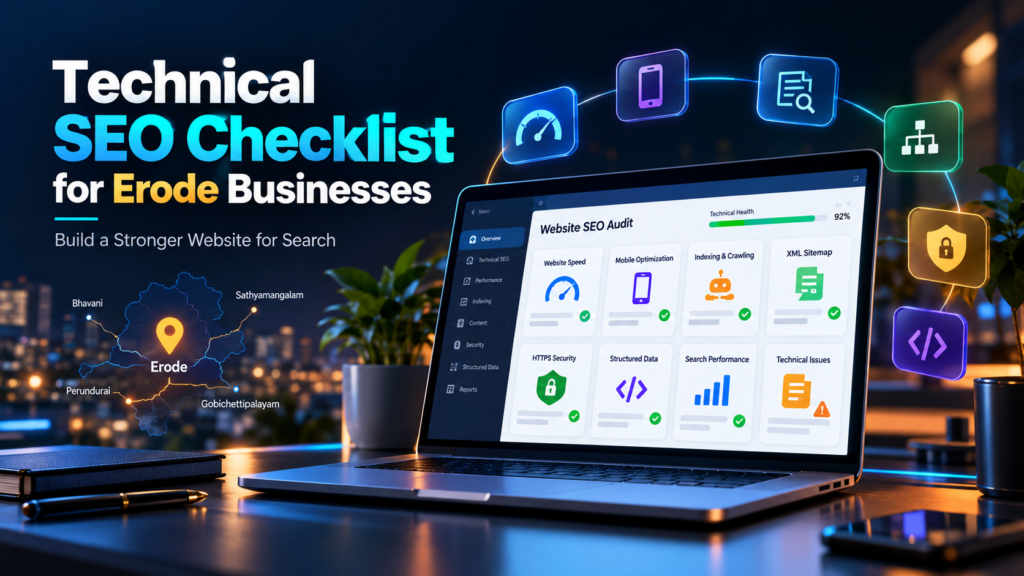
Technical SEO Checklist for Business Websites in Erode is a practical guide for business owners who want to improve website crawlability, indexing, speed, mobile usability, search visibility and overall website performance.
You may have a professional-looking website, useful content and attractive service pages. But if search engines have difficulty crawling or understanding your website, those pages may struggle to perform in organic search.
Technical SEO focuses on the foundation of your website. It helps make important pages accessible to search engines while also improving the experience for real users visiting from mobile phones, tablets and desktop devices.
For businesses in Erode, Perundurai, Bhavani, Gobichettipalayam, Sathyamangalam, Anthiyur and nearby areas, a technically healthy website can provide a stronger foundation for local SEO, content marketing and lead generation.
At Greap Technologies, we provide SEO services in Erode, including technical SEO audits, on-page SEO, local SEO, content optimization and website performance improvements.
Quick Technical SEO Checklist for Business Websites in Erode
If you are auditing your business website, start by checking these important technical SEO areas:
- Google crawling and indexing
- Google Search Console setup
- XML sitemap
- Robots.txt
- HTTPS security
- Mobile responsiveness
- Website loading speed
- Core Web Vitals
- SEO-friendly URL structure
- Canonical URLs
- 301 redirects
- 404 errors
- Broken internal links
- Internal linking
- Website architecture
- Image optimization
- Duplicate content
- Structured data
- Breadcrumbs
- Orphan pages
- Contact and enquiry form functionality
- Call and WhatsApp button functionality
Technical SEO can look complicated at first, but you do not need to fix everything randomly. Start with problems that prevent important pages from being crawled, indexed or used properly, then work through performance and structural improvements.
What Is Technical SEO?
Technical SEO is the process of improving the technical aspects of a website so search engines can efficiently access, crawl, understand and index important pages.
It can include:
- Crawling
- Indexing
- Website speed
- Mobile usability
- HTTPS
- XML sitemaps
- Robots.txt
- Canonical tags
- Redirects
- Website architecture
- Internal linking
- Structured data
- Core Web Vitals
Content helps explain what your business and individual pages are about. Technical SEO helps make sure search engines can access and process that content properly.
For a business website, both are important.
Why Technical SEO Matters for Erode Businesses
Customers increasingly search online before contacting a business. They may search for a service, compare companies, check reviews, visit websites and then make an enquiry through a call, WhatsApp message or contact form.
For example, users may search for:
- Website development company in Erode
- SEO company in Erode
- Builders in Erode
- Textile manufacturers in Erode
- Interior designers in Erode
- Hospitals in Erode
- Coaching centres in Erode
- Real estate companies in Erode
- Local service providers in Erode
If your website is slow, difficult to use on mobile, incorrectly indexed or full of broken links, you may lose potential customers even if your services are good.
Technical SEO therefore supports both search visibility and user experience.
1. Check Whether Google Can Crawl Your Website
Crawling is the process search engines use to discover website pages and follow links between them.
If important pages cannot be crawled, search engines may have difficulty discovering or processing them.
Start by reviewing important pages such as:
- Homepage
- Service pages
- Product pages
- Category pages
- Location pages
- Blog articles
- About page
- Contact page
Important pages should be accessible through your website structure and internal links.
Do not create useful service or blog pages and then leave them hidden where neither visitors nor crawlers can easily discover them.
2. Check Whether Important Pages Are Indexed
Crawling and indexing are related, but they are not the same thing.
A search engine may discover a URL without necessarily indexing it for search results.
Use Google Search Console to inspect important URLs and identify indexing problems.
Check your:
- Homepage
- Main service pages
- High-value product or category pages
- Important location pages
- Recently published blogs
- Lead-generation landing pages
If an important page is not indexed, investigate the reason instead of simply publishing more content.
Possible causes can include:
- Noindex directives
- Crawling restrictions
- Canonical issues
- Duplicate content
- Redirect problems
- Poor internal linking
- Low-value or thin pages
- Technical errors
3. Set Up Google Search Console
Google Search Console is one of the most useful tools for monitoring organic search performance and technical issues.
Business owners and SEO teams can use it to review:
- Search queries
- Search impressions
- Clicks
- Average search positions
- Top-performing pages
- Indexing information
- Sitemaps
- Core Web Vitals
- HTTPS reporting
- Manual actions
- Security issues
Instead of guessing why a page is not performing, use available search data to identify possible problems and opportunities.
4. Check Your Robots.txt File
A robots.txt file provides crawling instructions to compatible search engine crawlers.
It is commonly available at:
yourdomain.com/robots.txt
Review the file carefully to make sure important website sections are not accidentally blocked.
Common mistakes can include:
- Blocking important service pages
- Blocking important directories
- Incorrect wildcard rules
- Old rules left after website development
- Blocking resources unnecessarily
Remember that robots.txt crawling controls and indexing controls are not exactly the same thing.
5. Create and Submit an XML Sitemap
An XML sitemap helps search engines discover important URLs on your website.
A sitemap may include:
- Homepage
- Service pages
- Product pages
- Category pages
- Location pages
- Industry pages
- Blog posts
- Other important indexable pages
A common sitemap URL is:
yourdomain.com/sitemap.xml
Submit your sitemap through Google Search Console and keep it updated as the website changes.
Avoid filling the sitemap with broken, redirected, duplicate or intentionally non-indexable URLs.
6. Use HTTPS Security
Business websites should use HTTPS.
Your website URL should begin with:
https://
rather than an unsecured HTTP version.
Also check that HTTP URLs correctly redirect to their HTTPS equivalents.
Review whether multiple versions of your website are unnecessarily accessible, such as:
- HTTP
- HTTPS
- www
- Non-www
Your preferred website version should be implemented consistently across redirects, canonical tags, internal links and sitemaps.
7. Improve Website Loading Speed
Website speed matters for both users and search performance.
Imagine a potential customer in Erode searches for your service, opens your website and waits several seconds while a huge banner image, animation and multiple scripts load.
They may simply go back and open another website.
Common causes of slow websites include:
- Large images
- Unoptimized videos
- Heavy JavaScript
- Unused CSS
- Too many plugins
- Excessive third-party scripts
- Poor server response time
- Lack of browser caching
- Unnecessary animations
- Large font files
Optimize the website based on actual performance problems rather than installing random speed plugins and hoping for the best.
8. Check Core Web Vitals
Core Web Vitals measure important aspects of real-world website experience.
The main Core Web Vitals are:
Largest Contentful Paint (LCP)
LCP measures loading performance and focuses on how quickly the main visible content becomes available.
Large hero images, slow server responses and render-blocking resources can contribute to poor LCP.
Interaction to Next Paint (INP)
INP measures how responsive a page feels when a visitor interacts with it.
Heavy JavaScript and long-running browser tasks can make interactions feel slow.
Cumulative Layout Shift (CLS)
CLS measures unexpected movement of page content while the page loads.
For example, a visitor may try to click a button and suddenly the layout moves because an image or another element loads above it.
Review Core Web Vitals in Google Search Console and use appropriate performance testing tools during website development and maintenance.
9. Make Your Website Mobile-Friendly
Many potential customers will visit your business website from a smartphone.
Your website should therefore work properly across mobile, tablet and desktop screen sizes.
Check:
- Font readability
- Navigation menu
- Button size
- Forms
- Images
- Tables
- Popups
- Call buttons
- WhatsApp buttons
- Horizontal scrolling
- Page speed
Do not test responsiveness only by resizing your desktop browser. Check important pages on real mobile devices when possible.
If users have to zoom in just to read your phone number or tap the enquiry button, the mobile experience needs improvement.
10. Use SEO-Friendly URLs
URLs should be simple, readable and descriptive.
For example:
Poor URL:
example.com/page.php?id=298&cat=7
Cleaner URL:
example.com/seo-services-erode/
Good URLs should generally be:
- Readable
- Descriptive
- Relevant to the page
- Consistent
- As simple as practical
Avoid forcing multiple keyword variations into a single URL.
For example:
seo-company-best-seo-services-top-seo-agency-erode-tamilnadu
is unnecessary and difficult to read.
11. Check Canonical Tags
Canonical tags help indicate a preferred URL when similar or duplicate content is available through multiple URLs.
Canonical issues are particularly important for:
- Ecommerce websites
- Filter pages
- URL parameters
- Duplicate landing pages
- HTTP and HTTPS versions
- www and non-www versions
Incorrect canonical implementation may cause search engines to treat a different URL as the preferred version.
Your internal links, sitemap, redirects and canonical strategy should work together consistently.
12. Fix Broken Links and 404 Errors
A 404 page is not automatically an SEO disaster. Pages are removed and URLs sometimes change.
The real problem is when important internal links repeatedly send visitors and crawlers to URLs that no longer exist.
Regularly check for:
- Broken internal links
- Broken menu links
- Removed service pages
- Broken blog links
- Missing images
- Old campaign pages
- Incorrect URLs
If a removed URL has a genuine replacement, redirect visitors to the most relevant replacement page.
Do not redirect every missing page to the homepage just to remove 404 errors.
13. Manage 301 Redirects Properly
A permanent redirect is useful when a page has permanently moved to a new URL.
For example:
Old: example.com/old-seo-service/
New: example.com/seo-services-erode/
Redirects should send visitors to a relevant replacement.
Avoid unnecessary redirect chains such as:
Page A → Page B → Page C → Page D
Where practical, update internal links so they point directly to the final URL.
Also check for redirect loops that prevent a page from loading correctly.
14. Improve Internal Linking
Internal links help visitors navigate your website and help search engines discover relationships between pages.
For example, this technical SEO article can naturally link to:
Use descriptive anchor text where it helps readers understand what they will find after clicking.
Avoid stuffing the same exact keyword into every internal link.
15. Find and Fix Orphan Pages
An orphan page is a page with no useful internal links pointing to it, or one that is very difficult to discover through normal website navigation.
This can happen when businesses continuously publish new service pages and blogs without maintaining a clear website structure.
Important pages should be connected logically.
For example:
Home → SEO Services → Technical SEO → Related SEO Articles
This structure is more useful than publishing isolated pages that are disconnected from the rest of the website.
16. Create a Clear Website Architecture
Your website should not feel like a maze.
A typical business website structure could look like:
- Home
- Services
- Industries
- Locations
- Portfolio or Case Studies
- Blog
- About
- Contact
For a digital services company in Erode, the service structure could include:
- Website Development
- Ecommerce Development
- SEO Services
- Digital Marketing
- Mobile App Development
- Custom Software Development
A logical website hierarchy makes navigation easier for visitors and provides clearer relationships between content.
17. Optimize Website Images
Images are one of the most common reasons business websites become unnecessarily heavy.
Before uploading an image:
- Resize it to suitable dimensions
- Compress the file
- Use an appropriate modern image format where practical
- Use descriptive filenames
- Add useful ALT text where appropriate
- Specify image dimensions where possible
- Lazy-load suitable off-screen images
Instead of a filename such as:
IMG_83927.jpg
a descriptive filename could be:
technical-seo-audit-erode.webp
ALT text should primarily describe the image for accessibility. Do not fill it with repeated keywords.
18. Check Duplicate Content
Duplicate or near-duplicate content can create unnecessary complexity for both users and search engines.
This issue commonly appears when businesses create many location pages.
For example:
- SEO Services in Erode
- SEO Services in Perundurai
- SEO Services in Bhavani
- SEO Services in Gobichettipalayam
- SEO Services in Sathyamangalam
These pages can be useful if the business genuinely serves those areas and each page provides meaningful information.
Simply copying the same content and changing the town name is not a strong local SEO strategy.
Useful location pages can include:
- Relevant services
- Industries served
- Real project examples
- Customer examples where available
- Local service information
- Area-specific FAQs
- Relevant testimonials
- Clear contact options
19. Check for Keyword Cannibalization
Keyword cannibalization can occur when several pages on the same website compete for very similar search intent.
For example, publishing separate pages such as:
- Best SEO Company in Erode
- Top SEO Company in Erode
- SEO Company in Erode
- Best SEO Services in Erode
may not be useful if every page contains almost the same information and targets essentially the same user need.
A cleaner approach is to create one strong commercial SEO service page and support it with articles targeting distinct questions.
For example:
- SEO Cost in Erode
- Local SEO Checklist for Erode Businesses
- Technical SEO Checklist for Erode Business Websites
- Why Is My Business Not Showing on Google?
- SEO for Textile Companies in Erode
- SEO for Manufacturing Companies in Erode
This creates a more organized topic cluster.
20. Optimize SEO Titles
Every important page should have a clear and descriptive SEO title.
For example:
Weak title:
Home
Better title:
Website Development Company in Erode | Greap Technologies
Avoid keyword stuffing such as:
SEO Erode | Best SEO Erode | SEO Company Erode | Top SEO Services Erode
The title should accurately describe the page and encourage the right searcher to visit it.
21. Write Useful Meta Descriptions
A meta description provides a short summary of the page and may be used by search engines when generating a search snippet.
A useful description for this article could be:
Technical SEO checklist for Erode business websites covering crawling, indexing, Core Web Vitals, speed, mobile SEO, sitemaps, HTTPS, schema and more.
Each important page should have a relevant description instead of using the same generic text across the website.
22. Use a Logical Heading Structure
Headings help organize content and make long pages easier to scan.
A simple structure is:
- H1 for the main page topic
- H2 for major sections
- H3 for subsections
For example:
H1: Technical SEO Checklist for Business Websites in Erode
H2: Check Core Web Vitals
H3: Largest Contentful Paint
Use headings to organize information naturally rather than treating every heading as another place to repeat keywords.
23. Add Relevant Structured Data
Structured data provides machine-readable information about page content.
Depending on the website and page type, relevant structured data may include:
- Organization
- LocalBusiness
- Article or BlogPosting
- BreadcrumbList
- Product
- SoftwareApplication
For blog articles, Article or BlogPosting structured data can provide information such as the headline, author and representative image.
For a genuine local business, appropriate business structured data can provide accurate business information.
Structured data should represent content that actually exists on the page.
24. Validate Structured Data
Adding schema markup is not the end of the job.
Validate relevant structured data and check for errors after website updates.
Avoid fake or misleading structured data involving:
- Reviews
- Ratings
- Products
- Business information
- Authors
Structured data is not a shortcut to guaranteed rankings. Its purpose is to help machines understand eligible page information more clearly.
25. Add Breadcrumb Navigation
Breadcrumbs can help visitors understand where they are within a website.
For example:
Home → Blog → SEO → Technical SEO Checklist for Business Websites in Erode
Breadcrumbs are especially useful for larger websites with multiple service, product, category or blog sections.
Where appropriate, BreadcrumbList structured data can also describe this hierarchy to search engines.
26. Check Contact Forms and Lead Generation Features
This part is often forgotten during an SEO audit.
Getting traffic is useful, but the website also needs to turn relevant visitors into enquiries.
Test your:
- Contact forms
- Quote request forms
- Call buttons
- WhatsApp buttons
- Email links
- Appointment forms
- Thank-you pages
- Form notification emails
Test important conversion actions on both desktop and mobile devices.
Ranking a page and then losing a potential customer because the enquiry form is broken is an avoidable problem.
27. Check Your Local Business Information
Businesses targeting Erode should keep important company information accurate and consistent.
Review:
- Business name
- Address
- Phone number
- Website
- Opening hours
- Service information
- Google Business Profile details
If your business serves Erode and nearby locations, explain genuine service areas clearly.
Avoid creating fake addresses simply to target additional locations.
28. Monitor Google Search Console Regularly
Technical SEO is not a one-time task.
Websites constantly change.
New pages are published, old URLs are removed, developers update code, plugins change, images are added and website structures evolve.
Review Search Console regularly for:
- Indexing changes
- Search performance
- Core Web Vitals
- Sitemap problems
- HTTPS issues
- Manual actions
- Security issues
Also review which queries and pages are receiving impressions and clicks.
This can reveal content and optimization opportunities based on real search behaviour.
29. Perform Regular Technical SEO Audits
A technically healthy website today can develop problems later.
A simple maintenance schedule could include:
Weekly Checks
- Important website functionality
- Major Search Console warnings
- Lead forms
- Important landing pages
Monthly Checks
- Broken links
- Indexing
- Organic search performance
- Website speed
- Important page changes
- Conversion tracking
Quarterly Checks
- Full technical SEO audit
- Website architecture
- Internal linking
- Duplicate content
- Canonical implementation
- Structured data
- Core Web Vitals
- Content cannibalization
Larger ecommerce or frequently updated websites may require more frequent monitoring.
Technical SEO Checklist for Erode Businesses
| Technical SEO Check | What to Review | Why It Matters |
|---|---|---|
| Crawling | Important pages accessible to search engines | Supports page discovery |
| Indexing | Important pages eligible for search indexing | Required for organic search visibility |
| XML Sitemap | Valid and important URLs included | Supports URL discovery |
| Robots.txt | No accidental crawling blocks | Prevents important crawling problems |
| HTTPS | Secure website and correct redirects | Supports security and consistency |
| Mobile | Responsive design and usable controls | Improves mobile user experience |
| Page Speed | Images, scripts, server and page weight | Improves website usability |
| Core Web Vitals | LCP, INP and CLS | Measures important page experience signals |
| Canonical Tags | Preferred URLs configured correctly | Helps manage duplicate URLs |
| Redirects | 301s, chains and loops | Maintains clean URL transitions |
| Broken Links | Internal links and missing pages | Improves navigation and crawling |
| Internal Linking | Important pages properly connected | Supports discovery and website structure |
| Images | Compression, dimensions and ALT text | Supports performance and accessibility |
| Structured Data | Relevant and accurate schema markup | Provides machine-readable page information |
| Forms | Contact and enquiry forms working | Supports lead generation |
Common Technical SEO Mistakes on Business Websites
Some technical SEO problems appear repeatedly on business websites.
- Important pages accidentally set to noindex
- Incorrect robots.txt rules
- Missing XML sitemap
- Broken internal links
- Large uncompressed images
- Poor mobile responsiveness
- Slow page loading
- Redirect chains
- Incorrect canonical tags
- Duplicate location pages
- Weak internal linking
- Orphan service pages
- Incorrect structured data
- Broken contact forms
- Untracked lead actions
Fixing these issues can create a stronger technical foundation before investing heavily in additional SEO content.
Technical SEO for Local Businesses in Erode
Technical SEO is useful for local businesses across many industries.
This can include:
- Textile companies
- Manufacturers
- Construction companies
- Real estate businesses
- Hospitals and clinics
- Schools and coaching centres
- Hotels and restaurants
- Retail businesses
- Jewellery stores
- Automobile businesses
- Professional service providers
- Ecommerce businesses
The technical requirements may differ based on website size and business type, but crawlability, indexing, performance, usability and website structure remain important foundations.
Technical SEO for Ecommerce Websites in Erode
Ecommerce websites often require additional technical SEO attention because they can contain hundreds or thousands of product, category, filter and parameter URLs.
Important ecommerce technical SEO areas include:
- Product URL structure
- Category pages
- Collection pages
- Faceted navigation
- Filter URLs
- Canonical tags
- Product structured data
- Product availability
- Internal linking
- Pagination where applicable
- Image optimization
- Website speed
- Duplicate product content
Learn more about Ecommerce Development at Greap Technologies.
Technical SEO for Website Redesign Projects
A website redesign can improve design and usability, but it can also create SEO problems if existing URLs and search signals are ignored.
Before launching a redesigned website, check:
- Existing high-performing URLs
- Old-to-new URL mapping
- 301 redirects
- Canonical tags
- Metadata
- Heading structure
- Internal links
- XML sitemap
- Robots.txt
- Analytics
- Search Console verification
- Structured data
- Contact forms
After launch, monitor indexing, crawl errors, traffic and important landing pages closely.
Explore Website Development Services if your existing business website requires a technical or performance-focused redesign.
Technical SEO and Local SEO: What Is the Difference?
Technical SEO and local SEO work together, but they focus on different areas.
| Technical SEO | Local SEO |
|---|---|
| Crawling and indexing | Local search relevance |
| Website speed | Google Business Profile |
| Mobile usability | Business information |
| Canonical URLs | Reviews |
| XML sitemap | Local service pages |
| Structured data | Location-based content |
| Internal website structure | Local customer discovery |
A local business should not focus on one while completely ignoring the other.
Can Technical SEO Generate Business Leads?
Technical SEO does not magically create enquiries by itself.
Instead, it supports the foundation required for your important pages and content to be discovered, accessed and used effectively.
A lead-focused SEO process may look like:
Google Search → Useful Blog or Service Page → Relevant Information → Trust → Service Page → Call, WhatsApp or Contact Form → Business Enquiry
For this reason, technical SEO should work together with:
- Keyword research
- Useful content
- Service pages
- Local SEO
- Google Business Profile optimization
- Case studies
- Internal linking
- Clear calls to action
- Conversion tracking
The objective is not simply to increase traffic. The website should attract relevant potential customers and make it easy for them to take the next step.
Technical SEO for Erode and Nearby Areas
Businesses may serve customers across Erode district and surrounding markets, including Erode, Perundurai, Bhavani, Anthiyur, Gobichettipalayam, Sathyamangalam, Modakkurichi, Kodumudi, Nambiyur, Chennimalai, Kavindapadi, Ammapettai, Arachalur, Sivagiri, Punjai Puliampatti, Solar, Surampatti, Veerappanchatram, Nasiyanur and nearby areas.
However, local SEO should be based on genuine business operations and service areas.
Avoid creating dozens of almost identical pages by simply changing location names. Build pages that provide useful information for customers in the areas you genuinely serve.
How Often Should You Perform a Technical SEO Audit?
There is no single audit frequency suitable for every website.
A small business website that changes only occasionally may require less frequent full audits than a large ecommerce website where products and URLs change every day.
Technical SEO should also be reviewed after major changes such as:
- Website redesign
- Domain migration
- CMS migration
- URL changes
- Large content updates
- New ecommerce functionality
- Major plugin or theme changes
- Website performance changes
Why Choose Greap Technologies for Technical SEO in Erode?
Greap Technologies provides SEO and website development support for businesses in Erode and nearby areas.
Our technical SEO work can include:
- Technical SEO audit
- Crawling analysis
- Indexing review
- XML sitemap review
- Robots.txt review
- Website speed analysis
- Core Web Vitals review
- Mobile usability review
- Canonical analysis
- Redirect review
- Broken link analysis
- Internal linking review
- Website architecture review
- Image optimization recommendations
- Structured data review
- On-page SEO
- Local SEO
- Google Search Console monitoring
Our focus is on practical improvements that support website quality, organic search visibility and relevant business enquiries rather than guaranteed ranking promises.
Explore our SEO Services in Erode, Website Development Services, Ecommerce Development and Digital Marketing Services.
Conclusion
Technical SEO is the foundation that supports the rest of your website’s SEO strategy.
For business websites in Erode, start by making sure important pages can be crawled and indexed correctly. Then review your sitemap, robots.txt, HTTPS configuration, mobile usability, website speed, Core Web Vitals, URLs, canonicals, redirects, internal links, images and structured data.
Do not focus only on technical scores. Your website still needs useful content, relevant service pages, clear local information and an easy path for visitors to contact your business.
The strongest approach combines technical SEO, on-page SEO, useful content, local SEO, internal linking and conversion optimization.
Fix the foundation first, then build your organic visibility on top of it.
Contact Greap Technologies for a Technical SEO Audit
Not sure whether technical problems are affecting your website’s Google visibility?
Greap Technologies can review your business website for crawling, indexing, speed, mobile usability, Core Web Vitals, internal linking, structured data and other technical SEO issues.
We provide SEO support for businesses in Erode and nearby areas with a focus on improving website quality and generating relevant business enquiries.
Contact Greap Technologies on WhatsApp
Frequently Asked Questions
1. What is technical SEO?
Technical SEO involves improving technical aspects of a website so search engines can efficiently access, crawl, understand and index important pages while users receive a fast and usable website experience.
2. Is technical SEO important for businesses in Erode?
Yes. Businesses targeting customers in Erode still need websites that are crawlable, indexable, secure, mobile-friendly and easy to use. Technical SEO provides a stronger foundation for content, service pages and local SEO.
3. How can I check whether my website has technical SEO problems?
Start with Google Search Console and review indexing, URL Inspection, Core Web Vitals and sitemap information. A broader technical SEO audit can identify additional issues involving redirects, canonical tags, internal links, website architecture, duplicate URLs and performance.
4. Can technical SEO improve Google rankings?
Technical SEO can remove problems that make it harder for search engines to crawl, understand or index a website. Rankings still depend on many other factors, including relevance, content quality, competition, authority and search intent.
5. Can technical SEO guarantee first position on Google?
No. No legitimate SEO provider can guarantee an exact number-one organic position. Search results depend on many factors and can change over time.
6. What are Core Web Vitals?
Core Web Vitals are metrics used to evaluate important aspects of website experience, including loading performance, interaction responsiveness and visual stability.
7. How often should a technical SEO audit be performed?
The right frequency depends on the size of the website and how often it changes. Important issues can be monitored regularly, while broader technical audits can be performed periodically and after major website changes.
8. Is technical SEO different from local SEO?
Yes. Technical SEO focuses on areas such as crawling, indexing, speed, website architecture and structured data. Local SEO focuses more on local search relevance, Google Business Profile, business information, reviews and location-focused content. Both can work together.
9. Does technical SEO help ecommerce websites?
Yes. Ecommerce websites often require careful management of product URLs, category pages, filters, canonical tags, internal linking, structured data, image performance and duplicate content.
10. Can technical SEO help generate leads?
Technical SEO can support lead generation by creating a stronger foundation for important service pages and content to be discovered and used effectively. Lead generation also requires relevant search targeting, useful content and clear conversion options.
11. Does Greap Technologies provide technical SEO services in Erode?
Yes. Greap Technologies provides technical SEO audits, on-page SEO, local SEO, content optimization, website development and related SEO support for businesses in Erode and nearby areas.
12. Which areas around Erode can businesses target with local SEO?
Depending on genuine business operations and service coverage, businesses may target customers in Erode, Perundurai, Bhavani, Gobichettipalayam, Sathyamangalam, Anthiyur, Chennimalai, Modakkurichi, Kavindapadi, Nambiyur and other relevant nearby areas.