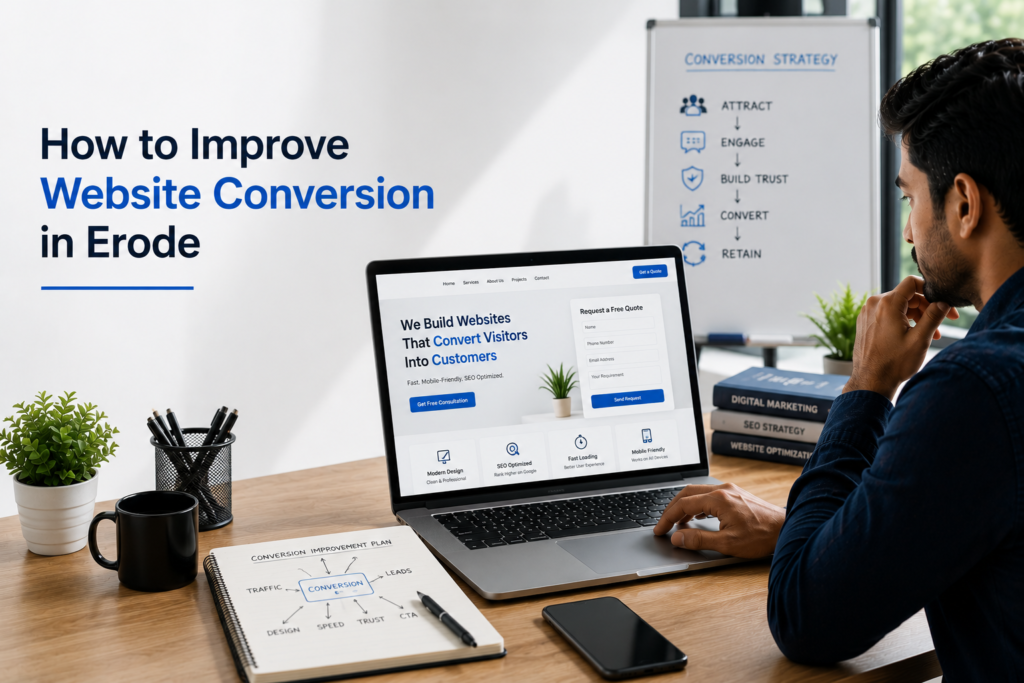
Many businesses invest in a professional website but still struggle to generate enquiries or sales. They receive visitors from Google, social media, or paid ads, yet very few people actually contact them.
This is known as a website conversion problem.
A website’s success should not be measured only by how many people visit it. The real measure is how many visitors become customers.
Whether you own a textile business, manufacturing company, hospital, retail store, educational institution, construction company, or service business in Erode, improving your website conversion rate can significantly increase enquiries without increasing your advertising budget.
This guide explains practical strategies that help convert more visitors into customers while improving user experience and supporting long-term SEO.
What is Website Conversion?
A website conversion happens when a visitor completes an action you want them to take.
Examples include:
- Calling your business
- Sending a WhatsApp message
- Filling out a contact form
- Requesting a quotation
- Booking an appointment
- Purchasing a product
- Downloading a brochure
- Registering for a service
The percentage of visitors who complete these actions is called your conversion rate.
Why Website Conversion Matters
Many businesses focus only on increasing website traffic.
However, more visitors do not always mean more sales.
For example:
- Website A receives 500 visitors and generates 50 enquiries.
- Website B receives 5,000 visitors but generates only 20 enquiries.
Website A performs better because it converts visitors more effectively.
Improving conversion allows you to:
- Generate more enquiries
- Reduce marketing costs
- Increase sales
- Improve return on investment (ROI)
- Make better use of existing traffic
Step 1: Understand What Your Visitors Want
Before improving your website, think like your customers.
Ask yourself:
- Why are they visiting?
- What problem are they trying to solve?
- What information do they need before contacting you?
Customers usually want answers to questions such as:
- What services do you provide?
- How much does it cost?
- Why should I choose you?
- Can I trust your business?
- How do I contact you?
Your website should answer these questions clearly.
Step 2: Improve Your Homepage
Your homepage creates the first impression.
Within a few seconds, visitors should understand:
- Who you are
- What you offer
- Who you help
- How to contact you
Your homepage should include:
- Clear headline
- Short description
- Professional images
- Primary call-to-action
- Service overview
- Customer reviews
- Contact information
Avoid clutter and unnecessary animations.
Step 3: Add Strong Call-to-Actions (CTA)
Many websites lose customers because visitors don’t know what to do next.
Every important page should include clear CTAs such as:
- Call Now
- Get Free Consultation
- Request a Quote
- Contact Our Team
- Book an Appointment
- WhatsApp Us
Use buttons that stand out visually without overwhelming the page.
Step 4: Make Your Website Mobile Friendly
Most local searches in Erode happen on mobile devices.
Your website should:
- Load quickly
- Display correctly on all screen sizes
- Have large, easy-to-click buttons
- Use readable fonts
- Offer click-to-call functionality
A poor mobile experience often results in lost enquiries.
Step 5: Improve Website Speed
Website speed directly affects both user experience and SEO.
A slow website increases bounce rates because visitors often leave before the page finishes loading.
Ways to improve speed include:
- Compress images
- Use modern image formats
- Reduce unnecessary scripts
- Enable browser caching
- Choose reliable hosting
- Optimize CSS and JavaScript
Fast websites create a smoother experience and encourage users to stay longer.
Step 6: Build Trust Before Asking for Enquiries
People rarely contact businesses they don’t trust.
Build credibility by including:
- Customer testimonials
- Google Reviews
- Completed projects
- Portfolio
- Team information
- Business experience
- Certifications
- Frequently Asked Questions
Trust signals reduce hesitation and increase conversions.
Step 7: Write Customer-Focused Content
Many websites only describe their services.
Instead, explain how your services solve customer problems.
For example, instead of saying:
“We build websites.”
Explain:
“We create fast, mobile-friendly, SEO-optimized websites designed to generate enquiries and help businesses grow online.”
Focus on customer benefits rather than business features.
Step 8: Improve Local SEO
Local SEO attracts visitors who are actively searching for businesses in your area.
Use naturally written location-based content covering:
- Erode
- Perundurai
- Bhavani
- Gobichettipalayam
- Anthiyur
- Sathyamangalam
- Modakkurichi
- Chennimalai
- Kodumudi
- Nambiyur
Create dedicated service pages for important locations whenever appropriate.
Step 9: Add Live Communication Options
Customers often prefer immediate communication.
Include:
- WhatsApp Button
- Click-to-Call Button
- Contact Form
- Google Maps
- Business Hours
Reducing communication barriers increases enquiry rates.
Step 10: Simplify Contact Forms
Long forms discourage visitors.
Ask only for information you actually need.
A simple enquiry form usually includes:
- Name
- Phone Number
- Message
Shorter forms generally achieve higher completion rates.
Step 11: Use Real Photos
Authentic business photos create more trust than generic stock images.
Include photos of:
- Office
- Team
- Projects
- Products
- Customers (with permission)
- Workplace
Real images help visitors connect with your business.
Step 12: Publish Helpful Blog Content
Educational content builds authority.
Examples include:
- How to Create a Website for Your Business
- How to Rank on Google
- Website Development Cost
- SEO vs Google Ads
- Digital Marketing Guide
- Website Mistakes That Reduce Sales
Helpful articles also support Answer Engine Optimization (AEO) and AI search experiences.
Step 13: Measure Your Conversion Rate
Use tools such as:
- Google Analytics
- Google Search Console
- Microsoft Clarity
- Google Tag Manager
Track:
- Contact form submissions
- Phone calls
- Button clicks
- WhatsApp clicks
- Landing page performance
- Bounce rate
Regular analysis helps identify opportunities for improvement.
Common Website Conversion Mistakes
Businesses often struggle because they:
- Have slow websites
- Use unclear headlines
- Hide contact information
- Use poor-quality images
- Lack customer reviews
- Have confusing navigation
- Don’t include strong CTAs
- Ignore mobile users
Avoiding these issues can significantly improve conversion rates.
Website Conversion Checklist
Before launching your website, confirm that you have:
✅ Clear headline
✅ Professional design
✅ Fast loading speed
✅ Mobile responsiveness
✅ Strong call-to-action
✅ WhatsApp button
✅ Contact form
✅ Google Reviews
✅ Portfolio
✅ Blog
✅ SEO optimization
Frequently Asked Questions
What is website conversion?
Website conversion refers to visitors completing important actions such as contacting your business, requesting a quotation, or making a purchase.
Why is my website getting visitors but no enquiries?
Common reasons include weak calls-to-action, poor design, slow loading speed, lack of trust signals, confusing navigation, or content that doesn’t answer customer questions.
Does website speed affect conversions?
Yes. Faster websites generally provide a better user experience, reduce bounce rates, and improve the likelihood that visitors will contact your business.
How can local SEO improve conversions?
Local SEO attracts visitors who are already searching for businesses in your service area. This increases the chances of generating qualified enquiries.
Is website conversion more important than website traffic?
Both are important, but a well-optimized website that converts visitors effectively often produces better business results than a high-traffic website with poor conversion.
Conclusion
Improving website conversion isn’t about making dramatic changes overnight. It’s about understanding your customers, answering their questions clearly, building trust, simplifying communication, and creating a smooth user experience.
A professional website should do more than simply look attractive—it should guide visitors toward taking action. When combined with strong local SEO, helpful content, fast performance, and clear calls-to-action, your website becomes a powerful tool for generating consistent enquiries and supporting long-term business growth.
For businesses in Erode, investing in website conversion optimization can often deliver better results than simply increasing advertising spend. Converting more of your existing visitors into customers is one of the most cost-effective ways to grow your business online.