Supermarket Billing and Inventory Software Development in Erode
Running a supermarket involves much more than scanning products and collecting payments. Supermarket owners, cashiers, inventory employees and purchase managers need to coordinate product catalogues, barcode billing, stock quantities, suppliers, purchase orders, customer transactions and daily sales reports.
When these activities are managed through notebooks, spreadsheets or disconnected applications, employees may spend additional time checking product prices, locating stock information and reconciling sales records.
For example, a customer visiting a supermarket in Erode may purchase groceries, packaged foods, household essentials and fresh produce in one transaction. The cashier needs to identify each item, calculate the applicable price and tax, apply eligible discounts, record the payment and generate a receipt.
At the same time, the supermarket needs to maintain accurate inventory records and identify products that may need replenishment.
A well-designed supermarket billing and inventory software system in Erode can help connect these retail activities through one structured digital platform.
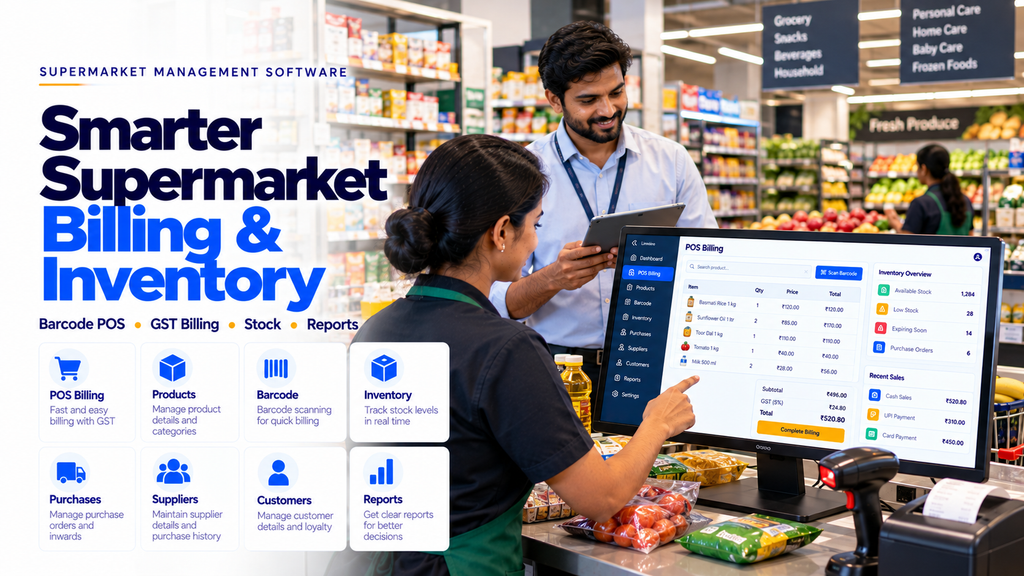
Custom supermarket software may include barcode POS billing, product management, GST configuration, stock tracking, batch and expiry records, supplier purchases, customer loyalty programmes and retail analytics.
This guide explains the main features, development process, implementation requirements and cost factors involved in building supermarket billing and inventory software.
What Is Supermarket Billing and Inventory Software?
Supermarket billing and inventory software is a digital application designed to manage retail transactions, product records and stock movements.
Depending on the supermarket’s requirements, the system may support:
- Barcode billing
- Touchscreen POS
- Product catalogues
- Price management
- GST invoice generation
- Discounts and offers
- Stock management
- Batch and expiry tracking
- Purchase management
- Supplier accounts
- Customer loyalty
- Sales reports
- Multi-branch inventory
The exact features depend on the store’s size, product categories, operating procedures and technology requirements.
Why Supermarkets in Erode Need Billing and Inventory Software
Supermarkets may manage hundreds or thousands of products across different categories, price ranges, suppliers and storage locations.
Common operational challenges include:
- Manual billing calculations
- Incorrect product prices
- Difficulty locating product stock
- Unrecorded stock movements
- Missing purchase information
- Unclear supplier balances
- Difficulty tracking expiring products
- Manual GST calculations
- Limited visibility into daily sales
- Difficulty managing multiple billing counters
Suitable supermarket software can help organize these activities and make operational information easier for authorized employees to access.
1. Supermarket Point-of-Sale Billing
The POS billing module is the central transaction interface used by supermarket cashiers.
Potential features include:
- Barcode scanning
- Product search
- Quantity adjustment
- Price lookup
- Discount controls
- Applicable tax calculation
- Invoice generation
- Receipt printing
- Payment recording
The POS interface should be designed for practical use during busy checkout periods.
2. Barcode Billing Software
Barcode billing helps cashiers identify products through supported barcode scanners.
Potential features include:
- Barcode-based product lookup
- Product identification
- Price retrieval
- Quantity updates
- Billing cart management
- Barcode label printing
Barcode formats and scanner compatibility should be tested with the store’s actual hardware.
3. Supermarket Product Management
Product management helps supermarkets organize their retail catalogue.
Possible fields include:
- Product name
- SKU
- Barcode
- Category
- Brand
- Unit of measurement
- Purchase price
- Selling price
- Applicable tax information
- Stock quantity
Product records should be updated when prices, packaging or stock details change.
4. Product Category Management
Supermarkets may organize products into categories such as:
- Rice and grains
- Pulses and spices
- Packaged foods
- Beverages
- Dairy products
- Personal care
- Household cleaning
- Fresh produce
- Stationery
- Other grocery items
Category management can help with product search, stock reporting and sales analysis.
5. SKU and Barcode Generation
Some products may require internal stock keeping units or store-generated barcode labels.
Potential features include:
- SKU generation
- Internal barcode assignment
- Label printing
- Product identification
- Barcode uniqueness validation
Store-generated identifiers should be managed carefully to avoid conflicts with manufacturer barcodes.
6. Supermarket Price Management
Supermarkets may need to update prices across different products and categories.
Potential features include:
- Purchase price
- Selling price
- MRP records
- Authorized price changes
- Discount rules
- Price history
Pricing and discounts must follow applicable consumer and retail requirements.
7. Supermarket GST Billing
Supermarket billing software may need to support applicable GST requirements.
Potential features include:
- Product tax configuration
- Relevant HSN information
- Invoice generation
- Tax summaries
- Credit note records
- Sales reporting
Tax treatment may vary by product category. Configuration should be reviewed with qualified accounting professionals.
8. Supermarket Discount and Offer Management
Retail businesses may provide selected discounts and promotional offers.
Possible features include:
- Product discounts
- Category discounts
- Promotional offers
- Offer validity
- Customer eligibility
- Authorized discount approval
Offer terms should be clear and consistently applied.
9. Supermarket Inventory Management
Inventory management is one of the most important modules of supermarket software.
Potential features include:
- Product stock quantities
- Stock locations
- Stock receipts
- Stock deductions
- Stock adjustments
- Inventory transfers
- Stock reports
Inventory accuracy depends on consistent transaction recording and periodic physical stock verification.
10. Real-Time Stock Updates
Suitable software can update stock records when validated sales, purchases or adjustments are recorded.
Potential features include:
- Sales-linked stock deduction
- Purchase-linked stock addition
- Stock transfer updates
- Authorized adjustments
- Stock movement history
Multi-device stock accuracy requires reliable synchronization and transaction handling.
11. Low-Stock Alerts
Low-stock notifications can help supermarket managers identify products that may need replenishment.
Possible features include:
- Minimum stock thresholds
- Reorder notifications
- Out-of-stock reports
- Purchase planning
- Supplier selection
Reorder levels should consider demand, supplier lead times and available budgets.
12. Batch and Expiry Date Tracking
Supermarkets selling relevant packaged or perishable goods may need batch and expiry records.
Potential features include:
- Batch identification
- Expiry date records
- Batch-level stock quantities
- Expiry alerts
- Stock review queues
- Authorized disposal records
Expiry tracking should support appropriate product handling and food safety procedures.
13. Grocery Weighing Scale Integration
Supermarkets selling products by weight may require weighing scale integration.
Potential features include:
- Supported weighing scale connectivity
- Weight-based item billing
- Price-per-unit calculations
- Barcode label reading
- Transaction records
Compatibility depends on the weighing scale model, supported interfaces and applicable measurement requirements.
14. Supermarket Purchase Management
Supermarkets may purchase goods from multiple distributors and wholesalers.
Potential features include:
- Purchase requests
- Purchase orders
- Supplier selection
- Goods receipt
- Purchase invoice records
- Stock updates
- Purchase history
15. Supplier Management
Supplier management helps supermarket businesses organize purchasing relationships.
Possible features include:
- Supplier profiles
- Contact details
- Purchase history
- Outstanding payments
- Purchase returns
- Supplier records
16. Goods Receipt Note Management
A Goods Receipt Note (GRN) records products received from suppliers.
Potential features include:
- Purchase order association
- Received product quantities
- Batch information
- Expiry information where relevant
- Receiving employee
- Receipt date
- Stock posting status
Received goods should be checked against purchase and delivery records.
17. Purchase Return Management
Supermarkets may need to return selected products to suppliers.
Possible features include:
- Purchase return requests
- Returned product details
- Quantities
- Return reasons
- Supplier association
- Stock adjustments
- Credit note records
18. Sales Return and Refund Management
Retail billing software may need to support permitted customer returns.
Potential features include:
- Original invoice lookup
- Returned item selection
- Return reason
- Authorized approval
- Refund records
- Stock adjustment
Return policies should comply with applicable consumer requirements.
19. Supermarket Payment Management
Supermarket POS systems may need to record different permitted payment methods.
Potential features include:
- Cash payments
- UPI payment records
- Card payment records
- Split payments
- Refunds
- Payment reconciliation
Payment processing should use suitable secure payment providers.
20. Cash Counter Management
Cash counter management helps supermarket owners review daily financial transactions.
Possible features include:
- Opening cash balance
- Cash sales
- Authorized adjustments
- Closing cash balance
- Shift reconciliation
- Cashier records
Cash adjustments should be logged and restricted to authorized users.
21. Multiple Billing Counter Management
Supermarkets may operate several checkout counters at the same time.
Potential features include:
- Counter identification
- Cashier assignment
- Counter-specific transactions
- Shared product catalogue
- Centralized stock updates
- Counter reports
Concurrent billing requires reliable database transactions and synchronization.
22. Supermarket Customer Management
Customer management features may help supermarkets organize permitted customer records.
Potential features include:
- Customer profiles
- Contact details
- Purchase history
- Invoice history
- Communication preferences
Customer information should be collected only for legitimate business purposes and protected appropriately.
23. Customer Loyalty and Reward Points
Some supermarkets may offer loyalty programmes to eligible customers.
Potential features include:
- Loyalty accounts
- Points rules
- Eligible purchases
- Reward redemption
- Points history
- Offer validity
Reward terms should be clearly communicated and consistently applied.
24. Supermarket Credit Customer Management
Some grocery businesses maintain approved customer credit accounts.
Possible features include:
- Authorized credit accounts
- Credit limits
- Credit sales
- Outstanding balances
- Payment records
- Account statements
Credit terms and collection practices should comply with applicable requirements.
25. Supermarket Expense Management
Retail businesses may need to record operating expenses.
Potential features include:
- Expense categories
- Expense records
- Authorized approvals
- Payment records
- Expense reports
Expense records should be reconciled with the business’s accounting procedures.
26. Supermarket Employee Management
Supermarket software may require different permissions for different employees.
Possible roles include:
- Supermarket Owner
- Store Manager
- Cashier
- Inventory Employee
- Purchase Manager
- Accounts Employee
- System Administrator
Permissions should reflect actual responsibilities and authorized activities.
27. Cashier Performance and Shift Reports
Supermarket managers may need to review transactions by cashier or shift.
Potential reports include:
- Transactions per shift
- Sales totals
- Payment summaries
- Authorized discounts
- Returns
- Cash reconciliation
Employee reports should be used responsibly and interpreted in the context of actual working conditions.
28. Supermarket Admin Dashboard
An administration dashboard may help supermarket owners review operational information.
Potential modules include:
- Today’s sales
- Billing counters
- Product stock
- Low-stock alerts
- Purchase orders
- Supplier balances
- Customer accounts
- Business reports
29. Supermarket Sales Reports
Sales reporting can help supermarket owners review retail transactions.
Possible reports include:
- Daily sales
- Monthly sales
- Product-wise sales
- Category-wise sales
- Counter-wise sales
- Payment method summaries
- Return summaries
Reports should be generated from accurate transaction records.
30. Supermarket Inventory Reports
Inventory reports can help managers review product stock and movement.
Potential reports include:
- Current stock
- Low-stock items
- Out-of-stock products
- Purchase history
- Stock movements
- Batch and expiry records
- Stock adjustments
31. Supermarket Profit and Margin Reports
Retail businesses may want to review product margins and operating performance.
Possible features include:
- Sales summaries
- Product cost records
- Purchase expenses
- Discount records
- Gross margin estimates
- Operating expense categories
Actual net profit requires complete and accurate expense, inventory and accounting records.
32. Multi-Branch Supermarket Management
Supermarket businesses operating multiple outlets may need centralized administration.
Potential features include:
- Branch-specific product stock
- Branch pricing
- Branch billing
- Stock transfer requests
- Centralized purchase management
- Branch reports
- Role-based access
Data access should be restricted according to branch responsibilities and management permissions.
33. Warehouse and Store Stock Transfers
Retail businesses with central warehouses may need stock transfer workflows.
Potential features include:
- Transfer requests
- Source location
- Destination location
- Product quantities
- Dispatch records
- Receiving confirmation
- Stock reconciliation
Transfers should preserve accurate stock movement histories.
34. Grocery Store Billing Software
Small grocery shops and provision stores may need simpler billing and stock management features.
Potential modules include:
- Quick POS billing
- Product catalogue
- Barcode lookup
- Stock management
- Supplier purchases
- Customer accounts
- Sales reports
The system should be selected based on the store’s actual operating requirements.
35. Mini Supermarket Management Software
Mini supermarkets may require an integrated system without the complexity of a large retail ERP platform.
Potential features include:
- Billing counter management
- Product inventory
- Barcode labels
- Purchase management
- GST configuration
- Daily sales reports
36. Supermarket Ecommerce Integration
Supermarkets offering online grocery ordering may need to connect their retail software with an ecommerce website.
Potential integrations include:
- Online product catalogue
- Product availability
- Online orders
- Order status
- Customer accounts
- Inventory synchronization
Reliable stock synchronization requires careful handling of simultaneous online and in-store transactions.
37. Supermarket Home Delivery Management
Some supermarkets offer local grocery delivery.
Potential features include:
- Delivery order management
- Delivery address records
- Order preparation status
- Delivery assignment
- Dispatch tracking
- Delivery confirmation
Delivery features should be configured according to the supermarket’s actual business model.
38. Supermarket POS Hardware Integration
Supermarket billing software may need to work with selected retail hardware.
Possible integrations include:
- Barcode scanners
- Thermal receipt printers
- Cash drawers
- Touchscreen POS terminals
- Customer-facing displays
- Supported weighing scales
- Barcode label printers
Hardware compatibility depends on device models, operating systems, drivers and supported interfaces.
39. Offline Supermarket Billing Software
Stores with unreliable internet connectivity may require offline-capable billing.
Potential features include:
- Local product catalogue
- Local billing transactions
- Offline receipt generation where supported
- Synchronization after connectivity returns
- Conflict handling
- Recovery procedures
Offline operation must be deliberately designed and tested. A normal cloud-based web application does not automatically work without internet access.
40. Supermarket POS vs General Billing Software
| General Billing Software | Supermarket POS Software |
|---|---|
| Standard invoices | Fast barcode-based checkout |
| Basic product records | Large retail product catalogues |
| General inventory | Retail stock, batches and expiry tracking |
| Ordinary sales transactions | Multiple checkout counter workflows |
| Basic sales reports | Retail-specific inventory and sales reports |
General billing software may be suitable for simple retail transactions, but supermarkets often require specialized checkout and inventory workflows.
41. Ready-Made vs Custom Supermarket Software
| Ready-Made Supermarket Software | Custom Supermarket Software |
|---|---|
| Predefined modules | Features based on store requirements |
| May offer faster setup | Requires development and testing |
| Customization depends on vendor | Supports tailored workflows |
| Often subscription-based | May involve development and maintenance costs |
| Integrations depend on provider support | Can connect suitable supported systems |
Supermarket owners should compare workflow fit, total cost, hardware compatibility, data portability, security and ongoing support.
42. Supermarket Software Architecture
A custom supermarket billing and inventory platform may include:
- Responsive POS interface
- Secure backend
- Product database
- Barcode management
- Billing module
- Inventory management
- Purchase management
- Supplier records
- Customer management
- Reporting dashboard
- Role-based permissions
- Audit logs
- Backup and recovery
43. Mobile-Friendly Supermarket Management Software
Supermarket owners and authorized employees may need access to selected features from mobile devices.
Responsive software may support:
- Product lookup
- Stock status
- Low-stock alerts
- Purchase requests
- Sales summaries
- Management reports
Mobile access should use appropriate authentication and role-based permissions.
44. Supermarket Software Security
Supermarket software may store customer contact details, employee accounts and financial records.
Important safeguards include:
- Secure authentication
- Role-based access controls
- Appropriate encryption
- Secure session management
- Input validation
- Audit logging
- Protected backups
- Access monitoring
- Secure software updates
Payment processing should use suitable secure providers rather than unnecessarily storing sensitive card information.
45. Supermarket Customer Data Privacy
Retail businesses should protect customer contact details, loyalty accounts and transaction records.
Important considerations include:
- Purpose-based data collection
- Appropriate privacy notices
- Consent where required
- Restricted employee access
- Secure data storage
- Authorized information sharing
- Data retention policies
- Secure deletion procedures
Applicable Indian data protection requirements should be reviewed before deployment.
46. Supermarket Backup and Disaster Recovery
Supermarkets should plan how important product, billing and inventory records can be recovered after technical failures.
Potential safeguards include:
- Scheduled backups
- Protected backup storage
- Recovery testing
- Documented restoration procedures
- Access-controlled recovery
47. Supermarket Software Development Process
- Requirement Analysis: Understand supermarket operations.
- Workflow Review: Map checkout, stock and purchase processes.
- Module Planning: Define billing, inventory, supplier and reporting modules.
- UI/UX Design: Design cashier, inventory and admin interfaces.
- Database Design: Structure product, stock and transaction records.
- Backend Development: Implement secure business logic.
- Frontend Development: Build responsive interfaces.
- Hardware Integration: Connect supported scanners, printers and scales.
- Payment Integration: Connect approved payment services.
- Security Testing: Verify permissions and data protection.
- Functional Testing: Test realistic retail transactions.
- Deployment: Release the application.
- Training: Train store employees.
- Maintenance: Monitor and improve the system.
48. Recommended Supermarket Software Modules
| Module | Main Purpose |
|---|---|
| POS Billing | Barcode checkout and invoices |
| Product Management | Products, categories and prices |
| Barcode Management | Barcode lookup and labels |
| Inventory | Stock quantities and movements |
| Batch and Expiry | Product batch and expiry records |
| Purchase Management | Supplier purchases and goods receipt |
| Supplier Management | Supplier accounts and history |
| Customer Management | Customer profiles and loyalty |
| Returns | Sales and purchase returns |
| Reports | Sales, stock and purchase reports |
| Multi-Branch | Branch operations and stock transfers |
| Admin Panel | Users, permissions and settings |
49. How Much Does Supermarket Software Development Cost in Erode?
Development cost depends on the supermarket’s requirements and project scope.
Factors include:
- Number of store branches
- Number of billing counters
- Product catalogue size
- Barcode management
- Inventory complexity
- Batch and expiry tracking
- Purchase management
- GST billing
- Hardware integrations
- Weighing scale integration
- Offline capabilities
- Ecommerce integration
- Data migration
- Security requirements
- Hosting and maintenance
Supermarket owners should request a detailed quotation separating development costs, POS hardware expenses, hosting and recurring support charges.
50. How Long Does Supermarket Software Development Take?
Development timelines depend on the number of modules, billing workflows, inventory requirements, hardware compatibility, testing and data migration.
A basic grocery billing application generally requires less development effort than a complete supermarket management platform with multiple counters, batch tracking, purchase management, warehouse transfers and multi-branch reporting.
Project milestones and acceptance criteria should be agreed upon before development begins.
51. How to Choose a Supermarket Software Development Company in Erode
Before selecting a software development provider, consider:
- Understanding of retail store operations
- Experience with custom POS applications
- Barcode billing capabilities
- Inventory management knowledge
- POS hardware compatibility
- GST billing configuration
- Responsive interface design
- Security practices
- Testing procedures
- Employee training
- Maintenance arrangements
52. Supermarket Software Development Across Erode District
Supermarkets, grocery stores, mini supermarkets and provision shops across Erode district may require software based on their product categories, billing volume and business operations.
Relevant locations include:
- Erode
- Perundurai
- Bhavani
- Anthiyur
- Gobichettipalayam
- Sathyamangalam
- Modakkurichi
- Kodumudi
- Nambiyur
- Chennimalai
- Kavindapadi
- Ammapettai
- Arachalur
- Sivagiri
- Punjai Puliampatti
- Thalavadi
- Solar
- Surampatti
- Veerappanchatram
- Nasiyanur
Software requirements should be determined by actual retail workflows rather than location alone.
53. Common Supermarket Software Development Mistakes
- Using billing software without reliable stock tracking
- Failing to validate product barcodes
- Incorrect tax configuration
- Ignoring batch and expiry requirements
- Failing to record stock adjustments
- Incorrect purchase receipt handling
- Weak cashier permissions
- Skipping barcode scanner compatibility testing
- Ignoring offline billing requirements
- Failing to plan multi-counter synchronization
- Skipping realistic retail testing
- Ignoring backup and recovery
- Failing to train employees
54. Supermarket Software Implementation Checklist
- Document current supermarket workflows.
- Define checkout and billing requirements.
- Prepare product catalogues.
- Validate SKU and barcode records.
- Define price and tax configuration.
- Plan stock movement rules.
- Assess batch and expiry requirements.
- Define purchase workflows.
- Plan supplier management.
- Review POS hardware compatibility.
- Plan multiple checkout counters.
- Review weighing scale requirements.
- Plan ecommerce integration if necessary.
- Define staff roles and permissions.
- Implement secure record storage.
- Plan backup and recovery.
- Test realistic retail transactions.
- Train employees.
- Maintain and update the application.
55. How Greap Technologies Can Help
Greap Technologies can help supermarket owners discuss custom software development requirements, including barcode billing, POS systems, product inventory, purchases, suppliers and retail reporting.
Depending on the agreed project scope, solutions may include:
- Supermarket software requirement analysis
- Touchscreen POS billing
- Barcode billing
- Product catalogue management
- Retail inventory management
- Batch and expiry tracking
- Supplier and purchase management
- GST billing
- Customer loyalty
- Multi-counter billing
- Multi-branch inventory
- Retail reporting dashboards
- Responsive admin panels
- Security testing and maintenance
Explore Greap Technologies for custom software development, retail management applications and business automation solutions.
Conclusion
Supermarket billing and inventory software development in Erode can help retail businesses organize barcode billing, product catalogues, stock movements, purchases, suppliers, customer transactions and daily business reporting.
Unlike basic billing applications, supermarket software may require specialized features such as multiple checkout counters, barcode label management, batch tracking, weighing scale integration and centralized stock management.
Successful implementation depends on clear requirements, reliable hardware integration, accurate inventory workflows, secure data handling, realistic testing, employee training and ongoing maintenance.
For supermarkets across Erode and Tamil Nadu, a requirements-based approach can help determine whether ready-made retail POS software or a custom supermarket management platform is the better fit.
Need Supermarket Billing and Inventory Software in Erode?
Greap Technologies can help you discuss barcode billing, retail POS, stock tracking, purchase management, GST billing and custom supermarket software requirements.
Frequently Asked Questions
1. What is supermarket billing and inventory software?
It is a digital system that helps supermarkets manage barcode billing, product stock, purchases, suppliers, customer transactions and business reports.
2. Can supermarket software support barcode billing?
Yes. Suitable software can support barcode scanners, product lookup, billing carts and receipt generation.
3. Can supermarket billing software generate GST invoices?
Yes. Billing modules can support applicable GST configuration and invoice generation.
4. Can supermarket software manage inventory?
Yes. Inventory modules can track stock quantities, purchases, sales, transfers and authorized adjustments.
5. Can supermarket software track product expiry dates?
Yes. Batch and expiry management features can be included for relevant product categories.
6. Can supermarket software integrate with weighing scales?
Some weighing scales support software integration. Compatibility depends on the device model and supported interfaces.
7. Can supermarkets use multiple billing counters?
Yes. Multi-counter POS systems can support simultaneous billing with appropriate transaction synchronization.
8. Can supermarket POS software work without internet?
Offline billing is possible when the software is specifically designed with local transaction storage and synchronization.
9. Can multiple supermarket branches use one system?
Yes. Multi-branch software can support centralized administration with branch-specific billing, inventory and reporting.
10. How much does supermarket software cost in Erode?
Cost depends on barcode billing, inventory, purchase management, hardware integrations, offline requirements and ongoing maintenance.
11. Can supermarket software integrate with an online grocery store?
Yes. Ecommerce integration may support online product catalogues, orders and inventory synchronization.
12. Does Greap Technologies develop supermarket software in Erode?
Greap Technologies can help assess supermarket software requirements and develop suitable custom applications according to the agreed project scope.