NGO and Trust Website Development in Erode: Donations, Events and Volunteer Management
Non-governmental organizations, charitable trusts and nonprofit institutions need a professional online presence to communicate their mission, showcase genuine activities, accept eligible donations and connect with supporters.
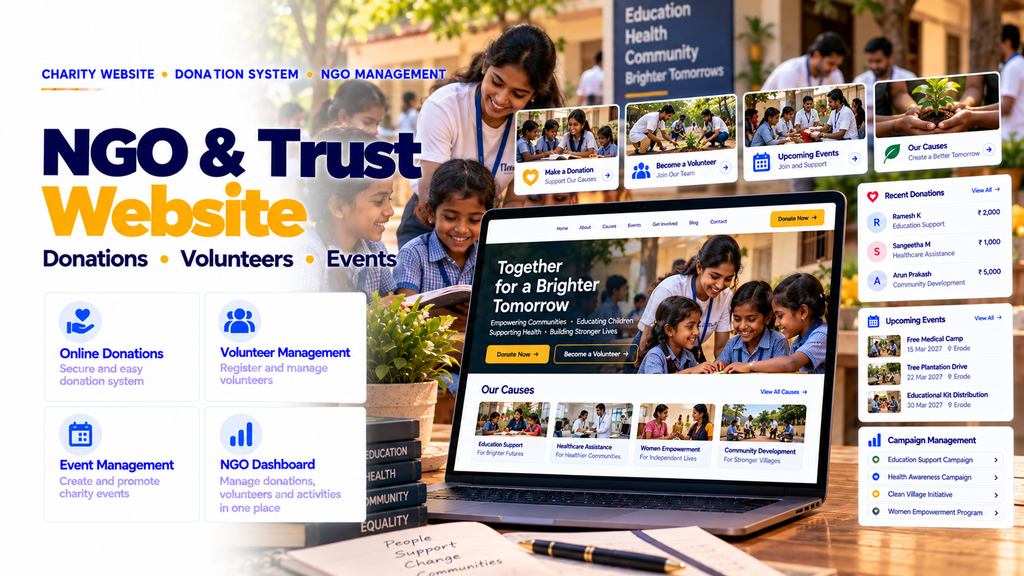
Effective NGO and trust website development in Erode combines clear organizational information, project galleries, donation options, volunteer registration, charity event management, transparency pages, mobile-responsive design and search engine optimization.
Whether an organization works in education, community welfare, environmental protection, healthcare support or other charitable activities, its website should help visitors understand its work and participate through appropriate channels.
An NGO or charitable trust website should include an organization profile, mission and vision, programs, project updates, approved registration details, donation information, volunteer registration, events, contact information, privacy policy and mobile-responsive design. Advanced platforms may include secure online donations, automated receipts, donor management, campaign dashboards, volunteer coordination and event registration systems.
This guide explains essential NGO website features, donation workflows, volunteer management, transparency requirements, development cost considerations and SEO strategies for charitable organizations in Erode and Tamil Nadu.
1. What Is an NGO and Trust Website?
An NGO or trust website is an online platform that presents an organization’s purpose, charitable programs, activities, governance information and ways for supporters to participate.
It may also provide donation facilities, volunteer applications, event registration and updates about ongoing projects.
The required features depend on the organization’s activities, legal status, funding model and operational needs.
2. Why NGOs and Trusts in Erode Need a Website
A professional website can help nonprofit organizations communicate with supporters and provide reliable information.
Potential benefits include:
- Explain the organization’s mission
- Showcase genuine projects
- Publish program updates
- Provide verified contact information
- Share donation instructions
- Accept volunteer applications
- Announce charity events
- Publish relevant transparency documents
A website supports communication and accessibility but does not guarantee donations or volunteer participation.
3. Types of Organizations That Need NGO Websites
- Charitable trusts
- Educational trusts
- Social welfare organizations
- Community development organizations
- Environmental nonprofits
- Animal welfare organizations
- Healthcare support charities
- Disability support organizations
- Foundations
- Registered nonprofit societies
Website requirements should reflect the organization’s actual activities and legal structure.
4. NGO Website vs General Business Website
| Feature | General Business Website | NGO and Trust Website |
|---|---|---|
| Primary objective | Present products or services | Explain mission and charitable programs |
| Donation system | Usually unnecessary | Optional, subject to eligibility |
| Volunteer registration | Optional | Often useful |
| Transparency | Company information | Governance and relevant disclosures |
| Events | Marketing or company events | Charity and community activities |
| Supporter management | Customer CRM | Optional donor and volunteer management |
5. Design a Professional NGO Homepage
The homepage should clearly communicate the organization’s mission and provide meaningful actions for visitors.
Recommended sections include:
- Organization introduction
- Mission statement
- Key charitable programs
- Genuine activity photographs
- Latest project updates
- Donate button, where applicable
- Become a Volunteer button
- Upcoming events
- Contact details
6. Create Mission and Vision Pages
Mission and vision pages explain the organization’s purpose and long-term objectives.
Useful information includes:
- Why the organization was established
- Communities or causes served
- Primary charitable objectives
- Core organizational values
- Long-term goals
Use clear, factual language and avoid exaggerated impact claims.
7. Add an About the Organization Page
An About page helps visitors understand the organization’s background.
Possible information includes:
- Organization history
- Founding purpose
- Activities and programs
- Leadership information
- Registered organization details where appropriate
- Contact information
8. Add Trustees and Management Information
Organizations may choose to publish appropriate governance information.
Possible sections include:
- Board or trustee profiles
- Management team
- Organizational responsibilities
- Governance policies
Publish personal information only when appropriate and authorized.
9. Add Charitable Program Pages
Each major program can have a dedicated page explaining its objectives and activities.
Possible categories include:
- Education support
- Community development
- Environmental activities
- Healthcare assistance
- Animal welfare
- Skill development
- Other charitable initiatives
Describe only programs the organization actually operates.
10. Create Individual Project Pages
Dedicated project pages can explain specific nonprofit initiatives.
Useful information includes:
- Project name
- Purpose
- Location, when appropriate
- Activities
- Current status
- Progress updates
- Approved photographs
11. Add Genuine NGO Activity Galleries
Photo galleries can help supporters understand the organization’s work.
Possible categories include:
- Community events
- Education initiatives
- Awareness programs
- Volunteer activities
- Environmental projects
- Public service activities
Obtain appropriate consent before publishing identifiable beneficiaries, especially children or vulnerable individuals.
12. Add NGO Video Galleries
Video galleries can present authorized event highlights, project updates and educational material.
Optimize video delivery to avoid slowing the website.
Use captions and accessible controls where practical.
13. Add Online Donation Functionality
Eligible organizations may offer online donations through an appropriate payment provider.
Possible features include:
- Donate Now button
- Donation amount selection
- Custom donation amount
- Cause or campaign selection
- Secure payment processing
- Donation confirmation
- Receipt generation
Payment gateway onboarding, charitable eligibility and applicable legal requirements should be reviewed before launch.
14. Add One-Time Donation Options
One-time donations allow supporters to contribute a selected amount.
Possible workflow:
- Supporter selects a donation campaign.
- Supporter enters an amount.
- Required donor details are collected.
- Payment is processed securely.
- The system verifies the payment result.
- A receipt or acknowledgment is issued.
Payment verification should use trusted gateway confirmation rather than only a browser success page.
15. Add Recurring Donation Options
Some eligible nonprofits may offer recurring donations through supported payment providers.
Possible features include:
- Monthly contribution option
- Recurring payment authorization
- Payment status
- Donor notifications
- Cancellation instructions
Recurring payment functionality depends on provider support, donor authorization and applicable rules.
16. Add Cause-Based Donation Campaigns
Organizations managing multiple charitable programs may create separate donation campaign pages.
Useful information includes:
- Campaign purpose
- Activities supported
- Funding goal, where appropriate
- Current campaign status
- Updates
- Donation option
Campaign claims and financial figures should be accurate and regularly updated.
17. Add Donation Receipt Management
A donation receipt system can help maintain records and provide acknowledgments.
Possible fields include:
- Receipt reference
- Donation date
- Amount
- Payment reference
- Donor details where required
- Organization details
A general donation acknowledgment is not automatically a tax-deduction certificate. Any tax-related statement must match the organization’s actual eligibility and applicable law.
18. Add 80G Information Where Applicable
Indian charitable organizations may have relevant income-tax approvals, including 80G approval where granted.
If applicable, the website can publish accurate approval details and donor guidance.
Do not claim that donations qualify for income-tax deductions unless the organization holds the relevant valid approval and applicable conditions are met. Website development does not provide or establish 80G eligibility.
19. Add 12AB Registration Information Where Applicable
Organizations with relevant income-tax registration may publish appropriate verified details.
Do not confuse organizational registration, income-tax registration and donor deduction eligibility.
Consult qualified professionals for organization-specific compliance advice.
20. Add FCRA Information for Foreign Contributions
Organizations intending to receive foreign contributions must assess applicable Foreign Contribution (Regulation) Act requirements.
Foreign contribution acceptance is not enabled merely by integrating an international payment gateway.
Only enable relevant donation channels after verifying legal eligibility, banking requirements and payment provider support.
21. Add Donor Registration and Profiles
Advanced websites may offer optional donor accounts.
Possible features include:
- Donor profile
- Donation history
- Receipt downloads
- Recurring donation management
- Communication preferences
Guest donations may be more convenient for organizations that do not need donor accounts.
22. Add a Donor Management Dashboard
A donor management system can help authorized staff organize contributions.
Possible features include:
- Donation records
- Campaign association
- Payment status
- Receipt history
- Donor communication preferences
- Reporting
Financial and donor information should be accessible only to authorized users.
23. Add Donation Campaign Reporting
Campaign dashboards may summarize verified financial activity.
Possible metrics include:
- Confirmed contributions
- Campaign totals
- Payment failures
- Refunds
- Donation dates
Reports should distinguish successful payments from pending or failed transactions.
24. Add Volunteer Registration
Volunteer registration helps organizations collect expressions of interest.
Recommended fields include:
- Name
- Contact details
- Preferred volunteering area
- Skills
- General availability
- Preferred location
Collect only necessary information and explain how volunteer data will be used.
25. Add Volunteer Opportunity Listings
Organizations can publish current volunteering opportunities.
Useful information includes:
- Opportunity title
- Activity description
- Location
- Dates
- Required skills
- Eligibility requirements
- Application instructions
Keep opportunities current and accurately describe responsibilities.
26. Add Volunteer Management Software
Advanced nonprofit platforms may include a volunteer management dashboard.
Possible features include:
- Volunteer profiles
- Application review
- Activity assignment
- Availability tracking
- Communication history
- Volunteer status
27. Add Volunteer Scheduling
Volunteer scheduling tools can help coordinate approved participants.
Possible functions include:
- Activity dates
- Available time slots
- Volunteer assignment
- Participation confirmation
- Schedule updates
28. Add Volunteer Attendance Tracking
Organizations running regular activities may need volunteer attendance records.
Possible features include:
- Activity attendance
- Participation dates
- Approved volunteer hours
- Coordinator notes
- Activity summaries
Use accurate records and appropriate privacy controls.
29. Add Volunteer Communication Features
Volunteer communication can include:
- Application acknowledgment
- Opportunity updates
- Event reminders
- Schedule changes
- Participation confirmation
Use suitable communication channels and honor notification preferences.
30. Add NGO Event Management Pages
Nonprofit organizations may organize awareness campaigns, community programs, fundraising events and volunteer activities.
Event pages can include:
- Event title
- Purpose
- Date and time
- Venue
- Event description
- Registration instructions
- Contact information
31. Add Online Event Registration
Event registration forms can collect necessary attendee information.
Possible features include:
- Attendee registration
- Event capacity
- Confirmation messages
- Registration status
- Attendance lists
Only collect information needed to organize the event.
32. Add Event Calendar Functionality
An event calendar can display upcoming nonprofit activities.
Possible features include:
- Monthly event view
- Event categories
- Event detail pages
- Registration links
- Past event archive
33. Add Fundraising Event Pages
Eligible organizations may use event pages to explain fundraising initiatives.
Possible information includes:
- Fundraising purpose
- Event schedule
- Participation instructions
- Donation options
- Relevant organizer information
Clearly distinguish event registration fees from charitable donations where applicable.
34. Add NGO Project Updates
Regular project updates can help supporters understand ongoing activities.
Useful content includes:
- Recent activities
- Program milestones
- Approved photographs
- Challenges and progress
- Future plans
Use verified information and avoid unsupported impact figures.
35. Add Transparency and Accountability Pages
Transparency pages can provide appropriate information about the organization.
Possible sections include:
- Governance overview
- Registration information
- Financial reports where appropriate
- Annual reports
- Program updates
- Contact details
Publish documents only when disclosure is appropriate and legally permitted.
36. Add Annual Report Downloads
Organizations may provide annual reports as downloadable PDF documents.
Reports may include:
- Organizational activities
- Program summaries
- Financial information
- Governance information
- Future objectives
Make documents readable, accessible and appropriately reviewed before publication.
37. Add Impact Stories Responsibly
Impact stories can explain how programs support communities.
Use respectful language, accurate context and appropriate consent.
Avoid sensationalizing hardship or publishing private beneficiary information.
38. Add Corporate CSR Enquiry Features
Some nonprofits may wish to receive enquiries from companies interested in corporate social responsibility initiatives.
Possible features include:
- CSR partnership information
- Program overview
- Partnership enquiry form
- Relevant organizational documents
- Contact information
Do not claim CSR eligibility or approvals without verifying applicable requirements.
39. Add NGO and Trust SEO in Erode
Search engine optimization can help relevant nonprofit website pages become discoverable.
Important activities include:
- Keyword research
- Program page optimization
- Original activity descriptions
- Image SEO
- Internal linking
- Local SEO
- Technical SEO
- Search Console monitoring
SEO does not guarantee rankings, donations or volunteer registrations.
40. NGO Website Development SEO Keyword Examples
Potential keyword patterns include:
- NGO website development Erode
- Trust website design Erode
- Charitable trust website development
- Donation website development
- Volunteer management software
- NGO management software Erode
- Nonprofit website development Tamil Nadu
These are illustrative commercial keywords. Validate relevance and search demand before prioritizing them.
41. Local SEO for NGOs and Charitable Trusts
Eligible organizations can maintain accurate Google Business Profiles.
Important information includes:
- Real organization name
- Eligible office address or service-area information
- Appropriate organization category
- Contact details
- Operating hours
- Genuine organization photographs
Follow Google’s eligibility guidelines and avoid fake branch listings.
42. Target Relevant Areas Around Erode
Organizations based in Erode may serve nearby communities depending on their actual activities.
Examples include:
- Erode
- Perundurai
- Bhavani
- Anthiyur
- Gobichettipalayam
- Sathyamangalam
- Chennimalai
- Kavindapadi
- Modakkurichi
- Ammapettai
Only describe genuine program coverage and organizational presence.
43. Create Useful NGO Location Pages
Location pages can explain programs available in specific communities.
Useful information includes:
- Actual activities
- Relevant projects
- Program updates
- Volunteer opportunities
- Contact information
Avoid duplicate pages created only to target different town names.
44. Optimize NGO Website Images for SEO
Use descriptive filenames and meaningful alternative text.
Example filename:
ngo-community-education-program-erode.webp
Example alt text:
Volunteers conducting an educational activity at a community program.
Alt text should accurately describe the image without unnecessary keyword repetition.
45. Add Appropriate Structured Data
Depending on the page, relevant structured data may include:
- NGO
- Organization
- BreadcrumbList
- Article
- Event
Use schema types only when they accurately describe the page and comply with relevant search engine requirements.
Structured data does not guarantee rich results.
46. Build a Mobile-Responsive NGO Website
Supporters and volunteers may access nonprofit websites using smartphones.
Important mobile features include:
- Responsive layout
- Readable content
- Accessible navigation
- Mobile-friendly donation forms
- Easy volunteer registration
- Clear contact buttons
47. NGO Website Speed Optimization
Useful optimization techniques include:
- Compressed images
- Modern image formats
- Responsive image sizes
- Optimized scripts
- Appropriate caching
- Lazy loading where suitable
- Core Web Vitals monitoring
48. Add a Nonprofit Content Management System
A CMS allows authorized staff to update website information.
Useful functions include:
- Manage charitable programs
- Publish project updates
- Manage event pages
- Upload approved photographs
- Update volunteer opportunities
- Manage blog articles
- Edit SEO metadata
49. Track NGO Website Conversions With GA4
Google Analytics 4 can help measure configured website interactions.
Possible events include:
- Successful volunteer form submission
- Completed event registration
- Contact form submission
- Donation page visits
- Confirmed donation events where appropriately configured
Do not send donor names, contact information, payment details or other personally identifiable information to GA4.
50. Add Google Tag Manager
Google Tag Manager can help manage analytics and conversion tracking.
Track completed actions using reliable confirmation events.
A Donate button click is not equivalent to a completed payment.
51. Add Google Search Console
Google Search Console helps website owners monitor search performance and indexing.
Useful reports include:
- Search queries
- Organic clicks
- Search impressions
- Page indexing
- Technical issues
52. NGO Website Security
Nonprofit websites may collect donor, volunteer and event participant information.
Important security measures include:
- HTTPS
- Secure payment integration
- Role-based access
- Secure authentication
- Form validation
- Regular software updates
- Secure backups
- Activity logs where appropriate
53. Protect Donor and Volunteer Data
Organizations should clearly explain how personal information is collected, used, shared and retained.
Important considerations include:
- Privacy notice
- Appropriate consent or other lawful basis
- Restricted data access
- Secure storage
- Retention and deletion procedures
- Secure third-party integrations
Review applicable Indian data protection requirements before implementing donor or volunteer data processing.
54. Recommended NGO and Trust Website Pages
- Home
- About Us
- Mission and Vision
- Trustees and Management
- Programs
- Individual Project Pages
- Our Impact
- Gallery
- Donate
- Donation Campaigns
- Volunteer
- Volunteer Opportunities
- Events
- Annual Reports
- Transparency
- Blog
- FAQs
- Contact
- Privacy Policy
55. NGO and Trust Website Development Cost in Erode
Development costs depend on the website’s content, donation requirements, volunteer management features and integrations.
The following are illustrative budgeting estimates, not verified market averages or an official Greap Technologies quotation.
| Website Package | Indicative Cost | Typical Features |
|---|---|---|
| Basic NGO website | ₹10,000–₹20,000 | Organization pages, programs, gallery and contact forms |
| Professional NGO website | ₹20,000–₹45,000 | CMS, volunteer forms, events and donation information |
| Advanced NGO website | ₹45,000–₹1,00,000 | Eligible online donations, receipts, campaigns and volunteer dashboard |
| Custom NGO management platform | ₹1,00,000–₹3,00,000+ | Donor CRM, volunteer management, event workflows and custom reporting |
Domain, hosting, payment gateway fees, messaging services, compliance work, integrations, maintenance and applicable taxes may be additional.
56. Factors Affecting NGO Website Development Cost
- Number of pages
- Custom website design
- Donation payment integration
- Recurring donation functionality
- Receipt management
- Donor dashboard
- Volunteer registration
- Volunteer management
- Event registration
- Reporting requirements
- Security requirements
- Ongoing maintenance
57. WordPress vs Custom NGO Website
| Factor | WordPress | Custom Development |
|---|---|---|
| Best for | Content-focused nonprofit websites | Advanced nonprofit workflows |
| Donation system | Plugins and payment integrations | Custom integration |
| Volunteer registration | Forms and plugins | Custom volunteer system |
| Event management | Plugins | Custom event module |
| Donor CRM | Third-party integration | Custom CRM or integration |
| Maintenance | Core, theme and plugin updates | Application and dependency updates |
Choose the technology based on actual organizational requirements, available budget and long-term maintenance capacity.
58. NGO Website Development Process
- Gather organizational requirements.
- Identify visitor and supporter journeys.
- Review approved organization information.
- Plan programs and project pages.
- Design responsive layouts.
- Develop the CMS.
- Build volunteer registration forms.
- Configure event management.
- Assess donation eligibility and payment provider requirements.
- Integrate approved payment options.
- Implement secure data access.
- Configure technical SEO.
- Set up analytics.
- Test forms, payments and notifications.
- Launch and train authorized staff.
59. Common NGO Website Mistakes
- Publishing unclear organization information
- Using unsupported impact claims
- Showing outdated programs
- Publishing beneficiary images without permission
- Using insecure donation forms
- Claiming unverified tax benefits
- Not explaining donation purposes
- Ignoring mobile usability
- Failing to update event information
- Not protecting donor data
- Ignoring technical SEO
- Failing to plan ongoing maintenance
60. How to Choose an NGO Website Developer
Before selecting a development company, ask:
- Can the website explain the organization’s mission clearly?
- Can staff update programs independently?
- Can donation payments be integrated securely where eligible?
- Can receipts be managed?
- Can volunteers register online?
- Can events be published and managed?
- Will the website work on mobile?
- Is technical SEO included?
- How will donor information be protected?
- What are the recurring costs?
61. NGO Website Development Services in Erode
NGOs and charitable trusts in Erode may need different website solutions depending on their activities and organizational structure.
Possible solutions include:
- NGO websites
- Charitable trust websites
- Educational trust websites
- Donation management systems
- Volunteer registration portals
- Volunteer management software
- Charity event management
- Donor CRM
- Campaign dashboards
- Local SEO
- Website maintenance
62. How Greap Technologies Can Help
Greap Technologies provides website development, custom software, SEO and digital growth solutions.
NGOs and charitable trusts can discuss requirements for responsive websites, project galleries, eligible donation systems, volunteer registration, event management, donor dashboards and custom nonprofit software.
Website features and development costs depend on the agreed project scope.
Visit Greap Technologies to learn more about website development services.
Conclusion
NGO and trust website development in Erode should focus on communicating the organization’s genuine mission, presenting charitable programs clearly and making it easier for supporters to participate through appropriate channels.
A professional nonprofit website combines transparent organization information, program updates, eligible donation options, volunteer registration, event management, responsive design, SEO and secure data handling.
The right solution should match the organization’s real activities, legal eligibility and operational requirements.
Professional NGO Website + Transparent Programs + Secure Donations + Volunteer Management + Events + SEO = A stronger foundation for nonprofit communication and supporter engagement.
Need an NGO or Trust Website in Erode?
Planning a website for a charitable trust, nonprofit organization, educational trust or community welfare initiative?
Discuss project galleries, donation integrations, volunteer registration, event management, SEO and nonprofit management software with Greap Technologies.
Get NGO Website QuoteWebsite: www.greap.in
Phone: +91 70923 30168
Frequently Asked Questions About NGO and Trust Websites
1. What features should an NGO website have?
Important features include organization information, programs, project updates, donation options where eligible, volunteer registration, events, contact details and mobile-responsive design.
2. Can a charitable trust website accept online donations?
Yes, where the organization is legally eligible and accepted by an appropriate payment provider.
3. Can an NGO website generate donation receipts?
Yes. Donation management systems can issue acknowledgments and maintain payment records. Tax-related documents require separate eligibility and compliance checks.
4. Can an NGO website support recurring donations?
Yes, when supported by the payment provider and applicable recurring payment requirements.
5. How much does NGO website development cost in Erode?
Illustrative estimates range from ₹10,000–₹20,000 for basic websites to ₹1,00,000–₹3,00,000 or more for advanced custom nonprofit management platforms. Actual pricing depends on scope.
6. Can volunteers register through an NGO website?
Yes. Online forms can collect volunteer applications and support appropriate coordination workflows.
7. Can charity events be managed online?
Yes. Event management modules can support event pages, registration, scheduling and attendance records.
8. Does an NGO website automatically qualify for 80G benefits?
No. Tax-related eligibility depends on the organization’s applicable approvals and legal requirements, not on the website.
9. Can an NGO website accept foreign donations?
Only where the organization satisfies applicable foreign contribution requirements and relevant payment and banking conditions.
10. Is SEO important for NGO websites?
SEO can help relevant organization and program pages become discoverable through search engines. Rankings are not guaranteed.
11. Which is better: WordPress or custom NGO development?
WordPress can suit content-focused nonprofit websites, while custom development may be appropriate for advanced donor, volunteer and event management workflows.
12. Can Greap Technologies develop NGO and trust websites?
NGOs and trusts can contact Greap Technologies to discuss nonprofit websites, donation integrations, volunteer systems, event management, custom software and SEO requirements.