Industrial Machinery Manufacturer Website Development in Erode: Complete B2B Guide
Industrial machinery manufacturers need more than an attractive website. Their customers often require detailed technical information before making a purchasing decision.
For engineering companies, equipment manufacturers, automation suppliers and industrial businesses in Erode, a professional website can help potential buyers understand machinery specifications, evaluate manufacturing capabilities and request quotations.
Effective industrial machinery manufacturer website development in Erode combines technical product catalogs, professional website design, search engine optimization and structured B2B enquiry management.
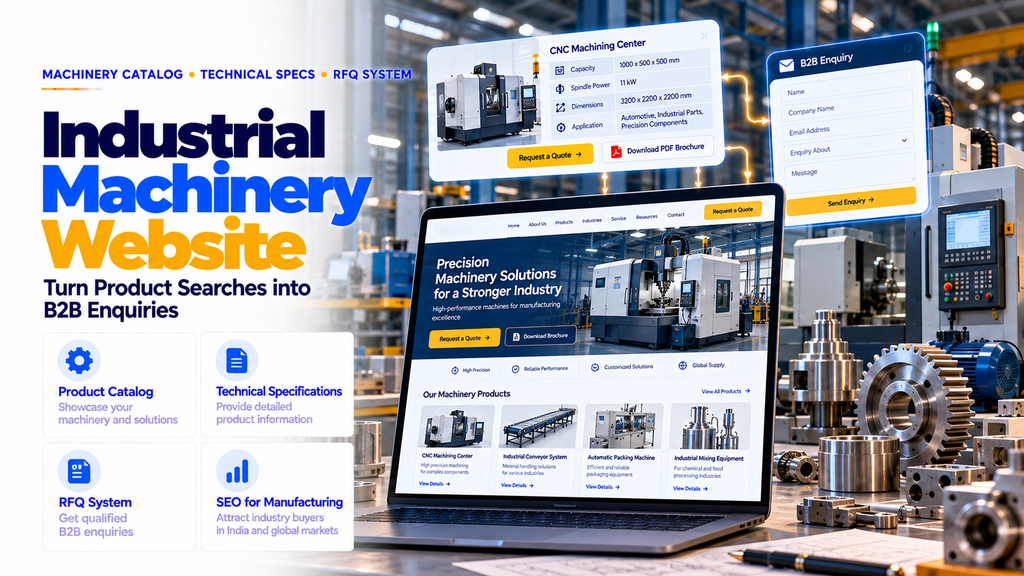
An industrial machinery manufacturer website should include a detailed machinery catalog, individual equipment pages, technical specification tables, downloadable brochures, genuine factory information, product videos, Request for Quotation (RFQ) forms, industrial SEO, mobile-responsive design and enquiry tracking. These features help buyers evaluate machinery and contact the manufacturer more efficiently.
This guide explains the important website features, recommended page structure, industrial SEO strategies, lead generation systems and development considerations for machinery manufacturers in Erode and Tamil Nadu.
1. What Is an Industrial Machinery Manufacturer Website?
An industrial machinery manufacturer website is a business website designed to present machinery products, engineering capabilities, technical specifications and supplier information to potential customers.
Unlike a general corporate website, an industrial website often needs to answer detailed product and application questions.
It may also support quotation requests, brochure downloads, product comparisons and after-sales service enquiries.
2. Why Machinery Manufacturers in Erode Need a Professional Website
Industrial buyers may research several equipment suppliers before contacting a manufacturer.
A well-structured website helps them understand:
- Which machinery models are available
- What each machine is designed to do
- Important technical specifications
- Production or operating capacity
- Customization options
- Installation and service support
- How to request a quotation
A website can support business discovery and enquiries, although it cannot guarantee sales or search rankings.
3. Industries That Benefit From Machinery Website Development
Industrial website development can support businesses manufacturing or supplying:
- Textile machinery
- Garment production machinery
- Food processing equipment
- Packaging machinery
- Agricultural machinery
- CNC and machining equipment
- Industrial automation systems
- Material handling equipment
- Pumps, motors and compressors
- Special-purpose machines
- Industrial fabrication equipment
- Spare parts and engineering components
4. Industrial Website vs Regular Business Website
| Feature | Regular Business Website | Industrial Machinery Website |
|---|---|---|
| Product details | Basic descriptions | Technical specifications and applications |
| Catalog | Simple product listing | Category and model-based machinery catalog |
| Enquiry form | General contact form | Machine-specific RFQ form |
| Downloads | Optional | Brochures, datasheets and manuals where appropriate |
| Buyer journey | General information | Technical evaluation and quotation |
| SEO | Broad service keywords | Machine, application and manufacturer keywords |
5. Understand the Industrial B2B Buying Process
Industrial machinery purchasing often involves multiple stages.
- Identifying a production requirement
- Researching suitable equipment
- Comparing technical specifications
- Reviewing manufacturers
- Requesting quotations
- Clarifying customization and installation needs
- Evaluating commercial terms
- Finalizing the purchase
Your website should help buyers complete the early research and enquiry stages without unnecessary difficulty.
6. Build a Professional Industrial Homepage
The homepage should immediately explain what the company manufactures.
Include:
- Clear company positioning
- Main machinery categories
- Manufacturing capabilities
- Relevant industry applications
- Genuine factory photographs
- Featured machinery models
- Prominent Request a Quote button
Avoid generic slogans that do not describe the actual products or services.
7. Create a Detailed Machinery Product Catalog
A machinery catalog helps buyers browse equipment by product category, machine type or application.
Useful catalog features include:
- Machinery category pages
- Individual machine model pages
- Product images
- Technical specifications
- Product filters
- Downloadable datasheets
- Enquiry buttons
8. Create Individual Machinery Product Pages
Important machinery models should have dedicated pages with original and accurate information.
For example, a packaging machinery manufacturer may organize its products by machine function and model.
Each page should explain what the machine does, its intended applications, its specifications and how buyers can request more information.
9. Add Detailed Technical Specification Tables
Technical specifications are among the most valuable elements of a machinery website.
Depending on the equipment, relevant fields may include:
- Model number
- Production capacity
- Motor power
- Operating voltage
- Machine dimensions
- Machine weight
- Material compatibility
- Operating speed
- Automation level
- Required utilities
Use verified specifications for each machine model.
10. Example Machinery Specification Table
| Specification | Information to Display |
|---|---|
| Machine model | Manufacturer’s official model number |
| Application | Intended industrial use |
| Capacity | Verified production or processing capacity |
| Power | Actual electrical requirements |
| Dimensions | Length, width and height |
| Weight | Verified machine weight |
| Automation | Manual, semi-automatic or automatic |
| Customization | Available configuration options |
This table illustrates the recommended data structure. Actual specifications must come from the manufacturer.
11. Include Machinery Application Details
Buyers often search by application rather than machine model.
A machinery page should explain:
- Which processes the equipment supports
- Which materials it can handle
- Relevant production environments
- Compatible product types
- Operating limitations
This information can help visitors determine whether the equipment fits their requirements.
12. Add Machinery Product Photographs
Clear product photographs help buyers evaluate machine design and configuration.
Useful views include:
- Front view
- Side view
- Control panel
- Important components
- Installed machine
- Relevant accessories
Use original or properly licensed images that accurately represent the equipment.
13. Add Product Demonstration Videos
Demonstration videos can help visitors understand how equipment operates.
Videos may show:
- Machine operation
- Product processing
- Control interface
- Output handling
- General machine capabilities
Provide appropriate safety context and avoid showing unsafe operating practices.
14. Offer Downloadable Machinery Brochures
Industrial purchasing teams may need product documents for internal evaluation.
Useful downloads include:
- Product brochures
- Technical datasheets
- Dimension drawings
- General product catalogs
- Approved technical documentation
Keep documents current and distinguish preliminary specifications from finalized product information.
15. Add Request for Quotation Forms
An RFQ system allows buyers to communicate machinery requirements clearly.
Possible fields include:
- Buyer name
- Company name
- Business email
- Contact number
- Location
- Machinery model
- Required capacity
- Quantity
- Application details
- Customization requirements
- Additional comments
Collect only information that is necessary for responding to the enquiry.
16. Use Machine-Specific RFQ Buttons
Every important machinery product page should provide a clear enquiry option.
For example:
- Request a Quote
- Ask About This Machine
- Request Technical Details
- Discuss Customization
Preselect the relevant machine in the enquiry form so buyers do not need to re-enter the model name.
17. Add Custom Machinery Enquiry Forms
Some manufacturers develop special-purpose machines based on customer requirements.
A custom machinery enquiry form may request:
- Application or process
- Material type
- Required output
- Available installation space
- Automation requirements
- Relevant technical constraints
Any technical file uploads should use secure validation, file-type restrictions and access controls.
18. Build a Machinery Comparison Feature
Manufacturers offering multiple models may benefit from a comparison tool.
Buyers could compare:
- Machine capacity
- Power requirements
- Dimensions
- Applications
- Automation level
- Available features
Only compare specifications using verified data.
19. Add Product Search and Filters
Large machinery catalogs should be easy to navigate.
Useful filters may include:
- Machinery category
- Application
- Capacity range
- Automation type
- Model series
For SEO, carefully manage filter-generated URLs to avoid unnecessary duplicate pages.
20. Create a Manufacturing Capabilities Page
A capabilities page helps buyers understand what the manufacturer can produce.
It may include:
- Engineering capabilities
- Production processes
- Assembly facilities
- Quality inspection procedures
- Customization services
- Relevant manufacturing equipment
Publish accurate descriptions supported by the company’s actual operations.
21. Add a Factory Infrastructure Page
Original factory photographs can help potential customers understand the business.
Useful content includes:
- Manufacturing facility overview
- Production areas
- Assembly facilities
- Inspection equipment
- General infrastructure information
Do not publish confidential customer projects or restricted facility information without permission.
22. Explain Quality Control Processes
Industrial buyers may want to understand how machinery is inspected before delivery.
Where applicable, explain:
- Material inspection
- Component inspection
- Assembly checks
- Performance testing
- Final inspection
- Documentation practices
Describe actual processes, not unsupported claims.
23. Display Certifications Responsibly
Relevant certifications may support buyer evaluation.
However, businesses should display only certifications they genuinely hold.
Provide accurate information about certification scope and validity.
Do not use unauthorized logos or imply certifications cover machinery models outside their scope.
24. Create an Industries Served Page
A manufacturer may supply equipment to several industries.
An Industries Served page can help visitors navigate to relevant machinery.
Possible categories include textiles, food processing, packaging, agriculture and engineering, depending on actual capabilities.
Link each industry section to relevant product and application pages.
25. Add Installation and Commissioning Information
Industrial machinery purchases may require installation and commissioning support.
If offered, explain:
- Installation assistance
- Commissioning services
- Operator training
- Documentation provided
- Service coverage areas
Clearly distinguish standard inclusions from separately quoted services.
26. Add After-Sales Service Information
Buyers may evaluate after-sales support before choosing a manufacturer.
Where applicable, describe:
- Maintenance support
- Spare parts availability
- Warranty terms
- Service request process
- Support contact details
Avoid promising response times or service coverage that cannot be fulfilled.
27. Create a Spare Parts Enquiry System
Manufacturers supplying replacement components may benefit from a separate spare parts enquiry form.
Useful fields include:
- Machine model
- Part number
- Required quantity
- Customer contact information
- Relevant part details
Ensure submitted information reaches the appropriate support team.
28. Add an Industrial Project Portfolio
Where customers have granted permission, manufacturers may showcase completed projects.
Useful case study information includes:
- Industry
- Customer requirement
- Equipment supplied
- Engineering approach
- Verified project outcomes
Do not fabricate client names, results or testimonials.
29. Create an Industrial Blog and Knowledge Center
Technical educational content can help potential buyers research machinery requirements.
Useful topics may include:
- How to select industrial machinery capacity
- Factors to consider before buying packaging equipment
- Automatic vs semi-automatic machinery
- Important questions to ask machinery suppliers
- How to compare machinery specifications
Technical information should be reviewed by someone qualified to verify its accuracy.
30. Industrial Machinery SEO: Why It Matters
Search engine optimization helps search engines discover and understand relevant website content.
For machinery manufacturers, SEO should focus on actual products, industrial applications and buyer search intent.
Technical SEO, original product information and clear website navigation form an important foundation.
31. Industrial Machinery Keyword Research
Potential keyword patterns include:
- Machine name + manufacturer
- Equipment type + supplier
- Industrial machine + Erode
- Machine application + manufacturer India
- Automatic + machine category
- Custom machinery manufacturer
These are keyword patterns rather than verified search-volume recommendations.
32. Local SEO for Machinery Manufacturers in Erode
Businesses with eligible customer-facing locations can maintain accurate Google Business Profiles.
Important information may include:
- Real business name
- Correct address
- Relevant business category
- Contact information
- Business hours
- Genuine facility photographs
Follow Google’s eligibility requirements. A factory or warehouse is not automatically eligible for every type of local business listing.
33. Target Relevant Industrial Areas
Machinery businesses in Erode may serve customers in areas such as:
- Erode
- Perundurai
- Chennimalai
- Bhavani
- Gobichettipalayam
- Anthiyur
- Sathyamangalam
- Tiruppur
- Coimbatore
- Salem
Explain genuine service coverage accurately. Do not create fake branch pages or Google Business Profiles for locations where the business does not operate.
34. Optimize Machinery Product Titles
Product titles should describe the actual equipment.
For example:
Automatic Packaging Machine – Technical Specifications and RFQ
Use the real product name, model and relevant terminology.
Avoid keyword stuffing or making unsupported performance claims.
35. Write Original Machinery Product Descriptions
Product descriptions should explain:
- Machine purpose
- Applications
- Important features
- Available configurations
- Technical requirements
- Relevant limitations
Original descriptions based on verified product information are generally more useful than repeated generic text.
36. Optimize Product Images for Search
Use meaningful image filenames and alt text.
Example filename:
automatic-packaging-machine-front-view.webp
Example alt text:
Front view of an automatic packaging machine showing its control panel and conveyor assembly.
Describe what the image actually shows.
37. Use Appropriate Structured Data
Relevant structured data may include:
- Organization
- Product
- BreadcrumbList
- Article
Structured data should accurately represent visible page content.
Google’s supported search features have specific eligibility requirements. Adding schema does not guarantee rich results or improved rankings.
38. Build a Logical Website URL Structure
A manufacturer website may use a structure such as:
example.com/
example.com/machines/
example.com/machines/packaging/
example.com/machines/packaging/model-a/
example.com/industries/
example.com/about/
example.com/request-quote/
These are illustrative URLs.
Choose a structure that supports navigation, maintainability and clear internal linking.
39. Improve Internal Linking
Useful internal links may connect:
- Homepage to machinery categories
- Category pages to machine models
- Product pages to relevant applications
- Application pages to related equipment
- Technical articles to relevant machinery
- Product pages to RFQ forms
40. Make the Website Mobile Responsive
Industrial buyers may research suppliers on mobile phones before reviewing technical details on desktop computers.
Ensure the website provides:
- Readable specifications
- Responsive product images
- Usable navigation
- Accessible enquiry forms
- Clickable contact information
- Downloadable documents
41. Optimize Website Loading Speed
Industrial websites often contain large product photographs, technical drawings and videos.
Useful optimization practices include:
- Appropriate image compression
- Modern image formats
- Lazy loading for suitable images
- Efficient video embedding
- Reduced unnecessary scripts
- Reliable hosting
- Core Web Vitals monitoring
42. Implement Website Security
Machinery enquiries may contain confidential technical and commercial information.
Important security measures include:
- HTTPS
- Server-side form validation
- Secure file uploads
- Role-based admin access
- Software updates
- Backup procedures
- Appropriate data retention policies
43. Add an Admin Product Management Panel
A content management system can help manufacturers maintain their catalogs.
Possible admin features include:
- Add and edit machinery
- Manage product categories
- Update specifications
- Upload product photographs
- Manage brochures
- Update SEO metadata
- Review website enquiries
44. Build an RFQ Management Dashboard
An enquiry dashboard can help sales teams manage quotation requests.
Possible fields include:
- Enquiry reference number
- Customer company
- Machinery model
- Required quantity
- Enquiry date
- Assigned salesperson
- Quotation status
- Follow-up date
Restrict access to authorized staff.
45. Integrate the Website With CRM Software
CRM integration can help sales teams organize enquiries and follow-ups.
For example, a typical enquiry may move through these stages:
- New enquiry
- Technical requirement review
- Sales discussion
- Quotation preparation
- Quotation sent
- Follow-up
- Won or lost
46. Use Automated Enquiry Notifications
Notifications can help the appropriate sales team identify new enquiries.
Possible channels include:
- Email alerts
- Admin notifications
- CRM notifications
- Approved business messaging integrations
Protect sensitive customer information in notification messages.
47. Track Machinery Website Leads With GA4
Google Analytics 4 can help measure configured website events.
Useful events may include:
- Successful RFQ submission
- Contact form submission
- Product brochure download
- Phone link click
- WhatsApp link click
- Service enquiry submission
A click is not automatically a confirmed lead or sale.
48. Use Google Tag Manager for Conversion Tracking
Google Tag Manager can help configure website event tracking.
For example, after a successful RFQ submission, a website may send a GA4 generate_lead event.
Do not send customer names, email addresses, phone numbers or confidential technical requirements to GA4.
49. Use Google Search Console for Industrial SEO
Google Search Console helps website owners monitor search visibility and indexing.
Useful reports include:
- Search performance
- Product page indexing
- Search queries
- Clicks and impressions
- Canonical URL information
- Relevant technical issues
50. Measure Qualified B2B Enquiries
Not every enquiry represents a genuine purchasing opportunity.
Businesses can evaluate lead quality based on appropriate factors such as:
- Product relevance
- Technical requirement clarity
- Requested quantity
- Project timeline
- Business suitability
Combine website analytics with CRM records to understand actual enquiry outcomes.
51. Industrial Website Development for Textile Machinery
Textile machinery manufacturers may need specialized product information.
Depending on the machine, relevant details may include:
- Machine type
- Fabric or yarn compatibility
- Operating speed
- Production capacity
- Power requirements
- Automation options
- Maintenance requirements
Publish accurate model-specific specifications.
52. Industrial Website Development for Food Processing Equipment
Food processing machinery websites may need information about:
- Processing applications
- Product compatibility
- Capacity
- Construction materials
- Cleaning considerations
- Utility requirements
- Relevant compliance information
Only make hygiene, food-safety or regulatory compliance claims that are substantiated.
53. Industrial Website Development for Packaging Machinery
Packaging machinery suppliers may organize products by:
- Packaging application
- Machine type
- Compatible packaging materials
- Product dimensions
- Operating capacity
- Automation level
Detailed application information can help buyers identify relevant models.
54. Industrial Website Development for Automation Companies
Industrial automation companies may require websites that explain:
- Automation solutions
- Control system capabilities
- Integration services
- Relevant industries
- Project workflows
- Technical support
Case studies should use approved, accurate project information.
55. Machinery Catalog Website vs B2B Ecommerce Website
| Factor | Catalog + RFQ | B2B Ecommerce |
|---|---|---|
| Main purpose | Product information and quotations | Ordering and account management |
| Pricing | Often quotation-based | May support negotiated or account-specific pricing |
| Technical catalog | Yes | Yes |
| Online ordering | Not required | Can be supported |
| Customer accounts | Optional | Often useful |
| Complexity | Depends on catalog and RFQ scope | Typically more integration requirements |
56. Recommended Machinery Manufacturer Website Structure
- Home
- About Us
- Machinery Categories
- Individual Machinery Pages
- Industries Served
- Manufacturing Capabilities
- Factory Infrastructure
- Quality Assurance
- Projects or Case Studies
- Downloads
- After-Sales Support
- Blog or Resources
- Contact
- Request a Quote
- Privacy Policy
Use only the sections that match the company’s actual operations.
57. Common Machinery Website Development Mistakes
- Listing machines without specifications
- Using low-quality product photographs
- Publishing identical descriptions across products
- Omitting quotation buttons
- Providing outdated brochures
- Using incorrect technical data
- Ignoring mobile usability
- Failing to secure enquiry forms
- Not tracking successful enquiries
- Ignoring product page indexing
- Making unsupported certification claims
- Neglecting website maintenance
58. Industrial Machinery Website Development Checklist
- Identify target industries and buyers.
- Prepare the machinery product list.
- Organize equipment categories.
- Collect verified specifications.
- Prepare original product photographs.
- Create detailed machinery pages.
- Develop technical specification tables.
- Add brochure downloads.
- Configure RFQ forms.
- Build secure enquiry processing.
- Add manufacturing capability information.
- Provide accurate service details.
- Optimize website navigation.
- Implement mobile-responsive design.
- Improve website performance.
- Configure technical SEO.
- Set up Search Console.
- Configure GA4 conversion events.
- Test enquiry notifications.
- Train staff to update the catalog.
- Maintain product and business information.
59. How Much Does a Machinery Manufacturer Website Cost in Erode?
The cost depends on the required features and project scope.
Important factors include:
- Number of machinery products
- Technical specification complexity
- Product filtering
- RFQ forms
- Custom admin dashboard
- Brochure management
- CRM integration
- Multilingual requirements
- SEO scope
- Hosting and maintenance
A basic corporate machinery website and a custom B2B machinery catalog platform require different development effort.
Request a detailed quotation based on actual business needs.
60. How Long Does Machinery Website Development Take?
Development time depends on product count, design requirements, content availability, custom features and testing.
Technical specification preparation and product photography can significantly affect the schedule.
A clear requirements document can help organize development and approvals.
61. How to Choose a Machinery Website Development Company
Before selecting a developer, ask:
- Can the website manage detailed machinery specifications?
- Will each model have a dedicated page?
- Can customers request model-specific quotations?
- Can staff update products independently?
- Will the website be responsive?
- Will technical SEO be considered?
- Will lead tracking be configured?
- How will enquiry information be secured?
- What maintenance support is included?
62. Industrial Machinery Website Development Services in Erode
Industrial manufacturers and engineering businesses in Erode and nearby areas may require specialized website development.
Relevant solutions include:
- Machinery manufacturer websites
- Engineering company websites
- Industrial product catalogs
- Technical specification management
- RFQ management systems
- Industrial SEO
- Lead tracking integration
- Website maintenance
63. How Greap Technologies Can Help
Greap Technologies provides website development, custom software, SEO and digital growth solutions.
Industrial machinery manufacturers can discuss requirements for product catalog websites, technical specification pages, quotation systems, admin dashboards and search engine optimization.
The right solution depends on the machinery range, target buyers, product information and sales workflow.
Visit Greap Technologies to learn more about website and software development services.
Conclusion
Industrial machinery manufacturer website development in Erode should focus on helping buyers understand machinery capabilities, compare technical information and submit meaningful enquiries.
A professional industrial website combines detailed product pages, verified specifications, original images, RFQ functionality, technical SEO and reliable enquiry management.
For machinery manufacturers, engineering companies and industrial suppliers, the website should support the real purchasing process rather than function only as an online brochure.
Professional Industrial Website + Technical Machinery Catalog + Verified Specifications + RFQ System + Industrial SEO + Lead Tracking = A stronger foundation for B2B enquiries.
Need an Industrial Machinery Website in Erode?
Planning a professional website for your machinery manufacturing company, engineering business or industrial equipment supply operation?
Discuss your product catalog, technical specifications, quotation system and SEO requirements with Greap Technologies.
Discuss Machinery Website DevelopmentWebsite: www.greap.in
Phone: +91 70923 30168
Frequently Asked Questions About Industrial Machinery Website Development
1. What is an industrial machinery manufacturer website?
It is a business website designed to present machinery products, technical specifications, manufacturing capabilities and enquiry options to industrial buyers.
2. Why do machinery manufacturers need a website?
A professional website can help potential buyers discover equipment, review specifications and contact the manufacturer.
3. What features should a machinery website include?
Important features include machinery catalogs, model pages, specification tables, brochures, RFQ forms, mobile-responsive design and relevant SEO.
4. Can a machinery website generate B2B enquiries?
Yes. A discoverable and useful website can support enquiries, but the volume and quality of leads are not guaranteed.
5. What is a machinery RFQ system?
An RFQ system collects customer requirements so the manufacturer can prepare a suitable quotation.
6. Should each machine have a separate product page?
Dedicated pages are useful for important models when they provide accurate, meaningful specifications and product information.
7. Is industrial SEO important for manufacturers?
Industrial SEO can help search engines discover relevant machinery, manufacturer and application pages.
8. Can machinery websites include PDF brochures?
Yes. Downloadable brochures and datasheets can help purchasing teams evaluate equipment.
9. Can the website support custom machinery enquiries?
Yes. Custom forms can collect application, capacity and other relevant technical requirements.
10. Can GA4 track machinery quotation enquiries?
GA4 can measure correctly configured successful enquiry events. Actual qualified leads should also be reviewed through business records.
11. How much does machinery website development cost?
Costs depend on catalog size, specification complexity, custom features, integrations and maintenance requirements.
12. Can Greap Technologies help develop industrial machinery websites?
Industrial businesses can contact Greap Technologies to discuss website development, product catalogs, RFQ systems and SEO requirements.