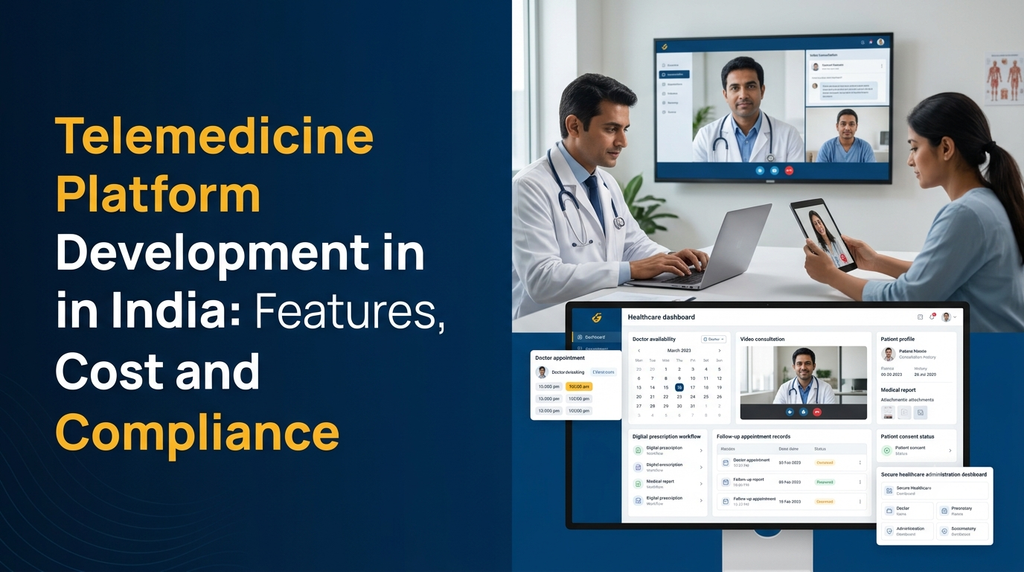
Telemedicine Platform Development in India: Features, Cost and Compliance
Telemedicine platform development involves building secure digital healthcare software that connects patients with registered medical practitioners through video, audio and text-based consultations. A custom platform can include appointment booking, doctor profiles, patient records, digital prescriptions, online payments, follow-up management and healthcare administration.
What Is a Telemedicine Platform?
A telemedicine platform is a web or mobile application that supports healthcare consultations when patients and medical practitioners are not physically present in the same location.
It uses communication technologies such as video calls, audio calls, messaging and secure document exchange to facilitate appropriate healthcare interactions.
Depending on the business model, a telemedicine platform may serve an individual clinic, a hospital network, a healthcare startup, a group of medical practitioners or a multi-provider healthcare marketplace.
Unlike a basic video-calling application, a healthcare consultation platform needs structured patient information, practitioner verification, consent records, appointment workflows, consultation documentation and suitable security controls.
Why Are Businesses Developing Telemedicine Platforms?
Healthcare organisations may introduce telemedicine to make selected consultation services accessible through digital channels and improve coordination between patients and medical practitioners.
Common business requirements include:
- Allowing patients to request appointments online.
- Providing remote consultations for appropriate cases.
- Managing doctor schedules and availability.
- Maintaining organised consultation records.
- Supporting follow-up appointments.
- Sharing relevant medical documents securely.
- Providing digital prescriptions where clinically and legally appropriate.
- Managing consultation fees and payment records.
- Coordinating doctors across multiple clinics or locations.
- Giving administrators operational reports and dashboards.
Telemedicine is not suitable for every medical situation. A registered medical practitioner must use professional judgment to determine whether remote consultation is sufficient or an in-person examination or referral is needed.
Types of Telemedicine Platforms
1. Doctor-to-Patient Consultation Platform
This model connects patients directly with registered medical practitioners. It may include doctor discovery, appointment booking, online consultation, payment and follow-up management.
2. Hospital Telemedicine Platform
Hospitals can use telemedicine software to coordinate remote consultations between patients and their existing doctors or specialists. It may connect with appointment systems, hospital administration and electronic medical records.
3. Multi-Doctor Healthcare Marketplace
A healthcare marketplace allows multiple verified practitioners to maintain profiles, availability and consultation schedules on one platform. Patients can select a suitable practitioner based on relevant information.
4. Clinic Teleconsultation System
Clinics can provide online follow-up consultations, appointment scheduling and patient communication using a dedicated web or mobile platform.
5. Specialist Consultation Platform
A specialist platform can connect patients with relevant specialists through appointment and consultation workflows. Clinical suitability and practitioner eligibility remain important considerations.
6. Doctor-to-Doctor Consultation Platform
Healthcare organisations can build systems that support professional discussions and referrals between registered medical practitioners, subject to appropriate patient consent, information sharing and professional responsibilities.
Essential Features of Telemedicine Platform Development
1. Patient Registration and Profile Management
Patients need a simple registration and account management process. The platform can maintain relevant details required for consultation and appointment administration.
- Patient registration and secure login.
- Basic personal profile.
- Contact information.
- Age and relevant identity details.
- Emergency contact information where appropriate.
- Consultation and appointment history.
- Medical information and report uploads.
- Account and privacy settings.
Collect only information necessary for the platform’s defined purposes. Avoid collecting unnecessary personal or medical information.
2. Doctor Registration and Verification
Doctor onboarding is a particularly important component of telemedicine platform development. A platform that lists registered medical practitioners should conduct due diligence before allowing them to provide consultations.
Doctor profiles can include:
- Doctor’s name and profile photograph.
- Medical qualification details.
- Specialisation information.
- State Medical Council or relevant registration details.
- Registration number and verification status.
- Clinic or hospital affiliation, where applicable.
- Professional contact information.
- Consultation availability.
An administrator can review submitted documents, verify registration information and approve eligible profiles before activation. Verification should not be treated as a one-time checkbox; the platform should support appropriate review and account-status management.
3. Doctor Search and Discovery
A patient-facing platform can provide search and filtering features to help users find available practitioners.
- Search by doctor’s name.
- Filter by speciality.
- View qualifications and registration details.
- View consultation modes.
- Check available appointment slots.
- View clinic or hospital affiliation.
- Display consultation fees where applicable.
Search results should present accurate practitioner information and should not make unsupported claims about medical outcomes or professional rankings.
4. Appointment Booking and Scheduling
Appointment management helps patients request consultations while allowing doctors and administrators to coordinate availability.
- Doctor-wise appointment calendars.
- Available time slots.
- Appointment booking and confirmation.
- Rescheduling and cancellation workflows.
- Follow-up appointment scheduling.
- Appointment reminders.
- Appointment status tracking.
- Doctor leave and availability management.
5. Video Consultation System
Video consultation is a major component of many telemedicine applications. It allows patients and doctors to communicate in real time when a visual interaction is appropriate.
Possible features include:
- Secure consultation-room access.
- Audio and video controls.
- Waiting-room functionality.
- Doctor and patient identity display.
- Connection-status indicators.
- Consultation start and end records.
- Technical support or reconnection workflow.
Video functionality can be implemented through a suitable real-time communication service or compatible video infrastructure. The platform should also support audio and text-based consultation workflows where appropriate.
Recording consultations should not be assumed to be necessary. Any recording feature needs a clearly defined purpose, suitable permissions, privacy safeguards and legal review.
6. Audio and Text-Based Consultation
Not every consultation requires a video call. Depending on the clinical context and professional judgment, the platform may support audio or text-based communication.
- Secure messaging.
- Audio consultation support.
- Document and image sharing.
- Consultation status updates.
- Follow-up communication records.
The system should allow practitioners to select an appropriate mode of consultation rather than forcing every interaction into a video call.
7. Medical History and Document Management
Doctors may need relevant medical history, previous reports or other supporting information to assess a consultation.
- Patient medical history.
- Previous consultation summaries.
- Laboratory and diagnostic reports.
- Uploaded medical documents.
- Consultation notes.
- Follow-up information.
- Document access permissions.
Access to medical information should be limited to authorised users. The platform should maintain suitable records of important access and document-related activities.
8. Digital Prescription Management
A telemedicine platform can provide a prescription workflow that allows an authorised registered medical practitioner to prepare and share an electronic prescription when appropriate.
Possible capabilities include:
- Doctor-created prescription records.
- Patient and consultation references.
- Medicine details entered by the practitioner.
- Dosage and usage instructions as determined by the practitioner.
- Doctor identification and registration details.
- Signed prescription document generation.
- Secure prescription delivery to the patient.
- Prescription history and record retention.
9. Online Payment and Billing
A platform may include a payment module to manage consultation charges and related transactions.
- Consultation fee configuration.
- Online payment gateway integration.
- Payment confirmation.
- Transaction history.
- Refund and cancellation records.
- Invoice and receipt generation.
- Doctor or clinic settlement reports.
Payment gateway charges, settlement terms, refunds and taxation should be handled according to the selected provider and business arrangement.
10. Notifications and Reminders
Automated communication can help patients and doctors stay informed about appointment activities.
- Appointment confirmation.
- Upcoming consultation reminders.
- Doctor schedule changes.
- Payment status notifications.
- Consultation completion updates.
- Prescription availability alerts.
- Follow-up reminders.
Notifications may use email, SMS or supported messaging APIs. Avoid displaying sensitive medical information in notification previews unless there is a justified need and appropriate protection.
11. Follow-Up Consultation Management
Follow-up management helps practitioners and patients organise continuing consultation activities.
- Previous consultation references.
- Follow-up appointment scheduling.
- Doctor notes and instructions.
- Relevant report attachments.
- Consultation history.
- Follow-up status tracking.
12. Admin Dashboard
A central administrator dashboard helps healthcare organisations manage platform operations.
- Patient account management.
- Doctor onboarding and verification.
- Appointment administration.
- Consultation activity records.
- Payment and transaction reports.
- Support and grievance management.
- Role and permission management.
- System configuration.
- Operational reports and analytics.
Important User Roles in a Telemedicine Platform
| User role | Main responsibilities |
|---|---|
| Patient | Manage profile, request appointments, attend consultations and access permitted records. |
| Registered Medical Practitioner | Review patient information, conduct appropriate consultations, document decisions and manage prescriptions. |
| Clinic Staff | Coordinate appointments and authorised administrative activities. |
| Platform Administrator | Manage users, doctor verification, platform settings and operational reports. |
| Support Team | Handle technical enquiries and platform-related complaints within assigned permissions. |
| Pharmacy Partner | Participate in permitted prescription-related workflows where properly integrated and authorised. |
How a Telemedicine Consultation Workflow Works
A typical patient-to-doctor consultation workflow may follow these steps:
- Patient registration: The patient creates an account and provides the information needed for the service.
- Doctor selection: The patient views available registered practitioners and relevant profile details.
- Appointment request: The patient selects an available slot and submits a booking request.
- Payment: Where applicable, the patient completes the consultation payment.
- Consent and identification: The required patient identification and consent steps are recorded.
- Consultation: The doctor reviews the information and chooses an appropriate communication mode.
- Clinical assessment: The practitioner decides whether remote consultation is sufficient or further examination is required.
- Documentation: Relevant consultation notes, reports and records are maintained.
- Prescription or referral: Where appropriate, the practitioner provides a prescription, advice or referral.
- Follow-up: The patient can access permitted records and request a suitable follow-up appointment.
Telemedicine Platform Development Architecture
A custom platform can be organised into separate application layers. This helps development teams manage patient interactions, doctor workflows, business logic, communication services and healthcare records.
Frontend Applications
- Patient mobile application.
- Doctor web dashboard.
- Doctor mobile application where required.
- Administrator web dashboard.
- Clinic or hospital staff portal.
Backend Application
- User authentication and permissions.
- Appointment and scheduling logic.
- Doctor verification workflow.
- Consultation management.
- Prescription records.
- Payment and billing services.
- Notifications and reporting.
- Audit and activity logging.
Database and File Storage
The database can maintain patient profiles, doctor information, appointments, consultation references, payment records and application settings. Medical documents should be stored through appropriately protected file storage with controlled access.
Communication Infrastructure
Video, audio and messaging functionality can be connected through suitable communication services. The selected provider should be evaluated for security, availability, supported features, data processing terms and operational cost.
Recommended Technology Stack
| Technology layer | Possible technologies | Purpose |
|---|---|---|
| Web frontend | React or Next.js | Doctor, clinic and administration dashboards. |
| Mobile applications | Flutter or native Android/iOS | Patient and doctor mobile experiences. |
| Backend | Laravel or Node.js | Business logic, APIs and workflows. |
| Database | PostgreSQL or MySQL | Structured application records. |
| Real-time communication | WebRTC or a suitable video communication provider | Video and audio consultations. |
| File storage | Secure object storage | Medical reports and authorised documents. |
| Notifications | Email, SMS and messaging APIs | Appointment and platform updates. |
| Payments | Compatible payment gateway | Consultation fees and transaction records. |
The final stack should be selected according to expected traffic, application complexity, integration needs, maintenance capability and data protection requirements. Technology selection alone does not establish healthcare regulatory compliance.
Telemedicine Platform Compliance in India
Compliance is a core part of telemedicine platform planning. A software developer should understand the technical requirements, while the healthcare organisation and qualified legal or regulatory advisers should review the actual service model and professional responsibilities.
1. Telemedicine Practice Guidelines, 2020
India’s Telemedicine Practice Guidelines, issued on 25 March 2020, provide a framework for registered medical practitioners delivering healthcare through digital communication technologies.
The guidelines address important matters such as:
- Registered medical practitioner responsibilities.
- Patient and practitioner identification.
- Appropriateness of the communication mode.
- Patient consent.
- Patient evaluation and management.
- Privacy and confidentiality.
- Digital consultation records.
- Prescription requirements.
The platform should provide workflows that help practitioners follow the applicable requirements. A software feature alone cannot guarantee that a consultation is professionally or legally compliant.
2. Registered Medical Practitioner Verification
Technology platforms that enable patients to consult registered medical practitioners should conduct due diligence before listing practitioners. The guidelines specify displaying relevant practitioner information, including name, qualifications and registration number.
The platform should therefore include:
- Doctor document submission.
- Registration information capture.
- Verification and approval workflow.
- Practitioner name and qualification display.
- Registration number display.
- Account suspension and status management.
3. Patient Identification and Consent
Patient identification and consent should be considered in the consultation workflow. The Telemedicine Practice Guidelines distinguish between patient-initiated consultations and situations where another person initiates the consultation.
A platform can support:
- Patient identity information.
- Consent capture where required.
- Consent timestamps and consultation references.
- Records of the consent communication.
- Appropriate guardian or adult involvement where applicable.
The system should not assume that a generic website terms-and-conditions checkbox automatically satisfies every consultation consent requirement.
4. Prescription and Medicine Restrictions
Digital prescription functionality must follow the applicable Telemedicine Practice Guidelines and relevant medicines laws. The platform should implement appropriate prescription controls and restrictions rather than allowing unrestricted medicine selection or automatic prescribing.
The registered medical practitioner remains responsible for professional judgment and the prescription. Where a prescription is transmitted to a pharmacy, the applicable patient-consent requirements must also be considered.
5. Digital Consultation Records
The guidelines require registered medical practitioners to maintain appropriate records of telemedicine interactions and relevant patient information used during consultations.
A suitable platform should support:
- Consultation date and time.
- Patient and practitioner references.
- Communication and interaction logs.
- Consultation notes.
- Reports and supporting documents.
- Prescription records.
- Access and activity logs.
Retention periods and access policies should be established with reference to the applicable legal and professional requirements. Avoid assuming that every type of healthcare record has one universal retention period.
6. Digital Personal Data Protection Act and Rules
The Digital Personal Data Protection Act, 2023 and Digital Personal Data Protection Rules, 2025 are important considerations for digital healthcare platforms handling personal information.
The platform’s data protection design should consider:
- Clear privacy notices.
- Purpose-based data collection.
- Appropriate consent and lawful processing arrangements.
- Access controls and data security.
- Data retention and deletion policies.
- Processes for handling data principal requests.
- Personal data breach response.
- Third-party processor and vendor arrangements.
The DPDP Rules have a phased commencement schedule. The applicable obligations and effective dates should be checked against the official Gazette when planning or launching a platform. Organisations should prepare their privacy and security systems ahead of the relevant commencement dates rather than waiting until the final stage.
7. Ayushman Bharat Digital Mission (ABDM)
Organisations considering participation in India’s digital health ecosystem may evaluate relevant Ayushman Bharat Digital Mission capabilities.
Depending on the intended use case and eligibility, integration planning may consider:
- ABHA-related workflows.
- Health facility and healthcare professional records.
- Health information exchange.
- Digital health record interoperability.
- Applicable ABDM specifications and consent arrangements.
ABDM integration is not an automatic feature of every telemedicine application. It requires an assessment of the organisation’s role, onboarding requirements, supported interfaces and applicable technical specifications.
8. AI and Automated Healthcare Features
AI may support administrative work such as appointment coordination, document organisation and non-clinical assistance. However, the Telemedicine Practice Guidelines state that AI/ML technology platforms cannot independently counsel patients or prescribe medicines.
The final clinical counselling and prescription must be delivered directly by the registered medical practitioner. Any decision-support functionality should be designed around appropriate professional oversight, validation and applicable rules.
Security Requirements for Telemedicine Software
Telemedicine platforms may process personal information, consultation notes, medical documents, prescription records and other confidential information. Security should be included in the architecture from the beginning.
Important security controls include:
- HTTPS and secure communication channels.
- Secure authentication and password storage.
- Role-based access control.
- Multi-factor authentication for appropriate accounts.
- Server-side permission validation.
- Secure storage of medical documents.
- Encryption of sensitive information where appropriate.
- Audit logs for important user activities.
- Database backup and recovery procedures.
- Secure API authentication and access restrictions.
- Vulnerability assessment and software updates.
- Incident response and breach-management procedures.
Access should follow the principle of least privilege. For example, a support employee who handles appointment problems should not automatically receive unrestricted access to a patient’s medical history.
Integrations for a Telemedicine Platform
Integrations can connect the telemedicine platform with external services and existing healthcare systems.
Payment Gateway Integration
Supports consultation fee collection, transaction records, payment confirmation and refund workflows.
Pharmacy Integration
Where permitted and properly authorised, the platform can connect prescription-related workflows with pharmacy systems. Prescription transmission and dispensing must follow applicable requirements.
Laboratory and Diagnostic Integration
Suitable integrations can support diagnostic appointment references, report exchange and authorised document access.
Hospital Management System Integration
A hospital platform may connect telemedicine workflows with appointment management, patient administration or existing health record systems. Data mapping and access permissions should be carefully planned.
ABDM and Health Data Interoperability
Relevant health data interoperability capabilities may be considered based on the intended ABDM use case, supported specifications and onboarding requirements.
Telemedicine Platform Development Cost in India
The cost of telemedicine software development depends on the number of applications, user roles, video infrastructure, healthcare workflows, integrations, security requirements and expected scale.
The following are illustrative custom development planning estimates in India. They are not fixed Greap quotations or guaranteed market prices.
| Development scope | Illustrative cost estimate |
|---|---|
| Basic doctor listing and appointment booking website | ₹35,000–₹60,000 |
| Patient registration and doctor administration platform | ₹50,000–₹90,000 |
| Platform with video consultation integration | ₹75,000–₹1,30,000 |
| Patient portal, doctor dashboard and prescription workflow | ₹90,000–₹1,60,000 |
| Complete telemedicine web platform with admin panel | ₹1,20,000–₹2,50,000+ |
| Telemedicine platform with Android and iOS applications | ₹2,00,000–₹4,50,000+ |
| Advanced multi-provider healthcare platform with integrations | ₹4,00,000–₹8,00,000+ |
These estimates describe different software scopes and should not be treated as interchangeable package prices. A detailed requirement specification is needed before preparing a project quotation.
Additional Costs to Consider
- Domain registration and hosting.
- Cloud infrastructure and database services.
- Video consultation service usage.
- Secure file storage and backups.
- SMS, email and messaging provider charges.
- Payment gateway transaction fees.
- ABDM or third-party integration work where applicable.
- Mobile application publishing and developer accounts.
- Security testing and compliance advisory.
- Data migration and external system integration.
- Taxes, maintenance and ongoing technical support.
How Long Does Telemedicine Software Development Take?
Development time depends on the selected modules, the complexity of consultation workflows, integration requirements and testing scope. A smaller appointment and consultation platform can be developed in fewer phases than a multi-provider healthcare ecosystem.
A typical project can be divided into these stages:
- Requirement analysis: Define the business model, healthcare workflows and user roles.
- UI/UX design: Plan patient, doctor and administrator experiences.
- Architecture planning: Design the backend, database, communication and security layers.
- Core development: Build registration, scheduling, consultation and administration modules.
- Integration: Connect selected video, payment, messaging and healthcare services.
- Security and quality testing: Test access permissions, data handling, workflows and application reliability.
- Deployment: Configure infrastructure, publish applications where required and prepare operational documentation.
Regulatory review, doctor verification arrangements and operational readiness should be considered alongside technical development, not postponed until after launch.
How to Choose a Telemedicine Software Development Company
Selecting a development partner is an important decision because the application handles confidential information and supports healthcare workflows.
- Healthcare workflow understanding: Check whether the team understands appointments, consultations, doctor verification and prescription records.
- Security architecture: Ask how authentication, access permissions, backups and audit logs will be implemented.
- Regulatory awareness: Discuss how the software will support applicable telemedicine and data protection requirements.
- Integration capability: Identify the exact video, payment, messaging and healthcare integrations required.
- Mobile experience: Review patient and doctor usability on common mobile devices.
- Scalability: Check how the application will handle additional doctors, patients and consultation activity.
- Documentation: Confirm that API documentation, deployment instructions and technical handover are included.
- Ownership: Clarify source-code ownership, hosting access, third-party subscriptions and maintenance responsibilities.
Telemedicine Platform Development in Tamil Nadu
Hospitals, clinics, specialist practices and healthcare startups across Tamil Nadu may consider telemedicine platforms to support appropriate remote consultation workflows.
Healthcare organisations in Erode, Coimbatore, Chennai, Salem, Tiruppur and other locations can plan a system around their existing consultation model, practitioner network and patient requirements.
A local clinic may begin with online appointments and doctor dashboards. A hospital group may need multiple departments, patient records, administration and integration with existing systems. A healthcare technology startup may require a multi-provider platform with separate patient, doctor and administrator applications.
The software should be designed around the actual healthcare service model rather than adding every available feature to the first release.
Why Consider Custom Telemedicine Software from Greap Technologies?
Greap Technologies provides website development, software development and digital growth solutions for businesses. A custom telemedicine platform can be planned around the requirements of clinics, hospitals and healthcare technology businesses.
Depending on the project scope, a solution can include:
- Patient registration and profile management.
- Doctor onboarding and verification workflows.
- Appointment booking and scheduling.
- Video, audio and text consultation integration.
- Medical document management.
- Doctor-controlled prescription workflows.
- Payment and billing integration.
- Patient and doctor dashboards.
- Administrator management panel.
- Reports, access controls and audit logs.
- Mobile applications and third-party integrations.
The recommended starting point is a detailed discussion of the healthcare service model, user roles, consultation process, data requirements, integrations and regulatory responsibilities. This helps define a realistic first development phase.
Frequently Asked Questions
1. What is telemedicine platform development?
Telemedicine platform development is the process of building web or mobile software that allows patients and registered medical practitioners to communicate remotely through appropriate digital consultation methods such as video, audio and text.
2. What features should a telemedicine application include?
Common features include patient registration, doctor verification, appointment booking, video consultations, medical document uploads, consultation records, prescriptions, payments, notifications and an administrator dashboard.
3. Is telemedicine legal in India?
India has Telemedicine Practice Guidelines issued on 25 March 2020 covering telemedicine practice by registered medical practitioners. Healthcare organisations and platforms must consider the applicable professional, prescription, privacy and other legal requirements.
4. Who can provide telemedicine consultations in India?
The applicable guidelines establish requirements for registered medical practitioners. Platforms that list practitioners should conduct appropriate due diligence and display relevant professional and registration information.
5. Can a telemedicine platform generate digital prescriptions?
Yes. A platform can support a digital prescription workflow, but prescribing decisions must remain with the authorised registered medical practitioner and follow the applicable medicine and prescription requirements.
6. Can a telemedicine application support video consultations?
Yes. Video consultation functionality can be implemented using suitable real-time communication technology or an external video service. Audio and text options may also be included.
7. How much does telemedicine software development cost in India?
The cost depends on the platform scope. A basic appointment and doctor management system may require a smaller budget, while video consultations, mobile applications, medical records, integrations and advanced security features increase development complexity and cost.
8. Does a telemedicine platform need a mobile application?
Not necessarily. A responsive web application may be suitable for an initial release. Dedicated Android and iOS applications can be added when mobile-specific workflows, notifications or user requirements justify them.
9. Can a telemedicine platform integrate with ABDM?
ABDM-related integration may be possible depending on the intended use case, eligibility, onboarding requirements and supported technical specifications. It should be planned as a separate integration workstream.
10. What is the role of the DPDP Act in telemedicine software?
The Digital Personal Data Protection Act, 2023 and its associated Rules are relevant to organisations processing personal digital data. Telemedicine platforms should plan for appropriate notices, processing purposes, consent arrangements, security, data retention and individual rights, taking account of the phased commencement schedule.
11. Can AI prescribe medicines in a telemedicine application?
The Telemedicine Practice Guidelines do not permit AI/ML technology platforms to independently counsel patients or prescribe medicines. Clinical counselling and prescriptions must be provided directly by the registered medical practitioner.
12. Can patients upload medical reports before a consultation?
Yes. A platform can allow patients to upload relevant reports and documents through a secure interface. Access should be restricted to authorised users and records should be managed according to applicable privacy and retention requirements.
13. Can one telemedicine platform support multiple hospitals?
Yes. A multi-organisation architecture can support separate hospitals, clinics, doctors and administrators while applying appropriate organisation-level data separation and access permissions.
14. Is telemedicine suitable for every medical condition?
No. The registered medical practitioner must decide whether the available information and consultation method are sufficient. If an in-person examination or urgent referral is needed, the patient should be directed to appropriate in-person care.
15. How long does it take to develop a telemedicine platform?
Development time depends on the number of applications, consultation workflows, integrations, security requirements and testing scope. A phased implementation can help launch essential functions before adding more advanced modules.
Planning a Custom Telemedicine Platform?
Build a digital healthcare platform with patient management, doctor dashboards, appointment booking, consultation workflows and secure administration features.
Contact Greap Technologies to discuss your healthcare software development requirements.
Website: www.greap.in
WhatsApp: Discuss Your Software Requirement
Call: 70923 30168