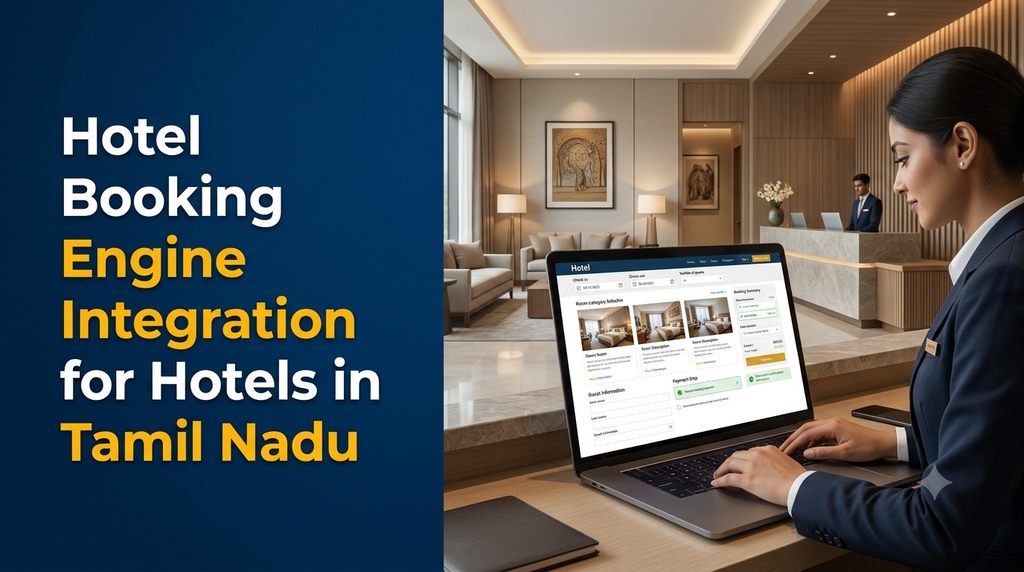
Hotel booking engine integration connects a hotel’s website to an online reservation system so visitors can check room availability, compare available room options, select their stay dates, enter guest details and make reservations directly. For hotels in Tamil Nadu, a properly integrated booking engine can provide a convenient direct booking channel while connecting reservation information with the hotel’s property management system (PMS), where supported.
Independent hotels, boutique properties, resorts and lodges can use a booking engine to accept reservations without requiring every guest to contact the front desk. The booking experience can be designed around the hotel’s room categories, rate plans, cancellation policies, payment methods and operational requirements.
Why Do Hotels Need a Website Booking Engine?
A hotel website may attract visitors through search engines, maps, social media, advertisements and referrals. However, visitors need a convenient way to check availability and reserve a room. If the website only displays a telephone number or enquiry form, the guest may need to wait for staff to confirm the reservation.
An online booking engine provides a structured reservation process. Depending on its configuration, it can allow visitors to:
- Select arrival and departure dates.
- Choose the number of guests and rooms.
- View available room categories.
- Compare room descriptions and included facilities.
- Review configured rates and booking conditions.
- Enter guest and contact information.
- Pay an advance or complete the configured payment process.
- Receive a booking reference and confirmation.
For the hotel team, the reservation can be transferred into the PMS or another operational workflow through a supported integration. This reduces the need to manually recreate every website booking.
Who Can Benefit from Hotel Booking Engine Integration?
Independent hotels
Independent hotels can offer direct reservations through their own websites and provide guests with a convenient alternative to telephone bookings.
Boutique hotels
Boutique properties can display distinctive room categories, photographs, facilities and packages through a booking experience that reflects their brand.
Resorts and holiday properties
Resorts may need to present accommodation packages, meal options, activity information and additional booking conditions alongside room availability.
Business hotels
Business accommodation providers can support date-based room searches, corporate rate plans and straightforward reservation confirmation.
Lodges and highway accommodation
Lodges can use a mobile-friendly booking experience for visitors searching for rooms while travelling. Simple date selection and clear contact information are particularly useful.
Small hotel groups
Hotel groups may require a central booking experience that lets visitors select a property, view its available room categories and complete a reservation under the correct property’s inventory.
Essential Features of a Hotel Website Booking Engine
1. Availability search
The availability search is the starting point of the booking process. Visitors should be able to select their travel dates and guest count without navigating complicated forms.
Typical search fields include:
- Check-in date.
- Check-out date.
- Number of adults.
- Number of children, where applicable.
- Number of rooms.
- Optional property or location selection for hotel groups.
The system should validate dates, occupancy limits and room availability before presenting booking options. It should also handle invalid date ranges and unavailable room categories with clear messages.
2. Room category and details display
After the visitor searches for availability, the booking engine should display suitable room categories with enough information to support an informed decision.
Each room listing may show:
- Room category and description.
- Room photographs.
- Maximum occupancy.
- Bed configuration.
- Facilities and amenities.
- Available rate plans.
- Included meals or services, where applicable.
- Cancellation and payment conditions.
Room photographs should be genuine and accurately represent the property. Room descriptions should explain meaningful differences between categories rather than repeat generic marketing language.
3. Rate plan and pricing management
Hotels may offer different rates depending on dates, occupancy, booking conditions and package inclusions. The booking engine should display the applicable rate and explain its conditions before the guest confirms.
Possible rate configurations include:
- Standard flexible rate.
- Non-refundable rate, with clearly displayed conditions.
- Breakfast-inclusive rate.
- Weekend rate.
- Seasonal pricing.
- Corporate or negotiated rate.
- Special packages and promotional offers.
- Extra guest charges.
The final price presentation should clearly identify applicable taxes, additional charges and payment requirements. Rate calculations should be consistent with the hotel’s configured pricing rules.
4. Guest information and booking form
Once a guest selects a room and rate plan, the system should collect the information needed to process the reservation.
A booking form may include:
- Guest name.
- Email address.
- Contact number.
- Guest count.
- Special requests.
- Billing information, where required.
- Acceptance of displayed booking terms.
Keep the form as short as practical. Collecting unnecessary information can make the booking process harder, particularly on mobile devices.
5. Booking summary and confirmation
Before payment or final confirmation, visitors should see a clear summary of their reservation.
The summary can display:
- Selected room category.
- Check-in and check-out dates.
- Number of nights.
- Guest count.
- Selected rate plan.
- Room charges.
- Applicable taxes and additional charges.
- Advance amount or total payment due.
- Cancellation and modification conditions.
After the booking is successfully confirmed, the system should generate a unique reservation reference. Confirmation should reflect the actual booking and payment status rather than treating a submitted form as a completed reservation.
6. Secure online payment integration
A hotel may require full payment, a fixed advance amount, a percentage deposit or payment at the property. These rules should be configurable according to the hotel’s reservation policy and supported payment provider.
Payment integration may support:
- UPI payments.
- Debit and credit cards.
- Net banking.
- Supported digital payment methods.
- Advance or deposit collection.
- Payment transaction references.
- Payment success, failure and pending status.
- Refund records where supported.
The booking engine should verify payment results through the provider’s trusted server-side notification or verification mechanism. A visitor returning to the website after payment should not, by itself, be treated as proof that the payment succeeded.
7. Booking modification and cancellation
Guests may need to change dates, room selections or booking details. The hotel should define which modifications are allowed online and which require staff approval.
Useful functions include:
- Reservation lookup using a booking reference and suitable verification.
- Modification request submission.
- Availability rechecking before date changes.
- Cancellation request processing.
- Cancellation policy display.
- Refund status tracking.
- Staff approval and audit records where necessary.
The booking engine should not promise a refund automatically unless the hotel policy and payment provider support that process. Refund eligibility and processing should follow the displayed terms.
How Hotel Booking Engine Integration Works
A booking engine can be connected to a hotel website and the hotel’s operational software through a defined integration. The exact workflow depends on whether the hotel uses a custom PMS, a third-party PMS or a channel manager.
- Guest visits the hotel website: The visitor opens the booking section on a desktop or mobile device.
- Dates and guest count are selected: The booking engine receives the search information.
- Availability is checked: The system retrieves available room options and applicable rates from its configured inventory source.
- Guest selects a room: The selected category, rate and booking conditions are displayed.
- Guest information is collected: The reservation form captures the necessary details.
- Payment is initiated: If required, the guest completes the configured payment process.
- Reservation is confirmed: The booking engine records the confirmed reservation after the required validation.
- Hotel system receives the booking: A supported PMS integration transfers the reservation details.
- Confirmation is sent: The guest receives a confirmation through the configured email or messaging provider.
- Hotel staff manage the stay: The reservation becomes available in the hotel’s operational workflow.
A reliable implementation should account for interrupted payment attempts, duplicate requests, delayed integration responses and temporary service failures. The system should use suitable booking references, transaction identifiers and retry handling to avoid duplicate or inconsistent records.
Hotel Booking Engine and PMS Integration
Connecting a booking engine to a hotel PMS helps reduce manual work between the guest-facing reservation process and internal hotel operations.
Depending on the supported API, the integration may exchange:
- Room categories and room identifiers.
- Room availability.
- Rate plans and pricing information.
- Reservation details.
- Guest contact information.
- Booking status and modifications.
- Cancellation information.
- Payment references and payment status.
Not every PMS exposes every field or supports real-time updates. Before development, the integration provider’s documentation, API access, rate limits, event notifications and commercial terms should be reviewed.
Booking Engine vs PMS vs Channel Manager
Hotels often use these terms together, but each system has a different responsibility.
| System | Primary purpose | Typical functionality |
|---|---|---|
| Booking Engine | Accept direct guest reservations | Website search, room selection, rates, guest forms and payment. |
| Hotel PMS | Manage internal hotel operations | Front desk, room allocation, check-in, check-out, housekeeping and billing. |
| Channel Manager | Distribute and synchronise inventory across connected channels | Availability, rates and reservation updates for supported booking channels. |
A hotel may use all three systems, or begin with a booking engine and PMS before introducing channel management. The best arrangement depends on the number of booking channels, operational complexity and integration availability.
Direct Booking Engine vs Online Travel Agency Reservations
Online travel agencies can help hotels reach customers through external booking platforms. A direct booking engine provides another route: guests can reserve through the hotel’s own website.
| Area | Direct website booking | OTA booking |
|---|---|---|
| Booking destination | Hotel’s own website | External travel platform |
| Brand experience | Controlled by the hotel website | Presented within the OTA’s platform |
| Guest journey | Designed around the hotel’s website | Follows the OTA’s booking process |
| Payment arrangement | Configured with the hotel’s payment and deposit policy | Depends on the OTA’s payment arrangement |
| Inventory updates | Through the booking engine’s configured inventory connection | Through the OTA connection or channel manager |
| Commercial charges | Payment provider and website operating costs may apply | OTA commission or other contractual charges may apply |
Direct booking and OTA distribution are not necessarily competing approaches. Many hotels use both. The important requirement is that availability and reservations remain consistent across connected systems.
Mobile-Friendly Booking Experience
Many visitors browse hotel websites on smartphones. The booking engine should therefore be designed for small screens from the beginning rather than simply shrinking a desktop interface.
Important mobile booking considerations include:
- Readable room photographs and descriptions.
- Easy-to-use date selection.
- Simple guest and room selection.
- Clearly displayed total price and booking conditions.
- Short forms with suitable mobile input types.
- Convenient payment flow.
- Visible confirmation and contact details.
- Fast loading and accessible navigation.
A mobile visitor should be able to understand the room options, payment requirements and cancellation policy without repeatedly zooming or navigating between unrelated pages.
Website and Marketing Integrations
A booking engine is most useful when it works with the hotel’s website and marketing measurement setup.
Hotel website integration
The booking experience can be embedded into the existing website, linked through a dedicated booking page or connected through a supported booking widget. The design should match the hotel’s brand and provide a consistent journey from room information to confirmation.
Search engine optimisation
The hotel’s website should have useful pages for room categories, property facilities, location information and booking guidance. Search engines should be able to understand the publicly accessible website content.
The booking process itself may include dynamic search results and availability data. Important hotel information should not exist only inside a form or an inaccessible booking interface.
Analytics and conversion tracking
Analytics tools can help hotel owners understand how visitors interact with the booking journey.
Possible events to measure include:
- Booking page view.
- Availability search submitted.
- Room category selected.
- Booking form started.
- Payment process initiated.
- Reservation confirmed.
- Booking cancellation, where measurable.
Tracking should avoid sending unnecessary personal or payment information to analytics platforms. Conversion reports should distinguish a completed reservation from a search or form submission.
Security and Reliability Considerations
An online booking engine handles guest details and reservation transactions. Security and reliability should be part of the initial design rather than treated as optional features after launch.
- HTTPS for secure communication.
- Server-side validation of reservation information.
- Secure payment provider integration.
- Verification of payment notifications.
- Protection against duplicate booking requests.
- Access control for hotel staff and administrators.
- Audit logs for booking and rate changes.
- Regular database backups.
- Monitoring of application errors and availability.
- Documented recovery and support procedures.
- Privacy-conscious handling of guest information.
The system should not store raw card details unless there is a specific, properly assessed requirement and compliant infrastructure. A suitable hosted or tokenised payment flow can reduce the handling of sensitive payment information by the hotel application.
Custom Booking Engine Development vs Ready-Made Integration
Hotels can choose between using an existing booking engine, integrating a third-party solution or developing a custom booking experience. The appropriate option depends on operational requirements, available integrations and long-term costs.
| Approach | Advantages | Considerations |
|---|---|---|
| Ready-made booking engine | May provide an established booking workflow and standard features. | Subscription fees, provider limitations and integration availability. |
| Third-party engine integrated into website | Can add booking capability without building every function from scratch. | Brand consistency, data exchange and provider dependency. |
| Custom booking engine | Greater control over user experience, booking rules and system integration. | Higher development responsibility, testing and maintenance needs. |
| Custom engine with PMS integration | Can align guest bookings with the hotel’s operational workflow. | Requires API compatibility, integration testing and ongoing support. |
A ready-made solution may be more practical for a hotel with standard requirements. Custom development is worth considering when the property needs a distinctive booking journey, specialised rate rules, custom integrations or control over its application workflow.
How Much Does Hotel Booking Engine Integration Cost in India?
The cost depends on whether the hotel needs a simple booking widget, a customised website booking flow, payment gateway connectivity, PMS integration or a more advanced multi-property reservation platform.
The following are illustrative planning estimates for custom development in India. They are not fixed quotations, guaranteed market prices or published Greap prices.
| Project scope | Illustrative estimate |
|---|---|
| Basic hotel website booking form and enquiry workflow | ₹20,000–₹35,000 |
| Room search, date selection and availability interface | ₹30,000–₹55,000 |
| Booking engine with room categories and rate plans | ₹45,000–₹80,000 |
| Booking engine with payment gateway integration | ₹55,000–₹95,000 |
| Booking engine connected to a compatible hotel PMS | ₹75,000–₹1.5 lakh+ |
| Advanced platform with booking management and channel connectivity | ₹1.5–₹3 lakh+ |
| Multi-property booking platform with advanced integrations | ₹3–₹6 lakh+ |
These estimates may change significantly based on third-party API access, provider documentation, integration complexity and the number of supported booking workflows. Payment gateway charges, channel manager subscriptions, PMS licensing, hosting, domain registration, SMS or WhatsApp messaging, email services, taxes, migration and maintenance may be additional.
Steps Involved in Hotel Booking Engine Integration
A structured development process helps identify integration issues before the system is made available to guests.
- Requirement analysis: Understand the hotel’s room categories, pricing rules, booking policies and reservation sources.
- System selection: Identify whether the project needs a third-party engine, custom booking engine or existing PMS integration.
- Integration review: Check API availability, authentication, supported data fields and provider limitations.
- Booking flow design: Plan search, room selection, guest details, payment and confirmation screens.
- Development: Implement the booking interface, reservation logic and required connections.
- Payment integration: Configure payment requests, server-side verification and transaction records.
- PMS synchronisation: Connect reservations and relevant inventory information through the supported integration.
- Testing: Test successful bookings, unavailable rooms, failed payments, duplicate requests, modifications and cancellations.
- Deployment: Configure production hosting, domain security, monitoring and backups.
- Ongoing maintenance: Review provider API changes, booking errors, performance and user feedback.
Hotel Booking Engine Integration for Hotels in Tamil Nadu
Hotels across Tamil Nadu serve different types of guests, including business travellers, families, tourists, event visitors and people travelling between cities. Their booking requirements can vary based on property location, room categories, seasonality and guest expectations.
Hotels in Erode, Perundurai, Bhavani, Gobichettipalayam, Sathyamangalam and nearby areas can consider a website booking engine that supports their actual reservation process. A small independent hotel may need a straightforward room search and advance payment flow, while a resort or multi-property business may require packages, multiple rate plans and more extensive integrations.
The booking experience should clearly present property location, room photographs, facilities, check-in and check-out policies, cancellation conditions and contact information. This helps visitors understand what they are booking before submitting their details.
For properties that receive bookings through several channels, inventory synchronisation becomes especially important. A suitable PMS or channel manager integration should be evaluated before the hotel accepts reservations from multiple connected sources.
Why Consider Hotel Booking Engine Development with Greap Technologies?
Greap Technologies provides website development, software development and digital growth services for businesses. Hotels planning a direct booking website or custom reservation platform can begin with a review of their current website, room categories, booking policies and operational software.
A hotel booking engine project can include:
- Responsive hotel website booking interface.
- Room category and availability display.
- Guest information and reservation forms.
- Rate plan and booking summary configuration.
- Payment gateway integration, where required.
- Compatible PMS integration, where supported.
- Booking notifications and confirmation workflow.
- Analytics and conversion tracking setup.
- Testing, deployment and maintenance planning.
Planning a Direct Booking System for Your Hotel?
Whether you manage an independent hotel, boutique property, lodge or resort, a well-planned booking engine can give guests a convenient way to reserve rooms through your website.
Discuss your hotel website and booking integration requirements with Greap Technologies.
Website: www.greap.in
WhatsApp: Chat with Greap Technologies
Call: 70923 30168
Frequently Asked Questions About Hotel Booking Engine Integration
1. What is a hotel booking engine?
A hotel booking engine is an online reservation system connected to a hotel’s website. It allows visitors to search for available rooms, select dates, enter guest details and complete a reservation through the configured booking process.
2. Why should a hotel integrate a booking engine into its website?
A booking engine gives visitors a direct way to check room availability and make reservations. It can reduce dependence on manual enquiry handling and connect website bookings to the hotel’s operational system where supported.
3. Can a hotel booking engine connect with an existing PMS?
Yes, if the PMS provides a supported API or integration method. The connection can exchange information such as room availability, rates and reservation details, depending on the provider’s capabilities.
4. What is the difference between a booking engine and a channel manager?
A booking engine accepts reservations through the hotel’s own website. A channel manager distributes and synchronises rates and availability across supported external booking channels. They may be connected to the same PMS.
5. Can guests pay online when booking a hotel room?
Yes. A booking engine can integrate with a supported payment gateway to collect full payment or an advance amount. Payment status should be verified through the payment provider before confirming the transaction.
6. Can a booking engine support UPI payments in India?
It can support UPI when the selected payment gateway and integration method provide that option. Availability depends on the payment provider, merchant configuration and supported transaction flow.
7. Can hotel owners manage room rates and availability?
Yes. Depending on the system design, authorised staff can manage room categories, rate plans, availability and booking restrictions through the PMS or connected administration interface.
8. Can a hotel booking engine work on mobile phones?
Yes. A responsive booking engine can support mobile browsers and adapt its search forms, room listings, booking summary and payment steps to smaller screens.
9. Can guests cancel or modify their reservations online?
Yes, if the hotel enables those features and defines the applicable policies. The system can provide a reservation lookup, modification request or cancellation workflow, subject to availability and booking conditions.
10. How much does hotel booking engine integration cost in India?
The cost depends on the booking features, payment gateway, PMS connectivity and other integrations. As an illustrative planning range, a basic custom booking interface may cost around ₹20,000–₹35,000, while an advanced integrated platform can require several lakh rupees.
11. How long does hotel booking engine development take?
A basic booking interface may take several weeks, while a custom booking engine with payment, PMS and channel manager integrations can take longer. The timeline depends on API access, integration complexity, testing and the final feature scope.
12. Can one booking engine support multiple hotel properties?
Yes. A multi-property booking engine can allow guests to select a property and search its room inventory. The platform needs property-specific room categories, rates, availability and reservation management.
13. Is a custom booking engine better than a ready-made solution?
Not in every case. A ready-made solution may be more economical for standard requirements. Custom development can be useful when a hotel needs specialised booking rules, a tailored user experience or integration with its existing software. Compare subscription, integration, maintenance and ownership costs before choosing.