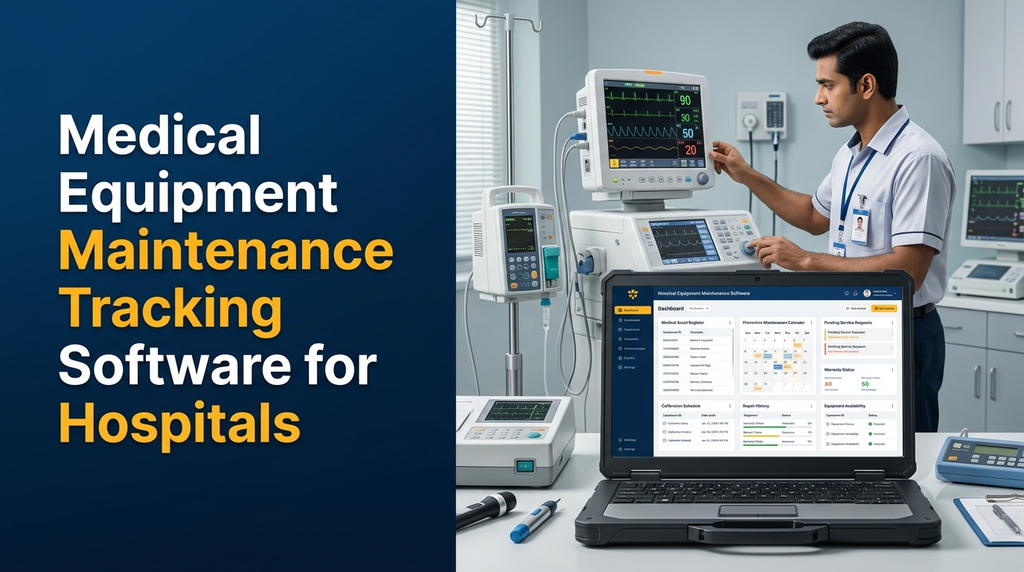
Medical equipment maintenance tracking software is a digital system that helps hospitals maintain medical asset records, schedule preventive maintenance, track repair requests, manage calibration dates, record service history and monitor equipment availability. It gives biomedical engineering teams and hospital administrators a central place to coordinate equipment maintenance activities.
Hospitals depend on a wide range of medical devices, diagnostic machines, monitoring equipment and supporting systems. Keeping these assets properly documented and maintained is important for operational continuity. When maintenance schedules are managed through separate spreadsheets, paper registers or disconnected applications, staff may find it difficult to identify upcoming service requirements and retrieve historical records.
A custom hospital equipment maintenance management system can organise these activities through asset registers, automated reminders, work orders, technician assignments and maintenance reports.
This guide explains the key features, modules, workflows, integrations, development process and estimated costs of medical equipment maintenance software for healthcare institutions in India.
What Is Medical Equipment Maintenance Tracking Software?
Medical equipment maintenance tracking software is a specialised asset and maintenance management application designed for healthcare environments. It records equipment information and coordinates planned and corrective maintenance activities throughout an asset’s operational lifecycle.
Depending on the hospital’s requirements, the system may manage:
- Medical equipment registration and asset identification.
- Equipment location and department assignment.
- Preventive maintenance schedules.
- Breakdown and repair requests.
- Technician assignment and work orders.
- Calibration and inspection records.
- Warranty and annual maintenance contract details.
- Spare parts and maintenance expenses.
- Equipment downtime and service history.
- Management dashboards and audit reports.
The system supports maintenance administration and documentation. It does not replace qualified biomedical engineers, manufacturer instructions, equipment validation or applicable clinical safety procedures.
Why Do Hospitals Need Equipment Maintenance Management Software?
1. Centralised equipment information
Hospitals may have equipment distributed across intensive care units, operating theatres, laboratories, diagnostic departments, emergency units and outpatient areas. A central asset register helps authorised staff identify equipment, ownership, location and service history.
2. Better preventive maintenance planning
Preventive maintenance schedules help teams plan inspections and servicing based on manufacturer guidance, institutional policies and applicable requirements. The software can generate reminders and show upcoming maintenance activities.
3. Organised repair requests
When a department reports a device issue, a maintenance request can be recorded with an asset reference, problem description, priority and current status. This creates a documented workflow instead of relying only on informal communication.
4. Improved service history tracking
Equipment records can maintain repair history, technician details, replaced parts, service documents and closure notes. This information helps authorised staff understand previous maintenance activity.
5. Warranty and AMC visibility
Warranty periods and annual maintenance contracts can be stored against individual assets. Reminders can help administrators review upcoming contract renewals and service obligations.
6. Better maintenance cost visibility
Maintenance expenses, spare parts, vendor invoices and service costs can be associated with equipment records. Management can review historical spending and plan future budgets.
Essential Features of Hospital Medical Equipment Maintenance Software
1. Medical equipment asset register
The asset register is the foundation of the application. It maintains a structured record for every equipment item included in the system.
- Unique equipment identification number.
- Equipment name and category.
- Manufacturer and model information.
- Serial number and asset tag.
- Purchase and installation dates.
- Supplier and service provider details.
- Department and current location.
- Warranty and contract information.
- Equipment status and supporting documents.
2. Department and location management
Equipment is often moved between departments or hospital locations. The software can maintain an assignment history showing where an asset is currently located and its previous recorded movements.
Possible locations include:
- Intensive care units.
- Emergency departments.
- Operation theatres.
- Diagnostic imaging departments.
- Laboratories.
- General wards.
- Outpatient departments.
- Biomedical engineering and maintenance areas.
3. Preventive maintenance scheduling
The preventive maintenance module helps teams plan recurring inspections and servicing. Schedules can be configured according to equipment requirements, manufacturer instructions and hospital policies.
- Equipment-wise maintenance plans.
- Scheduled maintenance dates.
- Recurring schedule configuration.
- Assigned technician or service provider.
- Inspection checklist references.
- Pending and completed maintenance records.
- Overdue maintenance notifications.
The system should not apply one universal maintenance interval to every device. The relevant schedule must be configured and reviewed by the responsible hospital team.
4. Breakdown and service request management
Hospital departments need a simple way to report equipment problems. A service request module can capture the reported issue and route it to the appropriate maintenance team.
Typical fields include:
- Service request number.
- Equipment identification.
- Reporting department.
- Problem description.
- Reported date and time.
- Priority and current status.
- Assigned technician.
- Resolution notes and closure date.
5. Maintenance work order management
Work orders help convert service requests and planned maintenance activities into trackable tasks.
- Work order creation.
- Task assignment.
- Technician and vendor details.
- Scheduled and actual service dates.
- Inspection checklist records.
- Work completion notes.
- Review and closure status.
6. Calibration tracking
Some medical devices require calibration or performance verification according to applicable procedures. The software can maintain calibration schedules, certificates, service-provider details and next review dates.
Possible records include:
- Equipment identification.
- Calibration activity and date.
- Calibration provider.
- Certificate or supporting document.
- Recorded result and review status.
- Next scheduled date.
Calibration requirements vary by equipment type and institutional policy. The application should record the approved requirements rather than assume every device follows the same process.
7. Warranty and AMC management
Warranty and annual maintenance contract tracking helps hospitals maintain visibility into service coverage and contract dates.
- Warranty start and end dates.
- AMC or service contract details.
- Vendor and contact information.
- Contract document uploads.
- Renewal reminders.
- Service visit records.
8. Spare parts and inventory management
Maintenance departments may need to manage spare parts and consumable items used during repairs. A spare parts module can record stock levels, suppliers, purchase references and issue history.
- Spare part catalogue.
- Stock quantity and storage location.
- Supplier information.
- Purchase and receipt records.
- Parts issued for work orders.
- Minimum stock notifications.
9. Equipment downtime tracking
Recording equipment downtime helps management understand how long assets remain unavailable during maintenance or breakdown events.
Reports can include:
- Downtime records by equipment.
- Breakdown frequency.
- Repair turnaround history.
- Pending maintenance tasks.
- Repeated service requests.
- Department-wise equipment availability records.
Downtime reports should clearly distinguish recorded downtime from estimated or manually entered periods.
10. Vendor and service provider management
Hospitals may work with equipment manufacturers, authorised service centres and independent maintenance providers. The software can maintain vendor profiles, service agreements, contact details and service histories.
11. Document management
Equipment records can include supporting documents such as purchase invoices, installation reports, warranty certificates, user manuals, service reports, calibration certificates and maintenance checklists.
12. Dashboard and maintenance reports
A dashboard provides a central view of equipment maintenance activities and outstanding work.
- Total registered medical assets.
- Upcoming preventive maintenance.
- Overdue maintenance tasks.
- Open breakdown requests.
- Pending work orders.
- Calibration dates approaching.
- Warranty and AMC expiry reminders.
- Maintenance cost summaries.
- Department-wise asset reports.
Important Modules in a Hospital Equipment Maintenance System
| Software module | Primary function |
|---|---|
| Asset management | Maintain medical equipment details and identification. |
| Department management | Organise equipment by hospital department and location. |
| Preventive maintenance | Schedule recurring inspections and servicing. |
| Breakdown management | Record equipment issues and service requests. |
| Work order management | Assign, monitor and close maintenance tasks. |
| Calibration tracking | Maintain calibration records and upcoming dates. |
| Warranty and AMC | Track contracts, coverage and renewal information. |
| Spare parts inventory | Manage maintenance-related parts and stock movement. |
| Vendor management | Maintain service-provider and contract information. |
| Reports and audit | Review maintenance activities, costs and user actions. |
How the Medical Equipment Maintenance Workflow Works
A well-designed system connects equipment registration, maintenance planning, service requests and closure documentation.
- Register equipment: Add the asset, identification details, department and supporting documents.
- Configure maintenance requirements: Record approved preventive maintenance and calibration schedules.
- Generate maintenance tasks: Create scheduled work orders and reminders.
- Report equipment issues: Allow authorised departments to submit breakdown requests.
- Assign maintenance work: Allocate the task to an internal technician or approved service provider.
- Record service activity: Maintain inspection findings, parts used, work performed and supporting documents.
- Review and close: Complete the required review and update the equipment’s recorded status.
- Maintain history: Retain service, cost and downtime records for future reference.
Example: Medical Equipment Maintenance Record
The following is a fictional example showing how an equipment record might appear in the software. It is not a real hospital asset record or a recommended maintenance interval.
| Field | Illustrative record |
|---|---|
| Asset ID | MED-DEMO-00125 |
| Equipment | Patient monitoring device |
| Department | Critical care unit |
| Manufacturer | Demo manufacturer |
| Maintenance type | Preventive maintenance |
| Assigned technician | Technician Demo A |
| Work order | WO-DEMO-00125 |
| Service status | Pending review |
| Document reference | SERVICE-DEMO-00125 |
Web Application and Mobile App for Hospital Maintenance Teams
A custom solution can provide separate interfaces for hospital administrators, biomedical engineers, technicians and department users.
Administrator dashboard
- Equipment and department configuration.
- User roles and permissions.
- Maintenance schedules and reports.
- Vendor and contract management.
- Audit and configuration history.
Biomedical engineer dashboard
- Equipment maintenance overview.
- Preventive maintenance planning.
- Breakdown and service request review.
- Calibration documentation.
- Technician assignment and work order review.
Technician mobile application
- Assigned maintenance tasks.
- Equipment identification through QR or barcode.
- Work order status updates.
- Inspection checklist entry.
- Service notes and document uploads.
- Task completion notifications.
Department user portal
- Equipment service request submission.
- Request status tracking.
- Maintenance communication.
- Relevant equipment availability information.
Advanced Features for Modern Hospital Maintenance Software
QR code and barcode asset tagging
Each equipment item can have an asset tag linked to its software record. Authorised staff can scan the code to retrieve asset information, view maintenance history and access assigned tasks.
IoT-based equipment monitoring
Where equipment supports compatible interfaces, integration may help collect selected operating or monitoring information. The scope depends on manufacturer access, device compatibility, cybersecurity and validation requirements.
Automated maintenance reminders
Notifications can alert responsible staff about upcoming servicing, overdue work orders, contract renewals and calibration dates. Reminder rules should be configurable by equipment and institutional policy.
Predictive maintenance analytics
Historical maintenance records and available equipment data can be analysed to identify recurring faults or unusual maintenance patterns. Predictive recommendations should be treated as decision-support information and reviewed by qualified personnel.
Multi-hospital management
Healthcare networks can use a central platform to manage multiple facilities with location-specific asset registers, permissions, maintenance schedules and consolidated reporting.
Equipment lifecycle management
The system can maintain information from procurement and installation through maintenance, relocation, replacement and retirement. This gives administrators a structured history for asset planning.
Integration with Hospital Management Systems
Medical equipment maintenance software may need to exchange information with existing hospital applications and business systems.
- Hospital Management System (HMS): Relevant department and facility information.
- Procurement software: Purchase orders, supplier details and acquisition records.
- Inventory software: Spare parts and maintenance consumables.
- Finance and accounting: Maintenance expenses and vendor invoices.
- Employee management: Technician profiles and staff assignments.
- Notification services: Email, SMS or other authorised alerts.
- IoT gateways: Compatible monitoring data where supported.
Each integration should be scoped according to the source system, available APIs, data formats, access permissions and error-handling requirements. Healthcare interoperability standards may be relevant to certain integrations, but should not be claimed as supported unless implemented and tested.
Security and Data Protection Considerations
Although equipment maintenance systems primarily manage asset and service records, they may also contain sensitive operational information and, in some workflows, information linked to patients or clinical departments.
Role-based access control
Administrators, biomedical engineers, technicians, department users and external service providers should receive only the permissions required for their responsibilities.
Secure authentication
- Secure login and password handling.
- Appropriate session management.
- Multi-factor authentication where required.
- Account deactivation and access review.
Audit trails
Important changes to asset records, work orders, service status and approvals should be recorded with user and timestamp information.
Data backup and recovery
Implement scheduled backups, controlled access to backup files and periodic restoration testing. Recovery planning should consider how long the hospital can operate without the application.
Privacy and regulatory review
Assess applicable Indian data protection requirements, hospital policies, contractual responsibilities and relevant medical device and quality-system obligations. If the system stores patient-related information, its privacy and access-control design should reflect that additional sensitivity.
Medical Equipment Maintenance Software Development Process
1. Requirement analysis
Identify the equipment categories, departments, maintenance responsibilities, existing asset records, contract arrangements and reporting needs.
2. Database and workflow design
Plan asset records, locations, maintenance schedules, work orders, service history, spare parts, vendors and user permissions.
3. UI/UX design
Create simple dashboards for hospital administrators, engineers and technicians. Important tasks should be easy to identify on both desktop and mobile devices.
4. Software development
Build the web application, backend services, database, notification workflows, reporting modules and any agreed mobile interfaces.
5. Testing and validation
Test role permissions, maintenance schedules, notifications, work order status changes, document uploads, reports, backups and integrations using controlled demonstration records.
6. Deployment and training
Deploy the application, configure the production environment, migrate approved equipment records and train relevant hospital personnel.
7. Maintenance and support
Plan application updates, server monitoring, backup checks, security reviews and technical support.
How Much Does Medical Equipment Maintenance Software Development Cost in India?
Custom software pricing depends on equipment volume, user roles, departments, maintenance workflows, mobile application requirements, integrations and reporting complexity.
The following figures are illustrative early-stage planning estimates, not fixed Greap quotations or guaranteed market prices.
| Development scope | Illustrative estimate |
|---|---|
| Basic equipment register and asset tracking | ₹25,000–₹45,000 |
| Asset management with preventive maintenance | ₹40,000–₹75,000 |
| Maintenance requests and work order management | ₹55,000–₹95,000 |
| Calibration, warranty and AMC tracking | ₹70,000–₹1,20,000 |
| Complete hospital equipment maintenance platform | ₹1,00,000–₹2,00,000+ |
| Advanced platform with technician mobile app and integrations | ₹1,80,000–₹3,50,000+ |
| Multi-hospital asset and maintenance management system | ₹3,00,000–₹6,00,000+ |
Additional expenses may include:
- Domain and cloud hosting.
- Database and document storage.
- QR code labels and barcode equipment.
- Third-party integrations and APIs.
- SMS, email and notification services.
- IoT gateways and compatible sensors.
- Existing asset data migration.
- Security testing and infrastructure assessment.
- Mobile application publishing and maintenance.
- Applicable taxes and ongoing technical support.
A detailed quotation should be prepared after reviewing the hospital’s equipment categories, maintenance workflow, user roles and integration requirements.
How to Choose a Hospital Equipment Maintenance Software Development Company
Selecting a development partner requires evaluating both technical capability and understanding of hospital maintenance workflows.
- Healthcare workflow understanding: Can the team understand biomedical engineering and hospital maintenance requirements?
- Asset traceability: Can each equipment item retain its full service history?
- Preventive maintenance: Can schedules be configured individually according to approved requirements?
- Mobile usability: Can technicians update tasks from mobile devices?
- Reporting: Can management review costs, breakdowns and maintenance status?
- Security: Are permissions, backups and audit logs included?
- Integration: Can the application connect with existing hospital systems where supported?
- Scalability: Can additional departments or facilities be added later?
- Source code and ownership: Are deployment access, source code, documentation and data-export terms clearly defined?
Medical Equipment Maintenance Software for Hospitals in Tamil Nadu
Hospitals and diagnostic centres across Tamil Nadu manage different types of medical equipment, service agreements and maintenance teams. Their software requirements can vary according to facility size, departments and equipment categories.
Healthcare institutions in Erode, Coimbatore, Tiruppur, Salem, Chennai and other districts may benefit from a maintenance platform that organises asset records, preventive maintenance, breakdown requests and service documentation.
For hospitals in Erode and nearby areas, a project can begin by reviewing the existing equipment register and maintenance process. A suitable application scope can then be developed around the institution’s actual requirements rather than introducing unnecessary modules.
Frequently Asked Questions
1. What is medical equipment maintenance tracking software?
It is a digital system for managing hospital equipment records, preventive maintenance schedules, repair requests, work orders, calibration documentation, warranty information and service history.
2. Who uses hospital equipment maintenance software?
Hospital administrators, biomedical engineers, maintenance technicians, department representatives and authorised service providers can use the application according to their assigned permissions.
3. Can the software track all hospital medical equipment?
Yes. Equipment can be registered by category, department, manufacturer, model, serial number and asset identification. The system’s coverage depends on the hospital’s selected implementation scope.
4. Can the system schedule preventive maintenance?
Yes. It can maintain equipment-specific maintenance schedules and generate reminders for upcoming or overdue tasks based on configured requirements.
5. Can hospital staff report equipment breakdowns online?
Yes. An authorised department user can submit a service request with the equipment reference, issue description and supporting information. The maintenance team can then assign and track the request.
6. Can the software manage equipment calibration dates?
Yes. It can record calibration history, certificates, service providers and upcoming dates according to the requirements configured by the hospital.
7. Can it track warranty and annual maintenance contracts?
Yes. Warranty and AMC details can be stored against each equipment asset, with reminders for upcoming expiry or renewal dates.
8. Can technicians use a mobile application?
Yes. A technician app can support assigned work orders, QR or barcode scanning, inspection checklist updates, service notes and maintenance notifications.
9. Can the software track equipment downtime?
Yes. Recorded breakdown and maintenance periods can be used to generate equipment-wise and department-wise downtime reports.
10. Can medical equipment maintenance software integrate with HMS?
It can integrate with a hospital management system when suitable APIs or other supported interfaces are available. The required data exchange should be assessed during project planning.
11. Can one application manage multiple hospitals?
Yes. A multi-facility platform can provide central administration, hospital-specific asset records, location-based access and consolidated maintenance reporting.
12. Does the software support spare parts management?
Yes. A spare parts module can maintain item details, stock levels, suppliers, purchase records and parts issued against maintenance work orders.
13. How much does hospital equipment maintenance software cost in India?
Illustrative development estimates may begin around ₹25,000 for basic asset tracking and reach several lakhs for complete platforms with mobile apps, integrations and multi-hospital management. Accurate pricing requires a defined project scope.
14. How long does development take?
Development time depends on the modules, equipment volume, integrations, mobile application requirements and testing scope. A project timeline can be estimated after requirement analysis.
15. Can existing hospital equipment records be migrated?
Yes. Existing spreadsheets or digital records can be assessed and mapped into the new asset register. Data cleanup and verification may be required before migration.
Develop Custom Hospital Software with Greap Technologies
Greap Technologies develops websites, business applications and custom software solutions for organisations. Hospitals planning a medical equipment maintenance tracking platform can discuss their asset management, preventive maintenance, calibration, service requests, technician workflows and reporting requirements with our team.
We can help plan a custom application with an administrator dashboard, maintenance management modules, technician interfaces, database architecture and suitable web or mobile functionality based on the project scope.
Planning Medical Equipment Maintenance Software?
Discuss your hospital’s equipment management requirements with Greap Technologies and explore a custom software development solution.
Website: www.greap.in
WhatsApp: Chat with Greap Technologies
Call: +91 70923 30168