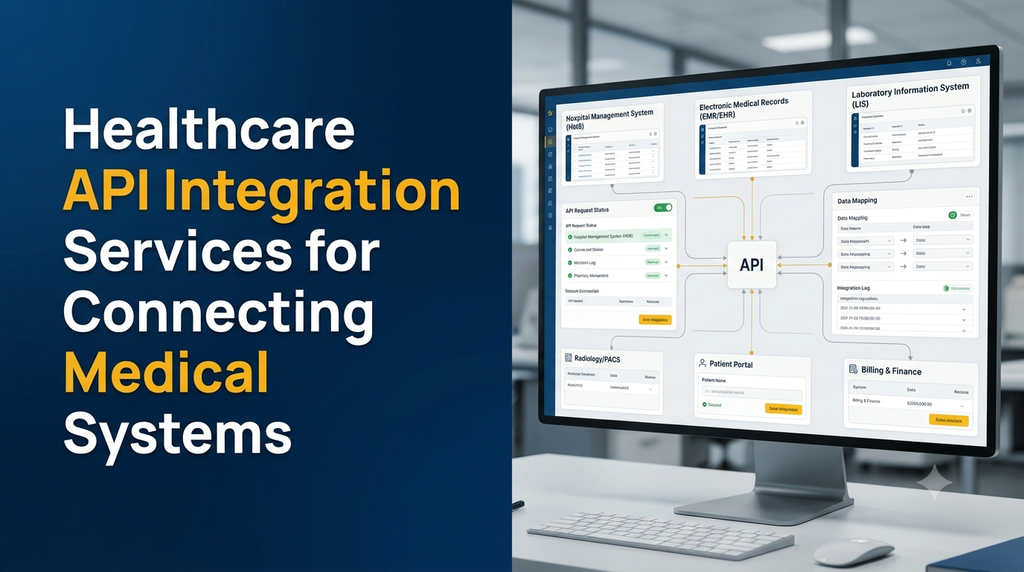
Healthcare API integration services help hospitals, clinics, laboratories and healthcare technology providers connect different medical software applications so authorised systems can exchange information. These integrations can connect hospital management systems, electronic medical records, laboratory applications, pharmacy platforms, billing software and patient portals through defined interfaces.
Healthcare organisations often use multiple software applications for different activities. Patient registration may happen in a hospital management system, laboratory results may be stored in a separate LIS, prescriptions may be managed through another application and patient communication may happen through a portal or mobile app.
When these applications operate independently, staff may need to enter the same information multiple times or switch between systems to retrieve records. Properly designed API integration can reduce unnecessary manual data entry and create more connected workflows.
This guide explains healthcare API integration, common medical system connections, HL7 and FHIR, security requirements, implementation challenges and development costs in India.
What Is Healthcare API Integration?
Healthcare API integration is the process of connecting medical software applications through application programming interfaces (APIs) so they can exchange defined data and trigger approved actions.
An API provides a structured way for one application to request or send information to another application. For example, a hospital registration system may send an authorised patient reference to a laboratory application when a test request is created.
Depending on the systems and project scope, healthcare integration may support:
- Patient registration and demographic information exchange.
- Appointment and encounter information.
- Laboratory orders and result communication.
- Prescription and medication-related workflows.
- Radiology orders and report references.
- Billing and payment information.
- Patient portal and mobile application synchronisation.
- Healthcare data exchange through supported interoperability standards.
Why Do Hospitals Need Healthcare Software Integration?
1. Reduce duplicate data entry
When connected systems can reuse authorised information, staff may not need to enter the same details repeatedly. This can simplify workflows and reduce avoidable administrative work.
2. Connect different hospital departments
Integration can link registration, consultation, laboratory, pharmacy, radiology and billing activities. Relevant information can move between departments through defined workflows.
3. Improve access to relevant information
Authorised users can retrieve information from connected applications without manually searching multiple disconnected systems, subject to permissions and data availability.
4. Support coordinated patient workflows
Connected applications can help coordinate appointments, test requests, report availability, prescriptions and billing activities.
5. Support digital healthcare services
Patient portals, telemedicine applications and healthcare mobile apps often need access to information maintained in other systems. APIs provide a controlled integration method where supported.
6. Improve operational reporting
Data from connected applications can be brought into reporting systems to support management dashboards. Reports must account for data quality, timing and differences between source systems.
Common Healthcare Systems That Need API Integration
1. Hospital Management System (HMS) Integration
An HMS may manage registration, appointments, admissions, billing and departmental operations. Integration with other applications can help connect these workflows.
Possible integration areas include:
- Patient and visit references.
- Appointment and admission information.
- Department and service details.
- Billing and transaction references.
- Relevant operational status updates.
2. Electronic Medical Records (EMR/EHR) Integration
EMR and EHR systems maintain clinical information. API integration can support the exchange of authorised patient and encounter information with connected healthcare applications.
- Patient identity references.
- Encounter and consultation records.
- Diagnosis and clinical documentation.
- Prescription information.
- Laboratory and diagnostic report references.
- Relevant clinical document exchange.
3. Laboratory Information System (LIS) Integration
Laboratory integration can connect test requests, sample references and result communication between a hospital system and a laboratory application.
- Laboratory test order submission.
- Sample and accession references.
- Test processing status.
- Verified result exchange.
- Report document references.
Result verification and release should remain under the laboratory’s authorised procedures. The integration should not silently convert an unverified result into a final clinical result.
4. Radiology Information System (RIS) and PACS Integration
Radiology systems manage imaging workflows, while Picture Archiving and Communication Systems store and retrieve medical images. Integration can connect imaging requests, examination status, report references and image access through supported interfaces.
Depending on the vendor and architecture, DICOM-related workflows and supported APIs may be relevant.
5. Pharmacy Management Integration
Pharmacy integration can connect authorised prescription and medication-related workflows with inventory and dispensing applications.
- Prescription references.
- Medication catalogue information.
- Dispensing status.
- Stock and availability information.
- Relevant billing references.
Medication terminology, units, strengths and identifiers must be mapped carefully. An integration should not change a prescribed medication or dose without an authorised workflow.
6. Medical Billing and Accounting Integration
Billing integration can exchange service charges, invoices, payment status and transaction references between healthcare applications and finance systems.
7. Patient Portal and Mobile App Integration
A patient portal may retrieve authorised appointment details, reports, prescriptions and billing information from connected applications. Access must be linked to appropriate identity verification, permissions and consent requirements.
8. Telemedicine Platform Integration
Telemedicine platforms may need to connect appointment schedules, patient references, consultation documentation and follow-up information with the institution’s existing systems.
Important Healthcare API Integration Standards
Healthcare integration projects may involve several technical standards. The right choice depends on the source application, destination system, available interfaces and information being exchanged.
HL7 Version 2
HL7 v2 is a widely used healthcare messaging standard for exchanging information between clinical and administrative systems. It is commonly encountered in hospital, laboratory and diagnostic integrations.
HL7 v2 messages may support workflows involving admissions, discharges, transfers, orders and results. Implementations can differ between vendors, so message structure and local interface requirements must be reviewed.
HL7 FHIR
Fast Healthcare Interoperability Resources (FHIR) is a healthcare interoperability standard that represents information through resources and defined exchange mechanisms. It commonly uses modern web technologies, including RESTful APIs and structured data formats.
FHIR resources may represent:
- Patient information.
- Practitioner details.
- Appointments and encounters.
- Observations and diagnostic results.
- Medication requests.
- Service requests.
- Clinical documents and related references.
FHIR version, implementation guides, terminology bindings and supported profiles should be agreed before development. Two applications claiming FHIR support may still require mapping and additional implementation work to exchange information correctly.
DICOM
Digital Imaging and Communications in Medicine (DICOM) is a standard used for medical imaging information. It is relevant when connecting imaging equipment, radiology systems, image archives and diagnostic workflows.
REST and SOAP APIs
Healthcare vendors may provide REST-based or SOAP-based APIs. REST APIs commonly use HTTP and structured formats such as JSON, while SOAP-based interfaces use a formal messaging structure, often described through service definitions.
The integration architecture should use the interface actually supported by the source application rather than assuming all medical systems expose modern REST APIs.
Healthcare API Integration vs Healthcare Interoperability
| Aspect | API integration | Interoperability |
|---|---|---|
| Main focus | Connecting applications through interfaces. | Exchanging and correctly interpreting information across systems. |
| Data exchange | Depends on the API’s supported structure. | Requires suitable formats, terminology and context. |
| Standards | May use custom APIs or standard interfaces. | Often uses standards and implementation guides. |
| Validation | Checks API requests and responses. | Also considers meaning, identity and workflow consistency. |
| Outcome | Enables technical connectivity. | Supports meaningful and reliable information exchange. |
Healthcare API Integration Architecture
A healthcare integration project can use different architectures depending on the number of systems, data volume, security requirements and available vendor interfaces.
1. Direct API integration
One application communicates directly with another through a supported API. This approach may suit smaller projects with a limited number of systems and relatively straightforward workflows.
2. Central integration layer
A central integration service manages communication between multiple healthcare applications. It can handle data mapping, authentication, validation, logging and error processing in one place.
3. API gateway architecture
An API gateway can provide a controlled entry point for application requests. It may manage authentication, access policies, request limits, routing and monitoring.
4. Event-driven integration
Events and message queues can support asynchronous communication between systems. For example, an application may publish a status-change event that another service processes later.
This approach can help separate system availability and processing responsibilities, but it requires careful handling of retries, duplicate events, ordering and message failures.
Example: Connecting Hospital, Laboratory and Patient Portal Systems
Consider a hospital using an HMS, an independent laboratory application and a patient portal. A properly designed integration may coordinate information across these systems.
- Patient registration: The hospital creates a patient record and a stable internal identifier.
- Test request: An authorised clinician creates a laboratory order through the hospital application.
- Request exchange: The integration layer sends the approved request to the laboratory system.
- Sample processing: The laboratory records the sample and processes the test using its own validated workflow.
- Result verification: The laboratory completes its review and releases the result according to its procedures.
- Result exchange: The verified result is communicated to the authorised destination system.
- Portal availability: The patient portal displays the result when the institution’s access and release policies allow it.
- Audit history: Relevant exchanges and status changes are logged for review.
Important Features of a Healthcare API Integration Platform
API authentication and authorisation
Integrations should use suitable authentication methods and clearly defined permissions. OAuth 2.0, token-based access and other supported mechanisms may be relevant depending on the API and deployment model.
Data mapping and transformation
Different applications may use different field names, identifiers, formats and terminology. Mapping rules translate source information into the structure expected by the destination system.
Patient identity matching
Patient matching requires particular care. Incorrectly linking records can expose information to the wrong person or create an inaccurate clinical history. Use agreed identifiers and controlled matching rules, with human review for uncertain matches.
Terminology and code mapping
Clinical concepts may be represented through different coding systems or local catalogues. Where applicable, mapping may involve recognised terminologies such as SNOMED CT, LOINC and other agreed code sets.
Terminology support must be verified for the relevant language, version, licensing conditions and implementation context.
API monitoring and integration logs
Monitoring helps teams identify failed requests, delayed messages, unavailable services and unexpected response formats. Logs should provide enough information for troubleshooting without unnecessarily storing sensitive clinical content.
Error handling and retry management
Network failures, timeouts and vendor downtime can interrupt data exchange. A reliable integration should include controlled retries, duplicate prevention, failure queues and a clear process for resolving messages that cannot be delivered.
Webhook and event notifications
When supported, webhooks can notify connected applications about events such as appointment updates, order status changes or report availability. Webhook authentication and duplicate-event handling should be included.
API documentation and version management
Document supported endpoints, request and response structures, permissions, rate limits, error codes and version changes. This helps maintain integrations when connected systems are updated.
Healthcare API Security and Data Privacy
Healthcare integrations may transfer sensitive personal and clinical information. Security and privacy requirements should be built into the integration architecture from the beginning.
1. Encrypted communication
Use HTTPS and suitable transport security for API communication. Sensitive information should not be sent through unprotected connections.
2. Strong authentication
Use appropriate credentials, token management and authentication policies. Secrets should be stored securely and rotated according to the organisation’s security requirements.
3. Least-privilege permissions
Each connected application should receive only the access needed for its assigned workflow. Avoid giving every integration unrestricted access to all patient records.
4. Consent and purpose limitation
Where required, information exchange must respect applicable consent, purpose and access requirements. The integration should preserve relevant consent context rather than assuming that technical access automatically authorises every use.
5. Audit logging
Record important events such as authentication, data exchange, permission changes and administrative actions. Logs should be protected against unauthorised alteration and unnecessary exposure of sensitive data.
6. Data minimisation
Only exchange information needed for the intended purpose. Avoid sending complete clinical records when a limited set of fields or references is sufficient.
7. Secure error reporting
Error messages and monitoring dashboards should not expose passwords, API keys, access tokens or unnecessary patient information.
Healthcare API Integration Considerations in India
Healthcare software integration in India may involve institution-specific requirements as well as national digital health initiatives and applicable data protection rules.
Ayushman Bharat Digital Mission (ABDM)
The Ayushman Bharat Digital Mission aims to support a connected digital health ecosystem. Its building blocks include health identifiers, healthcare professional and facility registries, and consent-based health information exchange.
Organisations planning ABDM-related integrations should review the current official specifications, sandbox requirements, applicable participation conditions and relevant technical validation procedures. A generic FHIR API integration should not automatically be described as ABDM-compliant.
ABHA and health record exchange
ABHA-related functionality may be relevant to applications participating in the ABDM ecosystem. The implementation must follow applicable identity, consent and data exchange requirements rather than treating an ABHA number as unrestricted permission to access records.
Digital Personal Data Protection framework
Projects should assess applicable obligations under India’s Digital Personal Data Protection Act and associated rules, including relevant commencement provisions and organisational responsibilities. Applicability depends on the parties, data processing activities and implementation context.
Healthcare interoperability standards
India’s healthcare interoperability initiatives and relevant electronic health record standards should be reviewed when planning data exchange. The appropriate profiles and interfaces depend on the institution, participating systems and intended use.
Common Challenges in Healthcare API Integration
Different data formats
Connected systems may use different structures, naming conventions and data types. Mapping and validation rules are needed to prevent incorrect or incomplete information exchange.
Legacy medical applications
Older systems may not provide modern APIs. Integration may require vendor-supported interfaces, HL7 messaging, secure file exchange or a separately approved adapter.
Patient identity mismatches
Different applications may maintain separate patient identifiers. Reliable identity mapping and controlled reconciliation are necessary to avoid incorrect record association.
Vendor API limitations
Some vendors restrict API access, impose usage limits or require additional licensing. These conditions should be confirmed before committing to an integration design.
Unreliable connectivity
Network interruptions and service downtime can delay communication. Queues, retries, reconciliation and monitoring help manage temporary failures.
Clinical workflow differences
Two applications may use the same technical field for different operational meanings. Workflow analysis is necessary to prevent incorrect interpretation.
Integration maintenance
Vendor updates, API version changes and security requirements can affect existing connections. Integrations need documentation, monitoring and ongoing support.
Healthcare API Integration Development Process
1. System discovery and requirement analysis
Identify every source and destination application, vendor, API availability, data owner, workflow and required exchange. Document what information needs to move and why.
2. Interface and standards assessment
Review API documentation, authentication methods, supported formats, HL7 or FHIR versions, rate limits and licensing conditions.
3. Data mapping and workflow design
Define field mappings, identifiers, terminology, validation rules, consent handling and expected system responses.
4. Integration architecture design
Choose an appropriate architecture, such as direct APIs, a central integration service, an API gateway or event-driven communication.
5. Development and implementation
Develop API clients, adapters, transformation logic, authentication, error handling, audit logging and monitoring.
6. Testing and validation
Test normal requests, invalid data, duplicate messages, timeouts, unavailable services, identity mismatches, permission failures and recovery procedures. Clinical data workflows should be validated by appropriate domain professionals.
7. Deployment and monitoring
Deploy the integration in a controlled environment, configure monitoring and establish a support process for failed exchanges and system updates.
How Much Do Healthcare API Integration Services Cost in India?
Integration cost depends on the number of applications, API documentation, data formats, integration standards, security requirements, testing scope and vendor access conditions.
The following figures are illustrative early-stage planning estimates, not fixed Greap quotations or guaranteed market prices.
| Integration scope | Illustrative estimate |
|---|---|
| Basic integration between two applications using documented APIs | ₹20,000–₹40,000 |
| Patient and appointment data integration | ₹30,000–₹60,000 |
| EMR and HMS integration with data mapping | ₹45,000–₹85,000 |
| LIS integration with order and result workflows | ₹55,000–₹1,00,000 |
| Multiple healthcare system integrations | ₹80,000–₹1,60,000 |
| Custom healthcare integration platform or central integration layer | ₹1,50,000–₹3,50,000+ |
| Advanced multi-system interoperability project | ₹3,00,000–₹7,00,000+ |
Additional expenses may include:
- Third-party API access and vendor licensing.
- Integration engine or gateway licensing.
- Cloud hosting and infrastructure.
- API monitoring and logging services.
- Security assessment and penetration testing.
- Data migration and reconciliation.
- Standards-based implementation and validation.
- External specialist and compliance review.
- Ongoing support and API version maintenance.
- Applicable taxes.
For accurate pricing, the development team should first inspect the API documentation and confirm whether the connected vendors permit the intended data exchange.
How to Choose a Healthcare API Integration Company
Healthcare integration requires both software development knowledge and careful understanding of medical information workflows. Evaluate potential development partners using the following criteria:
- API experience: Can the team work with REST, SOAP and vendor-specific interfaces?
- Healthcare standards: Do they understand HL7 v2, FHIR and relevant interoperability concepts?
- Data mapping: Can they document and validate source-to-destination field mappings?
- Identity management: Can they design reliable patient and provider matching workflows?
- Security: Are authentication, permissions, encryption and audit logs included?
- Error handling: Are retries, duplicate prevention and reconciliation planned?
- Testing: Can they test both technical exchanges and the actual operational workflow?
- Documentation: Will the project include API documentation, mapping records and support procedures?
- Maintenance: Can the team support vendor updates and API version changes?
Healthcare API Integration Services for Hospitals in Tamil Nadu
Hospitals, clinics, diagnostic laboratories and healthcare technology companies across Tamil Nadu may operate different software applications for registration, laboratory testing, clinical documentation, pharmacy, billing and patient communication.
Healthcare organisations in Erode, Coimbatore, Tiruppur, Salem, Chennai and other districts may need integration projects that connect existing applications without replacing every system at once.
For institutions in Erode and nearby areas, a practical integration project can begin with an assessment of the existing HMS, EMR, LIS and other software interfaces. The integration scope can then prioritise the most important data exchanges and workflows.
Frequently Asked Questions
1. What are healthcare API integration services?
Healthcare API integration services connect medical software applications such as HMS, EMR, LIS, pharmacy, billing and patient portals so authorised systems can exchange structured information.
2. Why do hospitals need API integration?
Hospitals use API integration to connect departmental applications, reduce duplicate data entry, exchange relevant records and coordinate selected workflows across different systems.
3. What is HL7 integration in healthcare?
HL7 integration uses healthcare messaging standards to exchange information between medical systems. HL7 v2 is commonly used in hospital and laboratory messaging workflows.
4. What is FHIR API integration?
FHIR API integration uses the HL7 FHIR standard to exchange healthcare information through defined resources and interfaces. The specific FHIR version and implementation guide must be agreed between participating systems.
5. Can HMS and EMR systems be integrated?
Yes. HMS and EMR applications can exchange selected patient, encounter and clinical information when compatible APIs or other supported interfaces are available.
6. Can a hospital connect its LIS with an HMS?
Yes. Integration can support laboratory orders, sample references, processing status and verified result communication, subject to the capabilities of both systems.
7. Can healthcare APIs connect pharmacy software?
Yes. A suitable integration can exchange prescription references, medication catalogue information, dispensing status and selected inventory information, depending on supported interfaces and permissions.
8. Can APIs connect a patient portal to hospital software?
Yes. A patient portal can retrieve authorised appointment, report, prescription and billing information from connected hospital applications, subject to identity, consent and access controls.
9. Is FHIR the same as REST API?
No. FHIR is a healthcare interoperability standard that can use RESTful APIs. REST is an architectural style, while FHIR defines healthcare resources, structures and exchange conventions.
10. What is the difference between HL7 and FHIR?
HL7 is the organisation and standards family behind multiple healthcare interoperability specifications. HL7 v2 uses message-based exchange, while FHIR defines resource-based information structures and modern exchange mechanisms.
11. Can legacy hospital software be integrated?
Potentially. The available options depend on vendor-supported interfaces, database access permissions, messaging support and security requirements. Some projects may need a custom adapter or integration layer.
12. Is healthcare API integration secure?
It can be designed with encryption, authentication, role-based permissions, consent controls, audit logging and monitoring. Security depends on the implementation and ongoing operation of every connected system.
13. Does API integration make a hospital ABDM-compliant?
No. Generic API connectivity does not establish ABDM compliance. Relevant participation requirements, technical specifications, validation and applicable conditions must be assessed separately.
14. How much does healthcare API integration cost in India?
Illustrative projects may start around ₹20,000 for a simple documented API connection. Multiple medical systems, complex data mapping, standards-based integration and security validation can increase the cost substantially.
15. How long does a healthcare API integration project take?
Timelines depend on vendor access, API documentation, number of workflows, data mapping, security requirements and testing. A basic connection may be simpler than a multi-system integration platform, so a project timeline should be estimated after technical discovery.
Build Connected Healthcare Applications with Greap Technologies
Greap Technologies develops websites, business applications and custom software solutions for organisations. Healthcare institutions planning to connect existing medical systems can discuss their HMS, EMR, LIS, pharmacy, billing and patient portal integration requirements with our team.
We can help assess available APIs, plan data exchange workflows, develop integration services and build connected web applications based on the agreed project scope.
Planning a Healthcare API Integration Project?
Discuss your existing medical systems and integration requirements with Greap Technologies.
Website: www.greap.in
WhatsApp: Chat with Greap Technologies
Call: +91 70923 30168