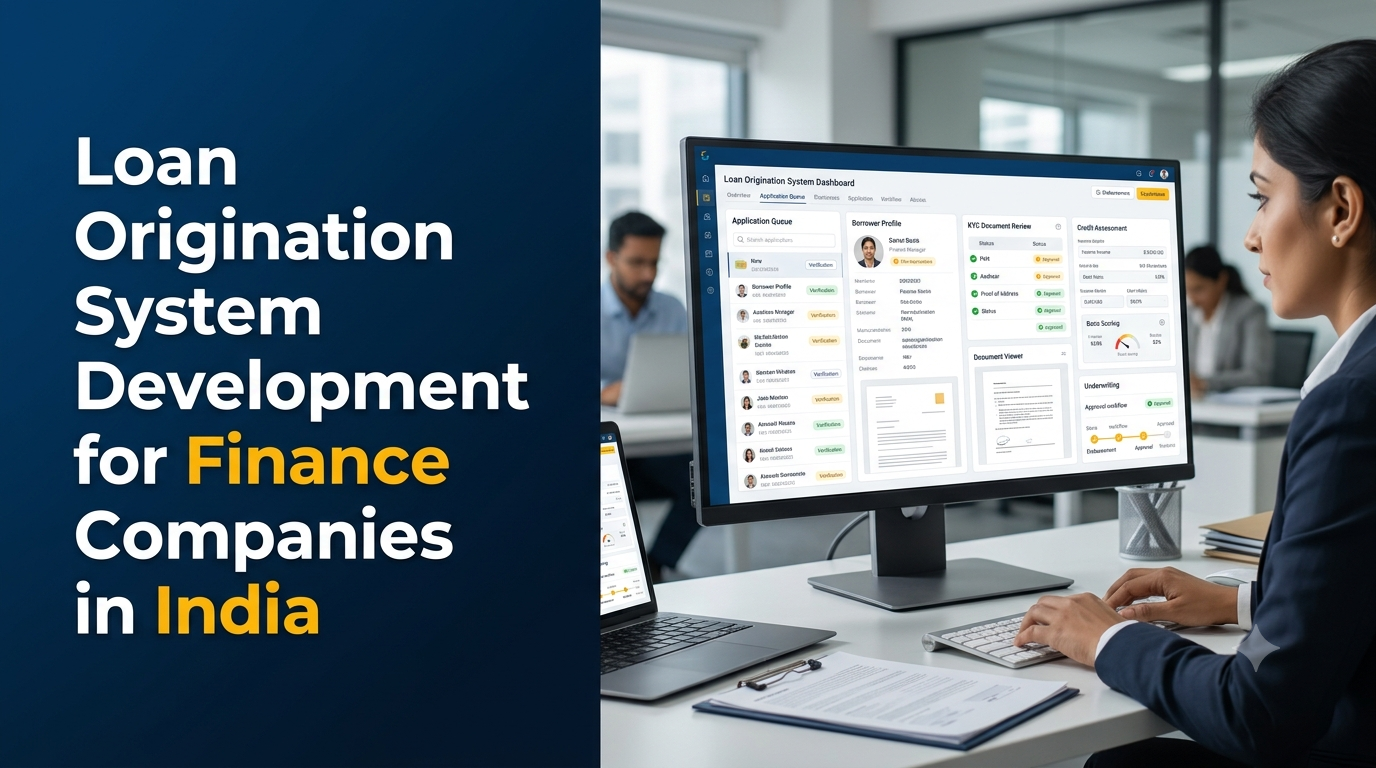
A Loan Origination System (LOS) is software that manages the process of receiving, evaluating and processing loan applications. For finance companies and NBFCs, a custom LOS can bring customer onboarding, KYC workflows, document collection, credit assessment, underwriting, approvals, loan agreements and disbursement coordination into one structured application.
Loan processing often involves several teams and verification stages. Customer information may arrive through branches, field agents, websites, mobile applications or business partners. Documents need to be checked, eligibility must be evaluated, and authorised employees must review applications before a lending decision is made.
When these activities are managed through disconnected spreadsheets, emails and manual records, tracking application status and maintaining consistent documentation can become difficult. A Loan Origination System provides a central workflow for managing these activities.
What Is a Loan Origination System?
A Loan Origination System is a digital platform used by a lender to manage the stages between a borrower’s initial application and the loan disbursement decision. It captures application information, coordinates verification tasks, records credit assessment results and routes cases through configured approval levels.
The system can support different lending products, including personal loans, business loans, vehicle finance, equipment finance, secured loans and other credit products. The workflow, eligibility rules and required documents should be configured according to the lender’s approved policies and applicable regulatory requirements.
Why Do Finance Companies Need Loan Origination Software?
Finance companies may receive applications from several locations and channels. A centralised LOS helps teams view the same application record and understand which activities are completed, pending or awaiting approval.
- Centralise applications from branches, agents and digital channels.
- Reduce repeated data entry across application stages.
- Track missing documents and verification tasks.
- Apply consistent eligibility and underwriting workflows.
- Route applications to authorised reviewers.
- Maintain an audit trail of decisions and changes.
- Monitor application turnaround times and pending workloads.
- Coordinate approved loan documentation and disbursement tasks.
- Generate operational reports for management.
Software can organise and automate defined administrative tasks, but it should not replace the lender’s responsibility for credit policy, customer protection, regulatory compliance and final lending decisions.
Types of Loans a LOS Can Support
1. Personal Loan Origination
A personal loan workflow may collect applicant details, employment and income information, existing obligations, identity documents and supporting records. The configured assessment process can route the application for review and record the authorised decision.
2. Business Loan Origination
Business loan applications may require business registration details, ownership information, financial statements, bank records, business vintage information and details of the proposed loan purpose. The application should support business and proprietor or director records where relevant.
3. Vehicle Finance
Vehicle finance workflows can include applicant information, vehicle details, quotation or invoice documents, down-payment information, valuation records where applicable and approval stages.
4. Equipment and Machinery Finance
Equipment finance applications may require supplier quotations, asset specifications, borrower financial details, proposed repayment information and supporting documentation.
5. Secured Loan Applications
Secured lending workflows may include collateral information, ownership documents, valuation records, legal verification tasks and additional approval stages. Sensitive collateral data should be accessible only to authorised users.
Essential Features of Loan Origination System Software
1. Digital Loan Application Management
Provide a structured application form for customer and loan details. Depending on the product, capture personal information, contact details, employment, income, business information, requested amount, tenure and loan purpose.
- Application reference number.
- Loan product and requested amount.
- Applicant and co-applicant details, where applicable.
- Employment or business information.
- Contact and address details.
- Application source and assigned branch or agent.
- Consent and acknowledgement records.
2. Customer Onboarding and KYC Workflow
The onboarding module records identity-verification tasks and their outcomes. Depending on the lender’s regulatory category and approved process, it may support document review, identity verification, address verification, CKYC-related workflows and authorised digital verification services.
Store verification status, reference numbers, reviewer details and timestamps. Do not treat an uploaded document as verified merely because a file has been submitted.
3. Document Management System
A document module helps collect and organise application records. It can support configurable checklists for different loan products.
- Identity and address documents.
- Income proof and employment records.
- Bank statements and financial documents.
- Business registration and ownership documents.
- Property, vehicle or asset documents where applicable.
- Loan quotations, agreements and supporting files.
The system should record document type, upload date, verification status, expiry information where relevant and the employee who reviewed it.
4. Eligibility Assessment Engine
A configurable eligibility module can evaluate application information against lender-defined product criteria. Rules may consider age, income, employment type, business profile, existing obligations, requested amount, loan tenure and other approved factors.
The result should be treated as an assessment output for authorised review, not an automatic promise that a loan will be approved.
5. Credit Assessment and Bureau Integration
Where the lender has the necessary authorisation and provider access, the system can connect with selected credit information services and store the response reference, retrieval date and permitted assessment information.
Access to credit information should be controlled, logged and limited to the purposes permitted by applicable law, provider terms and the lender’s policies.
6. Underwriting and Risk Review
The underwriting module gives authorised reviewers a structured view of the application, supporting documents, assessment results and outstanding conditions. It can record review notes, additional information requests, risk flags and recommendations.
Any automated score or decision rule should be documented, validated and governed by the lender. Provide a route for authorised human review and exception handling.
7. Multi-Level Loan Approval Workflow
Finance companies may require approval from a branch manager, credit officer, regional manager or authorised credit committee. A configurable workflow can assign applications based on product, amount, branch, risk category or internal policy.
- Approval, rejection and return-for-correction actions.
- Maker-checker controls.
- Approval limits and delegation rules.
- Reviewer comments and supporting notes.
- Timestamped decision history.
- Escalation for pending applications.
8. Loan Offer and Sanction Documentation
After an authorised approval, the system can prepare configured sanction documents, loan summaries and customer disclosures using approved templates. It should maintain document versions and record the authorised approval that permitted each document to be issued.
9. Agreement and E-Signature Integration
The LOS can connect with an appropriate electronic-signature or agreement-execution provider where the lender’s legal and operational requirements permit it. Track document generation, delivery, signing status and final executed copies.
10. Disbursement Coordination
The disbursement module manages the approved amount, beneficiary verification, payment instructions, authorisation and transaction status. It should distinguish an approved loan from a loan that has actually been disbursed.
For regulated digital lending, fund-flow design must be reviewed against the applicable RBI directions. Do not design a third-party pass-through account as the default route for loan disbursement or repayment.
11. Notifications and Communication
Send appropriate application updates through supported SMS, email or other authorised communication channels. Messages may cover application receipt, missing documents, verification progress, decisions and agreement status.
Communication preferences, consent, message content and delivery records should be managed carefully, particularly when sensitive financial information is involved.
12. Audit Trail and Operational Reports
Maintain a record of application creation, document access, status changes, verification actions, rule versions, approvals and manual adjustments. Reports can help managers understand application volumes, pending stages, approval patterns and processing times.
Important Modules in a Loan Origination Platform
| Module | Purpose | Typical users |
|---|---|---|
| Customer Portal | Submit applications and documents | Applicants |
| Lead and Application Management | Register enquiries and track applications | Sales and branch staff |
| KYC and Verification | Manage identity and document checks | Verification team |
| Credit Assessment | Record eligibility and credit review | Credit officers |
| Underwriting | Review risk, conditions and recommendations | Underwriters |
| Approval Management | Route cases to authorised decision-makers | Managers and credit committee |
| Document Generation | Prepare approved loan documents | Operations and legal teams |
| Disbursement | Coordinate approved payment instructions | Finance operations |
| Reports and Audit | Monitor applications and activity history | Management and auditors |
How the Loan Origination Workflow Works
A typical loan origination workflow can be organised into the following stages. The actual sequence should reflect the lender’s product policy, customer journey and regulatory obligations.
- Lead or application creation: Capture an enquiry or receive a loan application through a supported channel.
- Applicant information: Collect the required customer, employment, income or business details.
- Consent and KYC: Record required consent and complete applicable identity and customer due-diligence checks.
- Document collection: Receive and review the supporting records required for the selected product.
- Eligibility assessment: Apply configured product rules and record the assessment result.
- Credit and underwriting review: Evaluate available information and route exceptions for authorised review.
- Approval decision: Record the decision, conditions, authority and decision date.
- Customer disclosures and agreement: Provide required loan information and complete the approved documentation process.
- Disbursement coordination: Verify the approved beneficiary and process the authorised disbursement workflow.
- Handover to loan servicing: Transfer the originated loan record to the lender’s servicing or loan management system.
Loan Origination System vs Loan Management System
LOS and LMS are related but serve different stages of the lending lifecycle. Some financial platforms combine both, while others integrate separate applications.
| Area | Loan Origination System | Loan Management System |
|---|---|---|
| Main purpose | Process applications and lending decisions | Manage active loan accounts |
| Primary stages | Application to disbursement | After disbursement through closure |
| Typical records | Applicant, documents, assessment and approvals | Principal, interest, instalments and outstanding balance |
| Common features | KYC, underwriting, approval and sanction | Repayment schedules, collections, dues and account statements |
| Primary users | Sales, verification, credit and approval teams | Operations, collections and servicing teams |
A finance company may begin with an LOS and later integrate a dedicated loan management system for repayment schedules, collections, overdue accounts and account servicing.
Integrations Required for Loan Origination Software
Integrations should be selected according to the lender’s regulatory status, product, authorisations, service-provider contracts and technical access.
- KYC and identity services: Approved identity and customer-verification workflows.
- CKYC-related services: Access through eligible and authorised channels.
- Credit information companies: Credit information retrieval under applicable permissions and agreements.
- Bank statement services: Supported statement collection or authorised data-access integrations.
- Account Aggregator ecosystem: Where the regulated entity, use case, consent and participation model permit.
- Document verification: Selected OCR, document validation or verification providers.
- Electronic signatures: Approved agreement execution and signing workflows.
- Payment and banking systems: Disbursement and repayment coordination through permitted channels.
- SMS and email: Application notifications and delivery records.
- Loan management and accounting systems: Transfer approved loan data and financial entries.
An API being technically available does not automatically mean a finance company is authorised to use it. Confirm eligibility, consent, provider contracts, permitted purposes and data-handling requirements before building each integration.
RBI Digital Lending and KYC Considerations in India
Loan origination software used by regulated lenders must be designed around the rules applicable to the lender, loan product, distribution channel and digital lending arrangement. A software vendor can implement configured workflows, but software alone cannot establish regulatory compliance or make an organisation eligible to lend.
1. RBI Digital Lending Directions, 2025
The Reserve Bank of India’s Digital Lending Directions, 2025 cover regulated entities and their digital lending arrangements, including requirements relating to Lending Service Providers, borrower creditworthiness, disclosures, disbursement, repayment, cooling-off, grievance redressal, data and technology. The system should be designed to support the applicable responsibilities of the regulated entity.
2. Borrower Creditworthiness and Disclosures
The directions require regulated entities to obtain necessary information about the borrower’s economic profile for creditworthiness assessment. The LOS should retain the required information and audit records. It should also support the applicable Key Facts Statement (KFS), APR and other borrower disclosures.
3. Disbursement and Repayment Flow
RBI’s directions set requirements for loan disbursement and repayment flows, including the general requirement for disbursement into the borrower’s bank account and repayment directly to the regulated entity’s bank account, subject to specified exceptions. The workflow should be reviewed carefully rather than assuming that a third-party collection or pass-through account is acceptable.
4. Cooling-Off and Grievance Handling
The system should support the applicable cooling-off option, relevant disclosures, customer complaint submission and grievance tracking. The exact configuration must follow the regulated entity’s applicable policy and RBI requirements.
5. KYC, AML and Record Management
NBFCs must follow the KYC directions applicable to their category and maintain required customer due-diligence and record-management processes. A LOS should provide configurable verification checklists, access controls, review histories and retention processes.
6. Data Privacy and Technology Controls
Borrower data should be collected, used, shared and stored according to applicable requirements. Build consent records, purpose-based access, secure integrations, retention controls and an appropriate privacy policy into the application design.
Security Requirements for a Loan Origination Platform
Loan applications contain personal, identity, employment and financial information. Security should be considered from the database and API design stage rather than added only before launch.
- Role-based access control for branch, sales, credit and management teams.
- Multi-factor authentication for privileged and sensitive accounts.
- Encryption for data in transit and appropriate protection at rest.
- Secure document storage with controlled access and download permissions.
- Audit logs for document views, edits, approvals and administrative actions.
- Secure API authentication, secret management and integration monitoring.
- Session management and protection against common web application attacks.
- Regular backups, recovery testing and incident response procedures.
- Data minimisation, retention and deletion controls where applicable.
- Separate development, testing and production environments.
Admin Dashboard and User Roles
A well-designed LOS should provide different workspaces for each role. This prevents every employee from accessing every application or performing actions outside their responsibilities.
| User role | Typical responsibilities |
|---|---|
| Super Admin | Configure products, branches, roles and system settings |
| Branch Manager | Monitor branch applications and assigned approvals |
| Sales Executive | Register enquiries and assist with application submission |
| Field Agent | Submit assigned applications and track permitted tasks |
| KYC Executive | Review customer identity and supporting documents |
| Credit Analyst | Review financial information and assessment records |
| Underwriter | Evaluate applications and record recommendations |
| Approver | Make decisions within assigned approval authority |
| Finance Executive | Coordinate approved disbursement activities |
| Auditor | Access permitted records and review activity history |
Mobile App and Customer Portal Features
A mobile-friendly application can help customers submit information and allow authorised field or branch staff to manage assigned activities. The available functions should be based on the lender’s operating model.
- Customer registration and application tracking.
- Secure document upload and application updates.
- Consent and disclosure acknowledgement.
- Field-agent application submission.
- Assigned verification tasks and status updates.
- Manager approval notifications.
- Secure communication and support requests.
Sensitive financial information should not be exposed through notifications or stored insecurely on mobile devices. Mobile permissions, device security and offline data handling need particular attention.
Custom Loan Origination Software vs Ready-Made LOS
| Factor | Ready-made LOS | Custom LOS |
|---|---|---|
| Implementation | May be faster for supported workflows | Requires discovery and development |
| Workflow flexibility | Depends on available configuration | Can be designed around approved processes |
| Loan products | Limited to supported product models | Can support defined product-specific workflows |
| Integrations | Depends on vendor connectors | Can target selected systems and providers |
| Reporting | Uses standard vendor reports | Can include custom operational dashboards |
| Maintenance | Usually follows the vendor’s service model | Requires a defined support arrangement |
| Cost model | Subscription, licence or usage fees | Development plus hosting and maintenance |
A ready-made platform may be suitable when the lender’s processes are standard and its required integrations are supported. Custom development may be appropriate when the company needs specific approval structures, branch workflows, loan products, integrations or reporting.
Loan Origination System Development Cost in India
The cost of a custom LOS depends on the number of loan products, user roles, branches, verification workflows, integrations, document requirements, security controls and reporting modules.
The following are illustrative planning estimates for discussing development scope. They are not fixed Greap quotations or guaranteed market prices.
| Development scope | Illustrative estimate |
|---|---|
| Basic loan application and admin dashboard | ₹40,000–₹70,000 |
| Application, customer records and document management | ₹60,000–₹1 lakh |
| Application, KYC workflow and approval management | ₹80,000–₹1.4 lakh |
| Credit assessment, underwriting and multi-level approvals | ₹1.2–₹2 lakh |
| Complete LOS with customer portal and disbursement workflow | ₹1.8–₹3.5 lakh+ |
| Advanced multi-branch platform with multiple integrations | ₹3.5–₹7 lakh+ |
| Enterprise lending platform with mobile apps and extended integrations | ₹7 lakh+ |
Additional expenses may include cloud hosting, database and document storage, KYC and verification provider charges, credit bureau access, e-signature services, messaging, banking integrations, security assessments, data migration, app publishing, taxes and ongoing support. Provider contracts and regulatory review may also add project effort.
How to Choose a Loan Origination Software Development Company
Selecting a development partner is important because a LOS handles sensitive information and business-critical lending workflows. Evaluate the following before starting a project:
- Experience developing secure business and financial workflow software.
- Ability to map the full application-to-disbursement process.
- Understanding of role permissions and maker-checker approvals.
- Clear integration scope and provider-access requirements.
- Documented data protection, audit and backup design.
- Testing of application exceptions and approval scenarios.
- Maintainable architecture and technical documentation.
- Defined deployment, maintenance and support arrangements.
Ask for a demonstration using fictional application records. It should show how an application moves from registration to verification, underwriting, authorised approval and disbursement handover.
Loan Origination Software for Finance Companies in Erode and Tamil Nadu
Finance companies and lending businesses operating in Erode and across Tamil Nadu may manage applications through branches, field teams, business partners and digital channels. A centralised LOS can help organise application records, document reviews, approval responsibilities and management reporting across locations.
A project should begin by identifying the lender’s legal and regulatory category, loan products, customer journey, existing systems and approved operating policies. The software workflow can then be planned around those requirements rather than using a generic application form for every loan product.
Frequently Asked Questions
1. What is a Loan Origination System (LOS)?
A LOS is software that manages loan applications, customer onboarding, document collection, verification, credit assessment, underwriting, approvals and disbursement coordination.
2. What is the difference between LOS and LMS?
LOS manages the loan application and approval journey up to disbursement. A Loan Management System manages active loan accounts, repayment schedules, collections, dues and servicing after disbursement.
3. Can a LOS be developed for NBFCs in India?
Yes. A custom platform can be designed for an NBFC’s approved loan products, customer onboarding, KYC workflows, credit assessment, approvals and operational reporting. Its configuration must be reviewed against the NBFC’s applicable regulatory obligations.
4. Can the software support multiple loan products?
Yes. Product-specific forms, document checklists, eligibility rules, assessment stages and approval limits can be configured for different lending products.
5. Can a LOS integrate with KYC verification services?
It can integrate with selected eligible services when the lender has the required authorisation, provider agreement and technical access. The application can record verification status and audit references.
6. Can the system connect with credit bureaus?
Yes, where the lender is eligible and has the necessary agreements and permissions. The software can manage requests, permitted responses, access controls and assessment records.
7. Does loan origination software automatically approve loans?
It can apply configured rules and route applications for review, but final decision authority and governance should remain with the lender’s authorised process. Automated decisions require appropriate validation, monitoring and oversight.
8. Can a LOS support field agents and branch employees?
Yes. Role-based access can allow field agents to submit assigned applications, branch employees to review records and managers to monitor workloads and approvals.
9. Can customers track their loan applications online?
A customer portal can display permitted application updates, document requests, communication records and decision status through secure authentication.
10. Can a LOS generate sanction letters and loan documents?
Yes. It can generate documents from approved templates after the required authorisation. Document versions, disclosures, signing status and delivery records should be maintained.
11. Can loan origination software integrate with a loan management system?
Yes. An integration can transfer approved loan details, customer records, product information and disbursement data to a loan servicing or management application.
12. Is a mobile app necessary for a LOS?
Not always. A responsive web application may be sufficient for some lenders. A mobile app can be useful when customers or field employees need dedicated mobile workflows.
13. How long does loan origination software development take?
The timeline depends on product complexity, user roles, integrations, approval workflows, testing and regulatory review. A project schedule should be prepared after requirements and provider access are confirmed.
14. How much does custom LOS development cost in India?
Cost depends on modules, loan products, integrations, security, reporting and mobile requirements. A basic application workflow may need a smaller budget than a multi-branch lending platform with underwriting and external integrations.
15. Does developing a LOS make a company authorised to provide loans?
No. Software development does not grant a company permission or regulatory status to lend. The organisation must independently meet the applicable legal and regulatory requirements for its lending activities.
Planning a Custom Loan Origination System?
Greap Technologies develops business websites, custom software and digital solutions. If your finance company needs a loan application platform, discuss your loan products, onboarding process, verification requirements, approval structure and integration needs with our team.