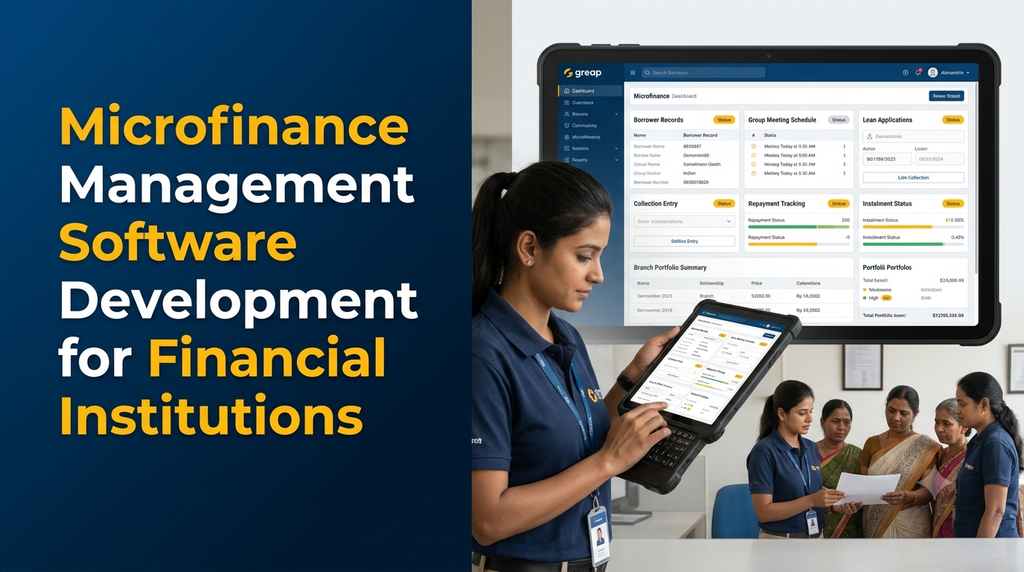
Microfinance management software is a digital platform that helps financial institutions manage borrowers, group lending, loan applications, field operations, collections, repayments and portfolio reports. A custom system can connect branch employees, field officers, managers and finance teams through a shared workflow.
Microfinance institutions often work with large numbers of borrowers across villages, towns, branches and field collection areas. Their daily activities may include customer registration, household information collection, group meetings, loan processing, repayment collection, receipt generation and overdue follow-ups.
When these activities are handled using separate spreadsheets, paper registers and disconnected applications, it can become difficult to maintain consistent records and monitor field operations. A microfinance management system brings these processes into one structured application.
What Is Microfinance Management Software?
Microfinance management software is a business application designed to manage the operational and financial activities of a microfinance lender or institution. Depending on the institution’s business model, it can support individual loans, group lending, self-help group workflows, borrower records, repayment schedules, field collections, branch accounting and portfolio monitoring.
The system can provide different interfaces for customers, field officers, branch managers, collection staff, credit teams and administrators. Each user receives access according to assigned responsibilities.
Why Do Microfinance Institutions Need Dedicated Software?
Microfinance operations involve more than recording loan amounts. Institutions need to maintain borrower information, track household assessments where applicable, coordinate field teams, record payments and monitor the performance of their loan portfolios.
- Centralise borrower and loan records across branches.
- Organise group and individual lending workflows.
- Manage field officer assignments and collection schedules.
- Record instalments and issue transaction receipts.
- Track overdue accounts and repayment follow-ups.
- Monitor branch-level and portfolio-level performance.
- Maintain approval histories and financial audit trails.
- Reduce repeated data entry and disconnected reporting.
- Provide management with consistent operational information.
Software can improve record organisation and process visibility. It cannot replace appropriate borrower assessment, responsible lending, customer communication or the institution’s regulatory responsibilities.
Types of Microfinance Lending Workflows
1. Individual Microfinance Loans
Individual lending workflows manage one borrower’s application, verification, assessment, approval, loan account and repayment schedule. The system can record the borrower’s household information and other assessment details required by the lender’s policy.
2. Joint Liability Group Lending
Joint liability group (JLG) workflows can organise borrowers into groups and centres, maintain membership records, schedule meetings and track each member’s individual loan account.
Group-level records should not remove the need to maintain clear individual borrower information, loan balances, payment histories and consent records. The system should reflect the actual lending agreement and approved group-lending model.
3. Self-Help Group Management
Some institutions support self-help groups (SHGs) and their related financial activities. Depending on the programme, software may maintain group membership, meeting records, savings information, loan applications, internal lending records and institution-level loan accounts.
SHG management and JLG lending are not identical. Their workflows, financial records and responsibilities should be configured separately rather than treating every group as the same type of loan account.
4. Small Enterprise and Livelihood Loans
Institutions may provide credit for small businesses, trading, agriculture-related activities or other livelihood purposes. Application forms can capture the relevant business or activity information and supporting documents required for the specific product.
Essential Features of Microfinance Management Software
1. Borrower Registration and Customer Management
The borrower management module maintains customer records and links them to applications, group memberships, loan accounts and repayment histories.
- Borrower reference number and profile.
- Contact and address information.
- Household composition and income information where required.
- Identity and verification status.
- Group and centre membership where applicable.
- Assigned branch and field officer.
- Customer communication and service history.
2. Group and Centre Management
For institutions using group lending, the system can manage centres, group records, membership, meeting schedules and assigned field officers.
- Centre and group registration.
- Member enrolment and status.
- Group meeting calendar.
- Attendance and meeting notes.
- Group-wise application tracking.
- Member-level loan and repayment details.
3. Loan Application Management
The loan application module collects the details required for the selected lending product. It can capture the requested amount, purpose, proposed repayment period, borrower profile, group information and supporting documents.
Application status should be visible to authorised users, with timestamps for submission, verification, review and decision.
4. KYC and Document Management
The system can maintain identity-verification tasks, document checklists, review status and authorised verification references. Documents should be collected and processed through permitted channels and in accordance with the institution’s applicable KYC and privacy requirements.
5. Household Income and Indebtedness Assessment
For applicable microfinance loans, the system should support the lender’s approved method of assessing household income and indebtedness. It can record household composition, income sources, existing loan obligations, supporting declarations and assessment history.
The application should retain the source, date and reviewer for assessment information. It should not assume that one income calculation or eligibility rule is appropriate for every institution or loan product.
6. Loan Approval and Disbursement
A configurable approval workflow can route applications to authorised credit officers and managers. It can record decisions, approval limits, conditions, sanction information and disbursement status.
The system should clearly distinguish a submitted application, an approved loan and a completed disbursement.
7. Repayment Schedule Management
Generate repayment schedules according to the approved loan terms and permitted repayment periodicity. The schedule should show instalment dates, principal, interest, outstanding balance and payment status.
Where the lender’s policy permits different repayment frequencies, the software should support configurable schedules rather than forcing every borrower into one fixed cycle.
8. Field Collection Management
Field collection is an important operational area for many microfinance institutions. The application can assign collection routes, display scheduled dues, record permitted payment details and synchronise completed collection records.
- Field officer-wise collection schedules.
- Centre and group meeting lists.
- Borrower-wise instalment details.
- Payment entry and receipt reference.
- Pending collection and follow-up status.
- Daily collection summaries.
- Supervisor review and reconciliation.
9. Digital Payment and Receipt Management
Where supported by the institution’s authorised payment arrangements, the system can record digital payment references and transaction statuses. It can also generate receipts for completed transactions and provide a searchable payment history.
Payment confirmation should come from the relevant authorised payment source. A field entry or screenshot alone should not be treated as conclusive proof of settlement.
10. Overdue and Delinquency Tracking
Monitor instalments that remain unpaid after their scheduled dates. The system can organise follow-up tasks, record contact attempts, show ageing categories and help authorised staff review overdue accounts.
Collection workflows should follow applicable borrower-protection requirements and the institution’s approved fair-practices policy.
11. Accounting and Branch Management
A microfinance platform can maintain branch-level financial records, collection summaries, cash reconciliation and configured accounting entries. Integration with an existing accounting or core financial system can reduce duplicate data entry.
12. Reports and Portfolio Dashboard
Management dashboards can display application volumes, active loan accounts, collections, outstanding balances, overdue accounts, branch performance and portfolio trends.
Reports should allow users to filter information by date, branch, centre, group, field officer and loan product, subject to access permissions.
Important Modules in a Microfinance Management System
| Module | Purpose | Typical users |
|---|---|---|
| Borrower Management | Maintain customer and household records | Branch staff |
| Group and Centre Management | Manage group membership and meeting schedules | Field officers |
| Loan Application | Register and track loan requests | Sales and credit teams |
| KYC and Documents | Manage verification tasks and files | Verification team |
| Loan Approval | Route applications to authorised reviewers | Credit managers |
| Loan Accounts | Maintain approved loan and repayment details | Operations team |
| Field Collections | Record and monitor collection activity | Field officers |
| Payment and Receipts | Maintain payment references and receipts | Collection and finance teams |
| Branch Accounting | Review collections and financial entries | Accountants |
| Reports and Audit | Monitor portfolio and user activity | Management and auditors |
How Microfinance Software Works: Complete Workflow
A typical workflow connects borrower onboarding, loan processing, disbursement and repayment operations. The exact stages depend on the institution’s lending model and approved policies.
- Borrower registration: Create a customer record and capture the required information.
- Group or centre assignment: Link the borrower to a group, centre and field officer where applicable.
- Application submission: Register the selected loan product and requested loan details.
- Verification: Complete the required KYC, document and assessment workflows.
- Credit review: Evaluate the application under the institution’s approved lending policy.
- Approval: Record the authorised decision and applicable loan conditions.
- Agreement and disclosure: Complete the required customer disclosures and loan documentation.
- Disbursement: Record the authorised disbursement and transaction reference.
- Repayment scheduling: Generate the repayment schedule using the approved loan terms.
- Collection and reconciliation: Record instalments, issue receipts and reconcile payment records.
- Portfolio monitoring: Review outstanding balances, overdue accounts and operational reports.
- Loan closure: Complete account closure after all applicable obligations are settled.
Field Officer Mobile App Features
A dedicated mobile application can help field employees manage assigned borrowers and daily operational activities. It should provide only the information and functions required for their responsibilities.
- Secure employee login.
- Assigned borrower, group and centre lists.
- Daily meeting and collection schedule.
- Borrower loan and instalment summary.
- Payment entry through authorised workflows.
- Digital receipt generation.
- Follow-up task updates.
- Supervisor review and daily activity summary.
- Controlled offline data capture, if required.
Offline functionality needs careful design. Sensitive information should be protected on the device, and pending records should be synchronised securely with duplicate checks and conflict handling. The application should not silently treat an offline entry as a confirmed bank or payment-provider settlement.
Admin Dashboard and User Roles
Role-based access helps separate operational responsibilities and protects sensitive borrower information.
| User role | Typical responsibilities |
|---|---|
| Super Admin | Configure branches, products, permissions and system settings |
| Branch Manager | Monitor branch activity and authorised approvals |
| Field Officer | Manage assigned groups, borrowers and field tasks |
| Credit Officer | Review applications and assessment records |
| Verification Executive | Review KYC and supporting documents |
| Collection Supervisor | Review collection schedules and field submissions |
| Accountant | Reconcile payments and review financial entries |
| Auditor | Review permitted records and activity history |
Important Reports for Microfinance Institutions
- Borrower registration and profile report.
- Group, centre and membership report.
- Loan application and approval report.
- Disbursement register.
- Daily, weekly and monthly collection report.
- Field officer-wise collection report.
- Branch-wise outstanding loan report.
- Instalment due and overdue report.
- Repayment history and account statement.
- Portfolio at Risk (PAR) report using configured ageing rules.
- Payment reconciliation and receipt register.
- Customer grievance and service-request report.
- User activity and audit report.
Microfinance Portfolio Monitoring and PAR Tracking
Portfolio monitoring helps management understand the status and quality of outstanding loans. A dashboard may show total outstanding principal, collections received, instalments due, overdue balances and portfolio ageing.
Portfolio at Risk (PAR) is a commonly used portfolio-quality measure. Institutions should configure the calculation consistently with their reporting policy and applicable accounting or supervisory requirements.
RBI Regulatory Considerations for Microfinance Software in India
A microfinance application used by a regulated financial institution must be designed around the institution’s regulatory category, lending products and applicable RBI directions. A bank, NBFC-MFI and other NBFC may have different regulatory instructions.
1. RBI NBFC-MFI Directions, 2025
RBI issued the Reserve Bank of India (Non-Banking Financial Companies – Microfinance Institution) Directions, 2025 on 28 November 2025. These directions apply specifically to NBFC-MFIs registered with RBI and operate alongside other applicable NBFC directions.
The directions define an NBFC-MFI using a qualifying-assets requirement: at least 60% of its total assets, net of intangible assets, must be deployed towards microfinance loans on an ongoing basis. A system designed for an NBFC-MFI may therefore need configurable portfolio classification and reporting support.
2. Microfinance Loan Definition and Household Assessment
RBI’s 2025 NBFC Credit Facilities Directions define a microfinance loan as a collateral-free loan to a household with annual household income up to ₹3 lakh. The definition and household assessment requirements should be reflected in the institution’s configured product and verification workflows.
3. Household Repayment Obligations
The applicable framework places a maximum limit of 50% of monthly household income on monthly loan repayment obligations. The calculation takes account of existing loan obligations as well as the proposed loan. The software can help capture the required information, calculate the configured assessment and flag applications for review.
4. Repayment Flexibility
The system should support the repayment periodicity permitted by the institution’s approved policy and applicable directions. Avoid designing every product around a single mandatory weekly or monthly collection pattern.
5. Pricing, Disclosures and Customer Protection
The application can maintain approved pricing parameters, interest and charge details, borrower disclosures and Key Facts Statement workflows where applicable. It should also support customer communication, grievance records and appropriate repayment information.
6. Credit Information Reporting
Regulated lenders have credit-information reporting and usage responsibilities. A microfinance platform can maintain the relevant data fields, validation records, submission history and exception reports needed for the institution’s authorised reporting process.
7. Responsible Collection Practices
Field collection workflows should be designed to support respectful customer interactions, accurate payment records, receipts and grievance escalation. Access to borrower information should be restricted to authorised personnel.
Security and Data Protection Requirements
Microfinance systems store personal, identity, household and financial records. Security must be considered in the architecture, mobile application, APIs, database and document-storage design.
- Role-based permissions for branches, field teams and management.
- Strong authentication for employee and administrator accounts.
- Encryption in transit and appropriate protection at rest.
- Secure document storage and controlled file access.
- Audit logs for borrower records, payment entries and approvals.
- Secure API authentication and credential management.
- Device-level protections for mobile field applications.
- Backups and tested recovery procedures.
- Data retention and deletion controls where applicable.
- Security testing and incident response planning.
Collect only the information required for a defined business or regulatory purpose. Avoid exposing identity numbers, financial details or borrower documents in ordinary notifications and unrestricted reports.
Custom Microfinance Software vs Ready-Made Software
| Factor | Ready-made software | Custom development |
|---|---|---|
| Implementation | May be faster for supported workflows | Requires requirement analysis and development |
| Group lending | Depends on built-in group features | Can be designed around the institution’s group model |
| Field operations | Uses supported collection and mobile functions | Can match specific routes and staff processes |
| Loan products | Limited to available product configuration | Can support defined product-specific rules |
| Integrations | Depends on vendor-supported connectors | Can target selected authorised systems |
| Reports | Uses standard reports | Can include custom branch and portfolio dashboards |
| Maintenance | Follows vendor service arrangements | Requires a defined support plan |
| Cost model | Subscription, licence or usage fees | Development plus hosting and maintenance |
Ready-made products may suit institutions with standard requirements and supported workflows. Custom software may be considered when the institution needs specific group structures, field collection processes, branch permissions, reporting or integrations.
Microfinance Management Software Development Process
- Requirement discovery: Understand the institution’s lending model, branches, products, field teams and reporting needs.
- Workflow mapping: Document borrower onboarding, group management, approvals, disbursement and collections.
- Regulatory review: Identify the rules applicable to the institution’s category and loan products.
- Database design: Plan borrower, household, group, loan, repayment, collection and audit records.
- Interface design: Design admin, branch, field officer and customer screens.
- Application development: Build the web platform, mobile application and configured business modules.
- Integration development: Connect selected authorised verification, payment and accounting services.
- Testing: Test repayment calculations, duplicate payments, offline sync, permissions and exception scenarios.
- Deployment and training: Configure production access, migrate approved records and train users.
- Maintenance: Monitor system performance, integration changes, security and operational feedback.
How Much Does Microfinance Software Development Cost in India?
Development cost depends on the number of modules, branches, users, lending products, group workflows, field collection requirements, mobile functionality and third-party integrations.
The following figures are illustrative planning estimates for discussing project scope. They are not fixed Greap quotations or guaranteed market prices.
| Development scope | Illustrative estimate |
|---|---|
| Basic borrower records and loan management | ₹35,000–₹60,000 |
| Borrower, group and centre management | ₹50,000–₹85,000 |
| Loan processing, repayment schedules and reports | ₹65,000–₹1.1 lakh |
| Field collection management and receipt workflow | ₹80,000–₹1.4 lakh |
| Complete microfinance web application with mobile field app | ₹1.3–₹2.5 lakh+ |
| Multi-branch platform with integrations and advanced reporting | ₹2.5–₹5 lakh+ |
| Advanced enterprise microfinance platform | ₹5 lakh+ |
Actual project estimates require a detailed scope. Cloud hosting, database and document storage, SMS services, verification providers, payment gateway charges, accounting integrations, device management, data migration, security assessments, taxes and ongoing maintenance may be additional.
How to Choose a Microfinance Software Development Company
A development partner should understand both the software workflow and the institution’s day-to-day operations. Evaluate the following:
- Experience with financial and loan-management applications.
- Understanding of group, centre and individual borrower records.
- Ability to design field collection and mobile workflows.
- Clear repayment calculation and reconciliation requirements.
- Configurable permissions and approval processes.
- Secure document, borrower and financial data handling.
- Testing of offline synchronisation and duplicate payment scenarios.
- Clear integration, deployment and maintenance scope.
Ask for a practical demonstration using fictional data. It should show how a borrower is registered, assigned to a group where applicable, linked to a loan, included in a repayment schedule and processed through a field collection workflow.
Microfinance Software for Financial Institutions in Erode and Tamil Nadu
Financial institutions operating in Erode and across Tamil Nadu may manage borrowers through branches, field officers, centres and group-based lending operations. A centralised application can help organise customer records, field assignments, collections, repayment information and branch-level reports.
Before development, institutions should document their lending model, branch structure, collection process, repayment policies, regulatory category and existing accounting systems. This helps create software that supports real operational requirements instead of relying on a generic loan-entry application.
Frequently Asked Questions
1. What is microfinance management software?
It is software used to manage borrowers, groups, loan applications, approvals, repayments, field collections, branch operations and portfolio reports for microfinance institutions.
2. What is the difference between microfinance software and loan management software?
Loan management software focuses on loan accounts, repayment schedules and servicing. Microfinance software may include those functions along with group management, centre meetings, field collections and borrower-level operational workflows.
3. Can the software support NBFC-MFIs?
Yes. A custom platform can be designed for NBFC-MFI operations, subject to the institution’s applicable RBI directions, approved policies and authorised processes.
4. Can it manage joint liability groups?
Yes. The system can manage group membership, centre assignments, meeting schedules and individual member loan accounts while maintaining borrower-level records.
5. Can it support self-help groups?
Yes. SHG-related membership, meeting, savings and lending records can be supported when they form part of the institution’s actual operating model. SHG and JLG workflows should be configured separately where their processes differ.
6. Does microfinance software include a field officer mobile app?
It can include a mobile app for assigned borrower lists, group meetings, collection schedules, payment entry, receipts and follow-up tasks.
7. Can field officers record repayments offline?
Offline data capture can be developed where operationally needed. The application should protect local data, prevent duplicate submissions and clearly distinguish pending synchronisation from confirmed payment status.
8. Can the system generate repayment schedules?
Yes. It can generate schedules according to approved loan terms, repayment frequency and configured calculation rules.
9. Can microfinance software track overdue loans?
Yes. It can identify unpaid instalments, display ageing information, create follow-up tasks and provide authorised overdue reports.
10. Can the system generate collection receipts?
Yes. It can generate receipts with transaction references, borrower details, payment amounts, dates and authorised collection information. Payment confirmation should be based on the relevant verified transaction record.
11. Can it calculate Portfolio at Risk (PAR)?
Yes. The dashboard can calculate PAR using the institution’s configured ageing threshold and approved calculation methodology. Reports should clearly show the basis and reporting date.
12. Can microfinance software manage multiple branches?
Yes. It can provide branch-wise users, borrower records, field assignments, collection reports and consolidated management dashboards.
13. Can it integrate with accounting and payment systems?
Yes, where suitable authorised APIs, provider agreements or supported data formats are available. The integration scope should be confirmed before development.
14. How much does microfinance management software cost in India?
Cost depends on modules, field operations, mobile applications, branches, integrations, reporting and security requirements. A detailed project scope is needed for a reliable estimate.
15. Does software development make an organisation an authorised microfinance lender?
No. Developing software does not grant regulatory registration or permission to lend. An organisation must independently meet the legal and regulatory requirements applicable to its activities.
Planning Custom Microfinance Management Software?
Greap Technologies develops business websites, custom software and digital solutions. If your financial institution needs a microfinance platform, discuss your borrower management, group lending, field collection, repayment tracking, branch operations and reporting requirements with our team.