Ecommerce SEO in Erode: How to Rank Product and Category Pages
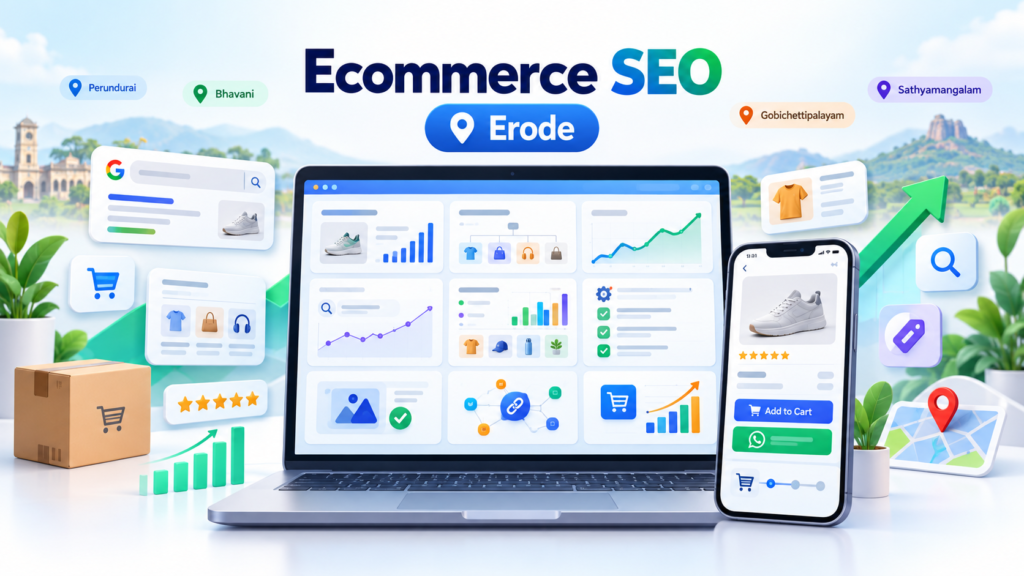
Ecommerce SEO in Erode helps online stores, Shopify websites, WooCommerce stores, D2C brands, textile ecommerce businesses, jewellery stores, gift shops, furniture businesses, fashion brands and other product-based companies improve product visibility on Google.
Launching an ecommerce website and uploading products does not automatically bring organic traffic. Search engines need clear information about your categories, products, variants, images, URLs, internal links and website structure before they can properly understand and index your store.
A strong ecommerce SEO strategy focuses on both product page SEO and category page SEO, supported by technical SEO, image optimization, structured data, internal linking and useful customer-focused content.
At Greap Technologies, we provide ecommerce SEO support in Erode for businesses using Shopify, WooCommerce and custom ecommerce websites.
Quick Answer
Ecommerce SEO in Erode is the process of optimizing an online store so its product pages, category pages and other shopping pages can become easier for search engines to discover, understand and rank for relevant searches.
Important ecommerce SEO activities include:
- Keyword research
- Category page SEO
- Product page SEO
- Product title optimization
- Unique product descriptions
- Image SEO
- SEO-friendly URLs
- Product variant optimization
- Internal linking
- Faceted navigation management
- Canonical tags
- Product structured data
- Technical SEO
- Page speed optimization
- Mobile optimization
- Local SEO where genuinely relevant
- Conversion tracking
A properly optimized ecommerce website can support more organic product discovery, category traffic, enquiries and online sales opportunities.
Ecommerce SEO in Erode: Overview
| SEO Area | Main Purpose |
|---|---|
| Product Page SEO | Improve visibility for specific products and buyer-intent searches |
| Category Page SEO | Target broader product-group searches |
| Technical SEO | Improve crawling, indexing, speed and duplicate-page control |
| Image SEO | Improve image delivery and product understanding |
| Internal Linking | Connect categories, products and supporting content |
| Local SEO | Support stores with genuine Erode-based pickup, delivery or showroom intent |
| Conversion Tracking | Measure product views, enquiries, carts, checkouts and purchases |
What Is Ecommerce SEO?
Ecommerce SEO is the process of improving an online store so search engines can understand its products, categories and website structure and show relevant pages for shopping-related searches.
It can include:
- Product page optimization
- Category page optimization
- Keyword research
- Content optimization
- Image optimization
- Structured data
- Internal linking
- URL optimization
- Duplicate-content management
- Technical SEO
- Mobile performance
- Page speed
An ecommerce business may target searches such as:
- Sarees online
- Jewellery online store
- Furniture online
- Gift products online
- Home decor products
- Women’s clothing online
- Textile products online
- Product name searches
- Category + location searches where relevant
Why Product and Category Pages Matter
Product and category pages normally carry the strongest commercial search intent on an ecommerce website.
Product Pages
Product pages focus on a specific item.
Examples:
- Cotton Printed Saree
- Gold-Plated Necklace
- Wooden Dining Table
- Personalized Gift
- Organic Turmeric Powder
A product page should help customers understand a specific item and decide whether to enquire, add it to cart or purchase it.
Category Pages
Category pages target broader product groups.
Examples:
- Sarees
- Necklaces
- Furniture
- Gifts
- Home Decor
- Electronics
- Beauty Products
Category pages are important because many customers search for a product type before choosing an individual product.
How to Optimize Product Pages for Ecommerce SEO
1. Use Clear Product Titles
Product titles should describe the item naturally.
Weak:
Beautiful Model 101
Better:
Cotton Printed Saree for Women
A useful product title may include:
- Product type
- Material
- Main feature
- Size or variant where useful
- Brand where relevant
Avoid forcing location names into every product title. Add Erode or another location only when the page genuinely targets local shopping intent.
2. Write Unique Product Descriptions
Important product pages should have original, useful descriptions instead of copied manufacturer text.
A useful product description can explain:
- Product overview
- Material
- Dimensions
- Available variants
- Colour options
- Applications or usage
- Care instructions
- Delivery information
- Return or replacement information
Write for customers first. Keywords should appear naturally.
3. Use Clear Product Features
Bullet points make important information easier to scan.
- Material
- Dimensions
- Weight
- Available colours
- Compatibility
- Usage
- Care information
4. Use Clean Product URLs
Weak:
/product?id=12345
Better:
/product/cotton-printed-saree/
Good ecommerce URLs should normally be:
- Readable
- Short
- Descriptive
- Lowercase
- Separated with hyphens
Changing live URLs purely to add keywords can create unnecessary redirect and indexing issues. Existing URLs should be changed only when there is a clear SEO or usability reason.
5. Optimize Product Images
Product images affect both shopping experience and site performance.
Useful practices include:
- Clear product photography
- Descriptive filenames
- Accurate ALT text
- Image compression
- Correct dimensions
- Modern formats where supported
- Responsive image delivery
- Lazy loading where appropriate
Example filename:
cotton-printed-saree.webp
Example ALT text:
Blue cotton printed saree for women
ALT text should accurately describe the image rather than repeat keywords unnecessarily.
6. Handle Product Variants Properly
Products may have size, colour, material or model variants.
The SEO structure should avoid creating large numbers of near-duplicate indexable pages for minor variations unless a variant has genuine independent search demand.
Variant planning can include:
- One main product URL with selectable variants
- Consistent canonical handling
- Unique variant URLs only where useful
- Correct price and availability information
- Clear variant names
7. Add Useful Product FAQs
FAQs can answer common buying questions such as:
- What material is used?
- Which sizes are available?
- How long does delivery take?
- Is store pickup available?
- What is the return or replacement policy?
- Can I order through WhatsApp?
FAQ content should be visible on the page and genuinely useful.
8. Use Accurate Product Structured Data
Product structured data can help search engines understand product information.
Depending on the website and available information, structured data may include:
- Product name
- Images
- Description
- SKU
- Brand
- Offers
- Price
- Currency
- Availability
- Reviews or ratings where genuine and eligible
Do not add fabricated reviews, ratings, prices or availability information to structured data.
9. Add Related Products and Internal Links
Useful internal links may include:
- Related products
- Similar products
- Parent category
- Matching accessories
- Best sellers
- Relevant buying guides
This can help users continue browsing while helping search engines discover related pages.
10. Improve Product Page Speed
Product pages often contain several images and scripts.
Speed improvements may include:
- Image compression
- Responsive images
- Lazy loading
- Reduced unnecessary scripts
- Optimized fonts
- Browser caching
- Good hosting
- Optimized product galleries
How to Optimize Category Pages for Ecommerce SEO
1. Build Useful Category Pages
A category page should do more than display a product grid.
A strong category page can include:
- Clear H1
- Short introduction
- Product grid
- Useful filters
- Sorting
- Subcategories
- Internal links
- Buying guidance
- FAQs
2. Target One Main Search Intent per Category
Examples:
- Women’s Sarees
- Bridal Jewellery
- Wooden Furniture
- Birthday Gifts
- Home Decor
Avoid creating several category pages targeting the same keyword without a meaningful difference in products or search intent.
3. Keep Introductory Content Short
Customers normally want to see products quickly.
A useful structure is:
Short introduction → Product grid → Supporting content → FAQs
This keeps shopping usability strong while still giving search engines useful category context.
4. Use Subcategories
Subcategories can improve both navigation and SEO.
Example clothing structure:
Clothing → Women → Sarees → Cotton Sarees
Example jewellery structure:
Jewellery → Necklaces → Bridal Necklaces
5. Manage Filters and Faceted Navigation Carefully
Filters can create hundreds or thousands of URL combinations.
Examples:
- ?colour=blue
- ?size=m
- ?price=1000-2000
- ?brand=example
If every filter combination becomes indexable, the website may create duplicate or low-value pages.
A technical SEO plan should determine:
- Which filter pages should be crawlable
- Which should be indexable
- Which need canonical handling
- Which should be excluded from search results
- Which high-demand filters deserve dedicated landing pages
6. Add Category FAQs
Useful questions may include:
- How do I choose the right product?
- Which sizes are available?
- Do you deliver to my location?
- Can I order through WhatsApp?
- What payment options are available?
- What is your return policy?
7. Link Related Categories
For example:
Sarees → Cotton Sarees → Silk Sarees → Blouse Materials → Women’s Accessories
Good internal linking helps distribute authority and improves product discovery.
Product Page SEO vs Category Page SEO
| SEO Area | Product Page | Category Page |
|---|---|---|
| Main Goal | Rank a specific product | Rank a product group |
| Keyword Intent | Specific | Broader shopping intent |
| Primary Content | Product information | Products + category context |
| Primary CTA | Add to Cart / Buy / Enquire | Browse Products |
| Internal Links | Category + related products | Subcategories + products |
Out-of-Stock and Discontinued Product SEO
Removing every unavailable product page immediately can waste existing search visibility and backlinks.
Temporarily Out of Stock
Where the product is expected to return:
- Keep the page live
- Show accurate availability
- Offer restock notification where supported
- Show related products
Permanently Discontinued
Depending on the situation:
- Redirect to a very close replacement
- Redirect to the relevant category when appropriate
- Keep the page temporarily if it still provides useful information
- Use a proper 404/410 response where no useful replacement exists
Avoid redirecting every discontinued product to the homepage.
Internal Linking Structure for Ecommerce Websites
A clear internal structure may follow:
Home → Main Category → Subcategory → Product
Supporting blog content can link back to commercial pages:
Buying Guide → Category → Product
Useful internal links help search engines understand which pages are most important.
Technical SEO for Ecommerce Websites
Ecommerce websites often have hundreds or thousands of URLs, making technical SEO especially important.
Important checks include:
- XML sitemap
- Robots.txt
- Canonical tags
- Indexability
- Duplicate content
- Filter URLs
- Pagination
- Broken links
- 404 pages
- Redirects
- HTTPS
- Breadcrumbs
- Structured data validation
- Mobile usability
- Core performance
Ecommerce SEO for Shopify Stores
Shopify ecommerce SEO can include:
- Collection page optimization
- Product page optimization
- Product titles
- Descriptions
- Image ALT text
- Navigation
- Internal linking
- Structured data checks
- Blog content
- Canonical checks
- Speed improvements
Shopify collection pages should normally be treated as important category pages.
Ecommerce SEO for WooCommerce Stores
WooCommerce SEO can include:
- Product category SEO
- Product page SEO
- SEO plugin configuration
- Breadcrumbs
- Structured data
- Product variation handling
- Image optimization
- Sitemap checks
- Canonical setup
- Filter URL management
- Database and speed optimization
WooCommerce provides strong flexibility, but plugins, filters and product variations should be managed carefully to avoid unnecessary URLs and performance issues.
Local Ecommerce SEO in Erode
Ecommerce SEO in Erode can include local SEO when a business genuinely serves Erode customers through a physical store, showroom, local delivery service or pickup option.
Local ecommerce SEO can include:
- Accurate Erode business information
- Google Business Profile
- Store or pickup location
- Google Maps
- Local delivery information
- Local FAQs
- Genuine customer reviews
- Contact details
- WhatsApp enquiry option
Relevant service areas may include Erode, Perundurai, Bhavani, Anthiyur, Gobichettipalayam, Sathyamangalam, Modakkurichi, Kodumudi, Nambiyur, Chennimalai, Kavindapadi, Ammapettai, Arachalur, Sivagiri, Solar, Surampatti and nearby areas where the business genuinely serves customers.
Avoid creating near-identical location pages only to target place names.
Conversion Tracking for Ecommerce SEO
SEO performance should not be measured using rankings alone.
Useful ecommerce actions include:
- Organic sessions
- Product views
- Category views
- Product enquiries
- WhatsApp clicks
- Add-to-cart actions
- Checkout starts
- Purchases
- Revenue
- Conversion rate
Product view → Add to Cart → Checkout → Purchase is a typical ecommerce conversion journey.
An add-to-cart, WhatsApp click or checkout start should not automatically be counted as a completed sale.
AI Search Optimization for Ecommerce Websites
Clear, structured and accurate ecommerce content can make product and category information easier for search engines and AI systems to understand.
Useful practices include:
- Clear product names
- Structured product details
- Accurate specifications
- Useful category introductions
- FAQs
- Descriptive images
- Consistent terminology
- Relevant structured data
- Strong internal linking
There is no guaranteed method to make an AI system rank, cite or recommend an ecommerce store or product. Accurate product information and useful customer-focused content should remain the priority.
Useful Definitions
Ecommerce SEO is the process of optimizing an online store so product pages and category pages are easier for search engines to discover and understand.
Product page SEO focuses on individual products through titles, descriptions, images, structured data, internal links and technical optimization.
Category page SEO focuses on groups of related products through category structure, keywords, product listings, internal links and supporting content.
Ecommerce SEO Checklist
| SEO Task | Recommendation |
|---|---|
| Keyword Research | Required |
| Product Title Optimization | Required |
| Unique Product Descriptions | Required for important products |
| Category Page Optimization | Required |
| SEO-Friendly URLs | Required |
| Image Optimization | Required |
| Internal Linking | Required |
| Mobile Optimization | Required |
| Technical SEO | Required |
| Canonical Tags | Required where applicable |
| Faceted Navigation Control | Required for stores using filters |
| Product Structured Data | Recommended |
| FAQs | Recommended |
| Local SEO | Based on business model |
| Conversion Tracking | Recommended |
| Monthly SEO Monitoring | Recommended |
Common Ecommerce SEO Mistakes
1. Copying Product Descriptions
Use original product information wherever practical, especially for important commercial pages.
2. Empty Category Pages
Category pages need useful context, internal links and navigation.
3. Poor Product Titles
Use descriptive titles customers can understand.
4. Keyword Stuffing Product Names
Do not force location names, features or repeated keywords into every product title.
5. Missing Image Optimization
Large uncompressed images can slow ecommerce pages.
6. No Internal Linking
Categories, subcategories, products and blogs should connect logically.
7. Uncontrolled Filter URLs
Faceted navigation can create thousands of duplicate or low-value pages.
8. Incorrect Structured Data
Schema should match the information visible on the page.
9. Poor Mobile Experience
Shopping, filtering and checkout should work smoothly on mobile devices.
10. Expecting Immediate SEO Results
Ecommerce SEO requires ongoing technical improvements, content optimization and monitoring.
How Greap Technologies Helps
Greap Technologies helps ecommerce businesses in Erode improve product visibility, category structure and technical search performance.
Our ecommerce SEO services can include:
- Ecommerce SEO audits
- Keyword research
- Product page SEO
- Category page SEO
- Shopify SEO
- WooCommerce SEO
- Product description optimization
- Category content
- Image SEO
- Technical SEO
- Faceted navigation review
- Internal linking
- Structured data implementation
- Local SEO
- Conversion tracking support
- Monthly SEO monitoring
Explore related Greap services:
- Ecommerce Website Development
- SEO Services
- Digital Marketing Services
- Website Development
- Custom Software Development
Conclusion
Ecommerce SEO in Erode can help online stores improve product discovery, category visibility and organic traffic.
A strong ecommerce SEO strategy should combine product page optimization, category page SEO, image optimization, internal linking, structured data, technical SEO, faceted-navigation management, mobile performance and conversion tracking.
SEO cannot guarantee specific rankings, traffic levels or sales. Ecommerce results also depend on product demand, pricing, competition, customer trust, delivery, website experience and checkout performance.
Need Ecommerce SEO for Your Online Store in Erode?
Greap Technologies can help improve product pages, category pages, technical SEO, image optimization, internal linking and ecommerce search visibility.
Frequently Asked Questions
1. What is ecommerce SEO in Erode?
Ecommerce SEO helps online stores improve search visibility for product pages, category pages and other shopping-related searches.
2. How can product pages rank better?
Product pages can be improved with clear titles, original descriptions, optimized images, structured data, internal links, useful product information and strong technical performance.
3. How can category pages rank better?
Category pages can be strengthened using clear search intent, product listings, subcategories, internal links, useful supporting content and proper technical SEO.
4. Are product descriptions important for ecommerce SEO?
Yes. Useful and original descriptions can help customers and search engines understand the product better.
5. Is image SEO important?
Yes. Ecommerce images should be clear, compressed, responsive and supported by descriptive filenames and accurate ALT text.
6. What is category page SEO?
Category page SEO is the process of optimizing product-group pages so they better match broader shopping searches.
7. Is Shopify SEO different from WooCommerce SEO?
The SEO principles are similar, but technical implementation differs because Shopify and WooCommerce use different URL, template, plugin and product-management systems.
8. Can ecommerce SEO increase sales?
SEO can improve organic product discovery and traffic. Sales also depend on pricing, product quality, trust, delivery, usability and checkout experience.
9. How long does ecommerce SEO take?
There is no fixed timeline. Results depend on website condition, competition, product range, content quality, technical issues and ongoing SEO work.
10. Can Greap Technologies provide ecommerce SEO in Erode?
Yes. Greap Technologies provides product page SEO, category page SEO, Shopify SEO, WooCommerce SEO, technical SEO and ecommerce website optimization support for businesses in Erode district.