Ecommerce SEO Services in Erode
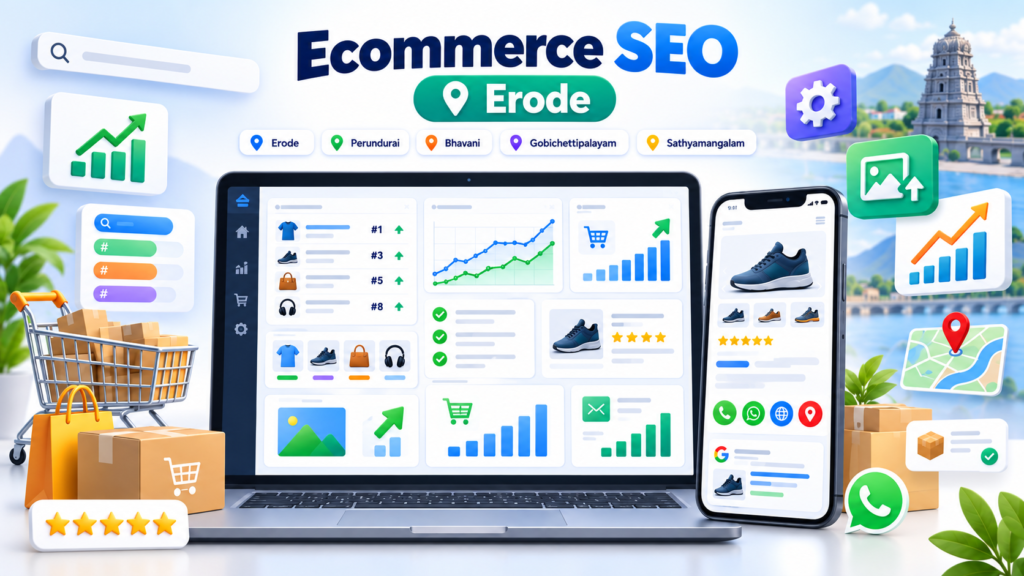
Ecommerce SEO Services in Erode help online stores, retail shops, D2C brands, textile businesses, jewellery stores, grocery shops, fashion brands, furniture businesses, electronics sellers and other product-based companies improve the visibility of their products and categories on Google.
Customers often search online before buying. They compare product details, prices, specifications, photos, reviews, delivery options, return policies and brand credibility before adding an item to the cart or sending an enquiry.
Having an ecommerce website alone does not guarantee that customers will discover it. Product pages, category pages, website architecture and technical SEO need to be structured so search engines can understand the store and customers can find relevant products easily.
At Greap Technologies, we provide Ecommerce SEO Services in Erode to help ecommerce businesses improve product discovery, organic search visibility and long-term digital growth.
Quick Answer: What Are Ecommerce SEO Services?
Ecommerce SEO is the process of optimizing an online store so its category pages, product pages and supporting content can become more visible for relevant customer searches.
Ecommerce SEO can include:
- Ecommerce SEO audit
- Keyword research
- Category page SEO
- Product page SEO
- Product-description optimization
- Image SEO
- Technical SEO
- Internal linking
- Product and breadcrumb structured data
- Duplicate-content management
- Filter and faceted-navigation planning
- Product-variant SEO
- Shopify SEO
- WooCommerce SEO
- Blog and buying-guide content
- Local SEO where relevant
- Conversion and revenue tracking
SEO can support product discovery and organic sales opportunities, but it cannot guarantee rankings, traffic or a fixed number of orders. Ecommerce performance also depends on pricing, product demand, availability, competition, trust, delivery, checkout experience and marketing.
Ecommerce SEO Services in Erode: Overview
| Detail | Information |
|---|---|
| Service | Ecommerce SEO Services in Erode |
| Provider | Greap Technologies |
| Suitable For | Online stores, retail shops, D2C brands and product-based businesses |
| Main Goal | Improve relevant product and category search visibility |
| Core SEO Areas | Category SEO, product SEO, technical SEO, image SEO, internal linking and content |
| Platforms | Shopify, WooCommerce and custom ecommerce websites |
| Important Conversions | Product views, add to cart, checkout, purchase, WhatsApp enquiry and quote request |
| Service Area | Erode District and businesses serving wider markets |
What Is Ecommerce SEO?
Ecommerce SEO is the process of improving an online store so search engines can understand its products, categories and website structure while customers can discover relevant items more easily.
Ecommerce SEO is usually more complex than SEO for a standard business website because online stores may contain:
- Hundreds or thousands of products
- Product categories
- Subcategories
- Variants
- Filters
- Sorting URLs
- Product images
- Out-of-stock items
- Pagination
- Cart and checkout pages
- Customer accounts
- Reviews
A strong strategy should therefore combine content SEO, website architecture and technical SEO.
Why Ecommerce SEO Matters for Online Stores in Erode
Many online stores invest in website development and paid advertising but do not create a proper organic-search foundation.
Common ecommerce SEO problems include:
- Category pages with no useful content
- Duplicate product descriptions
- Missing SEO titles
- Duplicate meta information
- Weak internal linking
- Unoptimized images
- Slow product pages
- Poor mobile usability
- Uncontrolled filter URLs
- Incorrect canonical tags
- Thin product pages
- Missing structured data
- Broken links from removed products
Ecommerce SEO can support:
- Product discovery
- Category visibility
- Organic traffic
- Buyer-intent traffic
- Brand visibility
- Long-tail product searches
- Reduced dependence on one paid channel
- Better website structure
- Long-term search growth
Which Businesses Can Benefit from Ecommerce SEO?
1. Online Stores
Any business selling products through a website can benefit from product, category and technical SEO.
2. Retail Shops
Local retail businesses can combine ecommerce SEO with local search and store-pickup information.
3. Textile and Fashion Stores
Saree shops, boutiques, garment brands and textile sellers can optimize collections, materials, styles, occasions and product pages.
4. Jewellery Stores
Jewellery businesses can optimize collection, design, material and occasion-focused pages.
5. Grocery and Food Stores
Grocery, snacks and food brands can optimize categories, individual products and local-delivery pages.
6. Gift and Home Décor Brands
Gift businesses can target occasion-based and recipient-based search intent such as birthdays, anniversaries and housewarming.
7. Furniture Businesses
Furniture stores can optimize room-wise, product-type and material-based categories.
8. Electronics Stores
Electronics businesses can optimize product categories, specifications, brand pages and comparison content.
9. Shopify Stores
Shopify stores can improve collections, products, content architecture, images, speed and internal linking.
10. WooCommerce Stores
WooCommerce businesses can optimize products, categories, WordPress content, technical setup and structured data.
Main Ecommerce SEO Services We Provide
1. Ecommerce Website SEO Audit
An ecommerce SEO audit helps identify structural, technical and content problems affecting product discovery.
The audit can review:
- Category architecture
- Product URLs
- Product metadata
- Duplicate content
- Canonical tags
- Filter URLs
- Pagination
- Indexability
- XML sitemap
- Internal linking
- Structured data
- Image performance
- Mobile usability
- Page speed
- Broken product links
2. Ecommerce Keyword Research
Keyword research should map customer searches to the correct website level.
Keyword groups can include:
- Category keywords
- Subcategory keywords
- Product keywords
- Material keywords
- Colour or style keywords
- Use-case keywords
- Occasion keywords
- Comparison searches
- Buying-guide searches
- Local product searches
Not every keyword should target an individual product page. Broader commercial terms are usually better suited to category or collection pages.
3. Category Page SEO
Category pages are often some of the most important organic landing pages in ecommerce.
A strong category page can include:
- Clear category title
- Relevant introduction
- Product listings
- Useful filters
- Internal links
- Subcategory links
- Buying guidance
- FAQs where useful
- SEO metadata
- Breadcrumbs
Category copy should help the shopper rather than simply repeating keywords.
4. Product Page SEO
Product pages should provide enough useful information to support both search visibility and purchase decisions.
A strong product page can include:
- Product name
- Clear product description
- Key features
- Specifications
- Material details
- Size or dimensions
- Available variants
- Product photographs
- Delivery information
- Return or replacement information
- Reviews where genuine
- Related products
- FAQs where appropriate
- Structured product data
5. Product Description Optimization
Product descriptions should be original and written for customers.
Useful information can include:
- What the product is
- Who it is suitable for
- Key benefits
- Material
- Dimensions
- Usage
- Care instructions
- Compatibility where relevant
- Delivery expectations
Copying supplier descriptions across many stores can make it difficult to create unique search value.
6. Product Variant SEO
Variants require careful planning.
Examples include:
- Colour
- Size
- Material
- Storage capacity
- Pack size
- Style
Not every variant needs a separate indexable URL. Whether variants should have unique URLs depends on search demand, product differences and website architecture.
7. Image SEO
Product-heavy stores need efficient image optimization.
Image SEO can include:
- Descriptive filenames
- Relevant ALT text
- Appropriate dimensions
- Image compression
- Modern image formats where supported
- Lazy loading where appropriate
- Optimized product galleries
ALT text should accurately describe the image instead of being stuffed with keywords.
8. Technical Ecommerce SEO
Technical SEO is especially important for large stores.
It can include:
- Crawlability
- Indexability
- Canonical setup
- XML sitemap
- Robots directives
- Redirects
- Broken-link management
- Pagination
- Filter URL handling
- Duplicate URL control
- Structured data
- Mobile usability
- Page performance
- HTTPS
Faceted Navigation and Filter SEO
Filters are useful to shoppers but can create thousands of URL combinations.
Examples include:
- Colour filters
- Size filters
- Price ranges
- Material filters
- Brand filters
- Availability filters
- Sorting options
Allowing every filter combination to become indexable can create crawl waste and duplicate content.
An ecommerce SEO strategy should decide:
- Which filtered pages deserve search visibility
- Which URLs should remain crawlable
- Which should not be indexed
- How canonical URLs should be handled
- How internal links should be structured
Out-of-Stock and Discontinued Product SEO
Products frequently become temporarily unavailable or permanently discontinued.
Temporarily Out of Stock
If the product is expected to return, keeping the page live can often preserve useful search value while clearly showing availability status.
Permanently Discontinued
Depending on the situation, options can include:
- Redirecting to a close replacement
- Redirecting to a relevant category
- Keeping an informative page where useful
Large-scale automatic redirects to unrelated products should be avoided.
Shopify SEO
Shopify SEO can include:
- Collection optimization
- Product optimization
- SEO metadata
- Internal linking
- Image ALT text
- Blog content
- Duplicate-content review
- App impact review
- Structured-data review
- Page-performance guidance
WooCommerce SEO
WooCommerce SEO can include:
- Product page optimization
- Product-category SEO
- WordPress SEO configuration
- Product schema review
- Image optimization
- Internal linking
- Blog strategy
- Technical SEO
- Performance improvements
- Mobile optimization
Ecommerce Internal Linking Strategy
Internal links help distribute relevance and make product discovery easier.
A useful structure can be:
Home → Category → Subcategory → Product
Additional internal links can connect:
- Related categories
- Related products
- Best sellers
- Buying guides
- Product-care guides
- Comparison articles
Breadcrumb navigation can also help customers understand where they are in the store hierarchy.
Structured Data for Ecommerce Websites
Relevant structured data can help search engines understand ecommerce pages.
Depending on the page and implementation, this may include:
- Product
- Offer
- AggregateRating where genuine and eligible
- Review where appropriate
- BreadcrumbList
- Organization
- WebSite
Structured data should accurately match visible page content. Do not mark up fake reviews, incorrect pricing or unavailable offers.
Ecommerce Blog and Content SEO
Informational content can attract users before they are ready to purchase and support important commercial categories.
Useful formats include:
- Buying guides
- Gift guides
- Product comparisons
- Material guides
- Product-care articles
- Size guides
- Style guides
- Seasonal guides
- Use-case content
A blog should link naturally to relevant products and categories instead of functioning as an isolated content section.
SEO Strategy for Ecommerce Businesses in Erode
Step 1: Understand the Product Catalogue
Identify:
- Main product categories
- High-margin categories
- Best sellers
- Seasonal products
- Customer types
- Delivery areas
- Current traffic
- Current conversion performance
Step 2: Build a Keyword-to-Page Map
Decide which keyword themes belong to categories, subcategories, products or informational pages.
Step 3: Optimize Category Pages
Start with commercially important categories and build strong structure, content and internal linking.
Step 4: Optimize Priority Products
High-demand and strategically important products can be prioritized before optimizing the full catalogue.
Step 5: Fix Technical SEO
Resolve crawl, duplicate-content, canonical, filtering and performance issues.
Step 6: Build Supporting Content
Create buying guides and informational pages that support important categories.
Step 7: Measure Organic Revenue and Enquiries
Track both search visibility and business outcomes.
Recommended Ecommerce Website Structure
Home
 └── Shop
      ├── Main Category
      │    ├── Subcategory
      │    │    ├── Product
      │    │    └── Product
      │    └── Subcategory
      └── Main Category

Blog / Guides
About
Contact
Shipping Policy
Return / Replacement Policy
Privacy Policy
The structure should stay understandable without creating unnecessary category levels.
Local SEO for Ecommerce Stores in Erode
Ecommerce SEO Services in Erode can include local SEO where the store has a physical showroom, offers local pickup or delivery, or genuinely targets customers in Erode District.
Local SEO can include:
- Accurate store address
- Google Business Profile
- Google Maps
- Store-opening hours
- Local pickup information
- Local-delivery information
- Phone and WhatsApp contact
- Local customer reviews
- Relevant Erode content
Businesses may genuinely serve customers from areas such as Erode, Perundurai, Bhavani, Anthiyur, Gobichettipalayam, Sathyamangalam, Modakkurichi, Kodumudi, Nambiyur, Chennimalai, Kavindapadi and nearby areas.
Location pages should only be created when the business genuinely serves that area and can provide useful unique information.
Ecommerce SEO for Different Industries
Textile and Fashion Ecommerce
Focus areas can include:
- Category SEO
- Material pages
- Occasion pages
- Size guides
- Product variants
- Image SEO
- Style content
Jewellery Ecommerce
Focus areas can include:
- Collection pages
- Material pages
- Occasion-based jewellery
- Design categories
- High-quality images
- Trust content
Grocery Ecommerce
Focus areas can include:
- Product-category architecture
- Availability
- Local delivery
- Bulk products
- Product attributes
Gift Ecommerce
Useful category themes can include:
- Birthday gifts
- Anniversary gifts
- Couple gifts
- Housewarming gifts
- Festival gifts
- Corporate gifts
Furniture Ecommerce
Focus areas can include:
- Room categories
- Furniture types
- Materials
- Dimensions
- Custom enquiries
- Delivery information
Google Search to Ecommerce Purchase Journey
A typical organic ecommerce journey can look like:
Google Search → Category / Product Page → Product Evaluation → Add to Cart → Checkout → Purchase
For high-value or enquiry-led products:
Google Search → Product Page → WhatsApp / Quote Request → Sales Follow-Up → Order
| Stage | Meaning |
|---|---|
| Organic Visit | User arrives through unpaid search |
| Product View | User views a product page |
| Add to Cart | Product is added to the cart |
| Checkout Started | User begins checkout |
| Purchase | Order is successfully completed and verified |
An add-to-cart action, WhatsApp click or checkout start should not automatically be reported as a completed sale.
SEO and AI Search Optimization for Ecommerce
Clear and well-structured product information can also make ecommerce pages easier for modern search and AI systems to understand.
Useful practices include:
- Accurate product information
- Clear category descriptions
- Structured attributes
- Helpful comparison content
- FAQs
- Buying guides
- Consistent brand information
- Genuine reviews
- Strong internal linking
- Updated availability and pricing
There is no guaranteed method to make an AI system cite or recommend a product. The priority should be accurate, useful and trustworthy product information.
Ecommerce SEO Content Plan
Commercial Pages
- Main Product Categories
- Subcategories
- Best Sellers
- New Arrivals
- Occasion Collections
- Material Collections
- Brand Collections
Supporting Content
- Product Buying Guides
- Best Products for Specific Use Cases
- Comparison Guides
- Gift Guides
- Size Guides
- Material Guides
- Product Care Guides
- Seasonal Shopping Guides
Ecommerce SEO Practical Checklist
| SEO Activity | Recommendation |
|---|---|
| Ecommerce SEO Audit | Required |
| Keyword Research | Required |
| Keyword-to-Page Mapping | Required |
| Category SEO | Required |
| Product SEO | Required |
| Unique Product Content | Required |
| Image ALT Text | Required |
| Technical SEO | Required |
| Mobile Optimization | Required |
| Page Performance | Required |
| Canonical / Duplicate Control | Required |
| Filter URL Strategy | Required for larger stores |
| Product Structured Data | Recommended |
| Breadcrumbs | Recommended |
| Internal Linking | Required |
| Blog / Buying Guides | Based on strategy |
| Local SEO | Based on business model |
| Conversion Tracking | Recommended |
Common Ecommerce SEO Mistakes to Avoid
1. Copying Supplier Product Descriptions
Important products should have useful original content where practical.
2. Thin Category Pages
Category pages should provide structure, context and useful navigation rather than only a product grid.
3. Indexing Every Filter Combination
Uncontrolled faceted URLs can create large amounts of duplicate or low-value content.
4. Poor Product Titles
Product names should be clear and descriptive without unnatural keyword repetition.
5. Missing Image Optimization
Large product images can negatively affect page performance.
6. Poor Mobile Experience
Product discovery, cart and checkout should work smoothly on mobile devices.
7. Weak Internal Linking
Categories, products and buying guides should be logically connected.
8. Removing Products Without SEO Planning
Deleted product URLs can create broken links and lose useful search equity.
9. Incorrect Structured Data
Pricing, availability, reviews and other markup should match visible and accurate page information.
10. Measuring Traffic Without Revenue
Ecommerce SEO should eventually be connected with product, checkout and purchase performance.
How Greap Technologies Helps with Ecommerce SEO in Erode
Greap Technologies helps ecommerce businesses improve website architecture, product visibility and organic-search performance through structured SEO planning.
Our ecommerce SEO services can include:
- Ecommerce SEO audit
- Product keyword research
- Category keyword research
- Keyword mapping
- Category page SEO
- Product page SEO
- Product description optimization
- Product variant planning
- Image SEO
- Technical ecommerce SEO
- Filter and canonical planning
- Shopify SEO
- WooCommerce SEO
- Internal linking
- Structured-data review
- Blog and buying-guide SEO
- Local SEO where relevant
- Page-performance improvements
- Conversion tracking
- SEO reporting
Explore related Greap services:
- SEO Services
- Ecommerce Development
- Website Development Services
- Digital Marketing Services
- API Integration Services
- Custom Software Development
Why Choose Greap Technologies for Ecommerce SEO?
Ecommerce-Focused SEO Planning
We can structure SEO around products, categories, customer intent and the online purchase journey.
SEO and Ecommerce Development Support
Technical and structural issues can be addressed alongside ecommerce development where required.
Shopify and WooCommerce SEO
SEO can be adapted to the platform and business model instead of applying one generic process.
Useful Product and Category Content
We focus on clear customer-focused content rather than keyword-stuffed descriptions.
Conversion-Focused Measurement
Organic performance can be connected to product views, add-to-cart, checkout, purchases and enquiries.
Complete Digital Support
Greap Technologies also supports ecommerce development, Google Ads, Meta Ads, CRM, order-management systems and custom software.
Conclusion
Ecommerce SEO Services in Erode can help online stores improve relevant product and category visibility, attract organic shoppers and build a stronger long-term search foundation.
A strong ecommerce SEO strategy can combine keyword research, category SEO, product SEO, original product descriptions, image optimization, technical SEO, structured data, internal linking, content marketing and conversion tracking.
SEO does not guarantee online sales, but consistent improvements to search visibility, product information, website performance, trust and user experience can support ecommerce growth over time.
Greap Technologies helps ecommerce businesses in Erode build SEO strategies around their catalogue, customers and long-term digital-growth goals.
Need Ecommerce SEO Services in Erode?
Greap Technologies can help with category SEO, product SEO, Shopify SEO, WooCommerce SEO, image optimization, technical SEO, content, internal linking and conversion tracking.
Frequently Asked Questions
1. What are ecommerce SEO services in Erode?
Ecommerce SEO services in Erode can include category SEO, product SEO, keyword research, image optimization, technical SEO, internal linking, structured data and organic-performance tracking.
2. Why does an ecommerce website need SEO?
SEO can help customers discover relevant products and categories through search engines and can support long-term organic traffic.
3. What is product page SEO?
Product page SEO involves optimizing product information, metadata, images, specifications, internal links and relevant structured data so the page is useful to customers and understandable to search engines.
4. What is category page SEO?
Category page SEO involves optimizing category structure, product listings, useful content, metadata, internal links, subcategories, filters and navigation.
5. Can SEO increase ecommerce sales?
SEO can support online sales by attracting relevant product searches. Actual sales also depend on product demand, pricing, trust, availability, delivery, checkout experience and other marketing factors.
6. Do Shopify stores need SEO?
Yes. Shopify stores can benefit from collection SEO, product optimization, image SEO, internal linking, technical improvements and useful supporting content.
7. Do WooCommerce stores need SEO?
Yes. WooCommerce SEO can include product, category, WordPress, technical, image and content optimization.
8. Is local SEO useful for ecommerce businesses?
Local SEO can be useful when an ecommerce business has a physical store, offers local pickup or delivery, or genuinely targets customers in a defined location.
9. How long does ecommerce SEO take?
There is no fixed timeline. Results depend on the website’s current condition, catalogue size, competition, product demand, technical setup, content quality and ongoing optimization.
10. Can Greap Technologies provide ecommerce SEO services in Erode?
Yes. Greap Technologies provides ecommerce SEO support for Shopify, WooCommerce and custom online stores based on their products, categories and business requirements.