
Order Management Software for Ecommerce Businesses in Erode
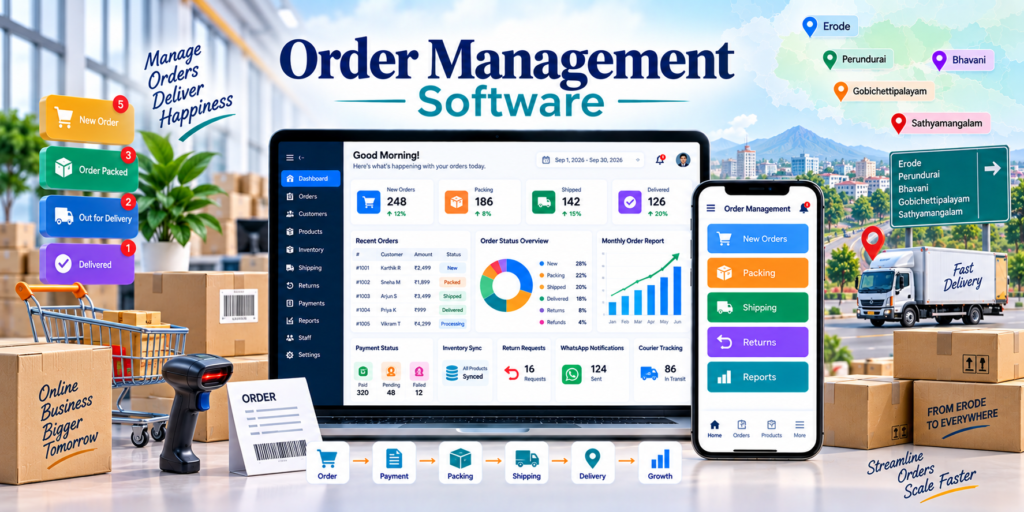
Order management software for ecommerce businesses in Erode helps online stores, D2C brands, textile ecommerce businesses, fashion brands, grocery sellers, electronics stores, wholesale ecommerce businesses and product-based companies manage orders, payments, inventory, packing, shipping, returns and customer updates in one structured system.
Ecommerce operations continue after the customer places an order. The business must confirm payment, reserve stock, pick products, pack the order, generate shipping details, hand the shipment to a courier, track delivery and handle cancellations, returns or refunds when required.
When these activities are managed through spreadsheets, individual WhatsApp chats or separate dashboards, order status can become difficult to control as daily volume increases.
At Greap Technologies, we provide order management software for ecommerce businesses in Erode, helping online businesses build practical and scalable order-management systems around their actual ecommerce workflow.
Quick Answer: What Is Ecommerce Order Management Software?
Ecommerce order management software, often called an OMS, is a system that helps manage a customer order from creation through payment, stock allocation, packing, shipping, delivery, cancellation, return or refund.
A custom ecommerce OMS can include:
- Order dashboard
- Order import and creation
- Customer management
- Product and variant management
- Inventory synchronization
- Reserved stock tracking
- Payment status
- COD management
- Picking and packing
- Invoice generation
- Shipping label generation
- Courier integration
- Tracking updates
- Delivery status
- RTO tracking
- Cancellation management
- Return and exchange management
- Refund tracking
- Staff access
- Reports and analytics
The exact structure should match the website platform, number of products, daily order volume, shipping process and customer-support workflow.
Order Management Software for Ecommerce Businesses in Erode: Service Overview
| Detail | Information |
|---|---|
| Service | Order Management Software for Ecommerce Businesses |
| Company | Greap Technologies |
| Location | Erode, Tamil Nadu |
| Main Audience | Ecommerce stores, D2C brands, retailers, wholesalers and online sellers |
| Main Goal | Manage orders from payment and stock allocation through shipping and returns |
| Core Modules | Orders, customers, inventory, payments, packing, shipping, returns and reports |
| Best For | Fashion, textile, grocery, electronics, jewellery, gifts, furniture and D2C brands |
| Service Area | Erode District and nearby areas |
Why Ecommerce Businesses in Erode Need Order Management Software
Order growth can create operational complexity quickly. Even if the ecommerce website receives orders correctly, the fulfilment team still needs to know what must happen next.
Without a centralized OMS, it can become difficult to know:
- Which orders are new?
- Which payments are confirmed?
- Which orders are COD?
- Which items are out of stock?
- Which products are reserved for active orders?
- Which orders are waiting for packing?
- Which shipments are delayed?
- Which deliveries failed?
- Which orders became RTO?
- Which customers requested returns?
- Which refunds are pending?
- Which staff member updated each order?
An order management system gives the business one operational view of the complete order lifecycle.
What Types of Ecommerce Businesses Need Order Management Software?
1. D2C Brands
D2C brands can manage website orders, customer history, inventory, shipping, returns, refunds and repeat orders.
2. Textile Ecommerce Businesses
Textile ecommerce stores can manage sarees, garments, home textiles and product variants such as size, colour and design.
3. Fashion and Clothing Brands
Fashion businesses can track:
- Size variants
- Colour variants
- Prepaid orders
- COD orders
- Exchanges
- Returns
- Refunds
4. Grocery Ecommerce Businesses
Grocery businesses can manage daily orders, delivery slots, substitutions, cancelled items, customer addresses and delivery status.
5. Electronics Ecommerce Stores
Electronics businesses can track high-value orders, serial numbers where required, installation requests, warranty references and delivery status.
6. Jewellery Ecommerce Stores
Jewellery businesses can manage payment verification, secure packing, dispatch and customer communication for online orders.
7. Gift and Home Décor Brands
Gift businesses can manage personalized order details, packaging, production readiness, dispatch and delivery updates.
8. Furniture Ecommerce Businesses
Furniture businesses can track larger orders, delivery schedules, custom specifications and installation status.
9. Wholesale Ecommerce Businesses
Wholesale ecommerce businesses can manage bulk orders, dealer accounts, order approval, payment status and dispatch.
10. Instagram and WhatsApp Sellers
Businesses taking orders manually through WhatsApp or social media can enter those orders into one system instead of maintaining separate chats and spreadsheets.
Benefits of Order Management Software for Ecommerce Businesses
1. Better Order Visibility
Each order can contain:
- Order number
- Customer
- Products
- Variants
- Quantity
- Order value
- Payment method
- Payment status
- Shipping address
- Order status
- Courier
- Tracking number
- Notes
2. Faster Fulfilment Workflow
An OMS can organize orders through stages such as:
New Order → Payment Check → Stock Reserved → Picking → Packing → Ready to Ship → Shipped → Delivered
This gives each team a clear next action.
3. Better Inventory Reservation
Instead of showing only total stock, order management software can distinguish between:
- Available stock
- Reserved stock
- Sold stock
- Returned stock
- Damaged stock
This can help reduce overselling when synchronization is configured correctly.
4. Better Payment Tracking
Payment statuses can include:
- Prepaid
- COD
- Payment pending
- Payment failed
- Payment verified
- Partial payment
- Refund pending
- Refunded
5. Better Packing Accuracy
Packing teams can view a picking or packing list showing exactly which products and variants belong to an order.
Barcode-based packing can also be added for higher order volumes.
6. Better Shipping Control
The shipping workflow can track:
- Courier partner
- Tracking number
- Shipment date
- In transit
- Out for delivery
- Delivered
- Delivery failed
- RTO initiated
- RTO delivered
7. Better Returns and Exchanges
Returns can be connected with the original order, customer, product and payment.
8. Better Customer Support
Customer-support staff can search an order and quickly see payment, shipping, return and refund status.
9. Better Management Reports
Owners can review orders by product, payment mode, courier, return rate, cancellation rate and other operational metrics.
Important Modules in Ecommerce Order Management Software
1. Order Dashboard
The dashboard can show:
- Orders received today
- Pending payment
- Pending confirmation
- Waiting for packing
- Ready to ship
- In transit
- Delivered
- Cancelled
- Returns
- RTO
- Refunds pending
2. Order Management Module
The order module can support:
- Website orders
- Manual orders
- WhatsApp orders
- Order editing
- Status updates
- Order notes
- Order history
- Order cancellation
3. Product and Variant Management
Products can include:
- SKU
- Product name
- Category
- Size
- Colour
- Price
- Stock
4. Inventory Synchronization
Inventory sync can connect ecommerce orders with stock quantities.
A typical logic can be:
Available Stock → Order Confirmed → Stock Reserved → Order Shipped → Stock Deducted
The exact deduction point should be configured according to the business workflow.
5. Payment Module
The payment module can store:
- Payment method
- Transaction reference
- Payment status
- COD amount
- Partial-payment amount
- Refund amount
- Refund status
6. Picking and Packing Module
Packing functionality can include:
- Picking list
- Product verification
- Barcode scan
- Packing status
- Packing staff
- Invoice print
- Shipping-label print
7. Shipping Module
Shipping can include:
- Courier selection
- AWB / tracking number
- Shipping charge
- Shipment date
- Tracking status
- Delivery date
- Delivery exception
8. RTO Management
Return to Origin is an important operational status for COD-heavy ecommerce businesses.
RTO tracking can include:
- Delivery attempt failed
- RTO initiated
- Courier return status
- Product received back
- Stock inspection
- Stock restored or damaged
9. Return and Exchange Management
A return module can include:
- Original order
- Return reason
- Requested product
- Approval status
- Pickup status
- Product received
- Quality inspection
- Exchange order
- Refund status
10. Refund Management
Refund records can include:
- Original payment
- Refund reason
- Refund amount
- Refund method
- Refund reference
- Status
11. Customer Management
Customer profiles can include:
- Name
- Phone
- Addresses
- Order history
- Return history
- Refund history
- Support notes
12. Staff and Role Management
User roles can include:
- Owner
- Admin
- Order Processing
- Packing Staff
- Dispatch Staff
- Customer Support
- Accounts
13. Reports and Analytics
Reports can include:
- Daily orders
- Monthly orders
- Product-wise sales
- Category-wise sales
- Prepaid vs COD
- Cancellation rate
- Return rate
- RTO rate
- Courier performance
- Refund report
- Staff activity
Recommended Ecommerce Order Status Workflow
A standard workflow can be:
New → Confirmed → Payment Verified → Stock Reserved → Picking → Packed → Ready to Ship → Shipped → Delivered → Closed
Cancellation Flow
New / Confirmed → Cancellation Requested → Cancelled → Stock Released → Refund if Required
Return Flow
Delivered → Return Requested → Approved → Pickup → Returned → Quality Check → Refund / Exchange → Closed
RTO Flow
Shipped → Delivery Failed → RTO → Returned to Warehouse → Stock Inspection → Restock / Damage
These statuses should be customized to match the real fulfilment process.
Order Management Software vs Inventory Software
| Feature | Order Management Software | Inventory Software |
|---|---|---|
| Main Purpose | Manage order fulfilment lifecycle | Manage stock movement |
| Order Status | Core focus | Limited |
| Picking & Packing | Core feature | Usually limited |
| Shipping | Important | Usually limited |
| Returns / Refunds | Strong focus | Mainly stock impact |
| Customer Communication | Important | Usually limited |
| Stock Tracking | Included | Core focus |
For ecommerce businesses, OMS and inventory functionality should normally work together.
Order Management Software vs CRM Software
| Feature | Order Management Software | CRM Software |
|---|---|---|
| Main Purpose | Manage confirmed orders | Manage enquiries and sales relationships |
| Lead Management | Not main focus | Core focus |
| Order Fulfilment | Core focus | Limited |
| Shipping | Core feature | Not main focus |
| Returns | Important | Limited |
| Customer Follow-Up | Order-related support | Sales-related follow-up |
Order Management Software vs ERP Software
| Feature | Order Management Software | ERP Software |
|---|---|---|
| Main Purpose | Ecommerce order fulfilment | Broader business operations |
| Orders | Core focus | Included |
| Inventory | Operational order stock | Broader inventory control |
| Purchase | Limited | Strong focus |
| Production | Not main purpose | Can be core |
| Shipping | Strong focus | Can be included |
| Accounting | Payment-status level | Broader financial integration |
A pure ecommerce brand may only need OMS + inventory + accounting integrations. A manufacturer selling online may need OMS connected to ERP.
Shopify and WooCommerce Order Management Integration
Custom order management software can connect with ecommerce platforms where supported by their APIs and permissions.
Possible integration workflows include:
- Automatic order import
- Product synchronization
- Variant synchronization
- Stock synchronization
- Order status updates
- Tracking-number updates
- Cancellation synchronization
- Refund status updates
Explore ecommerce development services for Shopify, WooCommerce and custom ecommerce requirements.
Courier Integration for Ecommerce Order Management
Courier or shipping integrations can reduce manual entry by exchanging shipment information through supported APIs.
Possible functions can include:
- Create shipment
- Generate AWB
- Generate shipping label
- Track shipment
- Receive delivery status
- Track RTO
Integration capability depends on the selected courier or shipping-aggregation provider.
WhatsApp and Email Order Notifications
Order notifications can be triggered for events such as:
- Order received
- Payment confirmed
- Order shipped
- Tracking available
- Delivered
- Return approved
- Refund processed
Automated WhatsApp messaging may require an approved WhatsApp Business Platform provider, templates and separate provider charges.
Multi-Channel Order Management
Some businesses receive orders from multiple channels:
- Ecommerce website
- Shopify
- WooCommerce
- Offline store
- Sales team
An OMS can bring supported order sources into one dashboard so the operations team does not need to manage multiple separate lists.
Admin Panel Features for Ecommerce Order Management Software
| Module | Purpose |
|---|---|
| Dashboard | View fulfilment overview |
| Orders | Manage customer orders |
| Customers | Manage customer information |
| Products | Manage product references |
| Inventory | Track available and reserved stock |
| Payments | Track order payment status |
| Picking | Prepare products for packing |
| Packing | Track packing activity |
| Shipping | Manage shipments |
| Returns | Manage return requests |
| Refunds | Track refund status |
| Users & Roles | Control staff access |
| Reports | Analyze ecommerce operations |
| Settings | Configure workflows and integrations |
Advanced Features for Ecommerce Order Management Software
- Automatic order import
- Multi-channel orders
- Inventory reservation
- Shopify integration
- WooCommerce integration
- Custom ecommerce API integration
- Payment-gateway synchronization
- Courier API integration
- Shipping-label generation
- Barcode packing verification
- COD tracking
- RTO tracking
- Return portal
- Refund workflow
- Exchange-order creation
- Multi-warehouse routing
- Customer notifications
- Role-based permissions
- Audit logs
- Analytics dashboard
- Mobile application
Advanced features should be introduced according to real order volume and operational requirements.
Order Management Software Development Process
Step 1: Requirement and Order-Flow Analysis
Important questions include:
- Which ecommerce platform do you use?
- How many orders do you receive per day?
- How many warehouses or stores fulfil orders?
- Do you support COD?
- Do you need stock synchronization?
- Which couriers do you use?
- How do you handle returns?
- Do you allow exchanges?
- Do you need WhatsApp notifications?
- How many staff members use the system?
- What reports does management need?
Step 2: Order Status Workflow Planning
Define the exact order stages before development.
Step 3: Integration Planning
Identify:
- Ecommerce platform
- Payment gateway
- Courier system
- Inventory
- CRM
- Accounting system
Step 4: UI/UX Design
Order-processing screens should allow fast searching, filtering and status updates.
Step 5: Software Development
Core modules can include orders, payments, packing, shipping, returns and reports.
Step 6: Existing Data and Integration Setup
Existing data may include:
- Products
- Customers
- Inventory
- Open orders
- Users
- Order statuses
Step 7: Testing
Test complete scenarios such as:
- Prepaid order
- COD order
- Failed payment
- Cancellation
- Successful delivery
- Return
- Exchange
- Refund
- RTO
Step 8: Staff Training
Separate training can be given for admin, packing, dispatch and support teams.
Step 9: Go-Live and Optimization
Workflows, reports and integrations can be refined after reviewing actual order-processing data.
Ecommerce Order Management Software Features Checklist
| Feature | Recommendation |
|---|---|
| Admin Dashboard | Required |
| Order Management | Required |
| Customer Management | Required |
| Product / Variant Management | Required |
| Inventory Sync | Recommended |
| Reserved Stock | Recommended |
| Payment Status | Required |
| COD Tracking | Based on business model |
| Picking | Recommended |
| Packing | Required |
| Shipping | Required |
| Delivery Tracking | Recommended |
| RTO Tracking | Recommended |
| Return Management | Recommended |
| Exchange Management | Based on business model |
| Refund Tracking | Recommended |
| Staff Login | Required |
| Role-Based Access | Recommended |
| WhatsApp / Email Notifications | Recommended |
| Courier Integration | Based on requirement |
| Shopify / WooCommerce Integration | Based on platform |
| Reports | Required |
| Mobile Responsive Design | Required |
Common Ecommerce Order Management Mistakes to Avoid
1. Managing Growing Order Volumes Only in Excel
Manual sheets become harder to coordinate as fulfilment volume and staff count increase.
2. No Clear Status Workflow
Every order should have one current status and a clear next action.
3. No Reserved-Stock Logic
Available and committed inventory should be distinguished where necessary.
4. No COD and RTO Tracking
COD-heavy businesses should monitor failed deliveries and returned shipments.
5. No Return Workflow
Returns should be linked with stock, refunds and original orders.
6. No Staff Accountability
User history should show who changed important order statuses.
7. No Courier Status Visibility
Operations teams should be able to identify delayed and failed deliveries.
8. No Reports
Owners should monitor cancellations, returns, RTO, payment types and fulfilment performance.
9. Overly Complicated Interface
Fulfilment teams need fast operational screens rather than unnecessary complexity.
10. No Integration Planning
Website, payment, stock and shipping systems should have clearly defined synchronization rules.
Erode District Ecommerce Order Management Strategy
Greap Technologies supports ecommerce businesses across:
Erode, Perundurai, Bhavani, Anthiyur, Gobichettipalayam, Sathyamangalam, Modakkurichi, Kodumudi, Nambiyur, Chennimalai, Kavindapadi, Ammapettai, Arachalur, Sivagiri, Punjai Puliampatti, Solar, Surampatti, Veerappanchatram, Nasiyanur and nearby areas.
Location-specific SEO pages should only be created for genuine service areas and should contain unique, useful content rather than simply replacing the place name.
How Greap Technologies Helps Ecommerce Businesses
Greap Technologies can develop custom ecommerce order-management software around the actual fulfilment process of the business.
Our OMS development services can include:
- Order-flow analysis
- Order dashboard development
- Order management
- Customer management
- Product and variant management
- Inventory synchronization
- Payment-status tracking
- COD management
- Picking and packing
- Shipping management
- Courier integration
- Tracking updates
- RTO management
- Returns and exchanges
- Refund tracking
- WhatsApp/email notifications
- Shopify integration
- WooCommerce integration
- Custom ecommerce integration
- Role-based permissions
- Dashboards and reports
- Data import support
- Testing and staff training
- Software maintenance support
Explore related Greap services:
- Ecommerce Development
- Custom Software Development
- API Integration Services
- Mobile App Development
- Digital Marketing Services
Why Choose Greap Technologies?
Ecommerce Workflow-Based Development
The software can be planned around order confirmation, stock reservation, packing, shipping, delivery and return workflows.
Custom OMS Development
The order-management system can match your actual fulfilment process instead of forcing the team into a generic fixed workflow.
Shopify, WooCommerce and Custom Integration
Supported ecommerce platforms can be connected through suitable APIs and integration methods.
Courier and Payment Integration Support
Courier, payment and other systems can be connected where supported by the selected providers.
Scalable Operations
The system can begin with core order processing and later add warehouse routing, barcode packing, returns automation and advanced reports.
Complete Digital Support
Greap Technologies can also support ecommerce websites, inventory software, CRM, ERP, mobile apps, SEO and digital marketing.
Conclusion
Order management software for ecommerce businesses in Erode can help online sellers organize customer orders, payment status, inventory allocation, packing, shipping, delivery, returns and refunds in one system.
A practical ecommerce OMS should provide clear order statuses, stock synchronization, payment visibility, packing workflows, courier tracking, return management, role-based staff access and useful operational reports.
For growing D2C and ecommerce businesses, a properly designed OMS can reduce fragmented manual work and give the operations team a clearer view of every active order.
Greap Technologies helps ecommerce businesses in Erode develop custom order-management software based on their website platform, fulfilment workflow, product type and growth requirements.
Need Order Management Software for Your Ecommerce Business in Erode?
Greap Technologies can help you build a custom OMS with order tracking, inventory sync, payment status, packing, shipping, RTO, returns, refunds and reports.
Frequently Asked Questions
1. What is order management software for ecommerce businesses?
Ecommerce order management software is a system for managing customer orders, stock allocation, payments, packing, shipping, delivery, cancellations, returns and refunds.
2. Why do ecommerce businesses in Erode need order management software?
An OMS can help ecommerce businesses organize growing order volumes, improve fulfilment visibility, track payment and shipping status and manage returns more consistently.
3. What features should ecommerce order management software include?
An ecommerce OMS can include orders, customers, products, inventory synchronization, payment status, picking, packing, shipping, returns, refunds, user access and reports.
4. Can order management software connect with Shopify or WooCommerce?
Yes. Supported order, product, inventory and status data can be synchronized depending on the platform APIs and the required workflow.
5. Can order management software track COD and prepaid payments?
Yes. The system can maintain payment types and statuses such as prepaid, COD, pending, failed, partial, refunded and refund pending.
6. Can order management software handle returns and exchanges?
Yes. Returns can be linked with the original order, pickup status, stock inspection, exchange order and refund status.
7. Can order management software track RTO?
Yes. RTO workflows can track failed delivery, return movement, warehouse receipt and stock-restoration decisions.
8. Can Greap Technologies build custom ecommerce order management software?
Yes. Greap Technologies can develop custom OMS software based on ecommerce platform, order workflow, shipping process, staff roles and reporting requirements.
9. Is order management software useful for D2C brands?
Yes. D2C brands can use OMS software to manage website orders, inventory, payment status, shipping, returns, refunds and customer order history.
10. Can order management software improve ecommerce operations?
Order management software can improve operational visibility and consistency when workflows, integrations and staff usage are configured properly.