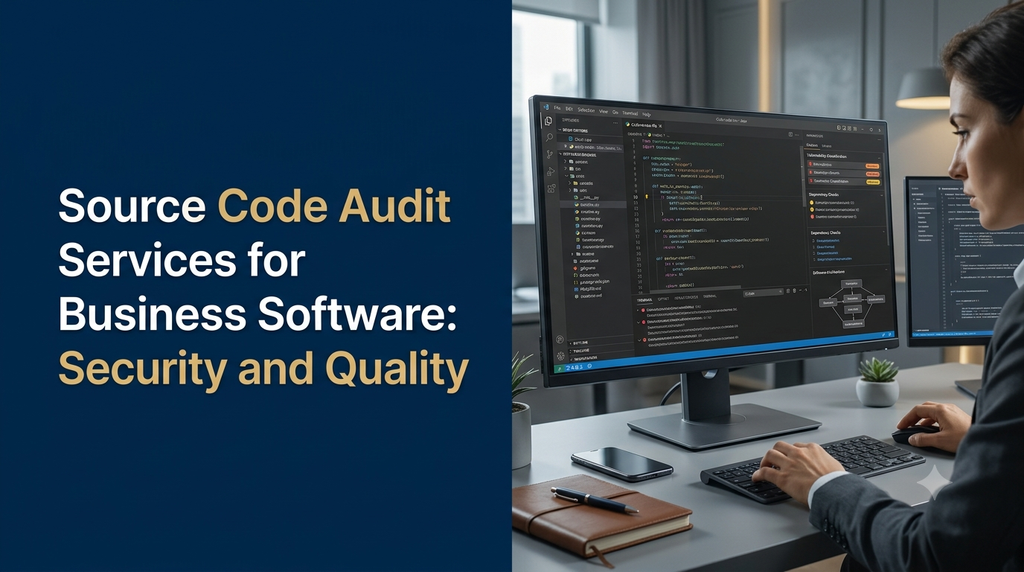
Business software often handles important information such as customer records, employee details, orders, invoices, payments and operational data. As applications grow, their underlying source code can become difficult to maintain, understand and secure. A professional source code audit helps businesses evaluate how their software is built, identify weaknesses and plan improvements before small technical problems become expensive issues.
What Are Source Code Audit Services?
Source code audit services involve reviewing the actual programming code used to build a website, mobile application, SaaS platform, ERP system, CRM or other business software.
The audit examines how the application is structured, how data is processed, how users are authenticated, how permissions are enforced and whether the code follows appropriate development and security practices.
Unlike a basic visual website review, a source code audit investigates the implementation behind the user interface. It can reveal problems that might not be visible during normal application usage.
A typical audit may cover:
- Application security and vulnerable coding patterns.
- User authentication and access-control implementation.
- Input validation and data-handling practices.
- Database queries and data-access logic.
- Third-party libraries and software dependencies.
- Code structure, duplication and maintainability.
- Error handling, logging and configuration practices.
- Performance-related coding concerns.
- Documentation and development standards.
Why Do Businesses Need a Source Code Audit?
Business applications rarely remain unchanged after launch. New features, integrations, developers and business requirements continuously affect the codebase. Without periodic reviews, technical debt and security risks can accumulate.
1. Identify Potential Security Weaknesses
Poorly implemented authentication, missing authorization checks, unsafe input handling and exposed sensitive configuration can create security risks. A source code review helps identify these issues and recommend corrective actions.
The audit should examine whether sensitive operations are properly protected and whether the application follows secure development principles.
2. Improve Code Quality
Unclear naming, duplicated functions, overly complex logic and inconsistent coding patterns make applications harder to maintain. A code quality review helps developers understand where refactoring or restructuring would be beneficial.
3. Reduce Long-Term Maintenance Problems
Poorly organized code can make even small feature updates time-consuming. Reviewing dependencies, architecture and code organization helps teams plan maintenance more effectively.
4. Evaluate Third-Party Dependencies
Modern applications rely on frameworks, packages, plugins and external libraries. Some dependencies may become outdated, unsupported or affected by publicly disclosed vulnerabilities.
A dependency review identifies components that may need updates, replacement or additional security assessment.
5. Support Software Ownership and Vendor Transitions
When a business changes its development partner or brings software maintenance in-house, the new team needs to understand the existing application. An independent audit can document code quality, architecture, dependencies and outstanding technical risks.
6. Prepare for New Features and Business Growth
An application designed for a small operation may need architectural improvements before supporting more users, branches, transactions or integrations. A source code audit helps identify areas that may require attention before expansion.
What Does a Professional Source Code Audit Cover?
| Audit area | What is reviewed? | Business benefit |
|---|---|---|
| Security review | Authentication, authorization, input validation and sensitive data handling. | Helps reduce application security risks. |
| Code quality | Complexity, duplication, readability and coding consistency. | Improves maintainability. |
| Dependency audit | Third-party packages, versions and known vulnerability information. | Supports safer dependency management. |
| Architecture review | Modules, application layers, integrations and design patterns. | Helps plan future improvements. |
| Database review | Data access, query handling, permissions and transaction logic. | Supports reliable data operations. |
| Configuration review | Environment settings, secret handling and deployment configuration. | Helps identify configuration risks. |
| Documentation review | Setup instructions, technical documentation and maintenance guidance. | Makes future development easier. |
Types of Source Code Audits
1. Manual Code Review
Experienced developers inspect selected parts of the codebase to understand implementation details, business logic and potential weaknesses. Manual review is particularly useful for complex workflows and issues that automated tools may not understand in context.
2. Static Application Security Testing (SAST)
SAST tools examine source code or compiled application representations without requiring the application to run. They can identify certain vulnerable coding patterns, unsafe functions and potential security weaknesses.
3. Software Composition Analysis (SCA)
Software composition analysis examines open-source and third-party dependencies. It can help identify known vulnerabilities, outdated components and dependency licensing considerations.
4. Architecture and Design Review
This review examines how application components communicate, how responsibilities are separated and whether the system design supports future maintenance and growth.
5. Configuration and Secrets Review
The audit checks how environment variables, API credentials, database connections, access tokens and other sensitive configuration values are managed. Real credentials should never be copied into an audit report.
6. Quality and Maintainability Review
This assessment examines code readability, complexity, duplication, test coverage and documentation. It helps developers prioritize improvements that can reduce future maintenance effort.
Popular Tools Used for Source Code Auditing
Professional audits often combine automated tools with manual engineering review. The exact tools depend on the programming language, framework, repository and audit objectives.
| Tool | Primary purpose | Common use |
|---|---|---|
| SonarQube | Code quality and static analysis | Maintainability and code issue identification. |
| Semgrep | Static code analysis | Detecting coding patterns and potential vulnerabilities. |
| CodeQL | Semantic code analysis | Finding certain security weaknesses in supported languages. |
| OWASP Dependency-Check | Dependency vulnerability analysis | Identifying vulnerable third-party components. |
| GitHub Dependabot | Dependency updates and alerts | Monitoring dependency updates and known vulnerabilities. |
| ESLint | JavaScript and TypeScript linting | Identifying coding issues and enforcing code standards. |
| Bandit | Python security linting | Checking for selected insecure coding patterns. |
Tools provide useful findings, but automated results should be validated by qualified reviewers. A tool warning does not automatically prove that a vulnerability is exploitable, and a clean scan does not prove that software is completely secure.
Source Code Audit Process: Step by Step
Step 1: Understand the Application
The audit begins with understanding the software’s purpose, technology stack, user roles, business workflows, integrations and deployment environment.
Step 2: Define the Audit Scope
The reviewer identifies which repositories, modules, services, dependencies and configurations are included. Exclusions and limitations should also be documented.
Step 3: Review the Codebase Structure
The team examines the directory structure, application layers, modules, naming conventions and development patterns to understand how the software is organized.
Step 4: Run Automated Analysis
Appropriate static analysis, dependency scanning and code quality tools are used to identify potential issues. Findings are collected for validation.
Step 5: Perform Manual Review
Reviewers examine important business logic, access-control decisions, data-handling functions and areas where automated analysis may not provide enough context.
Step 6: Evaluate Dependencies and Configuration
Third-party components, environment settings and sensitive configuration management are reviewed within the agreed scope.
Step 7: Classify Findings
Findings are organized by severity, business impact, affected component and remediation priority. Potential false positives are checked before being included as confirmed issues.
Step 8: Prepare the Audit Report
The report describes identified issues, supporting evidence, affected components, limitations and recommended corrective actions.
Step 9: Remediation and Reassessment
Developers fix the agreed issues. The audit team can then review the changes and verify whether the reported concerns have been addressed.
Common Problems Found During Source Code Audits
- Missing authorization checks on sensitive operations.
- Inadequate validation of user-submitted data.
- Unsafe database query construction.
- Hardcoded credentials or sensitive configuration values.
- Outdated libraries with known security advisories.
- Excessive permissions assigned to application components.
- Insufficient error handling and security logging.
- Duplicated code and overly complex business logic.
- Missing or inadequate automated tests.
- Incomplete technical documentation.
The actual impact of each finding depends on the application’s architecture, deployment environment, user permissions and business context. Findings should be validated rather than treated as confirmed security incidents without evidence.
Source Code Audit vs. Penetration Testing
Both activities support application security, but they investigate software from different perspectives.
| Aspect | Source code audit | Penetration testing |
|---|---|---|
| Primary focus | Code implementation and software design. | Application security from a testing perspective. |
| Typical approach | Manual review and automated source analysis. | Controlled testing of an application or environment. |
| Access required | Source code and relevant technical documentation. | Authorized access to the agreed test environment. |
| Findings | Code-level weaknesses, quality issues and design concerns. | Demonstrated security weaknesses within the test scope. |
These services complement each other. A source code audit can reveal implementation concerns, while an authorized penetration test can evaluate how selected security weaknesses behave in a running system. Neither should be presented as a replacement for the other.
Which Business Applications Need Source Code Auditing?
Any organization that owns, develops or maintains custom software can benefit from an appropriately scoped source code review.
- ERP software: Review inventory, finance, purchasing, production and employee-management modules.
- CRM platforms: Examine customer records, user permissions, communication workflows and integrations.
- Ecommerce applications: Review product management, order processing, account security and payment integrations.
- SaaS applications: Evaluate tenant separation, subscription workflows, access control and shared application services.
- Mobile application backends: Examine APIs, authentication, data access and server-side business logic.
- Custom business portals: Review employee, supplier, dealer and customer-facing workflows.
How Much Do Source Code Audit Services Cost?
The cost depends on the size and complexity of the application, number of repositories, programming languages, integrations, audit depth and reporting requirements.
The following figures are illustrative planning estimates for discussing a project scope. They are not fixed Greap quotations or guaranteed market prices.
| Audit category | Illustrative estimate |
|---|---|
| Basic code quality review for a small application | ₹8,000–₹15,000 |
| Small business application source code review | ₹15,000–₹30,000 |
| Security-focused code audit | ₹20,000–₹45,000 |
| Code quality and dependency assessment | ₹15,000–₹35,000 |
| Multi-module business software audit | ₹35,000–₹75,000+ |
| Large SaaS or enterprise platform | Custom assessment required |
Additional costs may apply for specialized tools, cloud testing environments, third-party security assessments, remediation work, extensive documentation and applicable taxes. A final quotation should follow a review of the actual project scope.
What Should a Source Code Audit Report Include?
A useful report should help business owners and development teams understand what was examined, what was discovered and what needs to happen next.
A professional report may include:
- Executive summary of the audit.
- Application and technology-stack overview.
- Audit scope, exclusions and methodology.
- Tools and review techniques used.
- Security findings and severity classifications.
- Code quality and maintainability observations.
- Dependency and configuration findings.
- Evidence and affected components, where appropriate.
- Recommended remediation steps.
- Prioritized improvement roadmap.
- Reassessment status, if follow-up verification is included.
How Often Should Business Software Be Audited?
There is no universal schedule for every application. Audit frequency should reflect the software’s risk, release cycle, data sensitivity and business importance.
Consider an audit or focused review when:
- A major application release is being prepared.
- The software is transferred to a new development team.
- A new payment, CRM, ERP or external API integration is introduced.
- The application undergoes major architectural changes.
- Important security advisories affect a used dependency.
- The application handles increasingly sensitive business data.
- Repeated maintenance problems indicate growing technical debt.
Continuous automated checks can be included in the development workflow, with deeper manual reviews performed at appropriate project milestones.
How to Choose a Source Code Audit Service Provider
Choosing an audit provider requires more than comparing prices. Businesses should evaluate the provider’s technical approach, communication and ability to explain findings clearly.
- Technology experience: Check experience with the application’s languages, frameworks and architecture.
- Security knowledge: Ask about secure coding practices, vulnerability classification and relevant security standards.
- Clear scope: Ensure the proposal explains included repositories, modules and exclusions.
- Human validation: Confirm that automated findings are reviewed and interpreted by qualified engineers.
- Actionable reporting: Request clear findings, business impact and remediation recommendations.
- Confidentiality: Establish secure source-code handling, access restrictions, retention periods and confidentiality responsibilities.
- Follow-up support: Understand whether remediation guidance and reassessment are included.
Why Source Code Auditing Matters for Growing Businesses in Erode
Businesses in Erode and across Tamil Nadu increasingly depend on custom-built applications for daily operations. Manufacturing companies, textile businesses, distributors, retailers, service providers and growing startups may use software for inventory, accounting, sales, customer management and internal workflows.
As these systems expand, their codebases and integrations become more complex. A structured source code review can help business owners understand software quality, identify technical concerns and plan improvements before investing in further development.
Whether an organization operates from Erode, Perundurai, Bhavani, Gobichettipalayam, Chennimalai or another part of Tamil Nadu, the audit process should be based on the actual application and its business requirements rather than location alone.
Frequently Asked Questions
1. What is a source code audit in software development?
A source code audit is a structured review of an application’s programming code to assess security, quality, maintainability, dependencies and implementation practices.
2. Why is source code auditing important for businesses?
It helps identify potential security weaknesses, code quality problems, outdated dependencies and maintenance risks. The findings support informed software improvement decisions.
3. Can a source code audit find security vulnerabilities?
Yes. Manual reviews and static analysis tools can identify certain insecure coding patterns and potential vulnerabilities. Not every issue is detectable through source code analysis alone.
4. What is the difference between code review and code audit?
A code review often examines a particular change or module. A source code audit generally evaluates a broader, agreed portion of the application against security, quality and maintainability objectives.
5. Can existing legacy software be audited?
Yes. Legacy applications can be reviewed to understand their structure, dependencies, coding practices and technical risks before maintenance or modernization work begins.
6. Which tools are used for source code auditing?
Depending on the technology stack, tools may include SonarQube, Semgrep, CodeQL, OWASP Dependency-Check, Dependabot, ESLint and Bandit.
7. Does a source code audit guarantee that software is secure?
No. An audit reduces uncertainty by identifying issues within its defined scope. It cannot guarantee that an application has no vulnerabilities or will remain secure in every environment.
8. How long does a source code audit take?
A small application may require a few working days, while a complex multi-module system can take considerably longer. The timeline depends on codebase size, documentation, technology and audit depth.
9. Should businesses audit software before changing developers?
It can be useful. An independent review helps the incoming team understand code quality, dependencies, architecture and outstanding technical concerns before taking over maintenance.
10. Can a source code audit improve software performance?
It can identify inefficient logic, unnecessary duplication and potential architectural bottlenecks. Actual performance improvements may require separate profiling, testing and optimization.
Need a Source Code Audit for Your Business Software?
Greap Technologies helps businesses plan and develop websites, custom software and digital solutions. If you need to assess an existing application, improve code quality or plan a software modernization project, discuss your requirements with our team.
Visit Greap Technologies Discuss on WhatsApp Call 7092330168Conclusion
Source code auditing is an important part of responsible software ownership. It gives businesses a clearer understanding of how their applications are structured, where potential security and quality problems exist, and which improvements should receive attention first.
Combining automated analysis with experienced manual review provides more useful results than relying on scanning tools alone. For growing businesses, periodic code assessments can support better maintenance decisions, more reliable development and a stronger foundation for future software improvements.
If your organization depends on custom business software, consider including source code reviews as part of its ongoing software maintenance and quality strategy.