A growing business website needs more than attractive design and useful features. As visitors, enquiries, orders and online transactions increase, the infrastructure behind the website must handle traffic reliably. If one server fails or an application becomes unavailable during a busy period, the business may lose enquiries, sales and customer confidence.
This is where high-availability website architecture becomes important. It helps businesses design websites and web applications that can continue operating when individual infrastructure components experience problems.
For businesses in India, a suitable high-availability architecture can support ecommerce platforms, booking systems, customer portals, SaaS products, business websites and other applications that depend on consistent availability.
1. What Is High-Availability Website Architecture?
High-availability website architecture is a system design in which critical website components are arranged to reduce the impact of individual failures. Instead of depending entirely on one server, one database or one network path, the architecture uses suitable backup components and recovery mechanisms.
For example, a website hosted on a single server may become unavailable if that server develops a hardware or software problem. In a more resilient design, traffic can be directed to another healthy application server when one instance becomes unavailable.
Depending on business requirements, high availability may include:
- Multiple application server instances.
- Load balancing and health checks.
- Database replication and recovery planning.
- Redundant networking and infrastructure components.
- Automated monitoring and alerts.
- Backup systems and disaster recovery procedures.
- Scalable infrastructure for changing traffic levels.
2. Why Growing Businesses Need High Availability
A website that performs well with a small number of visitors may face challenges when traffic and application usage increase. More users can create additional demands on the database, application server, storage, network and third-party services.
Reduce business interruptions
Redundant components can help maintain service when an individual server or infrastructure component fails.
Support increasing traffic
Scalable infrastructure can accommodate traffic growth without depending on a single overloaded server.
Protect online transactions
Reliable application and database design helps ecommerce and booking platforms manage critical operations more consistently.
Improve customer confidence
Consistent access to websites and customer portals supports a more dependable digital experience.
Improve operational visibility
Monitoring and alerting help technical teams identify infrastructure problems earlier.
Plan for recovery
Backups and documented recovery procedures help businesses respond to serious incidents.
3. Core Components of a High-Availability Website Architecture
High availability is not a single hosting feature. It is a combination of infrastructure, application design, data management and operational processes.
3.1 Load Balancer
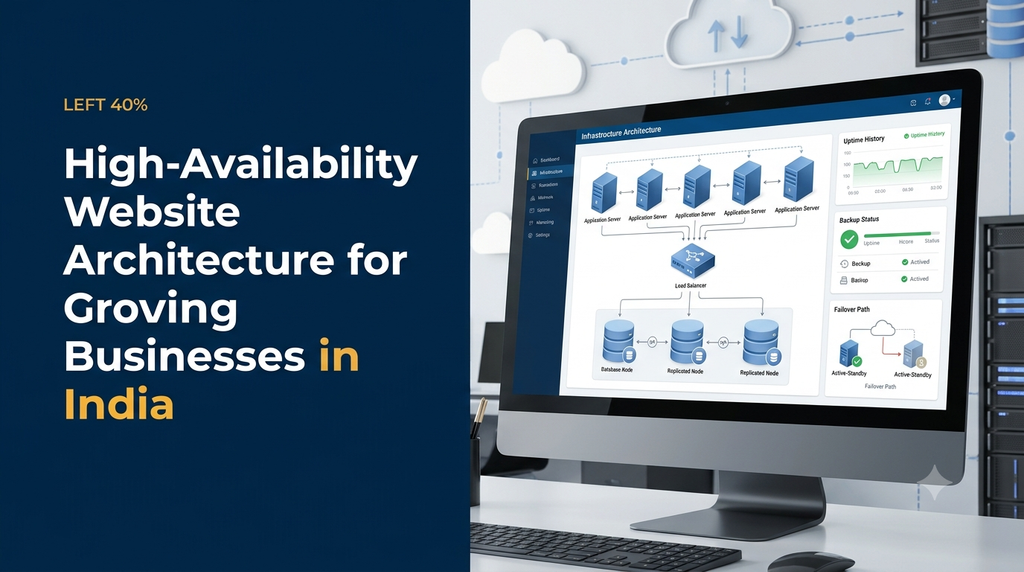
A load balancer distributes incoming requests across multiple application servers. It can check server health and avoid sending new requests to instances that are unavailable or unhealthy.
Load balancing helps distribute traffic and reduces the risk of one application server becoming a bottleneck. Depending on the setup, load balancing may be performed at the network, transport or application layer.
3.2 Multiple Application Servers
Running multiple application instances provides redundancy. If one instance becomes unavailable, other healthy instances may continue serving requests.
Applications should be designed to support this arrangement. For example, user sessions and uploaded files should not depend entirely on the local storage of one application server.
3.3 Database Redundancy and Replication
The database stores important business information, including customer details, orders, invoices and application records. A database failure can affect the entire application even when the web servers are operating normally.
Database replication maintains copies of data on additional database instances. Depending on the database platform and configuration, replication can support read scaling, recovery or failover.
Replication is not a replacement for backups. Accidental deletion or corrupted data can also be replicated, so independent backups and recovery testing remain necessary.
3.4 Content Delivery Network (CDN)
A CDN distributes eligible website content through a network of geographically distributed servers. It can deliver images, stylesheets, scripts and other cacheable resources closer to visitors.
For businesses serving customers across India, a suitable CDN configuration can reduce the distance that static content travels and help manage traffic spikes.
3.5 Health Checks and Automated Failover
Health checks evaluate whether application instances and infrastructure services are responding as expected. A failover mechanism can redirect workloads to an available component when a failure is detected.
Failover needs careful testing. A system that switches traffic to a backup server but cannot access the required database or application dependencies may still remain unavailable.
3.6 Monitoring and Alerting
Monitoring provides visibility into infrastructure and application performance. Useful measurements include response time, error rates, server resource usage, database connections, storage capacity and service availability.
Alerts can notify the responsible technical team when a service becomes unhealthy or a metric crosses a defined threshold.
3.7 Backup and Disaster Recovery
High availability helps reduce interruptions during component failures. Disaster recovery focuses on restoring services after larger incidents, such as major infrastructure outages, accidental data loss or serious security events.
Businesses should define backup frequency, retention, recovery priorities and restoration procedures. Backups should be tested periodically rather than assumed to be usable.
4. Example of a High-Availability Website Architecture
Consider a growing Indian ecommerce business that receives traffic from multiple cities. A possible architecture could include a CDN, a managed load balancer, multiple application instances, a managed database with an appropriate redundancy configuration, object storage and centralized monitoring.
- Visitors access the website through a domain name.
- DNS and CDN services route eligible requests through the configured network path.
- A load balancer distributes application requests across healthy instances.
- Application servers process business logic and communicate with required services.
- The database stores and retrieves business information.
- Monitoring services observe application and infrastructure health.
- Backup and recovery systems support restoration when required.
The exact architecture depends on the application, traffic pattern, data requirements, hosting provider and acceptable downtime. A small business website may need a simpler design, while a transaction-heavy platform may require more extensive redundancy.
5. Common High-Availability Architecture Patterns
| Architecture pattern | How it works | Typical consideration |
|---|---|---|
| Single server | Website and application run on one server. | Simple to operate, but creates a major single point of failure. |
| Active-passive | A primary system handles normal traffic while a standby system is prepared for failover. | Requires tested failover and data consistency planning. |
| Active-active | Multiple instances handle traffic simultaneously. | Requires suitable application, session and data architecture. |
| Multi-zone deployment | Infrastructure is distributed across separate availability zones. | Reduces dependence on a single zone, subject to provider design. |
| Multi-region deployment | Infrastructure operates across separate geographic regions. | Can improve regional resilience but increases complexity and cost. |
6. High Availability vs Scalability vs Disaster Recovery
These concepts are related, but they solve different problems. A scalable website is not automatically highly available, and a highly available website does not necessarily have a complete disaster recovery plan.
| Concept | Main objective | Example |
|---|---|---|
| High availability | Reduce service interruptions. | Redirect traffic when an application instance fails. |
| Scalability | Handle changing workloads. | Add application instances as traffic increases. |
| Disaster recovery | Restore operations after a major incident. | Recover an application and its data in an alternate environment. |
| Performance optimization | Improve speed and resource efficiency. | Optimize database queries and cache suitable content. |
7. How to Design a Scalable and Reliable Website
A reliable architecture should be planned around actual business requirements instead of adding infrastructure components without a clear purpose.
Step 1: Understand Business Requirements
Identify the website’s purpose, expected traffic, critical functions, customer locations, transaction volume and operating requirements. A brochure website and an ecommerce platform have very different availability needs.
Step 2: Identify Single Points of Failure
Review the complete request path, including DNS, CDN, firewall, load balancer, application servers, database, storage, authentication and external APIs. A single critical dependency can affect the entire service.
Step 3: Select Suitable Hosting Infrastructure
Choose an infrastructure platform that supports the required redundancy, monitoring, backup, scaling and recovery features. Compare managed hosting, cloud infrastructure and dedicated environments based on operational needs.
Step 4: Design the Application for Multiple Instances
Avoid unnecessary dependence on local server state. Use suitable shared storage, centralized session management, externalized configuration and reliable service communication where appropriate.
Step 5: Plan Database Availability
Select a database architecture that matches transaction requirements and recovery objectives. Define replication behaviour, backup schedules, restore procedures and how the application responds to temporary database unavailability.
Step 6: Configure Monitoring and Alerts
Monitor both infrastructure and user-facing application behaviour. A server may be running while important website functions are failing, so include application-level checks.
Step 7: Test Failure and Recovery Scenarios
Test how the system responds when an application instance becomes unhealthy, a database connection fails or a deployment introduces an issue. Conduct controlled tests with a documented recovery plan.
Step 8: Review and Improve Regularly
Review traffic patterns, incident reports, infrastructure costs and recovery results. Update the architecture as the business and application requirements change.
8. Choosing the Right Hosting Architecture in India
Businesses in India can choose from several hosting approaches. The best option depends on application complexity, traffic, technical support requirements and budget.
| Hosting approach | Suitable for | Important consideration |
|---|---|---|
| Shared hosting | Small websites and early-stage projects. | Limited control over infrastructure redundancy and resource allocation. |
| VPS hosting | Growing websites with moderate resource requirements. | A single VPS still creates a potential single point of failure. |
| Dedicated server | Applications needing dedicated resources and configuration control. | Redundancy and recovery need to be designed separately. |
| Cloud infrastructure | Growing applications requiring flexible infrastructure. | Availability depends on the actual architecture, not simply the word cloud. |
| Managed cloud hosting | Businesses seeking infrastructure management support. | Review service limits, support coverage, backup policies and additional charges. |
A cloud-hosted website is not automatically highly available. If the application, database and storage all depend on one instance or one failure domain, an outage can still interrupt the entire website.
9. Important Availability Metrics: SLA, RTO and RPO
Businesses should define measurable availability and recovery objectives before selecting an infrastructure design.
Uptime and Availability
Availability is commonly expressed as a percentage of the time a service is accessible during a defined measurement period. For example, a 99.9% availability target allows a small amount of downtime over a year. Actual results depend on the measurement method and exclusions in the relevant service agreement.
| Illustrative availability target | Approximate annual downtime allowance |
|---|---|
| 99% | About 3 days and 15 hours |
| 99.9% | About 8 hours and 46 minutes |
| 99.95% | About 4 hours and 23 minutes |
| 99.99% | About 52 minutes and 34 seconds |
These are mathematical illustrations based on a 365-day year, not promises of actual service performance. Maintenance policies and SLA measurement rules can affect reported availability.
Recovery Time Objective (RTO)
RTO defines the maximum acceptable time to restore a service after a disruption. A business that needs its ordering system restored quickly will generally require a shorter RTO than a website where temporary unavailability has a smaller operational impact.
Recovery Point Objective (RPO)
RPO defines the maximum acceptable amount of data loss measured in time. For example, a business may decide that recovering to a point no more than 15 minutes before an incident is acceptable. Achieving a particular RPO requires suitable backup or replication arrangements.
Service Level Agreement (SLA)
An SLA describes a provider’s contractual service commitments, measurement rules, exclusions and possible remedies. Businesses should review the actual agreement rather than relying only on an advertised uptime figure.
10. Security Considerations for High-Availability Websites
Availability and security are closely connected. A security incident can make an otherwise reliable website unavailable or affect the integrity of business data.
- Use HTTPS and maintain valid TLS certificates.
- Apply security updates to operating systems, frameworks and dependencies.
- Use appropriate firewall and web application protection controls.
- Apply role-based access controls and multi-factor authentication where appropriate.
- Protect administrative interfaces and infrastructure credentials.
- Maintain secure, independent backups.
- Monitor unusual application and infrastructure activity.
- Define incident response and recovery responsibilities.
Security controls should be tested and maintained. Adding redundancy without access controls or backup protection can increase infrastructure complexity without adequately protecting the business.
11. Common Mistakes Businesses Should Avoid
- Assuming cloud hosting guarantees uptime: Availability depends on the complete system design.
- Using one database for everything: A single database can remain a critical failure point.
- Ignoring application dependencies: External APIs, payment services and authentication providers can affect availability.
- Not testing backups: A backup that cannot be restored is not a reliable recovery solution.
- Overlooking session management: Multiple servers need a consistent way to manage user sessions.
- Ignoring deployment risks: Poorly planned updates can cause outages even when infrastructure is redundant.
- Adding unnecessary infrastructure: More components can increase costs and operational complexity.
- Failing to monitor the application: Infrastructure health alone does not prove that customers can complete important tasks.
12. High-Availability Architecture for Different Business Types
Ecommerce Websites
Ecommerce platforms need reliable product browsing, checkout, payment integration and order management. Suitable architecture may include CDN caching, redundant application instances, database recovery planning and monitoring of checkout workflows.
Business Websites and Lead Generation Platforms
Company websites that generate enquiries through forms, phone calls and WhatsApp links should prioritize reliable page delivery, form processing, security and monitoring. Their architecture may be simpler than that of a transaction-heavy application.
SaaS Applications
SaaS platforms need to consider tenant isolation, authentication, background jobs, database capacity, subscription workflows and service dependencies. High availability should be designed around the application’s critical user journeys.
Manufacturing and ERP Applications
Manufacturing businesses may depend on ERP systems for inventory, production, purchasing, dispatch and reporting. Infrastructure planning should consider the operational impact of application downtime and the recovery requirements of critical business data.
Customer and Supplier Portals
Customer self-service, supplier ordering and dealer portals may require reliable login, document access, order processing and notifications. These functions should be included in application-level availability monitoring.
13. What Does High-Availability Website Development Cost in India?
The cost depends on the number of application instances, database requirements, hosting provider, traffic, backup retention, monitoring tools, security controls and recovery objectives. There is no single price that applies to every website.
The following table provides broad illustrative planning ranges for development and configuration work. These are not fixed Greap quotations or guaranteed market prices.
| Project scope | Illustrative planning range |
|---|---|
| Basic website infrastructure assessment | ₹5,000 – ₹15,000 |
| Website hosting and performance improvement | ₹10,000 – ₹25,000 |
| Multi-instance application configuration | ₹25,000 – ₹60,000 |
| Load balancing and database redundancy setup | ₹40,000 – ₹1,00,000 |
| Advanced high-availability architecture | ₹1,00,000 – ₹2,50,000+ |
| Complex multi-region architecture | Based on technical assessment |
These figures are indicative planning estimates only. Actual project costs may be lower or higher depending on existing infrastructure, application complexity, data migration, testing and required service levels.
Cloud hosting, managed database services, CDN usage, storage, bandwidth, monitoring products, backups, licences, security tools, third-party APIs, ongoing support and applicable taxes may be charged separately. Monthly infrastructure expenses should be estimated independently from one-time development costs.
14. How to Choose a Website Development and Infrastructure Partner
High availability requires both sound architecture and ongoing operational management. When evaluating a development or infrastructure partner, consider the following:
- Experience with the website platform and application technology.
- Knowledge of cloud, VPS and managed hosting environments.
- Ability to identify single points of failure.
- Experience with load balancing and database configuration.
- Clear backup, restore and disaster recovery procedures.
- Monitoring, alerting and incident response arrangements.
- Transparent infrastructure and maintenance costs.
- Documented deployment and change management practices.
- Testing plans for failover and recovery scenarios.
Ask for an architecture document that explains how requests flow through the system, which components are redundant, what happens during a failure and how services are restored.
15. High-Availability Website Architecture Checklist
- Expected traffic and business-critical functions are documented.
- Critical single points of failure have been identified.
- Application server redundancy matches business requirements.
- Load balancing and health checks are configured where needed.
- Database backup and recovery arrangements are documented.
- Replication and failover behaviour have been tested where applicable.
- Static assets use suitable caching and CDN configuration.
- Application-level and infrastructure-level monitoring are enabled.
- Security updates and access controls are maintained.
- RTO and RPO targets have been agreed.
- Backup restoration and incident response are tested periodically.
- Infrastructure costs and capacity are reviewed regularly.
16. Build a Reliable and Scalable Website with Greap Technologies
Growing businesses need websites and software that can support changing customer expectations and operational requirements. Infrastructure decisions made during development can influence future performance, maintenance, scalability and recovery.
Greap Technologies provides website development, custom software development and digital growth solutions for businesses. We help businesses plan and develop digital platforms with attention to application requirements, performance, security, integrations and future scalability.
Whether you need a business website, ecommerce platform, customer portal, SaaS application or custom business software, the right architecture should be based on your actual usage and reliability requirements.
Planning a Reliable Website for Your Growing Business?
Discuss your website or application requirements with Greap Technologies. Get guidance on development, hosting architecture, performance and infrastructure planning.
Visit Greap Technologies Discuss Your Project on WhatsApp Call GreapFrequently Asked Questions
1. What is high availability in website hosting?
High availability in website hosting means designing infrastructure to reduce service interruptions through redundancy, health checks, failover, monitoring and recovery planning.
2. Does cloud hosting automatically provide high availability?
No. Cloud hosting provides infrastructure options, but high availability depends on how application servers, databases, storage, networking and other dependencies are configured.
3. What is the difference between high availability and load balancing?
Load balancing distributes requests across available servers. High availability is a broader architecture strategy that can include load balancing, redundancy, monitoring, failover and recovery planning.
4. Is high availability necessary for a small business website?
Not every small website needs a complex multi-server architecture. The right level of availability depends on how important the website is to sales, enquiries, customer access and business operations.
5. What is the difference between active-active and active-passive architecture?
In active-active architecture, multiple instances handle workloads at the same time. In active-passive architecture, a primary instance handles normal workloads while a standby instance is available for failover.
6. Can high availability prevent all website downtime?
No. Redundancy and failover can reduce the impact of many failures, but software defects, provider-wide incidents, network problems, security events and configuration errors can still cause downtime.
7. What are RTO and RPO in website disaster recovery?
RTO is the target time to restore a service after an incident. RPO is the maximum acceptable data loss measured in time. Both help determine backup, replication and recovery requirements.
8. Does a high-availability website need multiple databases?
Not always. The database design depends on business requirements, data volume, recovery objectives and transaction behaviour. Some projects use managed database redundancy, while others may require additional replicas or more advanced configurations.
9. How much does high-availability website architecture cost in India?
Costs vary according to the application, hosting provider, number of infrastructure components, database design, monitoring and recovery requirements. A technical assessment is needed for a dependable estimate.
10. How often should website failover and backup recovery be tested?
Testing frequency should be based on business risk, infrastructure changes and recovery requirements. Businesses should schedule regular backup restoration tests and controlled failover exercises, with additional testing after significant architecture changes.
Conclusion
High-availability website architecture helps growing businesses reduce the impact of infrastructure failures and prepare for increasing digital demand. Load balancing, redundant application instances, database recovery, monitoring, security and tested backups all contribute to a more reliable platform.
The best solution is not necessarily the most complex or expensive one. Businesses should begin with their critical requirements, identify potential failure points and select an architecture that balances availability, scalability, operational complexity and cost.
With proper planning and ongoing maintenance, a business website or application can be better prepared to support customers as the business grows.