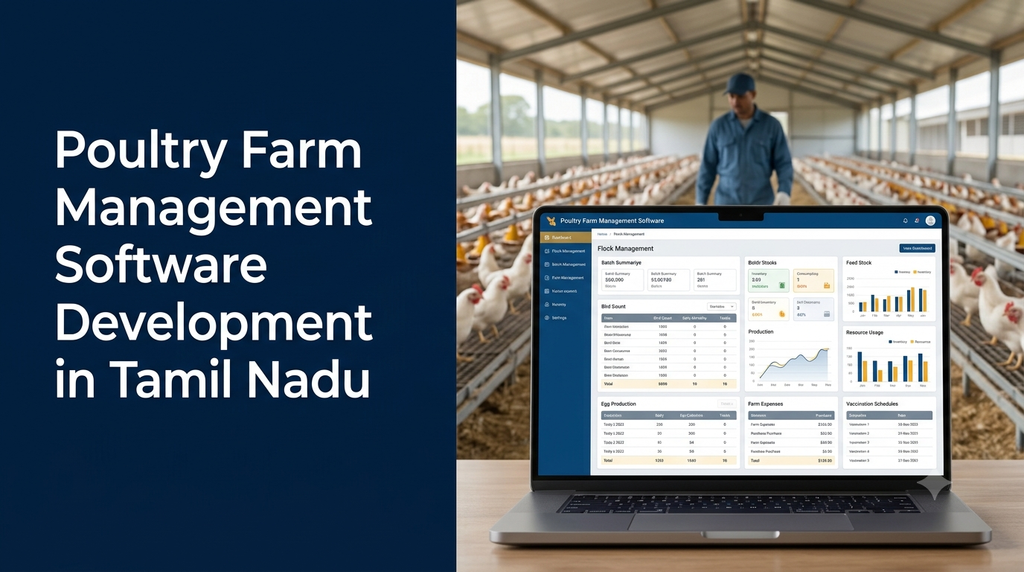
Poultry farming involves much more than maintaining birds inside a farm. Owners and managers must coordinate flock records, feed consumption, egg collection, purchases, sales, expenses, worker activities and production reports. When these operations are managed through separate notebooks and spreadsheets, it can become difficult to maintain accurate records across multiple sheds or farm locations.
Poultry farm management software brings important operational information into one digital system. It helps farm owners record daily activities, monitor stock, review production trends and access business reports from a central dashboard. For poultry businesses in Tamil Nadu, custom software can be designed around the actual workflows of broiler farms, layer farms, hatcheries and poultry integrators.
This guide explains the features, modules, development process and estimated costs involved in building poultry farm management software for businesses in Tamil Nadu.
What Is Poultry Farm Management Software?
Poultry farm management software is a digital application used to record, organise and analyse the operational activities of a poultry business. It can connect farm-level records with central administration, inventory, purchasing, sales and financial reporting.
Depending on the business model, the application may support:
- Broiler chicken farms
- Layer poultry farms
- Hatcheries and chick distribution businesses
- Feed production and distribution businesses
- Multi-farm poultry operators
- Poultry contract farming operations
- Integrated poultry businesses
Why Do Poultry Farms Need Management Software?
1. Centralised farm records
A digital system can keep flock, feed, inventory, production and expense information in a structured location. Owners can review records without collecting multiple paper registers.
2. Better visibility into feed consumption
Feed is an important operational input. Recording feed receipts, issues, consumption and closing stock helps managers understand usage patterns and identify differences that need investigation.
3. Improved batch tracking
Each flock batch can have its own records, including placement date, bird quantity, daily observations, feed issues, activity history and final sales details.
4. Easier production reporting
Layer farms can record daily egg collection and grading information. Broiler farms can maintain batch-level records for bird quantities, dispatches and sales.
5. More organised purchasing and inventory
The software can track purchases of feed, medicines, equipment, packaging materials and other supplies. Stock records can be organised by warehouse, farm or shed.
6. Better expense visibility
Managers can record expenses related to feed, labour, transportation, electricity, equipment and maintenance. Reports help owners review operational spending over a selected period.
7. Multi-farm management
Businesses operating multiple poultry locations can maintain separate records while giving authorised managers access to consolidated reports.
Essential Features of Poultry Farm Management Software
1. Farm and Shed Management
The farm management module stores the basic details of each poultry location and its sheds.
- Farm name and location
- Shed identification and capacity records
- Farm manager and assigned workers
- Shed-wise operational status
- Farm activity history
- Farm-wise reports and summaries
2. Flock and Batch Management
Flock management is a core feature because each batch has its own operational timeline. The software should allow users to create a batch record and maintain its history until completion.
- Batch identification number
- Bird type and category
- Farm and shed assignment
- Placement date and initial bird count
- Supplier or source details
- Daily bird quantity records
- Transfer and dispatch records
- Batch closure and historical reports
3. Daily Farm Activity Recording
Farm staff should be able to enter daily operational information using a simple mobile-friendly interface.
- Daily bird count observations
- Feed issued and consumed
- Water system observations
- Egg collection, where applicable
- Routine cleaning and maintenance records
- Scheduled activity completion
- Remarks and incident records
The application should make it clear which entries are actual measurements, manual observations or calculated summaries. This helps prevent reports from presenting estimates as verified measurements.
4. Feed Management and Inventory
Feed inventory management helps businesses track purchases, storage, issues and consumption.
- Feed item and category management
- Supplier and purchase records
- Batch or lot identification, if required
- Warehouse and farm stock
- Feed issue entries by shed or batch
- Stock adjustment records
- Low-stock notifications
- Feed purchase and consumption reports
The system can also maintain feed-related observations for review by farm management. Feed formulation and nutritional decisions should remain under the guidance of appropriately qualified poultry nutrition professionals.
5. Bird Health and Routine Activity Records
A record-keeping module can help authorised farm staff maintain a history of routine health-related activities and professional instructions.
- Scheduled vaccination and activity entries
- Veterinary visit records
- Professional recommendations and notes
- Medicine stock and issue records
- Incident and observation logs
- Follow-up reminders
- Supporting document attachments
This module should be used for documentation and reminders, not as a substitute for veterinary diagnosis, treatment decisions or professional advice. Any medication or vaccination schedule should be entered from authorised veterinary guidance.
6. Egg Production Management for Layer Farms
Layer poultry farms need a production module that records egg collection and movement through storage, grading and dispatch.
- Daily egg collection entries
- Shed-wise production records
- Egg category and grading details
- Damaged or rejected egg records
- Storage and stock information
- Customer dispatch records
- Daily and monthly production summaries
7. Broiler Production and Sales Management
Broiler farm software can maintain batch-level records related to bird transfers, sales and dispatches.
- Batch-wise bird quantity records
- Dispatch and buyer details
- Weight and quantity entries, where measured
- Sales invoices and payment status
- Transport and delivery records
- Batch closure summaries
8. Hatchery Management
Hatcheries may require additional modules for egg intake, incubation batches, process records and chick dispatches.
- Egg supplier and intake records
- Incubation batch details
- Scheduled process records
- Hatch results entered by authorised staff
- Chick quantity and grading records
- Customer orders and dispatches
- Batch-level reports
9. Purchase and Supplier Management
A purchasing module helps manage suppliers and the materials required for daily operations.
- Supplier profiles and contact information
- Purchase orders
- Goods receipt records
- Supplier invoices
- Payment tracking
- Purchase history and reports
10. Expense and Financial Management
Farm owners need visibility into recurring and batch-related expenses. A financial module can organise operational transactions without necessarily replacing a dedicated accounting platform.
- Feed and material expenses
- Labour and staff costs
- Electricity and utility expenses
- Transport and delivery costs
- Equipment and maintenance expenses
- Supplier payments and outstanding amounts
- Customer receipts and pending payments
- Farm-wise and batch-wise summaries
11. Employee and Farm Staff Management
Staff management features can help assign responsibilities and maintain operational accountability.
- Employee profiles
- Farm and shed assignments
- Attendance records, if required
- Task assignments
- Activity completion logs
- Role-based application access
12. Reports and Management Dashboard
A central dashboard should turn daily entries into useful operational summaries.
- Farm-wise and shed-wise summaries
- Active flock and batch overview
- Feed purchase and issue reports
- Egg collection and dispatch reports
- Bird movement and sales reports
- Purchase and expense summaries
- Supplier and customer outstanding reports
- Historical comparisons by selected period
Broiler Farm Software vs Layer Farm Software
Broiler and layer farms share several management requirements, but their daily operational records are different. A custom application should reflect the actual production model.
| Feature | Broiler farm | Layer farm |
|---|---|---|
| Flock management | Batch and placement tracking | Flock and production-cycle tracking |
| Feed management | Batch-wise feed issue and usage records | Feed stock and consumption records |
| Production tracking | Bird quantity, weight and dispatch records | Egg collection, grading and dispatch |
| Sales management | Bird sales and buyer records | Egg sales and customer records |
| Reporting | Batch-level operational summaries | Egg production and flock summaries |
A business operating both models may need a combined platform with separate workflows and shared modules for purchasing, inventory, expenses and administration.
Mobile App for Poultry Farm Workers and Managers
Farm staff may need to record information while working across sheds and farm locations. A mobile application can make data entry more convenient than relying on a desktop computer in an office.
Useful mobile app features include:
- Secure staff login
- Assigned farm and shed selection
- Daily activity entry forms
- Feed issue and stock updates
- Egg collection entries
- Task and schedule notifications
- Photo attachments for operational records
- Activity history and submission status
If farms have unreliable internet connectivity, offline entry can be considered. The application should safely queue permitted entries and synchronise them when connectivity returns. It should also identify duplicate or conflicting submissions.
Admin Panel and User Roles
A web-based administration panel gives owners and authorised managers a central place to manage the application.
| User role | Possible responsibilities |
|---|---|
| Super Admin | Manage the platform, users, configuration and overall access |
| Farm Owner | Review farm performance, expenses and consolidated reports |
| Farm Manager | Manage assigned farm operations and approve selected entries |
| Farm Worker | Enter assigned daily activities and operational observations |
| Store Manager | Manage stock receipts, issues and inventory records |
| Accounts Staff | Record purchases, expenses, invoices and payments |
| Veterinary Professional | Access relevant records and enter authorised professional notes, if included |
The final permissions should be agreed with the business. Employees should only access the farms, modules and records required for their responsibilities.
Advanced Features for Poultry Farm Automation
Businesses with larger operations may consider integrating software with selected monitoring devices and connected equipment. These features should be introduced only where they provide a clear operational benefit.
IoT Sensor Integration
Supported sensors may provide environmental readings such as temperature, humidity and other configured measurements. The application can display readings, record history and notify authorised staff when configured thresholds are crossed.
Equipment and Utility Monitoring
Where compatible equipment provides data, the software may display selected operating status information and maintenance alerts.
Automated Alerts
Notifications can be configured for low inventory, overdue activities, incomplete records, equipment alerts and scheduled reviews.
Business Intelligence Reports
Reporting tools can compare farm-level expenses, production entries, purchases and sales over selected periods. Reports should clearly identify the source and date range of the information.
WhatsApp and Email Notifications
Approved notification services can send selected business alerts, reminders or report links to authorised users. Messaging provider charges and template requirements may apply.
Important Data to Track in a Poultry Management System
Before development begins, the business should decide which information is mandatory for each farm type. A sample data structure is shown below.
| Module | Example records |
|---|---|
| Farm | Farm ID, location, sheds, manager |
| Flock | Batch ID, bird category, placement date, initial count |
| Daily activity | Date, shed, activity type, quantity, staff member |
| Feed | Feed item, quantity received, quantity issued, stock balance |
| Egg production | Collection date, quantity, grade, damaged quantity |
| Purchases | Supplier, item, invoice, quantity, amount |
| Sales | Buyer, product, quantity, invoice and payment status |
| Expenses | Category, date, amount, farm and batch reference |
| Staff | Employee, role, assignment and activity history |
How to Develop Poultry Farm Management Software
Step 1: Understand the poultry business model
The development team should first understand whether the business operates broiler farms, layer farms, hatcheries or a combination. The number of farms, sheds, users and daily records will influence the system design.
Step 2: Map existing farm workflows
Review how the business currently records flock details, feed purchases, daily activities, production, sales and expenses. Identify repeated data entry and reporting difficulties.
Step 3: Define modules and user permissions
Prepare a module list and decide which user roles can create, view, edit or approve each type of record. Confirm which reports are needed by owners and managers.
Step 4: Design the database and application architecture
Plan the relationships between farms, sheds, flocks, batches, stock movements, purchases and transactions. For multi-farm applications, data separation and permission design should be considered from the beginning.
Step 5: Develop the admin panel and mobile interfaces
Build the core application modules with simple forms and dashboards. Prioritise mobile-friendly screens for users who enter records directly at the farm.
Step 6: Test calculations and workflows
Verify stock movements, batch records, production summaries, expense calculations, permissions and report filters. Test realistic scenarios with sample data before launch.
Step 7: Deploy and train users
Configure the hosting environment, backups, monitoring and user accounts. Train farm owners, managers and workers using workflows that match their responsibilities.
Step 8: Maintain and improve the application
After launch, review user feedback, correct issues, update dependencies and introduce additional modules based on operational needs.
Technology Stack for Poultry Farm Software Development
The technology stack should be selected according to application size, integration requirements, expected users and maintenance plans. One possible architecture is:
| Application layer | Possible technologies |
|---|---|
| Web frontend | React, Next.js or Vue |
| Backend | Laravel, Node.js or Django |
| Database | MySQL or PostgreSQL |
| Mobile application | Flutter or native Android development |
| API communication | REST APIs |
| Hosting | Cloud or managed server infrastructure |
| Reporting | Custom dashboards and exportable reports |
This is an example technology selection, not a fixed requirement. The final architecture should be based on the project’s scope and the development team’s ability to maintain it.
How Much Does Poultry Farm Management Software Cost in Tamil Nadu?
The cost depends on the number of modules, farms, users, mobile platforms, integrations, reporting requirements and deployment model. A simple record-keeping application will have a different budget from a multi-farm ERP platform with IoT integration.
The following figures are illustrative planning estimates for discussing project scope. They are not fixed Greap quotations, guaranteed market prices or final project offers.
| Software scope | Illustrative development estimate |
|---|---|
| Basic poultry farm record system | ₹25,000–₹45,000 |
| Farm, flock and feed management | ₹45,000–₹80,000 |
| Broiler or layer management platform | ₹60,000–₹1,20,000 |
| Web admin panel with staff mobile app | ₹80,000–₹1,60,000 |
| Multi-farm poultry management system | ₹1,20,000–₹2,50,000+ |
| Advanced poultry ERP with integrations | ₹2,00,000–₹5,00,000+ |
Final pricing should be prepared after reviewing the required modules, workflows, screens, user roles, data migration needs, hosting requirements and acceptance criteria. Hardware, IoT devices, messaging services, third-party subscriptions, app-store accounts, taxes and ongoing maintenance may be additional.
Factors That Affect Development Cost
- Number of modules: More operational workflows require additional design, development and testing.
- Number of farms and sheds: Multi-location operations need additional configuration and reporting.
- Mobile application requirements: Separate Android and iOS applications can affect the project budget.
- Offline support: Local data storage and synchronisation need additional development and testing.
- IoT integrations: Sensor compatibility, hardware and data processing can add complexity.
- Accounting and external integrations: Integration scope depends on the third-party system and available APIs.
- Reporting requirements: Custom dashboards, exports and historical comparisons require additional work.
- Data migration: Existing spreadsheets and paper-based records may need cleaning and structured import.
Cloud-Based vs On-Premises Poultry Software
Businesses should decide where the application and its data will be hosted. Both models have different operational considerations.
| Factor | Cloud-based system | On-premises system |
|---|---|---|
| Access | Accessible through supported internet connections | Usually accessed through the organisation’s configured network |
| Infrastructure | Hosted on a cloud or managed server | Business manages local server infrastructure |
| Maintenance | Provider and software team responsibilities must be agreed | Business needs suitable infrastructure and technical support |
| Scaling | Resources can often be adjusted as needs change | May require local hardware changes |
| Connectivity | Depends on internet access unless offline features are provided | Can support local network workflows, depending on design |
A cloud-based system is useful for owners who need to review multiple farm locations remotely. A local deployment may suit specific infrastructure or connectivity requirements. A hybrid design can also be considered.
Important Considerations for Poultry Farms in Tamil Nadu
Poultry businesses in Tamil Nadu operate with different farm sizes, staffing arrangements, supply chains and record-keeping practices. Software should be designed around the actual business rather than forcing every farm to follow the same workflow.
- Local workflow requirements: Understand how farm owners and workers currently record daily activities.
- Mobile usability: Use clear screens and simple forms suitable for routine farm entries.
- Language support: Consider Tamil and English labels where they help staff use the application.
- Connectivity: Assess internet availability at each farm before choosing cloud-only or offline-capable workflows.
- Multiple locations: Keep farm-wise records while supporting consolidated management reports.
- Local suppliers and buyers: Configure purchasing, sales and contact records around the business’s actual supply chain.
- Training: Provide role-based training for owners, managers, storekeepers and farm workers.
- Data protection: Apply access controls, backups and secure account management.
How to Choose a Poultry Software Development Company
Selecting a development partner is an important decision because the software may become part of daily farm operations. Businesses should review the following points before approving a project.
- Can the development team understand the farm’s operating model?
- Will the system support the required broiler, layer or hatchery workflows?
- Can the application manage multiple farms and user roles?
- Are reports and calculations clearly defined before development?
- Will the software work on the devices used by farm staff?
- Are data backup and recovery responsibilities documented?
- Will the business receive the agreed source code and technical documentation?
- Are hosting, maintenance and third-party costs explained separately?
- Is there a clear testing, training and handover process?
Ask for a written scope containing modules, deliverables, exclusions, estimated timelines, payment milestones and post-launch support terms. This helps avoid misunderstandings during implementation.
Frequently Asked Questions
1. What is poultry farm management software?
It is a digital system used to manage poultry farm records such as flock batches, feed inventory, daily activities, production, purchases, sales, expenses and reports.
2. Can poultry farm software manage broiler and layer farms?
Yes. A custom platform can include separate workflows for broiler and layer operations while sharing common modules such as farm management, purchasing, inventory, expenses and user administration.
3. Can the software manage multiple poultry farms?
Yes. Multi-farm functionality can maintain separate records for each location and provide authorised owners with consolidated reports across their operations.
4. Does poultry farm software include feed management?
It can include feed item records, purchases, stock balances, shed-wise issues, consumption entries and inventory reports. The exact features depend on the project scope.
5. Can the software track egg production?
Yes. A layer farm module can record daily egg collection, grading, damaged quantities, storage, dispatches and production summaries.
6. Is a mobile application necessary for poultry farm management?
A mobile app is useful when farm workers and managers need to enter records directly at sheds or across different locations. A responsive web application may also be suitable for smaller operations.
7. Can poultry software work without an internet connection?
Offline data entry can be developed for selected functions. The application needs a synchronisation process to upload stored entries when connectivity returns, with safeguards against duplicate or conflicting records.
8. How much does poultry farm management software cost in Tamil Nadu?
The cost depends on modules, user count, mobile features, integrations, reports and hosting requirements. A basic system may have a smaller scope than a multi-farm poultry ERP. A detailed estimate should follow a requirements assessment.
9. Can the software integrate with sensors and farm equipment?
It may integrate with compatible sensors and equipment that provide accessible data interfaces. Hardware compatibility, connectivity, installation and maintenance need to be evaluated separately.
10. How long does it take to develop poultry farm management software?
Development time depends on the number of modules, user interfaces, integrations and testing requirements. A basic record system may take less time than a multi-farm platform with mobile apps and advanced reporting. A project timeline should be agreed after scope definition.
Conclusion
Poultry farm management software can help businesses organise flock records, feed inventory, daily activities, egg production, purchases, sales and expenses in one system. For broiler farms, layer farms, hatcheries and multi-location poultry businesses in Tamil Nadu, custom development makes it possible to build workflows around the way each operation works.
The best starting point is to identify the farm’s current record-keeping challenges, define the required modules and prioritise the features that will support daily operations. With a clear scope, practical user interfaces and reliable reporting, a custom application can become a useful management tool as the business grows.
Looking for Custom Poultry Farm Management Software?
Greap Technologies develops websites and custom software solutions for business requirements. Discuss your poultry farm workflows, required modules, admin dashboard and mobile application needs with our team.