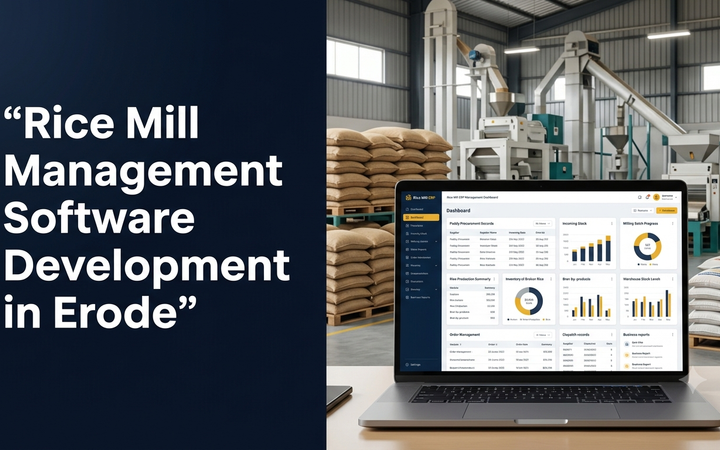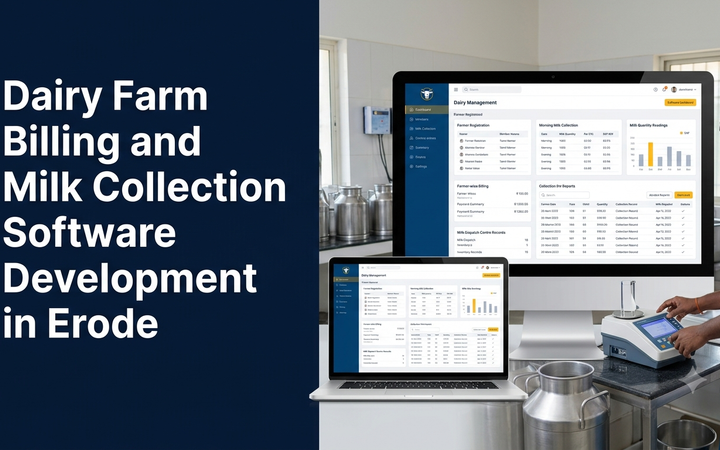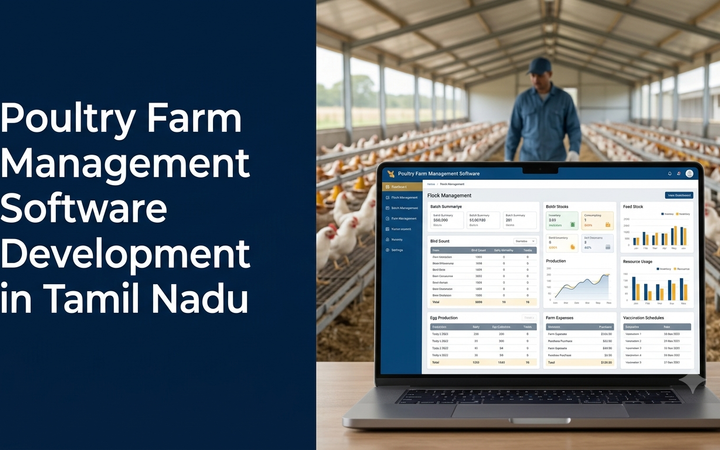
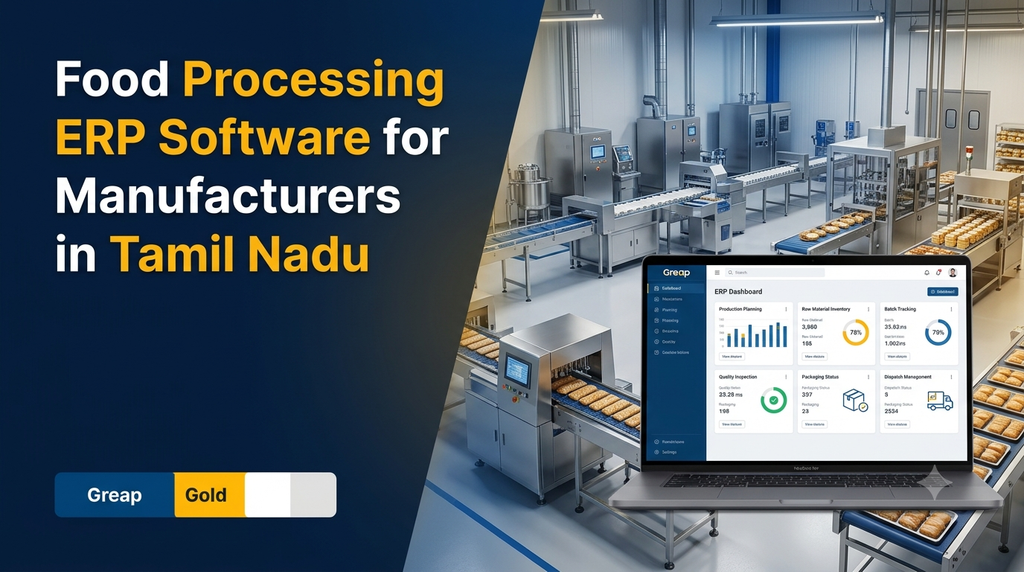
Food processing businesses manage multiple operations every day, including raw material purchasing, production planning, processing, quality inspection, packaging, inventory, billing and product distribution. When these activities are maintained using separate spreadsheets, paper registers or disconnected applications, it becomes difficult to maintain accurate business records and coordinate departments.
Food processing ERP software helps manufacturers manage these activities through a connected business management platform. Manufacturers in Tamil Nadu can use a customised ERP system to monitor production, track raw materials, manage batches, record quality checks and coordinate finished goods dispatch.
Whether a business manufactures rice products, spices, edible oils, dairy products, snacks, packaged foods or other processed food items, the right ERP solution can improve operational visibility and support business growth.
What Is Food Processing ERP Software?
Food processing ERP software is a business management system designed to coordinate the different activities involved in manufacturing and distributing food products. It connects departments through shared data, reducing the need to enter the same information repeatedly.
For example, when a manufacturer receives raw materials, the ERP system can update inventory records. When production starts, the system can record material consumption against a production batch. After processing and quality checks, finished goods can be transferred to packaging and dispatch.
A customised food manufacturing ERP may include:
- Raw material purchasing and supplier management.
- Raw material and finished goods inventory.
- Production planning and work orders.
- Recipe and formulation management.
- Batch and lot tracking.
- Quality inspection records.
- Packaging and labelling management.
- Sales orders and customer management.
- Billing and financial reporting.
- Dispatch and distribution tracking.
- Management dashboards and reports.
Why Food Manufacturers in Tamil Nadu Need ERP Software
Tamil Nadu has food manufacturing businesses across several industries, including rice milling, dairy processing, edible oils, spices, bakery products, snacks, beverages and packaged food production. Each business has different production methods and inventory requirements.
As production volumes increase, managing every department manually can create operational challenges.
1. Better raw material management
Food manufacturers purchase raw materials from multiple suppliers. An ERP system helps record supplier details, purchase quantities, received weights, material grades, rates and stock availability.
2. Improved production planning
Production teams can plan manufacturing schedules based on customer orders, available raw materials, production capacity and delivery commitments.
3. Accurate inventory tracking
The software can maintain separate stock records for raw materials, work-in-progress items, packaging materials, finished goods and rejected stock.
4. Better batch traceability
Each production batch can have a unique reference number. Businesses can connect raw material lots, production records, quality checks and finished goods to that batch.
5. Reduced manual data entry
When departments share the same ERP database, information entered during purchasing or production can be reused by inventory, accounts and reporting modules.
6. Faster management reporting
Business owners can review production quantities, material consumption, stock levels, order status and operational costs through centralised dashboards.
Essential Modules of Food Processing ERP Software
1. Purchase and supplier management
The purchase module manages the procurement of ingredients, agricultural products, additives, packaging materials and other supplies.
- Supplier registration and contact information.
- Purchase requisitions and purchase orders.
- Supplier quotations and purchase rates.
- Goods received records.
- Material quantity and weight verification.
- Supplier invoices and payment status.
- Supplier performance history.
2. Raw material inventory management
Inventory management helps businesses understand what materials are available, where they are stored and when additional purchases may be required.
Useful features include:
- Item-wise stock management.
- Warehouse and storage location tracking.
- Lot and expiry date records.
- Minimum stock alerts.
- Stock transfer between warehouses.
- Damaged and rejected stock management.
- Stock valuation and movement reports.
3. Recipe and formulation management
Food manufacturers that use specific ingredient combinations can maintain recipes or formulations within the ERP system. Authorised users can define ingredient quantities, units, production output expectations and revision history.
The system can help calculate estimated material requirements for a planned production quantity. Recipe access should be restricted to authorised employees where formulations are commercially sensitive.
4. Production planning and management
Production management connects customer demand with available materials and manufacturing capacity.
- Production orders and schedules.
- Machine and production line allocation.
- Daily production entry.
- Material issue and consumption records.
- Work-in-progress tracking.
- Actual production output.
- Production wastage and yield recording.
- Production delay and downtime records.
5. Batch and lot tracking
Batch tracking is particularly important for food manufacturers. The ERP system can assign a unique batch number to each production run and connect it with the materials used.
A batch record may contain:
- Batch identification number.
- Production date and shift.
- Raw material lot references.
- Ingredient consumption.
- Production quantity.
- Quality inspection results.
- Packaging details.
- Storage location and dispatch references.
This information helps businesses investigate quality complaints, review production history and identify affected stock when necessary.
6. Quality control management
Quality control features help manufacturers record inspection activities at different stages of production.
Depending on the product, inspections may include:
- Incoming raw material inspection.
- Supplier material acceptance or rejection.
- Processing-stage inspection.
- Product weight and measurement checks.
- Moisture or other relevant product measurements.
- Packaging inspection.
- Finished goods approval.
- Non-conformance and corrective action records.
Inspection parameters must be configured according to the product, applicable regulations and the manufacturer’s documented quality procedures.
7. Packaging and labelling management
The packaging module tracks how finished products are converted into saleable units such as packets, bottles, cartons, bags or containers.
- Packaging material inventory.
- Product-wise packaging configurations.
- Batch-wise packaging quantities.
- Label and barcode references.
- Finished package quantity.
- Rejected or damaged packaging records.
- Carton and pallet tracking where required.
8. Sales and customer management
The sales module manages customer orders and connects them with stock availability and dispatch planning.
- Customer registration.
- Product price lists.
- Sales quotations.
- Customer purchase orders.
- Order confirmation.
- Credit limits and payment tracking.
- Sales invoices.
- Outstanding payment reports.
9. Warehouse and dispatch management
After manufacturing and packaging, finished products need to be stored and delivered. The ERP system can manage warehouse stock, picking, loading and dispatch records.
- Finished goods warehouse management.
- Batch-wise stock availability.
- Order-based picking.
- Dispatch planning.
- Vehicle and transporter details.
- Delivery challan and invoice references.
- Dispatch status tracking.
10. Accounts and financial management
Financial modules connect purchasing, sales, expenses and payments with business reporting.
- Purchase and sales accounting.
- Supplier payment records.
- Customer outstanding reports.
- Operating expense tracking.
- Product and batch cost summaries.
- Tax-related invoice information.
- Cash flow and financial summaries.
The exact accounting scope and statutory reports should be configured and reviewed with the manufacturer’s qualified accounting professionals.
How Food Processing ERP Works: A Practical Example
Consider a packaged food manufacturer that purchases raw ingredients, processes them, packs the finished products and distributes them to wholesale customers.
The workflow may look like this:
- Purchase: The company creates a purchase order for required raw materials.
- Receiving: Incoming materials are weighed, inspected and recorded.
- Storage: Accepted materials are assigned to warehouse locations and lot records.
- Production planning: The production manager creates a work order based on expected demand.
- Material issue: Required ingredients are issued against the production batch.
- Processing: Employees record production quantities, consumption and wastage.
- Quality inspection: The quality team records inspection results and approval status.
- Packaging: Approved output is packed into defined product units.
- Finished goods: Saleable products are added to finished goods inventory.
- Sales and dispatch: Customer orders are allocated, invoiced and dispatched.
Food Industry Types That Can Use Custom ERP Software
A single ERP product may not suit every food manufacturing business. The modules should be selected according to production processes, storage requirements, quality parameters and distribution models.
| Business type | Useful ERP features |
|---|---|
| Rice mills | Paddy purchasing, weighing, milling, yield, by-product and stock management. |
| Dairy processing | Milk procurement, quality readings, processing, packaging and distribution. |
| Spice manufacturers | Raw spice inventory, cleaning, grinding, blending, batch and packaging management. |
| Edible oil manufacturers | Raw material procurement, processing yield, storage tanks and finished oil inventory. |
| Snack manufacturers | Recipe management, production planning, packaging and distributor orders. |
| Bakery manufacturers | Ingredient inventory, production scheduling, batch records and expiry management. |
| Packaged food companies | Batch traceability, labelling, finished goods, sales and distribution. |
| Fruit and vegetable processors | Procurement, grading, processing yield, cold storage and dispatch. |
Important ERP Requirements for Tamil Nadu Manufacturers
Manufacturing businesses in Tamil Nadu may operate with different supplier networks, production methods and distribution arrangements. A custom ERP should accommodate these operational requirements.
Multiple units of measurement
Some businesses purchase materials by kilogram or tonne and sell products by packet, bottle, box or carton. The software should support configurable units and conversion rules.
Weighbridge and weighing scale integration
Businesses that handle bulk agricultural materials may benefit from integration with compatible weighing equipment. The ERP should capture verified weight readings with transaction references and authorised corrections.
Multi-warehouse operations
Manufacturers with factories, raw material godowns and distribution warehouses need location-wise stock visibility.
Multi-language user interface
An ERP interface may support English and Tamil labels where useful for employees. Language support should be designed consistently across web and mobile screens.
GST-ready billing workflows
Businesses may need invoice information, tax classifications and accounting exports configured for their operations. Tax calculations and compliance workflows should be reviewed against current requirements by qualified professionals.
Mobile access for production teams
Supervisors and authorised employees can use mobile-friendly screens to record production entries, inspections, stock movements and dispatch updates from the factory floor.
Advanced Features for Growing Food Manufacturing Businesses
Barcode and QR code tracking
Barcode or QR code labels can help identify raw material lots, production batches, finished goods and warehouse movements. Scanning workflows can reduce manual reference entry.
Expiry and shelf-life management
For products with defined shelf lives, the ERP can maintain manufacturing dates, expiry dates and storage records. FEFO (First Expiry, First Out) allocation can help prioritise products with earlier expiry dates.
Product costing and production yield
The system can compare planned and actual ingredient consumption, production output, packaging expenses and other configurable cost components.
Equipment maintenance
A maintenance module can track machines, service schedules, breakdown reports, maintenance expenses and downtime.
Business intelligence dashboards
Management dashboards can present production trends, inventory movement, order fulfilment, wastage, product performance and operational costs.
Distributor and customer portals
Larger manufacturers may provide distributors with a portal for product catalogues, order placement, invoice access and order status tracking.
Web ERP vs Mobile ERP for Food Manufacturers
A practical food processing ERP may combine a central web application with mobile-friendly screens or dedicated Android applications.
| Platform | Typical users | Main activities |
|---|---|---|
| Admin web panel | Owners and administrators | Configuration, reports, users and business monitoring. |
| Purchase interface | Purchase team | Suppliers, purchase orders and receiving. |
| Production interface | Production supervisors | Work orders, consumption and output. |
| Quality interface | Quality team | Inspections, approvals and non-conformance records. |
| Warehouse interface | Storekeepers | Stock transfers, picking and dispatch. |
| Mobile application | Authorised factory employees | Quick entries, scanning and operational updates. |
Technology Stack for Custom Food ERP Development
The technology stack depends on the expected number of users, modules, integrations, reporting requirements and hosting environment.
- Frontend: React, Next.js or Vue.js for responsive ERP interfaces.
- Backend: Laravel, Node.js or another suitable server-side framework.
- Database: MySQL or PostgreSQL for structured business data.
- Mobile: Flutter or native Android development where dedicated applications are needed.
- APIs: REST APIs for communication between ERP modules and connected systems.
- Hosting: Suitable cloud or VPS infrastructure based on usage and availability needs.
- Security: Role-based access, secure authentication, backups and audit logs.
A well-designed database is particularly important because inventory, production, batches, purchases and sales share related records.
Food ERP Security and Data Management
ERP systems contain commercially important information such as supplier rates, recipes, customer details, stock quantities and financial records. Security should be considered during initial development rather than added later.
- Role-based access permissions.
- Strong authentication and secure password storage.
- Audit logs for important transactions.
- Approval workflows for sensitive changes.
- Encrypted communication using HTTPS.
- Scheduled backups and recovery procedures.
- Database access restrictions.
- Session management and account controls.
- Periodic security testing and software updates.
Businesses should also define who is responsible for reviewing backups and periodically testing whether important records can be restored.
Food Safety and Regulatory Considerations
Food manufacturers may need to maintain records relevant to their product category, licences, quality procedures and applicable food safety requirements. ERP software can help organise these records, but software alone does not guarantee regulatory compliance or product safety.
Depending on the business, useful records may include:
- Supplier and raw material details.
- Incoming material inspection records.
- Production batch records.
- Cleaning and sanitation logs.
- Quality inspection results.
- Packaging and labelling information.
- Storage and temperature records where applicable.
- Product complaint and corrective action records.
- Dispatch and traceability information.
The ERP configuration should be reviewed against applicable FSSAI requirements, relevant standards and the manufacturer’s documented procedures with qualified compliance professionals.
Food Processing ERP Software Development Cost in India
The cost of developing custom food manufacturing ERP software depends on the number of modules, factory locations, user roles, production complexity, integrations and reporting requirements.
The following figures are illustrative planning estimates only. They are not fixed Greap quotations or guaranteed market prices.
| ERP solution scope | Illustrative development budget |
|---|---|
| Basic inventory and purchase management | ₹30,000–₹55,000 |
| Inventory, purchase and sales ERP | ₹45,000–₹85,000 |
| Production and batch management ERP | ₹65,000–₹1.2 lakh |
| Production, inventory and quality control ERP | ₹85,000–₹1.5 lakh |
| Multi-module food manufacturing ERP | ₹1.2 lakh–₹2.5 lakh+ |
| Advanced multi-factory ERP with integrations | ₹2.5 lakh–₹6 lakh+ |
These ranges are indicative starting points for planning, not a price promise. Actual estimates require a review of workflows, user requirements and technical scope.
Factors that influence development cost
- Number of ERP modules.
- Number of factories and warehouses.
- Complexity of production and recipe management.
- Batch tracking and traceability requirements.
- Barcode, weighing scale and equipment integrations.
- Mobile application requirements.
- Custom dashboards and reports.
- Data migration from existing systems.
- Security, hosting and backup requirements.
- Training, support and maintenance scope.
Hardware purchases, cloud hosting, SMS or messaging services, paid third-party software, external integrations, taxes and ongoing support may be additional costs.
How to Choose the Right Food ERP Development Company
Choosing an ERP development partner is an important decision because the system may become part of everyday factory operations.
Before selecting a software development company, consider these points:
- Does the team understand manufacturing workflows?
- Can the software be customised for the actual production process?
- Will the system support future modules and additional factories?
- Are inventory and batch records designed consistently?
- Can existing data be migrated where necessary?
- Are access permissions and audit logs included?
- Will employees receive training?
- Are maintenance and technical support clearly defined?
- Will the business receive appropriate project documentation?
- Can the system integrate with required hardware or external applications?
A practical approach is to begin with a documented workflow assessment and a clearly defined first phase. Additional modules can then be introduced as the business grows.
Why Consider Custom ERP Development from Greap Technologies?
Greap Technologies provides website development, software development and digital growth solutions for businesses. A custom ERP project can be planned around the manufacturer’s actual operations rather than forcing every department into a generic workflow.
For food processing and manufacturing businesses, the project scope can include:
- Custom food manufacturing ERP development.
- Purchase and supplier management.
- Raw material and finished goods inventory.
- Production planning and monitoring.
- Batch and lot tracking.
- Quality inspection workflows.
- Packaging and dispatch management.
- Business dashboards and reports.
- Mobile-friendly employee interfaces.
- Ongoing software maintenance and improvements.
The recommended modules and development budget can be finalised after understanding the factory’s production process, number of users and reporting requirements.
Frequently Asked Questions
1. What is food processing ERP software?
Food processing ERP software is an integrated business application that manages purchasing, inventory, production, quality control, packaging, sales, accounts and dispatch for food manufacturing businesses.
2. Can ERP software be customised for food manufacturers in Tamil Nadu?
Yes. Custom ERP software can be designed around the manufacturing processes, product types, warehouse arrangements and reporting requirements of individual businesses in Tamil Nadu.
3. Can food ERP software manage raw materials and finished goods?
Yes. It can maintain separate inventory records for raw materials, packaging supplies, work-in-progress items and finished goods, with stock movements and warehouse tracking.
4. Does food manufacturing ERP support batch tracking?
Yes. A batch tracking module can connect raw material lots, production records, quality checks, packaging details and finished goods dispatch information.
5. Can ERP software manage food quality inspections?
Yes. The software can record incoming material inspections, production-stage checks, finished product approvals, rejected materials and corrective actions.
6. Can weighing machines be connected to food ERP software?
Yes, compatible weighing equipment may be integrated depending on its communication interface, supported protocols and available integration documentation.
7. Can food ERP software include an Android application?
Yes. A mobile application can be developed for authorised employees to record production, stock movements, quality inspections and dispatch updates.
8. How much does custom food processing ERP software cost?
A basic solution may require a smaller investment, while a multi-module manufacturing ERP with batch traceability, quality management and integrations will require a larger budget. A detailed estimate should be prepared after a requirement assessment.
9. Can the ERP system manage multiple factories?
Yes. A multi-location ERP can maintain factory-wise inventory, production records, warehouse details, user permissions and consolidated management reports.
10. How long does food ERP software development take?
The timeline depends on project scope. A limited inventory and purchase application may take less time than a complete manufacturing ERP with multiple integrations. The development schedule should be confirmed after requirements, milestones and testing scope are defined.
Conclusion
Food processing ERP software helps manufacturers connect purchasing, inventory, production, batch tracking, quality control, packaging, sales and dispatch in one business management platform. For growing food manufacturing companies in Tamil Nadu, a properly planned ERP system can improve operational visibility, strengthen record keeping and support more organised production workflows.
The most effective solution is one that reflects the manufacturer’s actual processes, supports employees with practical interfaces and can expand as business requirements change. Starting with essential modules and adding advanced functionality in phases can make ERP implementation easier to manage.
Planning Food Processing ERP Software for Your Manufacturing Business?
Greap Technologies can help plan and develop custom business software based on your production, inventory, quality control and distribution requirements.
Website: www.greap.in
WhatsApp: Discuss your ERP requirements
Call: 70923 30168