Rice mills handle several connected business activities, including paddy purchasing, supplier management, weighing, milling, rice grading, stock management, packaging, sales and payments. When these activities are recorded in separate registers or spreadsheets, it becomes difficult to maintain accurate stock records and understand production performance.
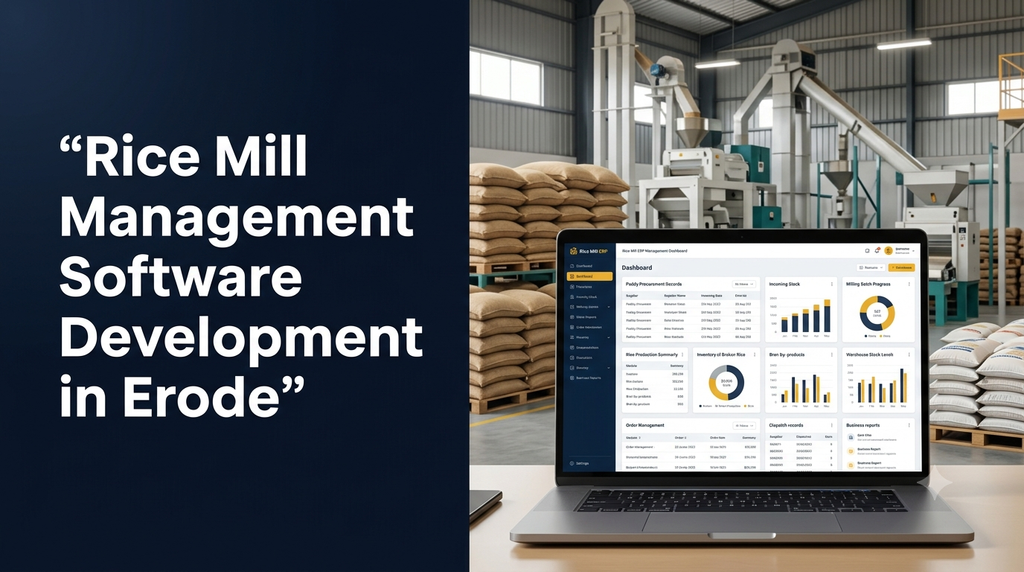
Rice mill management software brings these operations into one digital system. Rice mill owners can monitor incoming paddy, production batches, finished rice, by-products, customer orders and financial transactions through a central dashboard.
For rice mills in Erode and other parts of Tamil Nadu, a custom software solution can be designed around the actual procurement methods, milling processes, product varieties and accounting requirements of the business. This guide explains the essential features, development process and estimated costs.
What Is Rice Mill Management Software?
Rice mill management software is a business application designed to manage the operational and commercial activities of a rice processing unit. It records the movement of paddy from suppliers into the mill, tracks the milling process and maintains records of the rice and by-products produced.
Depending on the business requirements, the application may include a web-based administration panel, accounts module, warehouse interface, procurement staff application and mobile access for authorised employees.
Typical activities managed by the software include:
- Paddy supplier registration and procurement records.
- Vehicle, weighment and incoming material details.
- Paddy quality and moisture observations.
- Milling batch and production tracking.
- Rice varieties, grades and by-product records.
- Warehouse stock and packaging management.
- Customer orders, invoices and dispatch.
- Supplier payments, customer balances and expenses.
- Production, sales and financial reports.
Why Do Rice Mills in Erode Need Digital Management?
Rice milling involves continuous movement of raw materials and finished products. Even a small recording mistake can affect stock balances, supplier payments or customer deliveries. A digital system helps reduce manual coordination and provides a more consistent record of each transaction.
Better procurement records
Maintain supplier details, paddy quantities, purchase rates, vehicle information and weighment records.
Production visibility
Monitor milling batches, input quantities, output quantities, processing stages and production differences.
Accurate stock tracking
Track paddy, rice varieties, broken rice, bran, husk and packaged products separately.
Faster business reporting
Generate procurement, sales, stock, production and payment summaries without collecting multiple registers.
Essential Features of Rice Mill Management Software
1. Paddy Supplier Management
Supplier management is an important starting point for a rice mill application. The system should maintain a central record for farmers, traders, aggregators and other paddy suppliers.
Useful supplier fields include:
- Supplier name and contact information.
- Address and supplier identification number.
- Purchase history and delivery records.
- Payment history and outstanding balances.
- Supplier category and associated procurement centre.
Staff should be able to search suppliers quickly and review their previous transactions before entering a new procurement record.
2. Paddy Procurement and Purchase Management
The procurement module records every incoming paddy purchase. Each entry can contain supplier details, date, paddy variety, vehicle number, gross weight, tare weight, net weight, purchase rate and total value.
Depending on the mill’s process, the software can support:
- Purchase entries from farmers and traders.
- Different paddy varieties and purchase rates.
- Gross, tare and net weight records.
- Moisture and quality observations.
- Purchase deductions and configurable adjustments.
- Purchase receipts and supplier statements.
A configurable purchase workflow is useful because mills may follow different procurement rules and quality assessment practices.
3. Weighbridge and Weighment Integration
Rice mills that receive large quantities of paddy may use electronic weighing systems. Software can be designed to record weighment information and, where compatible equipment is available, integrate with the weighing device.
Potential integration features include:
- Vehicle entry and exit records.
- Gross and tare weight capture.
- Automatic net weight calculation.
- Weighment slip generation.
- Date-wise and vehicle-wise reports.
The integration method depends on the weighing machine’s communication interface, supported protocol and available documentation. Hardware compatibility should be checked before development.
4. Paddy Quality and Moisture Management
Paddy quality can influence purchase decisions and processing requirements. A rice mill system can record moisture readings, variety, quality observations and other parameters used by the business.
If the mill follows a predefined quality-based purchase policy, the application can support configurable rules for recording adjustments. The software should retain the original reading and the final approved purchase calculation for audit purposes.
5. Milling and Production Management
Production management connects the quantity of paddy processed with the rice and by-products obtained. Each milling batch should have a unique reference number so the mill can trace its input and output records.
A production entry may include:
- Production batch number and date.
- Paddy variety and input quantity.
- Machine or production line.
- Processing stage and operator details.
- Rice output by grade or variety.
- Broken rice, bran and husk quantities.
- Recorded wastage or process difference.
The system can generate production summaries for each batch, shift, date or machine. This helps management compare recorded input and output quantities.
6. Rice Yield and Production Reports
Production reports help owners understand how much finished material was recorded against the paddy processed. The application can calculate yield percentages based on the quantities entered.
For example, a simplified report may show:
| Production item | Illustrative quantity |
|---|---|
| Paddy input | 1,000 kg |
| Finished rice | 650 kg |
| Broken rice | 100 kg |
| Bran | 80 kg |
| Husk | 150 kg |
| Other recorded difference | 20 kg |
These figures are only an example of how a report may be structured. Actual output varies according to paddy variety, moisture, equipment, processing method and quality requirements. The system should not treat an illustrative yield as a guaranteed production standard.
7. Rice, By-Product and Warehouse Inventory
A rice mill needs to manage more than one type of stock. Paddy, raw rice, boiled rice, broken rice, bran, husk and packaged products may need separate inventory records.
Inventory features can include:
- Separate stock categories and product varieties.
- Warehouse and storage location management.
- Stock inward and outward entries.
- Batch-wise stock tracking.
- Bag count and weight management.
- Stock transfers between warehouses.
- Physical stock adjustment with approval.
- Low-stock alerts and stock valuation reports.
8. Packaging and Bag Management
Rice may be sold in different packaging sizes depending on customer requirements. The application can record bag sizes, packaging material consumption and finished product quantities.
For example, the software can manage 5 kg, 10 kg, 25 kg and 50 kg product configurations if those sizes are used by the business. It can also maintain packing dates, batch references, labels and dispatch quantities.
9. Customer, Sales and Billing Management
The sales module manages rice orders from wholesalers, retailers, distributors and other business customers.
- Customer registration and contact details.
- Product and variety-based price lists.
- Sales quotations and order entry.
- Tax and non-tax invoice configurations as applicable.
- Discounts and approved adjustments.
- Delivery and dispatch records.
- Customer payment and outstanding balance tracking.
- Sales returns and credit notes where required.
The system should support the business’s applicable GST and accounting requirements. Invoice formats and tax calculations should be reviewed with the mill’s accountant before launch.
10. By-Product Sales Management
Rice milling produces materials such as broken rice, bran and husk. Depending on the mill’s business model, these products may be sold separately or transferred for internal use.
A dedicated module can track by-product production, available quantity, sales rate, customer details, invoices and dispatch records. This helps avoid treating by-products as unrecorded material.
11. Supplier Payments and Customer Receivables
The accounts module can maintain purchase-related payments and sales-related collections. It should support cash, bank and other payment modes used by the business.
- Supplier payment entries.
- Customer receipt entries.
- Advance payments and adjustments.
- Partial payments and outstanding balances.
- Payment vouchers and transaction history.
- Date-wise cash and bank summaries.
If the mill already uses an external accounting application, integration or data export can be considered instead of rebuilding every accounting feature.
12. Expense and Operational Cost Management
A rice mill may record expenses related to electricity, labour, transportation, maintenance, packaging, fuel and other operational activities. The software can classify these expenses and generate period-wise summaries.
More advanced systems can associate selected expenses with production batches or departments. The allocation method should be agreed with management and the accountant so reports reflect the business’s actual accounting practices.
Recommended Rice Mill Management Dashboard
A central dashboard gives the owner and authorised managers a quick overview of current operations. It should highlight important business information without overwhelming users with unnecessary charts.
Procurement dashboard
Today’s paddy purchases, supplier entries, incoming vehicles and purchase summaries.
Production dashboard
Active batches, paddy processed, rice output and recorded by-products.
Inventory dashboard
Available paddy, finished rice, bag stock, warehouse balances and stock movements.
Accounts dashboard
Purchase payments, sales collections, customer dues and expense summaries.
Web Application, Mobile App or Complete ERP?
The appropriate solution depends on the size of the rice mill, number of employees, locations and the way transactions are recorded.
| Application | Primary users | Typical purpose |
|---|---|---|
| Admin web application | Owner and managers | Procurement, production, inventory, sales, accounts and reports. |
| Procurement mobile app | Purchase staff | Supplier entries, purchase records and incoming material information. |
| Warehouse application | Store staff | Stock inward, outward, transfers and physical stock checks. |
| Management mobile access | Owners and authorised managers | Business summaries, alerts and approval workflows. |
A smaller mill may start with a responsive web application. A larger operation with multiple procurement points or warehouses may benefit from mobile applications and a central ERP platform.
Advanced Features for Growing Rice Mills
Once the core system is stable, additional features can improve coordination and traceability.
- Multi-branch management: Manage multiple mills, warehouses or procurement centres from one system.
- Barcode or QR labels: Identify selected batches, packages and warehouse movements.
- Weighbridge integration: Capture supported electronic weighing data.
- Machine integration: Connect compatible equipment where a documented interface is available.
- Approval workflows: Require authorised approval for purchase-rate changes, stock adjustments or exceptional transactions.
- WhatsApp notifications: Send permitted order, payment or business notifications through an approved provider.
- Document management: Store purchase slips, invoices, quality records and supporting documents.
- Data export: Export selected reports to Excel or PDF for business review.
- Audit logs: Record who created or changed important transactions and when.
Rice Mill Software Development Process
A successful project begins with understanding how the mill currently operates. Software should follow the real workflow rather than forcing employees to change every process at once.
Step 1: Business Requirement Analysis
Identify the mill’s procurement process, weighing method, production stages, stock categories, sales workflow and accounting needs. Document the current registers and reports that need to be digitised.
Step 2: Workflow and UI/UX Design
Prepare screens for supplier registration, purchase entries, weighment, production batches, stock management, billing and reporting. Prioritise simple forms that staff can use during busy working hours.
Step 3: Database and Application Development
Build the application with a structured database that connects suppliers, purchases, batches, products, warehouses, invoices and payments. Use transaction controls to maintain consistent stock records.
Step 4: Testing with Sample Business Records
Test purchase calculations, stock movements, production entries, invoices, user permissions and reports. Validate the application using representative business scenarios before entering live records.
Step 5: Data Migration and Staff Training
If the mill has existing digital records, assess whether they can be imported. Clean and verify the data before migration. Train employees on their assigned modules.
Step 6: Deployment and Ongoing Support
Deploy the application on suitable hosting infrastructure, configure backups and security controls, and provide a process for reporting issues and requesting improvements.
Recommended Technology Stack
Technology should be selected based on the expected number of users, integrations, reporting needs and future expansion plans. A possible custom development stack includes:
| Application layer | Possible technologies |
|---|---|
| Frontend | React.js, Next.js or a responsive web interface |
| Backend | Laravel, Node.js or another suitable backend framework |
| Database | MySQL or PostgreSQL |
| Mobile application | Flutter or native Android development |
| Hosting | Cloud VPS or suitable managed infrastructure |
| Reports | PDF and spreadsheet export libraries |
| Integrations | Compatible device interfaces and approved third-party APIs |
How Much Does Rice Mill Management Software Cost in India?
The development cost depends on the number of modules, user roles, branches, integrations, reporting requirements and complexity of the existing business workflow. A basic procurement application costs less than a complete ERP with production, accounting, mobile applications and hardware integration.
The following figures are illustrative planning estimates for custom software development in India. They are not fixed Greap Technologies quotations or guaranteed market prices.
| Solution type | Illustrative development estimate |
|---|---|
| Basic supplier and paddy purchase management | ₹25,000–₹45,000 |
| Procurement, billing and stock management | ₹40,000–₹75,000 |
| Production and by-product management | ₹55,000–₹1,00,000 |
| Complete rice mill web management system | ₹75,000–₹1,50,000 |
| Web application with staff mobile app | ₹1,00,000–₹2,00,000+ |
| Multi-branch rice mill ERP | ₹1,50,000–₹3,00,000+ |
| Advanced ERP with supported hardware integrations | ₹2,00,000–₹4,00,000+ |
These are broad budgeting ranges, not a substitute for a technical assessment. Actual pricing can be lower or higher depending on scope, existing systems and implementation requirements.
Other costs may include:
- Domain name, server hosting and backups.
- SMS, WhatsApp or other third-party service charges.
- Weighbridge or other hardware procurement and integration.
- Paid software licences and external API subscriptions.
- Data migration, training and ongoing maintenance.
- Applicable taxes and additional support requirements.
How to Choose a Rice Mill Software Development Company in Erode
Selecting a development partner is important because rice mill software must reflect the mill’s actual procurement, production and stock workflows.
Before finalising a development company, check the following:
- Can the company understand your current rice mill operations?
- Can the software support your paddy varieties and product categories?
- Are purchase, production and stock calculations configurable?
- Can user permissions be configured for different employees?
- Are reports available in the formats your business needs?
- Can compatible weighing devices be integrated?
- Are backups, access controls and audit logs included?
- Is training and post-launch technical support available?
- Will you receive clear documentation and ownership terms?
Ask for a demonstration using a sample workflow similar to your own mill. A practical demonstration is more useful than choosing a system based only on a feature list.
Why Consider Custom Rice Mill Software?
Every rice mill may have different purchasing rules, production processes, product grades and accounting practices. A generic application may not cover all these requirements.
Custom development allows the business to choose its modules, workflows, reports and integrations. The software can begin with essential procurement and inventory features and expand later as the business grows.
Greap Technologies provides website and custom software development services for businesses. A rice mill management project can be planned around the mill’s operational requirements, user roles and future expansion needs.
Frequently Asked Questions
1. What is rice mill management software?
It is a business application that manages paddy procurement, supplier records, weighing, milling production, rice inventory, by-products, billing, dispatch and business reports.
2. Can rice mill software manage paddy purchases?
Yes. It can record supplier details, paddy varieties, purchase quantities, weight information, rates, quality observations and payment records.
3. Can the software calculate rice production yield?
Yes. The application can calculate output percentages using recorded paddy input and finished-product quantities. Actual yield depends on the paddy and milling process.
4. Can it manage broken rice, bran and husk?
Yes. These can be configured as separate inventory products with production, stock, sales and dispatch records.
5. Can rice mill software connect with a weighbridge?
It may be possible when the weighing equipment supports a compatible communication interface or integration method. Hardware specifications should be checked first.
6. Can multiple rice mill branches use one application?
Yes. A multi-branch system can manage separate locations, warehouses, procurement records and user permissions through a central platform.
7. Is a mobile app necessary for a rice mill?
Not always. A responsive web application may be sufficient for a smaller mill. Mobile apps can be useful when procurement or warehouse staff need to record information away from the main office.
8. How much does custom rice mill software cost?
A basic system may require a smaller investment, while a complete ERP with production, accounts, mobile apps and integrations costs more. The final estimate depends on the agreed requirements and development scope.
9. Can existing rice mill records be migrated?
Existing digital records may be imported after checking their format, completeness and consistency. Paper registers generally need to be reviewed and entered or digitised through an agreed migration process.
10. How long does rice mill software development take?
A small application may take several weeks, while a complete ERP with multiple modules and integrations can take longer. The timeline depends on scope, testing, data migration and user feedback.
Conclusion
Rice mill management software can help businesses organise paddy procurement, production, warehouse stock, by-product sales, customer billing and financial records. By bringing these activities into one system, owners and managers can improve operational visibility and reduce dependence on disconnected manual records.
For rice mills in Erode and across Tamil Nadu, the right solution should be based on actual business workflows, not simply the number of features offered. Starting with essential modules and expanding gradually can make digital adoption more practical.
Planning Custom Rice Mill Management Software?
Greap Technologies helps businesses plan and develop custom websites and software applications. Discuss your rice mill’s procurement, production, inventory, billing and reporting requirements to explore a suitable solution.