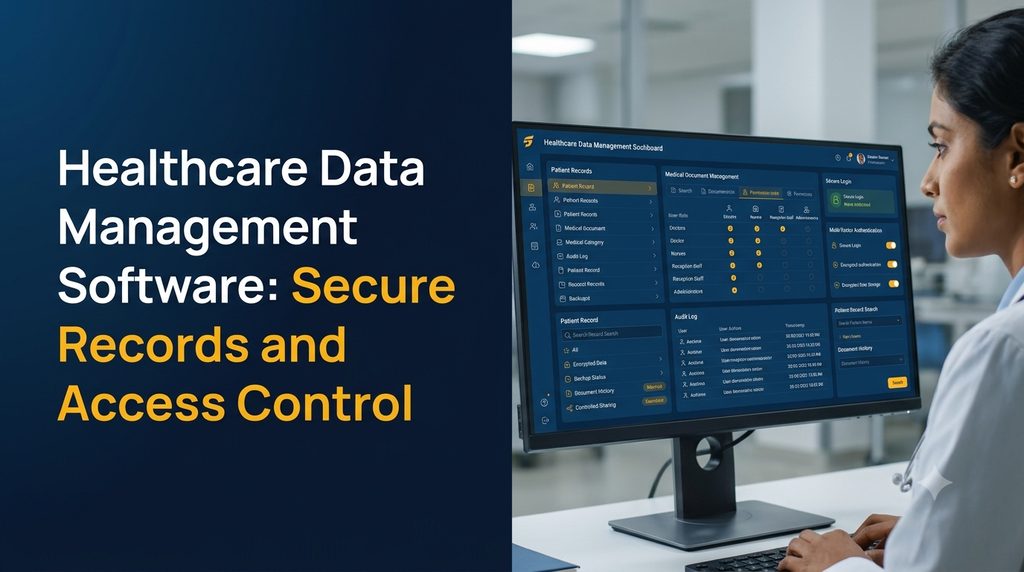
Healthcare organisations handle a wide range of information, from patient registration details and consultation records to diagnostic reports, prescriptions, billing documents and staff activity logs. Managing these records securely requires more than a shared folder or a basic database.
Healthcare data management software is a digital system that helps clinics, hospitals, diagnostic centres and healthcare networks organise, store, retrieve, protect and manage healthcare information. It can combine structured patient records, document management, user permissions, audit trails, backup processes and controlled data sharing in one platform.
What Is Healthcare Data Management Software?
Healthcare data management software is an application designed to manage information generated or used by healthcare organisations. It provides a structured way to collect, organise, search, update, store, retrieve and share information according to defined organisational rules.
Depending on the project, the platform may manage patient demographics, clinical documents, medical histories, diagnostic reports, prescriptions, appointment records, insurance documents, administrative files and operational information.
A custom healthcare data management platform may work independently or connect with existing hospital management systems (HMS), electronic medical records (EMR), electronic health records (EHR), laboratory information systems (LIS), pharmacy applications and patient portals.
Why Healthcare Organisations Need Structured Data Management
Healthcare information is often distributed across multiple departments and software applications. A reception team may manage registration data, doctors may maintain consultation records, laboratories may store test results, and administrators may manage operational documents.
Without a consistent information management process, organisations may experience duplicated records, inconsistent data, slow document retrieval and unclear access responsibilities.
- Organised information: Store records using consistent categories, identifiers and metadata.
- Controlled access: Give users permissions based on their responsibilities.
- Improved traceability: Record important activities such as viewing, editing, exporting and sharing records.
- Efficient retrieval: Help authorised staff locate the information needed for their work.
- Document control: Maintain document versions, upload history and ownership information.
- Operational continuity: Plan backups, restoration procedures and recovery testing.
- System integration: Reduce unnecessary manual duplication between connected applications.
Types of Healthcare Data a Management System Can Handle
The data categories depend on the organisation and the purpose of the software. A healthcare platform should collect only the information necessary for its intended functions.
| Data category | Examples | Possible users |
|---|---|---|
| Patient identity and registration | Patient ID, contact details and registration history | Authorised reception and administrative staff |
| Clinical records | Consultation notes, diagnoses and treatment documentation | Authorised doctors and clinical staff |
| Diagnostic information | Laboratory reports, imaging reports and test results | Relevant clinical and diagnostic teams |
| Medication records | Prescription history and medication-related documents | Authorised doctors and pharmacy staff |
| Administrative documents | Admission documents, forms and internal records | Designated administrative teams |
| Financial records | Invoices, receipts and payment references | Authorised billing and finance staff |
| System activity information | Login history, access events and change logs | Approved administrators and security personnel |
Essential Features of Healthcare Data Management Software
1. Centralised Patient Information Management
A structured patient information module can maintain registration details, unique patient identifiers, demographic information and links to relevant records. Search and duplicate-checking functions can help staff identify existing records before creating new ones.
The software should define how duplicate records are reviewed and merged. Automatic merging without appropriate validation can combine information belonging to different people.
2. Medical Document Management
Healthcare teams often need to store and retrieve scanned documents, referral letters, laboratory reports, discharge summaries, consent documents and other files. A document management module can organise these files using patient identifiers, document categories, upload dates and authorised ownership.
- Document upload and categorisation.
- Search by permitted metadata.
- Version history and change records.
- Controlled download and sharing permissions.
- Document retention and archival rules.
3. Role-Based Access Control
Role-based access control (RBAC) assigns permissions according to a user’s role. Instead of giving every employee access to every record, the organisation defines what each role can view, create, edit, approve, export or manage.
For example, a reception user may manage registration and appointments without receiving unrestricted access to clinical notes. A doctor may access relevant clinical records for authorised care activities. A system administrator may manage user accounts without automatically receiving permission to read all clinical content.
4. Department and Branch-Level Permissions
Hospitals and healthcare groups may operate several departments, branches or facilities. Permissions can be configured according to organisational units, assigned responsibilities and approved care relationships.
A multi-branch platform should clearly define whether users can access records across locations, whether a central administrator can view operational reports, and how exceptional access is approved and recorded.
5. Audit Trails and Activity Logs
Audit trails provide a record of important actions performed within the application. Depending on the system design, logs may capture the user, action, record reference, timestamp and relevant outcome.
- Successful and unsuccessful login events.
- Record creation and modification.
- Record viewing where audit requirements call for it.
- Document downloads and exports.
- Permission and user-account changes.
- Data-sharing and administrative actions.
Logs should be protected from unauthorised modification. Access to audit information should also be restricted and monitored.
6. Secure Authentication
The login module can support strong password policies, multi-factor authentication (MFA), secure session handling and account lockout or risk-based controls. Single sign-on may be considered for organisations with an existing identity management platform.
7. Encryption and Secure Data Transmission
Encryption helps protect information while it is transmitted and stored. A solution should use appropriately configured secure communication protocols and suitable encryption for databases, file storage and backups. Encryption keys should be managed separately from the data they protect.
8. Backup and Recovery Management
Backups should cover relevant databases, uploaded documents, configuration and other critical application data. Organisations should define backup frequency, retention, access permissions and recovery objectives.
A backup is useful only if it can be restored. Periodic restoration tests help verify that recovery procedures work as expected.
9. Consent and Controlled Information Sharing
Where patient information is shared through an applicable consent-based workflow, the platform should record the purpose, scope, recipient, status and relevant validity period of the permission. The workflow should support the applicable rules for recording and handling consent, including withdrawal where required.
10. Data Quality and Validation
Validation rules can reduce incomplete, inconsistent or incorrectly formatted information. Examples include required fields, date validation, unique identifiers, standardised document categories and duplicate-record checks.
Understanding Role-Based Access Control in Healthcare
Role-based access control is one of the most important design considerations in healthcare information management. It translates organisational responsibilities into application permissions.
A useful starting point is the principle of least privilege: each user should receive only the access required to perform their assigned duties. Permissions should be reviewed when employees change roles or leave the organisation.
| User role | Example permissions | Access considerations |
|---|---|---|
| Reception staff | Patient registration, appointment details and permitted administrative records | Clinical information should not be automatically available. |
| Doctor | Relevant patient history, consultation records and clinical documentation | Access should reflect authorised care responsibilities. |
| Nursing staff | Assigned patient information and approved nursing documentation | Limit access to relevant patients and workflows. |
| Laboratory staff | Relevant test requests, sample details and result entry | Do not expose unrelated patient or financial information. |
| Billing staff | Invoices, receipts and approved billing references | Clinical notes should remain restricted unless required. |
| Department manager | Approved department-level operational reports and workflows | Management access should not imply unrestricted clinical access. |
| System administrator | User accounts, configuration and technical operations | Separate technical administration from clinical record access where possible. |
Example Permission Matrix
The following is an illustrative starting point. Actual permissions must be decided by the healthcare organisation after reviewing job responsibilities, clinical workflows and applicable requirements.
| Action | Reception | Doctor | Lab staff | Billing | Administrator |
|---|---|---|---|---|---|
| Register patients | Yes | Limited | No | Limited | Configure |
| View relevant clinical records | Restricted | Yes | Limited | No | Not by default |
| Enter laboratory results | No | View | Yes | No | Configure |
| Manage invoices | Limited | View if required | No | Yes | Configure |
| Manage user accounts | No | No | No | No | Yes |
| Review audit logs | No | Restricted | Restricted | Restricted | Authorised role |
Yes, Limited, Restricted and No are illustrative permission labels, not a universal healthcare access standard.
How a Healthcare Data Management System Works
A typical implementation connects information collection, validation, storage, permission checks, audit logging and retrieval into a controlled workflow.
- Information entry: An authorised user creates or updates a record through an approved application screen or connected system.
- Validation: The application checks required fields, identifiers, formats and duplicate conditions.
- Permission check: The system verifies whether the user can perform the requested action.
- Secure storage: Approved information is saved in the relevant database or document repository.
- Audit recording: Important activities are recorded according to the audit policy.
- Authorised retrieval: Users can search for and access records within their assigned permissions.
- Backup and monitoring: The organisation monitors system health and verifies backup and recovery procedures.
Healthcare Data Management Software vs EMR, EHR and Hospital Management Systems
These systems can share features, but they do not necessarily serve the same purpose. A healthcare data management platform may connect several applications or provide a broader information governance layer.
| System | Primary purpose |
|---|---|
| Healthcare data management software | Organising, governing, protecting and managing healthcare information across workflows and systems. |
| EMR software | Maintaining electronic clinical records within a healthcare provider or organisation. |
| EHR platform | Supporting broader electronic health record information and, where implemented, exchange across providers. |
| Hospital management system | Managing hospital operations such as registration, appointments, billing, departments and administration. |
| Document management system | Managing digital documents, metadata, versions, access and retention. |
| Laboratory information system | Managing laboratory orders, samples, tests and results. |
A project may require one integrated platform, or several specialised systems connected through APIs. The correct approach depends on the organisation’s existing applications and information requirements.
Healthcare Software Integration and Interoperability
Healthcare organisations may use separate applications for clinical records, laboratory operations, imaging, pharmacy, billing and patient communication. Integration can help authorised information move between these systems without unnecessary repeated entry.
Common Integration Requirements
- HMS integration: Connect patient registration, admission and operational records.
- EMR/EHR integration: Exchange approved clinical information.
- LIS integration: Connect laboratory orders and results.
- Radiology integration: Link imaging reports and relevant imaging references.
- Pharmacy integration: Connect approved prescription and medication workflows.
- Billing integration: Link permitted service and payment information.
- Patient portal integration: Provide patients with approved access to their own information.
Depending on the systems involved, integration may use REST APIs, secure web services, HL7 messaging or FHIR-based resources. Data mapping, identity matching, error handling and access permissions must be planned before implementation.
Technical connectivity alone does not guarantee interoperability. Systems must also agree on identifiers, data meanings, formats, permitted purposes and exchange workflows.
Data Security Considerations for Healthcare Applications
Healthcare software should be designed with security and privacy requirements from the beginning. A login screen alone is not sufficient to protect sensitive information.
Important Security Controls
- Role-based and, where appropriate, attribute-based access permissions.
- Multi-factor authentication for suitable user groups and administrative accounts.
- Encryption for data in transit and at rest.
- Secure password storage and session management.
- Protected audit logs and monitoring of unusual access activity.
- Regular software updates and dependency maintenance.
- Secure API authentication, authorisation and rate limiting.
- Backups with restricted access and tested restoration procedures.
- Vulnerability assessments and security testing.
- Documented incident response and access-review processes.
Privacy by Design
Privacy by design means considering data protection throughout the software lifecycle rather than treating it as a final checklist. The development team should assess what information is necessary, why it is collected, who needs access, how long it should be retained and when it should be deleted or archived.
A healthcare organisation should also establish clear responsibilities for user access approval, employee onboarding and offboarding, data sharing, vendor access and incident handling.
Healthcare Data Management and Indian Regulatory Considerations
Healthcare organisations in India should review applicable data protection, health-sector and contractual requirements before designing a new information management platform. The software’s features should support the organisation’s actual obligations rather than relying on a generic claim of being compliant.
Digital Personal Data Protection Act and Rules
India’s Digital Personal Data Protection Act, 2023 and the Digital Personal Data Protection Rules, 2025 establish a framework for processing digital personal data. The Rules were notified in November 2025, with a phased commencement schedule. Organisations should check the official enforcement timeline and obtain appropriate legal advice when planning their obligations.
Software requirements may include appropriate notices, purpose-related data handling, consent workflows where applicable, security safeguards, individual-rights processes and retention or deletion procedures. The exact requirements depend on the processing activity, applicable provisions and their commencement dates.
Ayushman Bharat Digital Mission
The Ayushman Bharat Digital Mission (ABDM) supports a connected digital health ecosystem. Its framework includes health information exchange and consent-related mechanisms. Healthcare applications seeking ABDM participation or integration must review the relevant policies, technical specifications, sandbox requirements and validation processes.
ABDM integration should not be treated as an automatic feature of every healthcare database. It requires a separate assessment of the intended use case, technical requirements and applicable onboarding process.
Practical Implementation Checklist
- Identify the organisation’s role and responsibilities in handling personal data.
- Document the purpose and permitted use of each information category.
- Define user roles and record-level access requirements.
- Establish appropriate notices and consent workflows where required.
- Define retention, archival and deletion procedures.
- Review vendor, cloud hosting and third-party integration arrangements.
- Maintain security testing, incident response and recovery documentation.
- Review relevant ABDM requirements if participation or integration is planned.
This section is general technical information, not legal advice. Requirements and commencement dates should be verified against official government notifications before deployment.
Custom Healthcare Data Management Software Development Process
A successful implementation starts with understanding how information is created, used, accessed and retained across the organisation.
- Requirement discovery: Identify departments, data categories, existing systems, users and business objectives.
- Data classification: Categorise information and identify sensitive records and access requirements.
- Architecture planning: Design the application, database, storage, API and integration architecture.
- Access model design: Define roles, permissions, approval workflows and exceptional-access handling.
- Interface development: Build dashboards, record screens, search, document management and administration features.
- Integration development: Connect required external applications using documented interfaces.
- Security testing: Test authentication, permissions, data protection, audit logging and application security.
- Data migration: Validate existing records, map fields and reconcile migrated information.
- User acceptance testing: Verify workflows with authorised representatives from relevant departments.
- Deployment and support: Configure production infrastructure, monitoring, backups, training and maintenance.
Technology Considerations for Healthcare Data Platforms
The technology stack should match the project’s scale, integration needs, security requirements and maintenance capacity. There is no single framework that is automatically suitable for every healthcare organisation.
| Technology area | Possible options or considerations |
|---|---|
| Frontend | React, Next.js or another maintainable web framework. |
| Backend | Laravel, Node.js, Java, .NET or another suitable server framework. |
| Database | PostgreSQL, MySQL or an appropriately selected database platform. |
| Document storage | Controlled object storage or secure document repository. |
| Authentication | Secure identity management, MFA and suitable session controls. |
| Integration | Documented REST APIs, HL7 messaging or FHIR-based interfaces where applicable. |
| Infrastructure | Managed cloud or suitable private infrastructure with monitoring and recovery planning. |
Technology selection should consider long-term maintenance, vendor support, data portability, performance, security updates and the availability of skilled developers.
How Much Does Healthcare Data Management Software Development Cost in India?
The cost of custom healthcare data management software depends on the number of modules, user roles, security controls, integrations, document storage needs, migration requirements and deployment model.
The following figures are illustrative planning estimates for custom development, not fixed Greap quotations or guaranteed market prices.
| Project scope | Illustrative development estimate |
|---|---|
| Basic patient information and document management | ₹30,000–₹55,000 |
| Patient records, search and role-based permissions | ₹45,000–₹80,000 |
| Audit logs, document history and access administration | ₹60,000–₹1.1 lakh |
| Healthcare data platform with multiple user roles and reports | ₹80,000–₹1.5 lakh |
| Multi-department platform with selected system integrations | ₹1.2–₹2.5 lakh+ |
| Advanced multi-branch platform with mobile access and integrations | ₹2.5–₹5 lakh+ |
| Large-scale enterprise data management and interoperability platform | ₹5 lakh+ depending on scope |
Additional Costs to Consider
- Cloud hosting, storage and database infrastructure.
- Backup storage, monitoring and disaster recovery services.
- Third-party software, API and integration charges.
- Security assessments and specialist reviews.
- Legacy data migration and document digitisation.
- SMS, email and notification provider charges.
- Mobile application publishing and maintenance.
- Training, ongoing support, taxes and future enhancements.
A detailed requirement assessment is necessary before preparing a reliable quotation. Healthcare projects involving clinical data exchange, legacy migration or specialised interoperability may require additional technical and compliance review.
How to Choose a Healthcare Software Development Company
Healthcare data management is not simply a database development project. The development partner should understand information workflows, user permissions, integration requirements and the importance of protecting sensitive records.
Before selecting a development company, review the following:
- Experience developing database-driven business applications.
- Understanding of patient record and document workflows.
- Ability to design role-based permissions and audit trails.
- Knowledge of secure APIs and relevant healthcare data standards.
- Clear approach to encryption, backups and recovery testing.
- Documented development, testing and deployment processes.
- Data ownership, export and migration arrangements.
- Post-launch maintenance and security update plans.
- Transparent project scope, milestones and pricing.
Healthcare Data Management Software for Clinics and Hospitals in Tamil Nadu
Clinics, hospitals, laboratories and healthcare networks across Tamil Nadu may use different applications for patient registration, consultation management, diagnostics, billing and administration. A well-planned data management platform can help bring these workflows into a more organised information structure.
Healthcare providers in Erode, Perundurai, Bhavani, Gobichettipalayam, Sathyamangalam and nearby areas may consider custom software when existing tools do not adequately support their departments, branches, access policies or reporting needs.
A smaller clinic may begin with patient information management, document storage and staff permissions. A larger hospital may require department-level access, audit reporting, integration with EMR or HMS applications and a structured data migration plan.
The appropriate solution should be based on the organisation’s actual workflows and information governance requirements rather than adding unnecessary modules.
Frequently Asked Questions
1. What is healthcare data management software?
Healthcare data management software is a digital platform used to organise, store, retrieve, protect and manage information used by clinics, hospitals, laboratories and other healthcare organisations.
2. What is the difference between healthcare data management software and EMR software?
EMR software primarily manages electronic clinical records. Healthcare data management software can cover a wider range of information, including clinical documents, administrative records, access permissions, audit logs, storage and integrations across multiple applications.
3. What is role-based access control in healthcare?
Role-based access control assigns application permissions according to job responsibilities. For example, doctors, reception staff, laboratory staff and billing teams can receive different levels of access.
4. Can healthcare software restrict access to patient records?
Yes. A properly designed application can restrict record access based on user roles, assigned departments, organisational rules and other applicable conditions. Access decisions should be tested and monitored.
5. What is an audit trail in healthcare software?
An audit trail records important activities performed in a system, such as record updates, permission changes, document downloads and selected access events. It helps authorised reviewers understand how information has been handled.
6. Is encryption enough to secure healthcare data?
No. Encryption is one important safeguard, but a secure system also needs appropriate authentication, access control, audit logging, secure development, monitoring, backup and incident response procedures.
7. Can the software integrate with an existing hospital management system?
Yes, integration may be possible through documented APIs, HL7 messaging or other supported interfaces. Feasibility depends on the existing system, available documentation, vendor permissions and data formats.
8. Can healthcare data management software connect with FHIR?
A platform can be designed to exchange supported healthcare information through FHIR-based interfaces. The required FHIR version, resources, profiles and workflows must be agreed upon with the connected systems.
9. Does ABDM integration come automatically with healthcare software?
No. ABDM integration requires a separate assessment of the use case, technical specifications, applicable policies, sandbox process and validation requirements.
10. Can a clinic use custom healthcare data management software?
Yes. A clinic can use a custom platform for patient information, document management, staff permissions and selected integrations. The feature set should match the clinic’s size and workflows.
11. Can the system support multiple hospital branches?
Yes. A multi-branch platform can include location-based access, central administration, branch-level reporting and controlled record sharing, depending on the organisation’s requirements.
12. How are healthcare records backed up?
Backups may include databases, uploaded documents and important configuration data. The organisation should define backup frequency, retention, access restrictions and periodic restoration testing.
13. Can existing patient data be migrated into a new system?
Yes, subject to data quality, source formats, access rights and migration feasibility. A migration project should include field mapping, validation, duplicate review, reconciliation and an approved cutover plan.
14. How much does custom healthcare data management software cost in India?
Illustrative development estimates may start around ₹30,000 for a basic patient information and document management module. Multi-role platforms, integrations and enterprise features can cost substantially more depending on scope.
15. How long does healthcare data management software development take?
A basic application may take several weeks, while a larger platform with multiple departments, integrations, migration and security testing may take several months. The timeline depends on requirements, data readiness and stakeholder approvals.
Planning Healthcare Data Management Software for Your Organisation?
Greap Technologies develops custom websites, business applications and software solutions. If your clinic, hospital or healthcare organisation needs a structured platform for patient information, secure document management, role-based access, audit trails or system integrations, start with a discussion about your requirements.
We can help define the modules, user roles, data workflows, integration requirements and development scope for your project.
Discuss Your Project on WhatsApp Call Greap TechnologiesWebsite: www.greap.in