
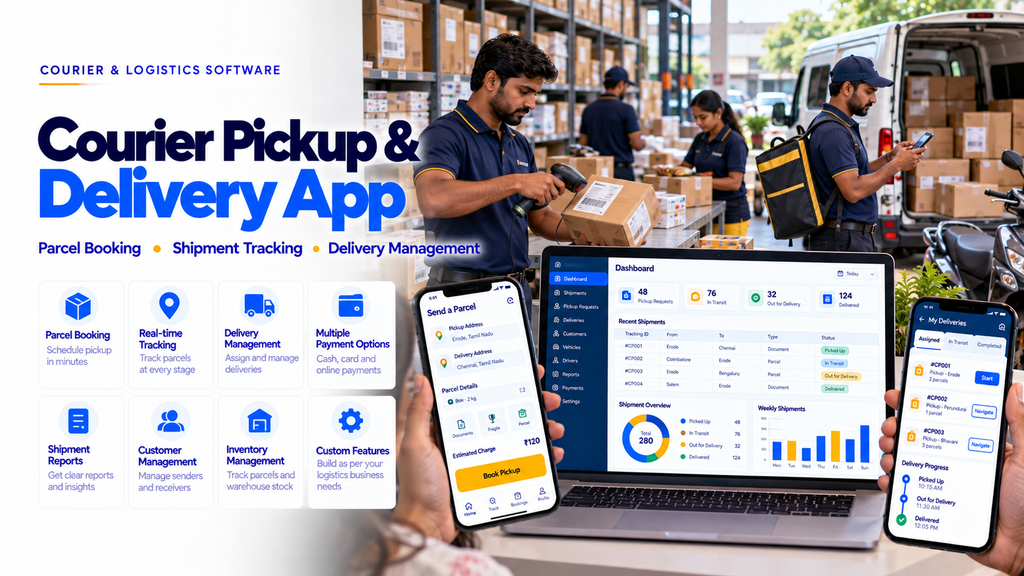
Courier Pickup and Delivery App Development for Logistics Companies
Courier and logistics companies manage several activities every day, including parcel bookings, pickup requests, shipment sorting, delivery assignments, tracking updates, billing and customer support.
For small courier businesses, these activities may initially be managed through phone calls, spreadsheets, WhatsApp messages and manual registers. As parcel volumes increase, coordinating pickups, tracking shipments and managing delivery employees can become more complicated.
A courier pickup and delivery app helps connect customers, delivery employees, branch operators and logistics administrators through a structured digital platform.
Customers can request parcel pickup, enter shipment details, receive booking confirmation and track shipment progress. Pickup and delivery employees can view assigned tasks, scan parcels and update shipment status. Logistics companies can manage shipments, branches, dispatch operations, payments and reports through an administration dashboard.
For courier companies, transport agencies, parcel delivery operators and logistics entrepreneurs in Erode and Tamil Nadu, a courier management platform may help organize daily delivery operations.
This guide explains the essential features, applications, parcel tracking workflows, business models, development costs and implementation considerations involved in courier pickup and delivery app development.
What Is a Courier Pickup and Delivery App?
A courier pickup and delivery app is a digital platform that allows customers to request parcel collection and helps logistics businesses coordinate shipment processing and delivery.
Depending on the business model, the platform may support:
- Doorstep parcel pickup
- Local courier delivery
- Intercity parcel delivery
- Business parcel shipments
- Scheduled pickups
- Shipment tracking
- Delivery employee assignments
- Branch-based parcel processing
- Cash-on-delivery collection
Actual service availability depends on the logistics company’s network, operational capacity and applicable requirements.
Why Courier Companies May Need a Digital Delivery App
Courier companies often handle parcel bookings and delivery communication through several disconnected systems.
Common operational challenges include:
- Missed pickup requests
- Difficulty tracking parcel movement
- Unorganized delivery assignments
- Manual shipment status updates
- Delayed customer communication
- Incorrect address information
- Difficulty managing multiple branches
- Manual cash collection records
- Limited operational reporting
A properly configured courier management platform can help maintain consistent shipment records and improve visibility across the delivery workflow.
1. Courier App Business Models
Single Courier Company App
A courier company can manage its own customers, branches, pickup employees and delivery operations through one platform.
Multi-Branch Courier Management
A logistics company can coordinate parcel movement across several branches and distribution locations.
Hyperlocal Parcel Delivery
A local delivery business may provide parcel pickup and delivery within selected service zones.
Courier Aggregator Platform
An aggregator may connect customers with multiple participating courier providers through approved integrations and commercial arrangements.
Business-to-Business Courier Platform
A B2B courier platform may support recurring shipments, business customer accounts, bulk bookings and consolidated billing.
2. Applications Required for Courier Pickup and Delivery
| Application | Primary Users | Purpose |
|---|---|---|
| Customer App | Individuals and businesses | Book pickups and track parcels |
| Pickup and Delivery App | Delivery employees | Manage assigned collection and delivery tasks |
| Super Admin Panel | Logistics company owner | Manage shipments and operations |
| Branch / Hub Panel | Branch employees | Scan, sort and dispatch parcels |
| Courier Booking Website | Customers | Request shipments through a browser |
| Business Customer Portal | Corporate customers | Manage bulk shipments and invoices |
3. Customer Courier Booking App Features
The customer application should make parcel booking straightforward.
Customer Registration
- Mobile number registration
- Supported OTP verification
- Customer profile
- Saved pickup addresses
- Saved delivery addresses
- Account settings
Parcel Booking
- Pickup address
- Delivery address
- Recipient contact details
- Parcel category
- Declared parcel weight
- Package dimensions
- Available service options
- Estimated delivery charges
Shipment Management
- Booking confirmation
- Tracking number
- Shipment status
- Shipment history
- Payment records
- Invoices
4. Courier Pickup Booking Management
Pickup scheduling helps coordinate customer collection requests.
Potential features include:
- Pickup location
- Pickup date
- Available pickup slots
- Parcel details
- Pickup instructions
- Employee assignment
- Pickup confirmation
Available pickup slots should reflect actual staff and vehicle capacity.
5. Pickup and Delivery Partner App Features
Courier employees may use a separate application to manage collection and delivery tasks.
Potential features include:
- Secure employee login
- Assigned pickups
- Assigned deliveries
- Customer addresses
- Navigation integration
- Parcel scanning
- Pickup confirmation
- Delivery status
- Proof of delivery
- Completed task history
Employee interfaces should minimize interaction while driving.
6. Courier Super Admin Panel Features
The administration dashboard helps logistics companies supervise platform operations.
Potential features include:
- Customer management
- Shipment management
- Pickup request management
- Delivery employee management
- Branch management
- Hub management
- Service area configuration
- Pricing rules
- Payment records
- Cash collection records
- Customer support
- Operational reports
7. Courier Branch and Hub Management
Multi-branch logistics companies may require separate branch and hub management workflows.
Potential features include:
- Branch profiles
- Hub profiles
- Employee assignments
- Incoming parcel records
- Outgoing parcel records
- Parcel scanning
- Dispatch manifests
- Branch-wise shipment reports
8. Parcel Tracking System
Parcel tracking helps customers and logistics employees understand shipment progress.
Potential tracking statuses include:
- Booking confirmed
- Pickup assigned
- Parcel collected
- Received at origin hub
- In transit
- Arrived at destination hub
- Out for delivery
- Delivered
- Delivery attempt unsuccessful
- Returned to sender
Tracking updates should reflect actual parcel scans and verified operational events.
9. Barcode and QR-Based Parcel Tracking
Barcode or QR-based identification can help logistics businesses maintain consistent shipment records.
Potential features include:
- Unique shipment identifiers
- Barcode generation
- QR code generation
- Parcel label printing
- Pickup scanning
- Hub arrival scanning
- Dispatch scanning
- Delivery confirmation scanning
10. Air Waybill and Shipping Label Management
Courier companies may generate shipment documents or shipping labels containing booking information.
Potential features include:
- Shipment reference number
- Sender details
- Recipient details
- Pickup address
- Delivery address
- Parcel weight
- Barcode or QR code
- Service category
Document fields should reflect the carrier’s operational and legal requirements.
11. Courier Parcel Weight Management
Courier pricing may depend on parcel weight.
Potential features include:
- Declared weight
- Measured weight
- Weight units
- Weight-based pricing
- Chargeable weight records
- Billing adjustments
Any final weight adjustments should be communicated according to the company’s published pricing policy.
12. Volumetric Weight Calculation
Some logistics providers calculate shipping charges using dimensional or volumetric weight.
A common calculation structure is:
The divisor, measurement units and applicable billing rules depend on the carrier’s service policy.
The system can compare actual and volumetric weight according to the configured pricing rules.
13. Courier Delivery Charge Calculation
Delivery charges may depend on several factors.
Potential pricing inputs include:
- Origin location
- Destination location
- Service zone
- Parcel weight
- Parcel dimensions
- Service speed
- Additional handling requirements
- Applicable taxes
Customers should receive clear pricing information before confirming a shipment.
14. Local and Intercity Courier Management
Courier companies may offer different delivery services based on operating coverage.
Potential service categories include:
- Local parcel delivery
- Same-day delivery where operationally available
- Next-day delivery where operationally available
- Intercity courier service
- Business parcel collection
- Scheduled parcel delivery
Delivery estimates should be based on actual network capacity and service conditions.
15. Courier Dispatch Management
Dispatch management helps organize parcels moving between branches and delivery locations.
Potential features include:
- Dispatch batches
- Shipment grouping
- Vehicle assignment
- Dispatch manifests
- Departure confirmation
- Arrival confirmation
- Dispatch history
16. Courier Route Management
Delivery route management helps organize assigned parcels according to operational priorities.
Potential features include:
- Delivery addresses
- Assigned routes
- Delivery sequences
- Navigation integration
- Route status
- Completed deliveries
- Unsuccessful delivery attempts
Route planning should account for real travel conditions, delivery windows and vehicle capacity.
17. Last-Mile Delivery Management
Last-mile delivery covers the final stage of parcel movement from the destination facility to the recipient.
Potential features include:
- Out-for-delivery assignments
- Delivery employee allocation
- Recipient contact information
- Delivery instructions
- Delivery confirmation
- Failed delivery reasons
- Reattempt scheduling
18. Proof of Delivery Management
Proof of delivery helps record that a shipment has been handed over according to the courier company’s procedures.
Potential features include:
- Delivery confirmation
- Recipient acknowledgement
- Authorized signature capture
- Delivery OTP where appropriate
- Delivery timestamp
- Permitted delivery photographs
Proof-of-delivery information should be collected and retained according to appropriate privacy and business policies.
19. Failed Delivery and Reattempt Management
Some parcels may not be delivered during the first attempt.
Potential features include:
- Unsuccessful delivery status
- Reason codes
- Customer notification
- Reattempt scheduling
- Return processing
- Delivery history
20. Return to Origin Management
Return-to-origin workflows help logistics companies manage parcels that cannot be delivered or must be returned.
Potential features include:
- Return request records
- Return reason
- Return shipment status
- Branch processing
- Return dispatch
- Sender notification
- Return completion
21. Reverse Logistics Management
Reverse logistics involves moving products or parcels back through a delivery network.
Potential features include:
- Return pickup requests
- Customer return addresses
- Pickup assignments
- Return parcel scanning
- Return tracking
- Return delivery confirmation
22. Ecommerce Courier Integration
Courier companies may integrate with ecommerce systems to receive shipment requests.
Potential features include:
- Shipment creation through APIs
- Order references
- Customer delivery details
- Shipping label generation
- Tracking updates
- Delivery confirmation
- Return shipment records
Integration availability depends on the ecommerce platform and its supported APIs.
23. Bulk Shipment Booking
Business customers may need to create several shipments at once.
Potential features include:
- Bulk shipment entry
- Supported file imports
- Address validation
- Shipment references
- Bulk label generation
- Booking confirmation
24. Corporate Courier Customer Management
Courier companies may provide separate accounts for business customers.
Potential features include:
- Business profiles
- Authorized users
- Pickup locations
- Contract pricing
- Shipment history
- Invoices
- Payment records
25. Cash-on-Delivery Management
Some courier businesses may support cash-on-delivery shipments.
Potential features include:
- COD shipment identification
- Collection amount
- Delivery confirmation
- Collection records
- Settlement calculations
- Remittance reports
COD operations require appropriate agreements, controls and financial reconciliation procedures.
26. Courier Online Payment Integration
Courier booking platforms may integrate supported payment providers.
Potential features include:
- Payment initiation
- Transaction confirmation
- Payment references
- Payment status
- Refund processing
- Payment reconciliation
Payment provider onboarding and transaction fees may be separate from software development costs.
27. Courier Invoice Management
Digital invoicing helps maintain organized shipment transaction records.
Potential features include:
- Invoice generation
- Customer information
- Shipment details
- Delivery charges
- Additional approved charges
- Applicable taxes
- Payment status
- Invoice history
28. Courier Franchise Management
Courier businesses operating through franchise partners may need additional administrative controls.
Potential features include:
- Franchise profiles
- Branch access permissions
- Shipment records
- Pickup assignments
- Delivery records
- Agreed settlement calculations
- Franchise reports
29. Courier Delivery Employee Management
Employee management helps logistics companies maintain records for pickup and delivery teams.
Potential features include:
- Employee profiles
- Roles and permissions
- Assigned service zones
- Pickup assignments
- Delivery assignments
- Task completion records
- Operational reports
30. Courier Vehicle Management
Logistics companies may use motorcycles, vans and other suitable vehicles for parcel transportation.
Potential features include:
- Vehicle profiles
- Vehicle categories
- Registration records
- Driver assignments
- Maintenance reminders
- Vehicle availability
- Document expiry alerts
31. Courier Customer Notifications
Notifications help customers stay informed about shipment progress.
Potential notifications include:
- Booking confirmation
- Pickup assignment
- Parcel collected
- Shipment dispatched
- Out for delivery
- Delivery completed
- Delivery attempt unsuccessful
32. SMS and WhatsApp Integration
Courier companies may use supported messaging services for shipment communication.
Potential features include:
- Booking confirmation messages
- Tracking notifications
- Delivery updates
- Pickup reminders
- Customer support links
Messaging providers may require approval and charge separately for usage.
33. Courier Customer Support Management
Customer support is important when shipment concerns arise.
Potential features include:
- Shipment-related support requests
- Pickup complaints
- Delivery delays
- Address correction requests
- Damage or loss reports
- Billing questions
- Resolution tracking
34. Parcel Damage and Loss Reporting
Courier companies may need procedures for recording parcel damage or missing shipment concerns.
Potential features include:
- Incident reports
- Shipment references
- Authorized photographs
- Handling notes
- Investigation records
- Customer communication
- Resolution status
Claims and compensation procedures should follow applicable laws and the company’s disclosed service terms.
35. Courier Operations Dashboard
A centralized dashboard may help logistics companies review daily activity.
Potential dashboard information includes:
- New bookings
- Pending pickups
- Parcels in transit
- Parcels at hubs
- Out-for-delivery shipments
- Completed deliveries
- Unsuccessful delivery attempts
- Pending payments
36. Courier Business Reports
Reporting features may help businesses review operational performance.
Potential reports include:
- Daily shipment bookings
- Pickup completion
- Delivery completion
- Branch-wise shipments
- Employee-wise deliveries
- Return shipments
- COD collections
- Payment summaries
37. Multi-City Courier Management
Courier companies operating in several cities may require centralized administration and location-specific workflows.
Potential features include:
- City management
- Branch management
- Hub management
- Service zone configuration
- City-wise shipments
- Delivery employee allocation
- Operational reports
38. Courier Booking Website Development
A responsive courier website can provide service information, booking forms and tracking options.
Potential features include:
- Courier service pages
- Pickup booking forms
- Shipment tracking
- Service coverage
- Contact information
- Customer login
- Business customer portal
39. Android Courier App Development
Android courier applications may be developed using native technologies or suitable cross-platform frameworks.
Important considerations include:
- Device compatibility
- Application performance
- Secure login
- Camera and barcode scanning
- Location permissions
- Notifications
- Google Play requirements
- Maintenance
40. iOS Courier App Development
Courier businesses may also require an iPhone application.
Important considerations include:
- Supported iOS versions
- Interface design
- Camera permissions
- Location permissions
- Payment integration
- App Store requirements
- Security testing
41. Flutter Courier App Development
Flutter is one possible framework for developing Android and iOS courier applications.
Potential advantages include:
- Shared codebase
- Reusable interface components
- Consistent cross-platform design
- Support for multiple mobile platforms
Technology selection should reflect scanning performance, GPS requirements and long-term maintenance.
42. Ready-Made vs Custom Courier Software
| Ready-Made Courier Software | Custom Courier Software |
|---|---|
| Existing standard modules | Features based on specific requirements |
| May offer faster setup | Requires design and development |
| Customization may be limited | Supports tailored workflows |
| Vendor-dependent updates | Maintenance follows the agreement |
| Licensing and configuration costs | Custom development and support costs |
Before choosing ready-made software, review licensing, source code access, integrations, security and maintenance support.
43. Courier Pickup and Delivery App Development Cost
Development cost depends on the number of applications, shipment workflows, integrations and customization.
Major cost factors include:
- Customer Android app
- Customer iOS app
- Pickup and delivery app
- Super admin panel
- Branch and hub panels
- Courier booking website
- Parcel barcode tracking
- Shipment status management
- Delivery route management
- Proof of delivery
- COD management
- Payment integration
- Franchise management
- Multi-city operations
- Security testing
- Hosting and maintenance
A local courier booking platform may require fewer modules than a multi-branch logistics system with hub scanning, route management and corporate billing.
Businesses should request a detailed quotation based on their actual requirements.
44. Courier App Budget Planning
| Component | Typical Scope | Cost Consideration |
|---|---|---|
| Customer App | Parcel booking and tracking | Platforms and features |
| Delivery App | Pickup and delivery tasks | Scanning and GPS workflows |
| Admin Panel | Shipments and employee management | Operational complexity |
| Branch Panel | Parcel sorting and dispatch | Branch and hub workflows |
| Booking Website | Shipment booking and tracking | Website requirements |
| Map Services | Routes and location services | API usage and provider pricing |
| Hosting | Server and database | Usage and infrastructure |
| Maintenance | Updates and support | Agreed service scope |
45. Courier App Development Timeline
Development time depends on the number of applications, customization, integrations, testing and deployment requirements.
A configurable ready-made solution may be implemented faster than a fully custom multi-branch courier management platform.
Project milestones should be agreed upon before development begins.
46. Courier App Development Process
- Requirement Analysis: Understand the courier business model.
- Feature Planning: Define customer, delivery, admin and branch modules.
- UI/UX Design: Design booking and tracking interfaces.
- Database Planning: Structure customers, shipments, branches and payments.
- Backend Development: Build secure application services.
- Mobile Development: Develop required applications.
- Admin Development: Implement shipment management.
- Scanning Integration: Configure barcode or QR workflows.
- Payment Integration: Connect supported providers.
- Testing: Verify realistic shipment scenarios.
- Security Review: Test authentication and permissions.
- Deployment: Release applications and website.
- Training: Train logistics employees.
- Maintenance: Monitor and improve the platform.
47. Courier App Security
Courier platforms may store customer addresses, recipient contact details, shipment records and payment references.
Important safeguards include:
- Secure authentication
- Role-based permissions
- Protected APIs
- Appropriate encryption
- Secure session management
- Input validation
- Audit logs
- Protected backups
- Security updates
48. Courier Customer Data Privacy
Courier companies should protect sender, recipient and employee information.
Important considerations include:
- Clear privacy notices
- Purpose-based data collection
- Consent where required
- Restricted employee access
- Appropriate location permissions
- Secure storage
- Data retention policies
- Secure deletion procedures
49. Courier Business Compliance Considerations
Courier software does not replace the legal or operational obligations of a logistics business.
Depending on the services offered, companies may need to consider:
- Applicable business registrations
- Transport and vehicle requirements
- Parcel acceptance policies
- Restricted and prohibited shipment categories
- Applicable tax and invoicing requirements
- Consumer protection obligations
- Data protection requirements
- Appropriate handling of sensitive shipments
Regulatory requirements should be verified for the company’s actual service model and operating locations.
50. Courier App Development Across Erode and Tamil Nadu
Courier businesses, parcel delivery operators and logistics companies across Erode district and Tamil Nadu may explore digital booking and shipment management systems.
Relevant Erode district locations include:
- Erode
- Perundurai
- Bhavani
- Anthiyur
- Gobichettipalayam
- Sathyamangalam
- Modakkurichi
- Kodumudi
- Nambiyur
- Chennimalai
- Kavindapadi
- Ammapettai
- Arachalur
- Sivagiri
- Punjai Puliampatti
- Thalavadi
- Solar
- Surampatti
- Veerappanchatram
- Nasiyanur
Broader Tamil Nadu markets may include Coimbatore, Tiruppur, Salem, Chennai, Madurai, Tiruchirappalli, Karur and Namakkal.
Actual pickup and delivery coverage depends on the logistics company’s operating network.
51. How to Choose a Courier App Development Company
Before selecting a development provider, consider:
- Understanding of courier operations
- Customer booking usability
- Delivery employee workflows
- Shipment tracking capabilities
- Barcode scanning integration
- Branch and hub management
- COD and payment integration knowledge
- Application security
- Testing procedures
- Source code and licensing terms
- Deployment support
- Maintenance arrangements
52. Common Courier App Development Mistakes
- Launching without understanding shipment workflows
- Complicated parcel booking forms
- Unclear delivery charges
- Missing parcel identification procedures
- Inconsistent shipment status updates
- Weak delivery employee assignment
- Unrealistic delivery promises
- Missing proof-of-delivery records
- Incorrect COD settlement calculations
- Weak customer support
- Ignoring customer data privacy
- Skipping realistic shipment testing
- Failing to train logistics employees
- Ignoring hosting and maintenance costs
53. Courier App Launch Checklist
- Define the courier business model.
- Choose service locations.
- Define parcel acceptance policies.
- Configure shipment categories.
- Plan pickup scheduling.
- Define parcel identification procedures.
- Plan branch and hub workflows.
- Configure delivery assignments.
- Define shipment tracking statuses.
- Configure pricing rules.
- Plan COD management if applicable.
- Configure payment options.
- Prepare customer service policies.
- Implement security safeguards.
- Test realistic shipment scenarios.
- Prepare app store information.
- Train logistics employees.
- Plan customer support.
- Maintain the platform after launch.
54. How Greap Technologies Can Help
Greap Technologies can help courier businesses and logistics companies discuss custom parcel pickup, delivery and shipment management software requirements.
Depending on the agreed project scope, solutions may include:
- Courier app requirement analysis
- Customer Android app development
- Customer iOS app development
- Pickup and delivery employee applications
- Super admin panel development
- Courier branch and hub management panels
- Courier booking website development
- Parcel barcode tracking
- Shipment status management
- Delivery assignment workflows
- Proof-of-delivery modules
- COD management
- Corporate customer portals
- Payment integration
- Application deployment support
- Security testing and maintenance
Explore Greap Technologies for mobile app development, custom business software and logistics management applications.
Conclusion
Courier pickup and delivery app development can help logistics companies organize parcel bookings, shipment tracking, branch operations, delivery assignments, billing and customer communication.
A complete courier platform may include a customer app, pickup and delivery employee app, super admin panel, branch management panel and optional courier booking website.
Development costs vary according to application modules, barcode tracking, route management, payment integrations, multi-branch features and customization requirements.
Before investing in courier software, businesses should define their shipment workflows, operating locations, pricing model, branch network, delivery processes and technical requirements.
A phased implementation can help courier companies validate daily operations before introducing advanced logistics features.
Planning a Courier Pickup and Delivery App?
Greap Technologies can help you discuss courier booking apps, delivery employee applications, parcel tracking, branch management and custom logistics software.
Frequently Asked Questions
1. What is a courier pickup and delivery app?
A courier pickup and delivery app allows customers to book parcel collection and helps logistics businesses manage shipment tracking, branch processing and delivery operations.
2. How much does courier app development cost?
Cost depends on the required applications, shipment tracking, barcode scanning, branch management, delivery workflows, payment integration and customization.
3. What applications are required for a courier company?
A typical solution may include a customer app, pickup and delivery employee app, super admin panel and branch management panel.
4. Can courier apps support parcel tracking?
Yes. Courier software can maintain shipment status updates based on actual parcel scans and operational events.
5. Can courier apps generate barcode labels?
Yes. Barcode or QR-based parcel identification can be included according to the logistics company’s requirements.
6. Can customers schedule parcel pickups?
Yes. Customers can select available pickup dates and time slots according to the company’s service capacity.
7. Can courier apps support cash-on-delivery?
Yes. COD management features can maintain collection records, shipment references and settlement information.
8. Can courier apps manage multiple branches?
Yes. Multi-branch courier systems can maintain separate branch operations, shipment records and reports.
9. Can delivery employees use a separate app?
Yes. Delivery applications can display assigned parcels, customer addresses, pickup tasks, delivery status and proof-of-delivery options.
10. Can courier software integrate with ecommerce websites?
Yes. Courier systems can integrate with supported ecommerce platforms through available APIs and approved configurations.
11. How long does courier app development take?
Development time depends on application modules, barcode integration, customization, testing and deployment requirements.
12. Does Greap Technologies develop courier management software?
Greap Technologies can assess courier booking, shipment tracking and logistics management requirements and propose development according to the agreed project scope.