Export Company Website Development in Erode: Features That Generate International Enquiries
Erode and nearby industrial areas are home to businesses involved in textiles, garments, agricultural products, manufacturing, machinery and wholesale trade.
For companies targeting overseas buyers, a professional website can do much more than display a business name and contact number.
An effective export company website should help international buyers discover products, verify supplier information, review technical specifications and submit clear business enquiries.
This is why export company website development in Erode requires a different approach from a basic corporate website.
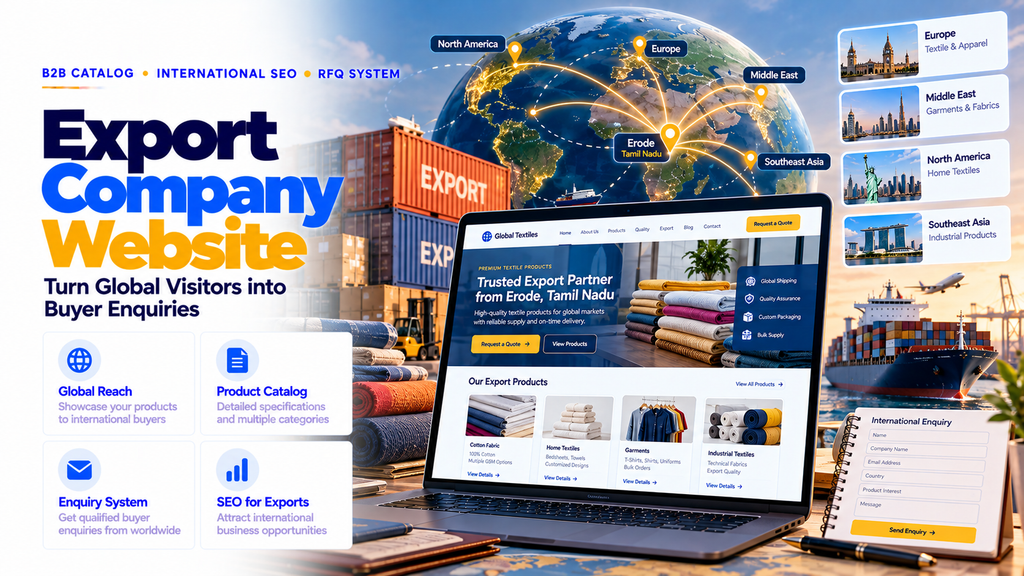
An effective export company website should include a professional company profile, detailed product catalog, technical specifications, Request for Quotation (RFQ) forms, verified business information, mobile-friendly design, international SEO, multilingual support where needed, secure enquiry handling and conversion tracking. These features help overseas buyers evaluate the supplier and contact the business more easily.
This guide explains the important features, website architecture, international SEO considerations and lead-generation strategies for export-oriented businesses in Erode and Tamil Nadu.
1. What Is an Export Company Website?
An export company website is a business website designed to present products, manufacturing capabilities and supplier information to potential customers in international markets.
Unlike a simple brochure website, it may support product discovery, technical document downloads, quotation requests and buyer communication.
The website should accurately represent the company’s actual export activities and capabilities.
2. Why Export Businesses in Erode Need a Professional Website
International buyers may research suppliers online before contacting them.
A professional website helps buyers understand:
- What products the company supplies
- Where the company operates
- Which manufacturing or sourcing capabilities are available
- What product specifications can be provided
- How to request pricing or samples
- How to contact the appropriate sales team
A website can support supplier discovery and evaluation, but it cannot guarantee export orders.
3. Export Industries That Can Benefit
Export-oriented website development may be useful for:
- Textile manufacturers and exporters
- Garment manufacturers
- Home textile suppliers
- Yarn and fabric traders
- Turmeric and spice exporters
- Food and agricultural product suppliers
- Engineering and machinery manufacturers
- Industrial component suppliers
- Packaging manufacturers
- Private-label product manufacturers
Each industry requires different product information and enquiry workflows.
4. Export Website vs Regular Business Website
| Feature | Regular Business Website | Export Company Website |
|---|---|---|
| Target audience | Primarily domestic customers | Domestic and overseas B2B buyers |
| Product information | Basic descriptions | Detailed technical specifications |
| Enquiry system | General contact form | Product-specific RFQ workflow |
| Language support | Usually one language | Additional languages where justified |
| SEO | Local or national targeting | Relevant international search targeting |
| Buyer verification | Basic company details | Detailed supplier credentials and capabilities |
5. Understand How International Buyers Search
Overseas buyers often use product-specific or supplier-related searches.
Examples include:
- Cotton fabric manufacturer in India
- Home textile supplier Tamil Nadu
- Bulk turmeric supplier India
- Industrial machinery exporter India
- Private label garment manufacturer
- Wholesale textile supplier Erode
These are illustrative search phrases. Actual keyword demand and competition should be verified through research.
6. Build a Professional Homepage
The homepage should explain the business clearly within the first visible section.
Include:
- Clear company positioning
- Main product categories
- Manufacturing or sourcing capabilities
- Genuine trust information
- Links to product pages
- Prominent RFQ or contact button
Avoid generic statements that provide little information about the business.
7. Create a Detailed About Us Page
International buyers may want to understand the company before submitting an enquiry.
Useful information includes:
- Registered company name
- Business history
- Actual operating location
- Manufacturing or trading model
- Team and facilities
- Quality management processes
- Relevant certifications where genuinely held
Only publish facts that the company can substantiate.
8. Create a B2B Product Catalog
A structured product catalog is one of the most important export website features.
It should help buyers browse products by category, type, material, application or specification.
Depending on the business, the catalog may include:
- Product categories
- Individual product pages
- Product photographs
- Technical specifications
- Downloadable documents
- Quotation request buttons
9. Use Dedicated Product Pages
Each important product should have a useful, descriptive page.
For example, a textile supplier may create separate pages for different fabric types instead of listing everything on one page.
Dedicated pages can improve product discovery and make enquiries more specific.
10. Include Detailed Product Specifications
International B2B buyers may require technical details before requesting a quotation.
Depending on the product, relevant specifications may include:
- Material composition
- Dimensions
- Weight
- Grade or quality
- Available variants
- Packaging options
- Applicable standards
- Minimum order quantity
- Production or supply capacity
Display only accurate, product-specific information.
11. Example Textile Product Specification Table
| Specification | Example Field |
|---|---|
| Product name | Cotton fabric |
| Material | Composition as verified by supplier |
| GSM | Available GSM range |
| Width | Available widths |
| Colours | Available colour options |
| MOQ | Supplier-confirmed minimum quantity |
| Packaging | Available packing methods |
| Lead time | Confirmed production or dispatch estimate |
This is a suggested field structure, not a specification for any particular product.
12. Add Request for Quotation (RFQ) Forms
An RFQ form allows buyers to provide the information required for pricing and commercial discussions.
A useful form should be easy to complete and collect only necessary details.
Possible fields include:
- Buyer name
- Company name
- Business email
- Country
- Product of interest
- Required quantity
- Required specifications
- Delivery destination
- Additional requirements
13. Use Product-Specific Enquiry Buttons
A product-specific enquiry button can preselect the product being viewed.
For example, a buyer reviewing a fabric product should be able to request a quotation without searching for the product name again.
Keep the product identifier in the enquiry record so the sales team can respond accurately.
14. Allow Buyers to Request Multiple Products
Some international buyers source several products from one supplier.
An advanced RFQ system may allow buyers to:
- Add multiple products to an enquiry list
- Specify quantities separately
- Add technical requirements
- Submit one consolidated quotation request
This is particularly useful for manufacturers and wholesale suppliers with extensive catalogs.
15. Add a Sample Request Workflow
Some export businesses may offer product samples before larger orders.
Where applicable, the website can support sample enquiries.
Explain sample availability, approval requirements, possible charges and shipping arrangements accurately.
Do not promise free samples unless the business genuinely offers them.
16. Show Minimum Order Quantity Clearly
MOQ means Minimum Order Quantity.
Displaying accurate MOQ information can help buyers determine whether a supplier is suitable for their purchasing requirements.
If MOQ varies by product or specification, explain that quotations depend on the requested configuration.
17. Explain Export Packaging Options
Packaging information may matter for international shipping, storage and product protection.
Relevant information can include:
- Available packing types
- Carton or pallet options
- Product labeling options
- Custom packaging availability
- Applicable handling requirements
Do not claim compliance with standards that have not been verified.
18. Explain Shipping and Trade Terms
Export buyers may ask about commercial delivery terms.
Common Incoterms include EXW, FOB, CIF and DAP.
These terms have specific meanings under ICC Incoterms rules.
A website may state which terms the supplier is prepared to discuss, but the final terms should be agreed in the commercial contract.
19. Build Trust With Verified Business Information
International buyers may need evidence that a supplier is a legitimate business.
Where relevant, the website may include:
- Legal business name
- Registered or operating address
- Official business contact information
- Verified company registrations
- Relevant industry memberships
- Authentic facility photographs
Business identifiers and documents should be shared thoughtfully, considering privacy and misuse risks.
20. Display Certifications Responsibly
Certifications can be relevant in industries such as textiles, food processing and manufacturing.
Only display certifications the company actually holds.
Where appropriate, include:
- Certification name
- Issuing organization
- Scope of certification
- Validity information
Do not display certification logos without permission or imply that certification covers products outside its actual scope.
21. Create a Manufacturing Capabilities Page
Manufacturers can describe their real production capabilities.
Useful information may include:
- Production processes
- Equipment categories
- Quality control practices
- Customization options
- Available product ranges
- Production capacity where verified
Original facility images and factual descriptions are more useful than unsupported claims.
22. Add a Quality Assurance Page
A quality assurance page can explain how the company checks its products.
Depending on the industry, it may describe:
- Incoming material checks
- In-process inspection
- Finished goods inspection
- Testing procedures
- Documentation and traceability
Describe actual practices rather than generic quality promises.
23. Add an Export Markets Page Carefully
Businesses may describe countries where they currently supply products or markets they are prepared to serve.
Keep these statements distinct.
For example, “We accept enquiries from buyers in Europe” is different from claiming an established customer base across Europe.
Do not invent international clients or export destinations.
24. Provide Clear International Contact Options
Export websites should make it easy for buyers to reach the correct sales team.
Useful options may include:
- Business email
- Contact form
- RFQ form
- International-format telephone number
- WhatsApp Business contact
- Meeting request option
Use accurate contact details and explain expected response arrangements where relevant.
25. Use Professional Business Email Addresses
A domain-based business email address can help present a consistent company identity.
For example:
exports@example.com
Configure email authentication and deliverability appropriately to reduce the risk of legitimate buyer enquiries being missed.
26. Add Multilingual Support Where Needed
International buyers may prefer information in their own language.
Businesses can consider translated versions of important pages based on target market demand.
Prioritize accurate professional translation of:
- Product descriptions
- Technical specifications
- RFQ instructions
- Company information
- Commercial terminology
27. Implement Multilingual SEO Correctly
For websites offering equivalent content in multiple languages, language-specific URLs and appropriate hreflang annotations can help search engines understand the intended versions.
Hreflang should reflect real available page versions.
Do not automatically create dozens of low-quality translated pages without a clear audience or maintenance plan.
28. Understand International SEO
International SEO helps search engines discover and understand content intended for users in different countries or languages.
Relevant factors include:
- Search intent in target markets
- Language and localization
- Product terminology
- Website accessibility
- Technical indexing
- Relevant content and links
International SEO does not guarantee visibility in any particular country.
29. Research Export Buyer Keywords
Keyword research should focus on how actual buyers describe the products they need.
Possible keyword patterns include:
- Product + manufacturer
- Product + supplier India
- Product + exporter
- Bulk + product name
- OEM + product category
- Wholesale + product name
Validate keyword demand, competition and relevance before selecting target phrases.
30. Optimize Product Page SEO
Each important product page should have:
- Descriptive title tag
- Relevant H1 heading
- Original product description
- Technical specifications
- Useful product photographs
- Descriptive image alt text
- Internal links
- Clear quotation CTA
31. Create Useful Industry Content
Informational content can help answer questions buyers ask before choosing a supplier.
Potential topics include:
- How to select fabric GSM for bulk orders
- Factors affecting industrial component specifications
- Questions to ask before ordering private-label garments
- How product packaging requirements affect export quotations
- Documents buyers may request from overseas suppliers
Content should be technically accurate and relevant to the company’s products.
32. Use Clear Website Navigation
Buyers should be able to locate important information quickly.
A suggested navigation structure is:
- Home
- About Us
- Products
- Manufacturing Capabilities
- Quality Assurance
- Export Information
- Blog or Resources
- Contact
- Request a Quote
Not every export business requires every section.
33. Make the Website Mobile Responsive
Export buyers may review suppliers from smartphones, tablets or desktop computers.
A responsive website should support:
- Readable product descriptions
- Mobile-friendly menus
- Usable specification tables
- Accessible enquiry forms
- Easy document downloads
- Clear contact buttons
34. Improve Website Loading Performance
Large product images, videos and downloadable catalogs can affect website performance.
Useful practices include:
- Compressing images appropriately
- Using modern image formats
- Setting image dimensions
- Reducing unnecessary scripts
- Optimizing server response
- Testing Core Web Vitals
Measure performance using suitable testing tools and real-user data where available.
35. Choose Suitable International Hosting
Hosting decisions should consider the location of target users, website traffic, application requirements and reliability.
For international audiences, suitable caching and content delivery infrastructure may improve access speed.
Hosting location alone does not guarantee international SEO performance.
36. Use HTTPS and Secure Forms
Export websites often receive business contact information and commercial enquiries.
Use HTTPS and appropriate security controls.
Important practices include:
- Valid TLS certificates
- Server-side form validation
- Spam protection
- Access controls
- Software updates
- Secure file upload handling
- Appropriate data retention
37. Protect Buyer Enquiry Information
RFQ submissions may contain commercially sensitive information.
Businesses should protect enquiry data and limit access to authorized staff.
Publish appropriate privacy information and consider applicable data protection requirements in relevant markets.
38. Add a Content Management System
A CMS can help staff maintain website information without editing code for every update.
Common management requirements include:
- Adding products
- Updating specifications
- Managing product images
- Publishing articles
- Updating contact details
- Maintaining SEO metadata
39. Add an Export Enquiry Management Dashboard
For businesses receiving frequent RFQs, an admin dashboard can improve enquiry handling.
Possible features include:
- New enquiry notifications
- Product-wise enquiry records
- Buyer country field
- Enquiry status
- Assigned sales representative
- Follow-up notes
- Quotation status
Access should be restricted to authorized team members.
40. Integrate Enquiries With a CRM
CRM integration can help sales teams manage enquiries after they arrive.
Depending on the workflow, an enquiry may progress through stages such as:
- New enquiry
- Initial review
- Requirement clarification
- Quotation preparation
- Quotation sent
- Follow-up
- Won or lost
These stages should reflect the company’s actual sales process.
41. Use Automated Enquiry Notifications
Notifications can help sales teams identify new RFQs promptly.
Possible channels include:
- Email notifications
- CRM alerts
- Admin dashboard notifications
- Authorized messaging integrations
Notifications should avoid unnecessarily exposing buyer information.
42. Track Website Enquiries With GA4
Google Analytics 4 can help businesses understand website traffic and configured interactions.
Useful measurement events include:
- Successful RFQ submission
- Contact form submission
- Product catalog download
- Phone link click
- WhatsApp link click
Use confirmed submission events rather than treating every Submit button click as a lead.
43. Use Google Tag Manager for Lead Tracking
Google Tag Manager can help configure supported website event tracking.
For example, a successful RFQ may trigger a GA4 generate_lead event.
Do not send buyer email addresses, telephone numbers or private quotation details through GA4 event parameters.
44. Measure International Website Traffic
GA4 can provide geographic information about measured website visitors, subject to data availability and privacy controls.
Businesses may review:
- Traffic by country
- Traffic by landing page
- Engagement
- Successful RFQ submissions
- Marketing channel performance
Country-level traffic does not necessarily indicate qualified overseas buying interest.
45. Use Google Search Console
Google Search Console helps website owners monitor organic search performance and indexing.
For an export website, useful checks include:
- Product page indexing
- Search queries
- Clicks and impressions
- Country-level search performance
- Mobile usability and performance indicators
- Canonical URL issues
46. Add Appropriate Structured Data
Structured data can describe information about the business and its content.
Depending on the website, relevant Schema.org types may include:
- Organization
- Product
- BreadcrumbList
- Article
Follow Google’s eligibility and content requirements for any supported search features.
Structured data does not guarantee rich results or improved rankings.
47. Optimize Product Images
Product images should help buyers evaluate products accurately.
Use:
- Original or properly licensed photographs
- Clear product views
- Appropriate image dimensions
- Descriptive filenames
- Meaningful alt text
- Optimized file sizes
For technical products, diagrams and dimensions may be useful where appropriate.
48. Add Downloadable Product Catalogs
Some B2B buyers prefer downloadable catalogs for internal purchasing discussions.
A catalog may include:
- Product categories
- Specifications
- Available variants
- Product images
- Company contact information
Keep downloadable documents updated and accessible.
49. Make Product Catalogs Searchable
For large catalogs, a website may benefit from:
- Category navigation
- Product search
- Specification filters
- Sorting options
- Related product recommendations
Technical SEO should account for faceted navigation and unnecessary duplicate URLs.
50. Export Website Development for Textile Companies in Erode
Textile exporters may need specialized product fields.
Depending on the product range, these may include:
- Fabric type
- Fiber composition
- GSM
- Width
- Weave or knit type
- Colour options
- Finishing details
- MOQ
- Packaging information
A structured textile catalog can help overseas buyers compare available specifications.
51. Export Website Development for Garment Manufacturers
Garment manufacturers may require information about:
- Product categories
- Fabric options
- Size ranges
- Customization
- Private-label capabilities
- Sampling procedures
- Production lead times
- Order quantity requirements
Only describe capabilities the business can actually provide.
52. Export Website Development for Agricultural Suppliers
Agricultural product suppliers may need to present:
- Product variety
- Grade and quality parameters
- Packaging options
- Available quantities
- Storage conditions
- Relevant test reports or certifications
- Seasonal availability
Product-specific compliance and destination-country requirements should be verified independently.
53. Export Website Development for Machinery Manufacturers
Industrial machinery websites may benefit from:
- Detailed technical specifications
- Equipment photographs
- Application information
- Capacity information
- Installation requirements
- Downloadable technical documents
- RFQ forms
54. Should Export Websites Display Prices?
Not every export website needs public pricing.
For customized products or bulk orders, pricing may depend on:
- Order quantity
- Material specification
- Customization
- Packaging
- Delivery terms
- Currency
- Commercial conditions
An RFQ-based approach may be more appropriate for complex B2B products.
55. Export Catalog Website vs B2B Ecommerce Website
| Factor | Catalog + RFQ Website | B2B Ecommerce Website |
|---|---|---|
| Primary action | Request quotation | Place orders or request quotations |
| Pricing | Often negotiated | May include customer-specific pricing |
| Product catalog | Yes | Yes |
| Online payment | Not necessarily required | Optional depending on model |
| Customer accounts | Usually optional | May be required |
| Order management | Sales-managed | Can be integrated |
56. Recommended Export Website Page Structure
A practical export website may use:
- Home
- About Company
- Product Categories
- Individual Product Pages
- Manufacturing Capabilities
- Quality Assurance
- Certifications
- Export Information
- Blog or Knowledge Center
- Contact
- Request a Quote
- Privacy Policy
Choose pages based on genuine business requirements.
57. Common Export Website Development Mistakes
- Using only a basic company profile with no product details
- Publishing low-quality product photographs
- Omitting technical specifications
- Making RFQ forms difficult to complete
- Using unverified certification claims
- Publishing copied supplier descriptions
- Ignoring mobile usability
- Failing to secure enquiry forms
- Neglecting international keyword research
- Ignoring website analytics
- Not updating catalogs
- Failing to follow up on buyer enquiries
58. Export Company Website Development Checklist
- Define target buyer types and countries.
- Identify priority products.
- Research relevant search terms.
- Prepare accurate company information.
- Collect product specifications.
- Organize product categories.
- Create useful product pages.
- Prepare original product images.
- Develop RFQ forms.
- Add product-specific enquiry buttons.
- Implement secure form processing.
- Set up enquiry notifications.
- Provide relevant trust information.
- Optimize mobile responsiveness.
- Improve page performance.
- Implement technical SEO.
- Configure multilingual SEO where required.
- Set up Search Console.
- Configure GA4 lead events.
- Test forms and enquiry delivery.
- Train staff to manage content and leads.
- Maintain products and business information.
59. How Much Does an Export Company Website Cost in Erode?
Export website development costs depend on project scope and complexity.
Important factors include:
- Number of website pages
- Number of products
- Custom product specification fields
- RFQ functionality
- Multilingual support
- CMS requirements
- CRM integrations
- Custom admin dashboard
- Technical SEO requirements
- Hosting and ongoing maintenance
A small catalog website and a custom B2B export platform will have different development requirements.
Request a detailed quotation rather than choosing a package based only on page count.
60. How Long Does Export Website Development Take?
The timeline depends on design complexity, content readiness, product count, integrations and testing requirements.
Delays commonly occur when product specifications, photographs, translations or business approvals are not ready.
A clear requirements document and content plan can make development more predictable.
61. How to Choose an Export Website Development Company
Before selecting a developer, ask:
- Can the website support detailed product specifications?
- Will RFQ forms capture product-specific information?
- Can staff update products through an admin panel?
- Will the website be responsive?
- Are international SEO requirements considered?
- Will enquiry forms be tested for reliability?
- Will analytics and lead tracking be configured?
- What security and maintenance support is included?
- Who owns the domain, hosting and website assets?
62. Export Website Development Services in Erode
Export businesses in Erode, Perundurai, Bhavani, Anthiyur, Gobichettipalayam, Chennimalai and nearby industrial areas may need professional websites designed for B2B enquiries.
Relevant website development services may include:
- Corporate export websites
- Manufacturer websites
- Textile exporter catalogs
- B2B product catalog systems
- Custom RFQ forms
- Multilingual websites
- International SEO
- Lead management dashboards
- Website maintenance
63. How Greap Technologies Can Help
Greap Technologies provides website development, custom software, SEO and digital growth solutions.
Export-oriented businesses can discuss requirements for professional company websites, product catalogs, RFQ workflows, mobile-responsive design and search engine optimization.
The appropriate solution depends on the company’s products, international markets, content requirements and sales process.
Visit Greap Technologies to explore website development services.
Conclusion
Export company website development in Erode should focus on helping international buyers discover products, verify supplier information and submit useful enquiries.
Detailed product catalogs, accurate specifications, secure RFQ forms, genuine trust signals and international SEO can help create a stronger online foundation for export-oriented businesses.
However, website enquiries are only one part of international business development. Product quality, commercial terms, buyer verification and effective sales follow-up remain essential.
Professional Website + Detailed Product Catalog + Genuine Supplier Information + RFQ System + International SEO + Lead Tracking = A stronger foundation for overseas buyer enquiries.
Need an Export Company Website in Erode?
Planning a website for your textile export company, manufacturing business, agricultural export operation or international B2B supplier?
Discuss your product catalog, quotation system, website design and SEO requirements with Greap Technologies.
Discuss Export Website DevelopmentWebsite: www.greap.in
Phone: +91 70923 30168
Frequently Asked Questions About Export Company Website Development
1. What is an export company website?
An export company website presents supplier information, products, capabilities and enquiry options to potential domestic and international B2B buyers.
2. Why do exporters need a professional website?
A professional website can help buyers discover products, evaluate supplier information and contact the business directly.
3. What features should an export website include?
Important features include a product catalog, technical specifications, company information, RFQ forms, responsive design, appropriate trust information and search optimization.
4. Can an export website generate international enquiries?
Yes. A discoverable and useful website can support international enquiries, but enquiry volume and quality depend on multiple factors and are not guaranteed.
5. Is international SEO important for exporters?
International SEO can help businesses create content aligned with relevant overseas search audiences and product terminology.
6. Should an export website display product prices?
It depends on the business model. Customized products and bulk orders may be better suited to quotation-based pricing.
7. What is an RFQ form?
RFQ means Request for Quotation. An RFQ form collects information needed to prepare a commercial quotation.
8. Can textile exporters in Erode use product catalog websites?
Yes. Textile exporters can organize products by fabric type, composition, GSM, width, colour and other relevant specifications.
9. Does an export website need multiple languages?
Not always. Multilingual support is useful when justified by target markets and available translation resources.
10. Can Google Analytics track export enquiries?
GA4 can track properly configured successful enquiry events and other website interactions. Actual buyer qualification requires additional business records.
11. How much does an export website cost in Erode?
Costs depend on product catalog size, custom features, integrations, multilingual requirements and development scope.
12. Can Greap Technologies develop export business websites?
Export businesses can contact Greap Technologies to discuss website development, product catalog, enquiry management and SEO requirements based on an agreed project scope.
Useful Official Resources
- Google Search Central: Managing Multi-Regional and Multilingual Sites
- Google Search Central: Localized Versions
- Google Search Central: Product Structured Data
- Google Search Central: Creating Helpful Content
- Google Search Console
- Directorate General of Foreign Trade, India
- International Chamber of Commerce: Incoterms Rules