Web Application Development for Finance Businesses in Erode
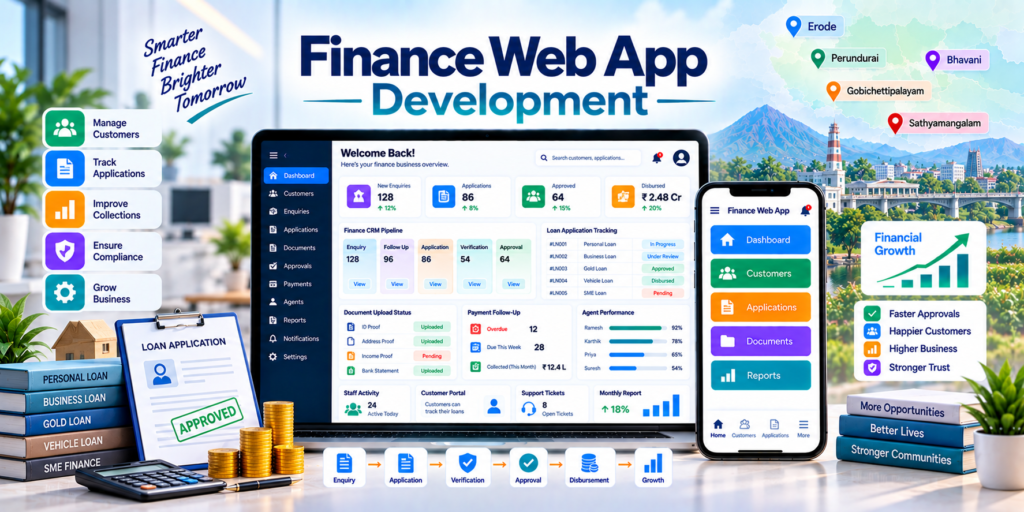
Web application development for finance businesses in Erode helps loan service providers, DSA businesses, finance service companies, accounting firms, tax consultants, insurance service providers, financial consultants, collection teams and other finance-related businesses manage customers, enquiries, applications, documents, approvals, follow-ups and reports through one secure online system.
Finance-related businesses often handle customer contact information, application records, documents, payment information, staff assignments and status updates every day. When these records are maintained through Excel sheets, notebooks, WhatsApp conversations, email folders and separate software, it can become difficult to maintain a clear and controlled workflow.
A custom finance web application can connect lead management, customer records, document collection, application status, approval workflows, payment follow-up, customer communication and management reports in one browser-based platform.
At Greap Technologies, we provide web application development for finance businesses in Erode, helping businesses create practical, secure and scalable applications based on their actual workflow, staff structure and service requirements.
Quick Answer: What Is Web Application Development for Finance Businesses?
Finance web application development means creating custom browser-based software for managing finance-related customer and operational workflows.
Depending on the business, a finance web application can include:
- Admin dashboard
- Finance CRM
- Lead management
- Customer management
- Loan/application tracking
- Document upload and verification status
- Follow-up reminders
- Approval workflow
- Agent / DSA management
- Payment follow-up
- Customer portal
- Support tickets
- Branch management
- Role-based staff access
- Audit/activity logs
- Reports and analytics
- API integrations
The exact modules should depend on whether the business handles loan facilitation, DSA operations, consulting, accounting, insurance services, collections or other financial-service workflows.
Web Application Development for Finance Businesses in Erode: Service Overview
| Detail | Information |
|---|---|
| Service | Web Application Development for Finance Businesses |
| Company | Greap Technologies |
| Location | Erode, Tamil Nadu |
| Main Audience | Loan service providers, DSA businesses, accounting firms, consultants, insurance service providers and finance-related businesses |
| Main Goal | Manage finance-related customer and operational workflows securely |
| Core Modules | CRM, customers, applications, documents, approvals, follow-ups, portal and reports |
| Best For | Loan services, DSA, accounting, tax consulting, insurance support, collections and financial consulting |
| Service Area | Erode District and nearby areas |
Why Finance Businesses in Erode Need Custom Web Applications
Finance businesses often need to coordinate leads, customers, documents, staff and approval stages while maintaining clear records of every important action.
Without a centralized application, it can become difficult to track:
- New customer enquiries
- Assigned staff or agents
- Required documents
- Documents received
- Pending verification
- Current application stage
- Internal approvals
- Customer callbacks
- Payment follow-ups
- Branch-wise activity
- Agent performance
- Customer communication history
- Support requests
- Management reports
A custom finance web application can provide structured workflows and give each authorized user access to the information required for their role.
What Types of Finance Businesses Can Use Web Applications?
1. Loan Service Providers
Loan service providers can manage enquiries, customer profiles, document collection, application stages, follow-ups and status updates.
2. DSA Businesses
DSA businesses can manage:
- Loan leads
- Agents
- Customer documents
- Application submission
- Lender/NBFC status references
- Follow-ups
- Commission records, where required
- Reports
3. Finance Service Companies
Finance-related service businesses can maintain customer requests, schedules, documents, payments and communication history.
4. Accounting Firms
Accounting firms can manage clients, service tasks, document requests, invoices, deadlines and client portal access.
5. Tax Consultants
Tax consultants can organize customer documents, service status, reminders, invoices and communication records.
6. Insurance Service Providers
Insurance-related service businesses can track enquiries, policy-related service requests, documents, renewal reminders and customer follow-ups.
7. Financial Consultants
Consultants can manage enquiries, appointments, service records, documents and client communication.
8. Collection Teams
Collection workflows can include assigned accounts, due dates, follow-ups, call notes, payment status and staff activity.
9. Billing and Payment Service Businesses
These businesses can manage customers, invoices, payment status, reminders and support requests.
10. Multi-Branch Finance Businesses
Businesses operating from multiple locations can use branch-wise users, customers, applications and reports with centralized management access.
Benefits of Web Application Development for Finance Businesses
1. Better Customer Management
Customer records can include:
- Name
- Phone number
- Address
- Employment or business information where required
- Service requirement
- Application history
- Document status
- Assigned staff
- Communication notes
Only information genuinely required for the business workflow should be collected and retained.
2. Better Lead and Enquiry Management
Leads can be captured or tracked from:
- Website forms
- Landing pages
- Google Ads
- Meta Ads
- WhatsApp enquiries
- Calls
- Referrals
- Offline campaigns
Automated lead capture depends on the APIs, permissions and supported integrations available from each platform.
3. Better Document Tracking
Document workflows can include:
- Requested
- Uploaded
- Under review
- Verified
- Rejected
- Replacement requested
This gives staff a clear view of what is still pending for each customer.
4. Better Application Tracking
A configurable application pipeline can include:
New Enquiry → Contacted → Documents Requested → Documents Received → Verification → Submitted → Under Review → Approved / Rejected → Completed
Actual approval decisions remain subject to the relevant lender, insurer, institution or authorized decision-maker.
5. Better Follow-Up Management
The application can show:
- Today’s follow-ups
- Overdue follow-ups
- Document follow-ups
- Application follow-ups
- Payment reminders
- Customer callbacks
- Renewal reminders
6. Better Staff and Agent Accountability
Records can show who:
- Created a lead
- Received an assignment
- Uploaded a document
- Changed an application status
- Completed a follow-up
- Approved or rejected an internal workflow step
7. Better Management Reporting
Owners can review:
- Lead volume
- Lead sources
- Application stages
- Pending documents
- Staff activity
- Agent activity
- Follow-up status
- Payment status
- Branch performance
Important Modules in Finance Web Applications
1. Admin Dashboard
The dashboard can show:
- New leads
- Active customers
- Pending documents
- Applications under review
- Approved/closed applications
- Today’s follow-ups
- Payment follow-ups
- Staff activity
- Branch-wise summary
2. Finance CRM Module
The CRM module can include:
- Lead creation
- Lead source
- Customer information
- Service/loan requirement
- Lead assignment
- Lead stage
- Follow-up date
- Call notes
- Communication history
3. Customer Management Module
Customer profiles can combine account information, documents, applications, follow-ups and payment-related records in one timeline.
4. Application Tracking Module
An application record can include:
- Application number
- Customer
- Product/service type
- Requested amount, where relevant
- Assigned staff/agent
- Document status
- Verification status
- Submission status
- Current stage
- Outcome/status
- Remarks
5. Document Management Module
Document functionality can include:
- Document categories
- Customer upload
- Staff upload
- Status
- Review remarks
- Replacement request
- Upload history
- Secure access
6. Approval Workflow Module
Internal approvals can be configured as:
Staff Submission → Manager Review → Verification → Authorized Approval → Next Stage
The number of approval levels can depend on the company’s internal process.
7. Follow-Up and Task Module
Tasks can include:
- Customer call
- Document request
- Application follow-up
- Payment follow-up
- Internal review
- Renewal reminder
8. Agent / DSA Management
Agent workflows can include:
- Agent profile
- Assigned leads
- Application status
- Customer records
- Performance reports
- Commission records, where applicable
9. Payment Follow-Up Module
Payment-related records can include:
- Invoice/reference number
- Amount
- Due date
- Paid amount
- Pending amount
- Payment status
- Receipt/reference
- Follow-up notes
This module should not be treated as a substitute for proper accounting software when full accounting or statutory reporting is required.
10. Customer Portal
A secure customer portal can include:
- Customer login
- Application status
- Pending-document list
- Document upload
- Invoices
- Payment status
- Notifications
- Support requests
11. Staff and Role Management
User roles can include:
- Owner
- Administrator
- Manager
- Sales Executive
- Telecaller
- Verification Staff
- Agent / DSA
- Accounts User
12. Reports and Analytics
Reports can include:
- Lead report
- Lead-source report
- Application-stage report
- Pending-document report
- Staff-wise report
- Agent-wise report
- Branch-wise report
- Follow-up report
- Payment report
- Monthly summary
Recommended Finance Application Workflow
A general finance-service workflow can be:
Lead → Customer Contact → Requirement Capture → Documents Requested → Documents Received → Verification → Application / Service Processing → Status Update → Payment / Completion → Closed
DSA Workflow
Lead Received → Agent Assigned → Customer Contacted → Documents Collected → Application Submitted → Lender Status → Approved / Rejected → Commission Record → Closed
Accounting / Tax Service Workflow
Client Added → Service Selected → Documents Requested → Task Assigned → Work in Progress → Review → Completed → Invoice → Payment
The workflow should match the actual service process and applicable business requirements.
Website vs Web Application for Finance Businesses
| Feature | Website | Finance Web Application |
|---|---|---|
| Main Purpose | Marketing and enquiry generation | Internal/customer workflow management |
| Main Users | Public visitors | Staff, agents, customers and admins |
| Lead Forms | Yes | Can receive/manage leads |
| Documents | Usually limited | Can be securely managed |
| Application Tracking | Usually limited | Core feature |
| Customer Portal | Optional | Can be included |
| Reports | Limited | Operational reports |
A finance business may use a public website to attract enquiries and a private web application to manage customers and operations.
Finance Web Application vs CRM Software
| Feature | Finance CRM | Finance Web Application |
|---|---|---|
| Main Purpose | Leads and customer follow-ups | Broader finance workflow management |
| Lead Management | Core focus | Can be included |
| Documents | Basic to moderate | Can be detailed |
| Applications | Can be limited | Can be detailed |
| Approval Workflow | Optional | Can be included |
| Customer Portal | Optional | Can be included |
Finance Web Application vs Loan Management Software
| Feature | Finance Web Application | Loan Management Software |
|---|---|---|
| Main Meaning | Custom system for different finance workflows | Software focused specifically on loan processes |
| CRM | Can be included | Can be included |
| Loan Applications | Optional | Core focus |
| Documents | Can be included | Common feature |
| Application Stages | Custom | Loan-specific |
| Repayment / EMI | Optional | Depends on LMS scope |
| Best For | Different finance service businesses | Loan-focused businesses |
Businesses that originate, service or manage regulated financial products may have additional operational and compliance requirements beyond a general custom web application.
Finance Web Application vs ERP Software
| Feature | Finance Web Application | ERP Software |
|---|---|---|
| Main Purpose | Specific customer/service workflow | Broader organization-wide operations |
| CRM | Can be included | Can be included |
| Applications | Can be core | Depends on ERP |
| Documents | Can be core | Can be included |
| Accounting | Usually integrated separately | Broader finance/accounting modules possible |
| Reports | Workflow-specific | Organization-wide |
Security and Privacy for Finance Web Applications
Finance applications can contain sensitive customer and commercial information. Security should therefore be planned as a core part of the system rather than added only after development.
Depending on the project, controls can include:
- HTTPS
- Secure password hashing
- Multi-factor authentication where appropriate
- Role-based access control
- Customer-level data isolation
- Agent-level access restrictions
- Session timeout
- Login rate limiting
- Audit logs
- User activity history
- Secure document storage
- File-type and file-size validation
- Controlled document downloads
- Database backups
- Restricted exports
- Former-employee access removal
Access controls should be enforced on the backend so that hiding a screen or button is not the only security mechanism.
Customer Document Security
Documents should be available only to authorized users and should not be exposed through unrestricted public URLs.
A secure document flow can follow:
Customer / Staff Upload → Secure Storage → Authorized Review → Status Update → Controlled Access
Businesses should define which documents are necessary, who can access them, how long they should be retained and when they should be removed according to applicable requirements.
Approval and Audit History
Important finance-related actions can maintain an audit history.
An activity record can include:
- User
- Action
- Previous status
- New status
- Date and time
- Remarks
This can help management understand how an application or customer record moved through the workflow.
Customer Portal for Finance Businesses
A customer portal can reduce repetitive status enquiries by giving customers controlled access to their own records.
Possible features include:
- Secure login
- Application status
- Document checklist
- Document upload
- Service status
- Invoice access
- Payment status
- Notifications
- Support tickets
A customer should never be able to access another customer’s applications, documents or account records.
Finance Web Application Design Style
| User Type | Primary Requirement |
|---|---|
| Business Owner | Dashboard, reports and access control |
| Manager | Applications, approvals and team performance |
| Sales Team | Leads, follow-ups and customer records |
| Telecaller | Call list, reminders and notes |
| Agent / DSA | Assigned leads and application status |
| Verification / Admin Team | Documents, workflow and approvals |
| Customer | Status, documents and support |
Useful design principles include:
- Clean dashboard
- Simple customer creation
- Clear stage pipeline
- Visible pending actions
- Fast search and filters
- Secure document access
- Mobile-responsive layouts
- Role-specific navigation
Finance Web Application Integrations
Web application development for finance businesses in Erode becomes more useful when connected with other systems through supported APIs and integrations.
Possible integrations include:
- Business website
- Landing pages
- CRM
- Customer portal
- Payment gateway
- Accounting software
- Email services
- SMS services
- WhatsApp Business communication
- Document storage systems
- Approved verification APIs
- Mobile applications
Integration availability depends on the external provider’s API, permissions, approval requirements and usage policies.
Explore API Integration Services for suitable integration requirements.
WhatsApp, SMS and Email Notifications
Notifications can be used for:
- Enquiry acknowledgement
- Document request
- Document status
- Application update
- Payment reminder
- Appointment reminder
- Support-ticket update
Automated WhatsApp communication may require an approved WhatsApp Business Platform provider, approved message templates and separate provider charges.
Advanced Features for Finance Web Applications
- Customer portal
- Agent / DSA portal
- Branch management
- Lead assignment rules
- Application pipeline
- Document checklist
- Document review workflow
- Internal approvals
- Follow-up automation
- Customer timeline
- Payment reminders
- Commission tracking
- Support tickets
- WhatsApp notifications
- Email/SMS notifications
- Audit logs
- Restricted exports
- Analytics dashboard
- API integrations
- Mobile application
Advanced features should be added according to genuine operational requirements and applicable compliance obligations.
Finance Web Application Development Process
Step 1: Requirement Analysis
Important questions include:
- What type of finance-related business do you operate?
- What information do you collect from customers?
- Do you manage applications?
- Which documents are required?
- Who reviews documents?
- Do you need internal approvals?
- Do agents need separate access?
- Do customers need portal access?
- Do you need payment reminders?
- Do you operate multiple branches?
- Which reports does management need?
Step 2: Workflow Mapping
Map the complete customer journey before development.
Step 3: Data and Permission Planning
Define:
- Customer data
- Document categories
- Staff roles
- Agent permissions
- Customer access
- Internal approval levels
Step 4: UI/UX Design
Common tasks such as lead creation, status update and document review should remain simple for daily users.
Step 5: Web Application Development
Core CRM, customers, applications and document modules can be developed before advanced automation features.
Step 6: Data Migration
Existing data can include:
- Customers
- Leads
- Applications
- Agents
- Staff
- Payment records
- Service categories
Existing records should be reviewed, cleaned and validated before import.
Step 7: Security Testing
Testing can include:
- Login
- Password reset
- Permissions
- Customer data isolation
- Agent access
- Document access
- Unauthorized URL access
- Session behaviour
- File uploads
Step 8: Functional Testing
Test:
- Lead creation
- Customer creation
- Application stages
- Document workflow
- Approvals
- Follow-ups
- Customer portal
- Reports
- Notifications
Step 9: Staff Training
Staff should be trained according to their individual access and responsibilities.
Step 10: Launch and Improvement
The workflow, dashboard and reports can be refined based on actual team usage after launch.
Finance Web Application Features Checklist
| Feature | Recommendation |
|---|---|
| Admin Dashboard | Required |
| Staff Login | Required |
| Role-Based Access | Required |
| Lead Management | Recommended |
| Customer Management | Required |
| Application Tracking | Based on business type |
| Document Management | Recommended |
| Document Status | Recommended |
| Follow-Up Reminders | Recommended |
| Approval Workflow | Based on requirement |
| Agent / DSA Login | Based on business type |
| Customer Portal | Recommended |
| Payment Follow-Up | Based on requirement |
| Support Tickets | Based on requirement |
| Notifications | Recommended |
| Audit Logs | Recommended |
| Secure Document Access | Required when storing documents |
| Reports | Required |
| Mobile Responsive Design | Required |
| API Integration | Based on requirement |
| Mobile App | Based on requirement |
Common Mistakes Finance Businesses Should Avoid
1. Managing Sensitive Customer Records in Multiple Uncontrolled Files
Customer information should be stored and accessed through a clearly controlled system.
2. Collecting More Data Than the Workflow Requires
Businesses should only request customer information that is necessary for the intended process.
3. No Document Status Tracking
Staff should know which documents are pending, received, reviewed or need replacement.
4. No Role-Based Access
Telecallers, agents, managers and administrators should not automatically have the same level of access.
5. No Audit History
Important changes to application and approval records should be traceable where appropriate.
6. No Customer Data Isolation
Customer portals must ensure that one customer cannot access another customer’s information.
7. No Follow-Up Workflow
Callbacks, document requests and other pending actions should use structured reminders.
8. Treating Software as a Replacement for Financial Compliance
A web application can support workflows, but regulated businesses remain responsible for applicable legal, regulatory, lending, KYC, data-protection and operational requirements.
9. Complicated Interface
Frequently used screens should remain simple enough for staff to use consistently.
10. No Staff Training
Even a technically strong application depends on accurate and consistent user adoption.
Erode District Finance Web Application Development Strategy
Greap Technologies supports businesses across:
Erode, Perundurai, Bhavani, Anthiyur, Gobichettipalayam, Sathyamangalam, Modakkurichi, Kodumudi, Nambiyur, Thalavadi, Chennimalai, Kavindapadi, Ammapettai, Arachalur, Sivagiri, Punjai Puliampatti, Solar, Surampatti, Veerappanchatram, Nasiyanur and nearby areas.
Location-specific SEO pages should only be created for genuine service areas and should contain unique, useful finance-business information rather than repeating the same content with only location changes.
How Greap Technologies Helps Finance Businesses
Greap Technologies can develop custom finance web applications around the actual customer, document and operational workflow of the business.
Our finance web application development services can include:
- Requirement analysis
- Workflow planning
- UI/UX design
- Admin dashboard
- Secure staff login
- Role-based permissions
- Finance CRM
- Lead management
- Customer management
- Application tracking
- Document management
- Approval workflow
- Follow-up management
- Agent / DSA management
- Payment follow-up
- Customer portal
- Support ticket system
- Audit/activity logs
- Notification integrations
- API integration
- Reports and analytics
- Data migration
- Testing and training
- Maintenance support
Explore related Greap services:
- Web Application Development
- Custom Software Development
- API Integration Services
- Mobile App Development
- Website Development Services
Why Choose Greap Technologies?
Workflow-Based Finance Application Development
We can structure the system around lead, document, application, approval and follow-up workflows.
Custom Web Application Development
The application can match your actual business process instead of forcing users into a generic workflow.
Security-Focused Access Planning
User roles, document access, activity tracking and customer-level permissions can be considered from the beginning.
Customer and Agent Portal Support
Separate portal access can be developed for customers, agents or DSA users based on actual requirements.
Integration Support
The application can connect with supported websites, payment systems, communication tools, accounting systems and APIs where appropriate.
Complete Digital Support
Greap Technologies also provides websites, CRM, ERP, customer portals, mobile apps, SEO and digital marketing services.
Conclusion
Web application development for finance businesses in Erode can help finance-related companies organize customer enquiries, documents, applications, follow-ups, approvals, staff activity and reports through one controlled online system.
A practical finance web application should combine clear workflow management with strong role-based access, secure document handling, audit history, mobile-responsive design and useful management reports.
For regulated financial activities, software should support—but not replace—the business’s legal, regulatory and compliance responsibilities.
Greap Technologies helps finance businesses in Erode develop custom web applications based on their customer process, team structure, document workflow and operational requirements.
Need a Custom Web Application for Your Finance Business in Erode?
Greap Technologies can help you build a finance web application with CRM, customer management, application tracking, document workflows, approvals, follow-ups, customer portal and reports.
Frequently Asked Questions
1. What is web application development for finance businesses?
It is the development of custom browser-based software for managing finance-related customers, leads, documents, applications, approvals, follow-ups and reports.
2. Why do finance businesses in Erode need a web application?
A finance web application can help centralize customer records, organize document workflows, track applications and give staff clearer pending-action visibility.
3. What features can a finance web application include?
A finance web application can include CRM, customer management, application tracking, document management, approvals, follow-ups, agent management, customer portal and reports.
4. Can a finance web application include loan-management features?
Yes. Loan-related workflows can include enquiry tracking, document collection, application stages, lender-status references, follow-ups and reports depending on the business model.
5. Can customers upload documents through the web application?
Yes. A secure customer portal can allow approved document uploads, subject to configured file controls, permissions and storage policies.
6. Can DSA businesses use a custom finance web application?
Yes. DSA workflows can include agent management, lead assignment, application tracking, customer documents, lender status and performance reports.
7. Can Greap Technologies build custom finance web applications?
Yes. Greap Technologies can develop finance web applications based on customer workflow, staff roles, document requirements, application stages and reporting needs.
8. Is role-based access important in finance software?
Yes. Sensitive customer, document and commercial information should only be accessible to users who require it for their responsibilities.
9. Can finance web applications integrate with websites and payment systems?
Yes. Integration may be possible with websites, landing pages, supported payment gateways, communication providers, accounting software and approved APIs.
10. Does finance software replace regulatory compliance?
No. Software can support business workflows and recordkeeping, but the business remains responsible for applicable legal, regulatory, privacy and operational compliance requirements.