Website vs Mobile App: What Should Erode Businesses Build First?
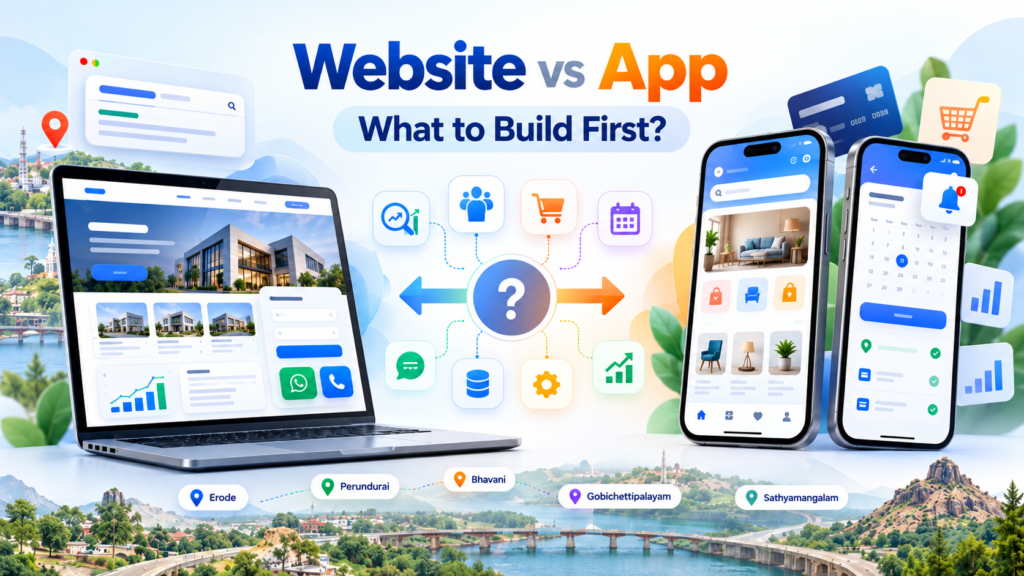
Website vs mobile app for Erode businesses is an important decision for companies that want to improve online visibility, generate leads, sell products, manage bookings, increase repeat customer engagement or automate business operations.
One of the most common questions business owners ask is:
“Should I build a website first or a mobile app first?”
For many Erode businesses, a professional website is the better first digital investment because it can support Google visibility, local SEO, business credibility, lead generation, advertising campaigns and easy customer access without requiring an installation.
However, this is not a universal rule.
A mobile app may deserve higher priority when the business depends on frequent customer usage, repeat orders, bookings, push notifications, location tracking, loyalty, personalized accounts or mobile-based operational workflows.
Some businesses may not need a traditional mobile app at all. A responsive web application can sometimes provide customer login, dashboards, reports, bookings, CRM functionality and business workflows directly through a browser.
At Greap Technologies, we help businesses choose between a website, ecommerce website, web application, mobile app, admin panel and custom software solution based on actual business requirements.
Quick Answer: Website or Mobile App First for Erode Businesses?
For most businesses that first need visibility, credibility, Google traffic or enquiries, start with a website.
Consider a mobile app earlier when the business requires:
- Frequent repeat usage
- Customer login
- Repeat ordering
- Bookings
- Push notifications
- Live delivery tracking
- GPS functionality
- Loyalty programs
- Personalized dashboards
- Delivery-partner workflows
- Field-staff workflows
A simple decision framework is:
| Business Requirement | Consider First |
|---|---|
| Google visibility | Website |
| SEO and local SEO | Website |
| Calls and enquiries | Website / landing page |
| Professional online presence | Website |
| Online selling | Ecommerce website first in many cases |
| Customer dashboard | Web app or mobile app |
| Internal dashboard | Web application |
| Frequent repeat ordering | Mobile app can add value |
| Push notifications | Mobile app |
| Delivery / driver tracking | Mobile app + backend |
| Custom business automation | Web app / mobile app / custom software |
A Practical Digital Roadmap for Many Erode Businesses
Website
↓
SEO + Local SEO + Digital Marketing
↓
Leads / Online Orders
↓
CRM / Admin Panel / Web Application
↓
Mobile App when customer behaviour justifies it
This phased approach can help avoid investing heavily in application functionality before the business has validated real customer demand.
What Is a Business Website?
A business website is a browser-based digital presence that customers can access through:
- Google Search
- Google Business Profile
- Google Ads
- Meta Ads
- QR codes
- Direct links
A business website can include:
- Homepage
- About page
- Service pages
- Product pages
- Industry pages
- Portfolio
- Testimonials
- Blog
- FAQ
- Contact page
- Enquiry forms
- WhatsApp CTA
- Call CTA
- Landing pages
- Ecommerce functionality
Greap Technologies provides website development services for businesses that need professional, responsive and growth-focused websites.
What Is a Mobile App?
A mobile application is software designed primarily for mobile devices such as Android phones and iPhones.
Depending on the business, an application can include:
- User registration
- Login
- Customer profiles
- Product catalogue
- Cart and checkout
- Booking
- Order management
- Payments
- Push notifications
- Location services
- Delivery tracking
- Order history
- Loyalty points
- Personalized dashboards
Greap Technologies’ mobile app development services include Android, iOS, cross-platform development, UI/UX, APIs, testing, deployment and maintenance.
What Is a Web Application?
A web application sits between a traditional informational website and an installed mobile application.
Users access it through a browser, but it can provide software-like functionality.
Examples include:
- Customer portal
- CRM
- ERP dashboard
- Admin panel
- Booking portal
- Dealer portal
- Employee dashboard
- Inventory system
- SaaS platform
- Reporting dashboard
For many internal business systems, a web application can be more practical than developing separate Android and iOS apps.
Website vs Mobile App: Main Differences
| Factor | Website | Mobile App |
|---|---|---|
| Access | Browser / URL | Usually installed on device |
| Google Search SEO | Strong use case | Different discovery model |
| First-time customer discovery | Strong | Usually requires more acquisition effort |
| Shareability | Easy URL sharing | App-store/deep-link flow |
| Repeat engagement | Good | Often stronger when users install and retain app |
| Push notifications | Limited / implementation dependent | Strong use case |
| Device functionality | Available to varying degrees | Strong access to native capabilities |
| Initial cost | Often lower | Often higher |
| Maintenance | Website/server maintenance | App + backend + platform compatibility |
When Should You Build a Website First?
1. When You Need Google Visibility
If customers are actively searching for your business category, services or products, a website gives you pages that can be optimized around those searches.
Examples:
- Clinic in Erode
- Textile manufacturer in Erode
- Website development company in Erode
- School admission in Erode
- Restaurant in Erode
- Real estate company in Erode
2. When You Need Leads
A lead-generation website can encourage:
- Phone calls
- WhatsApp enquiries
- Form submissions
- Appointment requests
- Quote requests
- Catalogue requests
- Site-visit enquiries
3. When Customers Need Information Before Contacting You
A website can explain:
- What you offer
- Who you serve
- Your experience
- Your process
- Your portfolio
- Your location
- Your contact information
4. When Your Budget Is Limited
A well-planned business website or landing page normally requires less initial investment than developing a complete mobile application with backend and admin functionality.
5. When You Need Marketing Landing Pages
Website landing pages can support:
- Google Ads
- Meta Ads
- SEO campaigns
- Admission campaigns
- Real estate campaigns
- Service promotions
When Should You Consider a Mobile App Earlier?
1. Customers Use the Product Frequently
If customers interact daily or weekly, installation friction may be worth it.
Examples:
- Grocery ordering
- Food delivery
- Taxi booking
- Recurring service bookings
- Learning platforms
- Customer loyalty applications
2. Push Notifications Are Important
Push notifications can support:
- Order updates
- Appointment reminders
- Offers
- Delivery updates
- Important service alerts
3. You Need Location or Device Features
A mobile app may be useful when the workflow relies heavily on:
- GPS
- Live tracking
- Camera
- Background location
- Saved sessions
- Offline functionality
4. Customers Need Personalized Accounts
Examples:
- Order history
- Booking history
- Loyalty balance
- Subscriptions
- Saved addresses
- Personalized content
5. The Mobile App Is the Product
For some startups, the application itself is the core service.
Examples:
- Taxi marketplace
- Delivery marketplace
- Field-service platform
- Consumer subscription product
In those cases, an app-first or app-and-web strategy can be appropriate.
Website vs Mobile App Cost Comparison
| Digital Solution | Indicative Planning Range |
|---|---|
| Basic Business Website | ₹10,000 – ₹30,000 |
| Professional Business Website | ₹25,000 – ₹60,000 |
| Lead Generation Landing Page | ₹7,000 – ₹25,000 |
| Ecommerce Website | ₹35,000 – ₹1,50,000+ |
| Basic Mobile App | ₹75,000 – ₹1,50,000 |
| Business Mobile App | ₹1,50,000 – ₹4,00,000+ |
| Ecommerce Mobile App | ₹2,00,000 – ₹8,00,000+ |
| Custom App + Admin Panel | ₹3,00,000 – ₹15,00,000+ |
Note: These are indicative planning ranges, not fixed Greap quotations or standard market prices. Final cost depends on actual scope, design, technology, integrations, backend and support requirements.
Website vs Mobile App for Ecommerce Businesses
For many ecommerce businesses, starting with a strong ecommerce website is practical because customers can access it immediately from search, social media and ads.
An ecommerce website can provide:
- Products
- Categories
- Cart
- Checkout
- Payments
- Shipping
- Reviews
- Order management
A mobile app can become more useful when:
- Repeat purchase frequency is high
- The customer base is established
- Push notifications are valuable
- Loyalty is important
- Customers regularly check order history
- Personalized experiences are required
Greap Technologies also provides ecommerce website development.
Website vs Mobile App for Lead Generation
If the main goal is first-time customer acquisition, a website or landing page will usually be the stronger starting point.
A typical flow is:
Google / Ad / Social Media
↓
Website or Landing Page
↓
Service Information + Trust
↓
Call / WhatsApp / Form
↓
Lead
Requiring a new customer to install an application simply to make an enquiry can add unnecessary friction.
Website vs Mobile App for Customer Retention
Mobile applications can be especially useful after customer acquisition when the business needs repeated interactions.
Retention functionality can include:
- Push notifications
- Saved login
- Repeat purchase
- Saved addresses
- Loyalty points
- Membership
- Booking history
- Order history
- Personalized offers
A useful way to think about the decision is:
Website for discovery. App for repeated interaction — when repeated interaction genuinely exists.
Industry-Wise Recommendation for Erode Businesses
Textile Businesses
Recommended starting point: Website or ecommerce website.
Useful first-stage functionality:
- Product categories
- Product gallery
- Catalogue enquiries
- Wholesale enquiries
- SEO content
Consider a mobile app later for dealer accounts, repeat ecommerce customers or specialized ordering workflows.
Retail Shops
Recommended starting point: Ecommerce website.
Consider an app once repeat online ordering, loyalty or customer retention becomes important.
Hospitals and Clinics
Recommended starting point: Professional website.
Useful pages include:
- Doctor profiles
- Services
- Appointment enquiry
- Clinic timings
- Location
- Patient information
A patient app can be considered later when there is a genuine need for accounts, appointment history, reports, reminders or other patient functionality.
Schools and Colleges
Recommended starting point: Website.
The website can support admissions, courses, facilities, notices, events and enquiries.
A student/parent app becomes more relevant for attendance, homework, communication, fees and personalized academic information.
Real Estate Businesses
Recommended starting point: Website + project landing pages.
A mobile app is normally unnecessary for a standard real-estate lead-generation business unless the company is building a larger property marketplace, broker platform or internal sales application.
Restaurants
Recommended starting point: Website or direct ordering website.
A mobile app becomes more valuable when the restaurant has:
- High repeat-order volume
- Direct delivery
- Customer loyalty
- App-only promotions
Grocery Businesses
Small local store: Online store or responsive ordering website first.
Larger grocery-delivery model: Website + customer app + admin panel may make sense earlier because ordering frequency is high.
Manufacturing Companies
Recommended starting point: B2B website.
Manufacturers typically need product catalogues, technical pages, certifications, enquiry forms and quote requests before they need a customer-facing app.
Mobile apps may become useful for:
- Dealer ordering
- Field sales
- Inventory
- Production workflows
- Internal reporting
Service Businesses
Recommended starting point: Website + landing pages.
An app becomes useful when repeated booking or customer self-service becomes a meaningful part of the business.
Startups
The answer depends entirely on the product.
| Startup Type | Possible Starting Point |
|---|---|
| Agency / Consulting | Website |
| Ecommerce Brand | Ecommerce website |
| SaaS Product | Web application |
| Taxi Platform | Mobile applications + backend |
| Delivery Platform | App/web platform + admin |
| B2B Software | Web application first in many cases |
Website vs Web App vs Mobile App
| Solution | Primary Purpose | Good Fit For |
|---|---|---|
| Website | Public information and discovery | SEO, leads, trust, services, content |
| Ecommerce Website | Online selling | Products, checkout, orders |
| Web Application | Browser-based software | CRM, ERP, SaaS, portals, dashboards |
| Mobile App | Mobile-first repeated usage | Orders, booking, tracking, loyalty, field operations |
Should You Build Both a Website and Mobile App?
Some businesses eventually benefit from both.
A complete digital ecosystem might look like:
Public Website
Discovery + SEO + marketing
↓
Customer App
Repeat interactions + engagement
↓
Admin Panel / Web App
Business operations + management
↓
CRM / Analytics
Customers + data + reporting
This approach is common for larger ecommerce, booking, marketplace, education, logistics and service platforms.
Best Digital Roadmap for Many Erode Businesses
Phase 1: Build the Digital Foundation
- Business website
- Important service/product pages
- Responsive design
- Calls / WhatsApp / forms
- Analytics
Phase 2: Improve Discovery
- SEO
- Local SEO
- Google Business Profile
- Content
- Google Ads
- Meta Ads
Phase 3: Improve Lead or Order Management
- CRM
- Admin dashboard
- Order management
- Customer management
- Reporting
Phase 4: Add Mobile App When Justified
Good app signals include:
- Large active customer base
- Frequent repeat usage
- High repeat-order rate
- Need for notifications
- Need for mobile-specific functionality
- Clear customer demand
Common Mistakes Businesses Make
1. Building an App Because Competitors Have One
Technology should solve a business problem rather than follow a trend.
2. Assuming Every Business Needs an App
Many businesses can achieve their goals with a website or responsive web application.
3. Building a Website Without Conversion Planning
A website should make relevant customer actions clear.
4. Ignoring SEO
Businesses relying on Google discovery need useful, crawlable website content and proper SEO foundations.
5. Building Too Many Features Initially
Start with the smallest useful version and expand based on actual usage.
6. Ignoring the Admin Side
Customer-facing functionality is only half the system. Businesses also need an effective way to manage users, orders, bookings and content.
7. No Analytics
Measure what customers actually do rather than guessing.
8. No Marketing Plan
Building a website or publishing an app does not guarantee traffic, downloads, enquiries or orders.
Website vs Mobile App Checklist
| Question | Likely Direction |
|---|---|
| Need Google discovery? | Website |
| Need local SEO? | Website |
| Need enquiries? | Website / landing page |
| Need internal dashboard? | Web application |
| Need customer login? | Web app or mobile app |
| Need repeat ordering? | Mobile app may add value |
| Need push notifications? | Mobile app |
| Need live driver tracking? | Mobile app + backend |
| Limited budget? | Website or MVP first |
| App is the actual product? | App-first can make sense |
Erode District Digital Strategy
Greap Technologies provides website, ecommerce, web application, mobile app and custom software services for businesses across:
Erode, Perundurai, Bhavani, Anthiyur, Gobichettipalayam, Sathyamangalam, Modakkurichi, Kodumudi, Nambiyur, Thalavadi, Chennimalai, Kavindapadi and relevant nearby areas.
Do not create near-identical “website vs mobile app” pages for every town simply by replacing the location name.
This topic works better as one strong Erode district decision guide supported by individual service pages.
How Greap Technologies Helps You Choose the Right Solution
Greap Technologies offers multiple digital-development paths instead of forcing every business into the same platform.
Our services include:
- Website Development
- Ecommerce Development
- Mobile App Development
- Web Application Development
- Custom Software Development
- SEO Services
- Digital Marketing
Before choosing the technology, we can evaluate:
- Business model
- Target customers
- Customer frequency
- Required features
- Budget
- Growth plans
- Integrations
- Operational workflows
Website, Web App or Mobile App?
Tell Greap Technologies what your business needs to achieve. We can help identify the most practical first version instead of building unnecessary features.
Why Choose Greap Technologies?
Business-First Planning
We start with the business problem rather than choosing technology first.
Website + App + Software Expertise
Greap provides websites, ecommerce, mobile apps, web applications and custom software systems.
SEO and Digital Marketing Support
For public-facing websites, Greap can also support search visibility, paid campaigns and conversion tracking.
Scalable Development
Projects can start with essential functionality and expand when the business has validated demand.
Admin and Backend Capability
We can develop the backend systems, APIs, dashboards and integrations required behind customer-facing products.
Website vs Mobile App for Erode Businesses – Conclusion
There is no universal answer to website vs mobile app for Erode businesses.
For many businesses, a website is the better first investment because it supports public discovery, SEO, credibility, lead generation and digital marketing.
A mobile app becomes more valuable when customers repeatedly interact with the business, require personalized accounts, receive push notifications, place frequent orders or use location and device features.
A web application can be the better answer when the business needs dashboards, portals, CRM functionality or browser-based software.
The correct decision should be based on:
Business Goal + Customer Behaviour + Usage Frequency + Features + Budget + Marketing + Long-Term Growth.
Greap Technologies helps Erode businesses choose and build the right digital solution without adding unnecessary complexity.
Frequently Asked Questions
1. Should Erode businesses build a website or mobile app first?
For many businesses that need Google visibility, enquiries and a professional public presence, a website is the better first step. Businesses built around frequent app usage may need a mobile application earlier.
2. Is a website better for SEO than a mobile app?
A public website is the primary format for traditional web SEO because its crawlable pages and URLs can appear in web search results. Mobile apps have their own app-store and app-discovery strategies.
3. Is a website cheaper than a mobile app?
Usually, a standard website has a lower initial development scope than a mobile application with backend, administration, Android/iOS testing and integrations. Actual cost depends on requirements.
4. Can a website generate leads without an app?
Yes. Websites can generate enquiries through calls, WhatsApp, forms, appointments, quote requests and landing pages.
5. When is a mobile app useful for a local shop?
A mobile app becomes more useful when the shop has frequent repeat purchases, customer accounts, loyalty functionality, recurring orders or personalized offers.
6. Should ecommerce businesses build a website or app first?
Many ecommerce businesses can validate demand and start selling through an ecommerce website first. A mobile app can be introduced later when repeat customer usage justifies it.
7. Do restaurants need a mobile app?
Not necessarily. A restaurant can start with a strong website, menu and direct ordering system. An app can become useful for high repeat ordering, loyalty and direct customer engagement.
8. What is the difference between a web app and mobile app?
A web app runs primarily through a browser, while a mobile app is designed for mobile operating systems and can use deeper device capabilities. The correct choice depends on the workflow.
9. Can Greap Technologies build both websites and apps?
Yes. Greap Technologies provides website development, ecommerce development, mobile app development, web applications, admin dashboards and custom software.
10. What is a good digital roadmap for most local businesses?
A common roadmap is website first, followed by SEO and marketing, then CRM or operational systems, and finally a mobile app when repeat customer usage or mobile-specific functionality creates a clear business case.