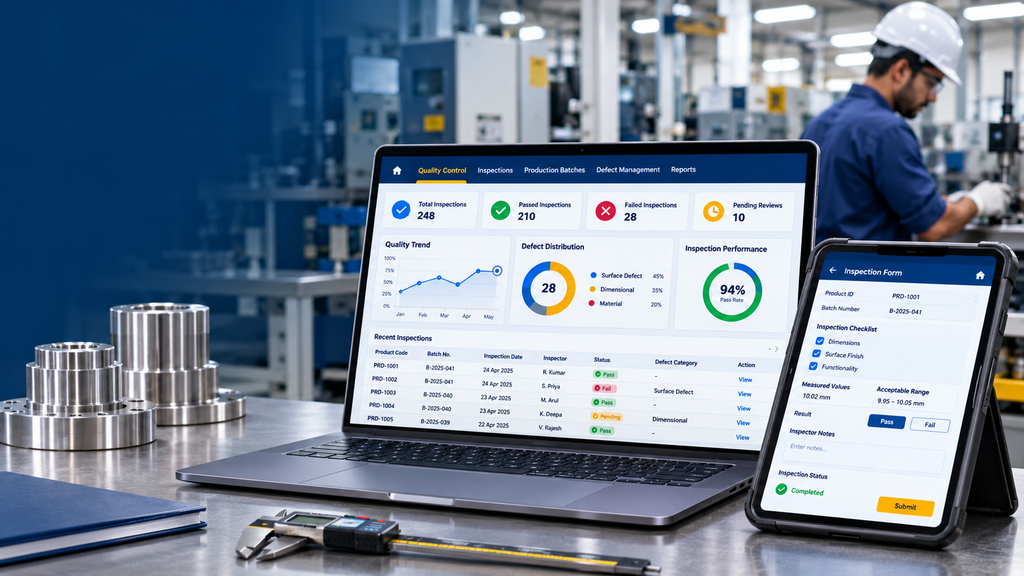
Manufacturing quality depends on more than checking finished products before dispatch. Businesses must inspect incoming materials, monitor production processes, verify measurements, record defects and ensure that quality issues receive appropriate attention. When these activities are managed through paper forms, spreadsheets and disconnected systems, maintaining consistent records across production stages can become difficult.
Looking for quality control management software development in Erode? Greap Technologies helps manufacturers explore custom software solutions for inspection records, defect tracking, production quality monitoring, corrective actions and digital quality reporting.
Quality control management software provides a central place to record inspection requirements, capture test results, identify non-conforming products and review quality trends. Depending on the production process, the system can support incoming material checks, in-process inspections, final product verification and supplier quality records.
For manufacturers in Erode and across Tamil Nadu, a well-designed quality management application can make inspection procedures easier to follow and help teams trace quality issues back to the relevant batch, production stage or material record.
What Is Quality Control Management Software?
Quality control management software is a business application used to plan inspections, record measurements, document defects and monitor whether products or processes meet defined acceptance criteria.
For example, a component manufacturer may need to verify dimensions against an approved specification. A textile manufacturer may record fabric inspection results, shade variation or weaving defects. A food processing company may need documented checks for selected production stages and batches.
The software can store inspection plans, checklists, acceptance limits, results, photographs, reviewer approvals and related documents. It can also create reports that help authorised staff review trends and follow up on identified issues.
Quality control software supports quality procedures; it does not automatically guarantee that products comply with every applicable standard. Requirements, inspection methods and acceptance criteria must be defined and validated for the business and its products.
Why Manufacturers in Erode May Need Digital Quality Control
Manufacturers may perform multiple inspections throughout procurement, production, assembly, packing and dispatch. Different teams may use different forms or record formats, making it harder to compare results and locate previous inspection records.
A central system can help teams answer questions such as:
- Which inspection checklist applies to a particular product or batch?
- Have the required incoming material checks been completed?
- Which production batches have pending inspections?
- What defects were recorded during a specific production run?
- Which products or batches require review before release?
- Has a corrective action been assigned and completed?
- Can the team retrieve the inspection history for a customer order?
Digital records can improve traceability and reduce the effort involved in searching through separate documents. These benefits depend on consistent data entry, clearly assigned responsibilities and inspection procedures that match the actual production process.
Which Manufacturing Industries Can Use Quality Control Software?
Textile and Garment Manufacturing
Record fabric inspection, measurements, stitching defects, shade variation, batch details and final garment checks.
Engineering and Metal Fabrication
Manage dimensional checks, component inspections, drawing references, material certificates and inspection approvals.
Industrial Machinery Manufacturing
Document assembly inspections, component verification, test results and final equipment checks.
Food Processing
Record applicable process checks, batch information, selected measurements and review activities according to established procedures.
Plastics and Packaging
Track dimensional checks, visual defects, packaging quality, sample inspections and production lot records.
Electrical and Electronic Products
Manage assembly checks, test outcomes, serial or batch references, non-conformities and product verification records.
Essential Features of Quality Control Management Software
1. Digital Inspection Checklists
Inspection checklists define what must be checked, how the check should be performed and what constitutes an acceptable result.
The software can provide different checklists for products, materials, machines or production stages. Depending on the application, fields may include:
- Product, part or batch identification
- Inspection stage and checklist version
- Parameter or characteristic to inspect
- Required measuring method
- Minimum and maximum acceptance limits, where applicable
- Recorded measurement or observation
- Pass, fail or review status
- Inspector, date and supporting evidence
Approved checklist versions should be managed carefully so that staff use the correct inspection requirements for the relevant product or production order.
2. Incoming Material Quality Inspection
Quality checks may begin when raw materials, components or packaging supplies arrive from a supplier. An incoming inspection module can link inspection records to supplier details, purchase orders, delivery references and received batches.
Depending on the process, the system can record sample results, document defects, attach photographs and flag material for review. It may also record whether a lot is accepted, rejected or awaiting a decision.
Integration with purchasing or inventory software can help ensure that the inspection status is reflected in the relevant material records. This integration should be planned around the existing business systems.
3. In-Process Quality Inspection
In-process inspections help verify product characteristics at selected stages of production. The software can assign inspection tasks according to a production order, batch, machine, workstation or defined quality plan.
Inspectors can enter measurements, observations and defect information. Supervisors can review submitted records and identify inspections that are incomplete or require further action.
For repeat production, standardised forms can help teams follow the same approved checks across relevant orders. The software should still allow authorised changes when an approved process or specification is revised.
4. Final Product Inspection
Final inspection records document the checks performed before products are approved for the next business step, such as packing or dispatch.
Depending on the product, a final inspection may include dimensions, visual appearance, assembly, functionality, labelling, packaging or other defined requirements.
The software can maintain the result, inspector details, reviewer approval and supporting evidence. If a required check fails, configurable workflows can prevent the record from being marked as approved until the appropriate review has taken place.
5. Defect and Non-Conformance Tracking
A non-conformance is a failure to meet a defined requirement. Quality control software can provide a structured process for documenting these events and tracking their resolution.
A defect record may include:
- Product, batch or production order
- Defect category and description
- Inspection stage where the issue was found
- Quantity inspected and quantity affected
- Photographs or supporting evidence
- Severity or priority, as defined by the business
- Containment or review status
- Assigned owner and follow-up date
- Disposition decision and closure notes
Possible dispositions may include rework, additional inspection, return to supplier, rejection or another approved decision. The appropriate choice depends on the product, specifications and internal procedures.
6. Corrective and Preventive Action Management
Recording a defect is only one part of managing quality. Businesses may also need to investigate why the issue occurred, decide on corrective actions and check whether the actions were effective.
A corrective action workflow can record the issue, investigation findings, responsible person, target date, action plan, approval and closure evidence.
Where the organisation uses formal corrective and preventive action procedures, the software can support those workflows. The exact terminology, approvals and documentation should match the company’s quality management process.
7. Batch, Lot and Product Traceability
Traceability connects quality records to the products, materials and production activities they relate to.
The system can link inspection results with:
- Production order and batch number
- Raw material lot or supplier delivery
- Product code and revision
- Machine, workstation or production line
- Inspection date and responsible inspector
- Recorded defect and corrective action
- Final approval or release status
These links help authorised users investigate a quality issue and retrieve the relevant history. The depth of traceability depends on which identifiers are captured and how consistently records are linked.
8. Supplier Quality Management
Manufacturers may need to review incoming quality issues associated with purchased materials and components. Supplier quality features can record inspection outcomes, rejected quantities, defect categories and related supplier communication.
Reports can help authorised staff compare recorded supplier issues over a defined period. Any supplier evaluation or scoring method should use clearly defined criteria rather than unsupported assumptions.
9. Measurement and Test Result Recording
Some products require precise measurements or tests against documented specifications. The software can record measured values, units, acceptance limits, test methods and the resulting status.
Depending on the equipment and integration requirements, results may be entered manually or imported from compatible measuring instruments or testing systems. Direct integration requires technical validation and should not be assumed to work with every device.
Where measuring equipment requires calibration, the application can link inspections to relevant calibration records or alert users when an instrument requires review.
10. Quality Dashboard and Reports
A quality dashboard can summarise inspection activity and help managers identify records that require attention.
Possible reports include:
- Inspections completed and pending
- Inspection outcomes by product or production batch
- Recorded defects by category
- Non-conformities awaiting review
- Corrective actions past their target dates
- Supplier-related inspection issues
- Quality trends over selected periods
- Rework and rejection records, where data is available
Reports should clearly state their definitions and date ranges. For example, a defect rate must use a defined numerator and denominator, and should not be presented as a universal industry benchmark.
Advanced Features for Growing Manufacturers
Manufacturers with more complex processes may require additional capabilities beyond basic inspection records.
- Mobile inspection application: Allow inspectors to record checks on compatible phones or tablets.
- QR code or barcode scanning: Retrieve product, batch or inspection records using labels.
- Approval workflows: Route failed inspections or selected quality decisions to authorised reviewers.
- Document control: Link approved specifications, drawings, work instructions and checklist versions.
- CAPA workflow: Assign, review and track corrective and preventive actions.
- Production system integration: Connect quality records to production orders and batch information.
- ERP and inventory integration: Exchange relevant material, supplier and order data with compatible systems.
- Notification rules: Alert authorised users about failed checks, pending approvals or overdue actions.
- Audit trail: Record important changes to inspection results, approvals and quality records.
- Role-based access: Separate permissions for inspectors, production staff, supervisors, quality managers and administrators.
These features should be selected according to actual operational needs. A smaller manufacturer may gain more value from consistent digital checklists and defect records than from starting with a complex enterprise platform.
Quality Control Software vs. Quality Management System Software
Quality control software generally concentrates on inspection activities, testing, measurements and defect identification. A broader quality management system may also cover document control, training records, audits, risk management, corrective actions, supplier management and other organisation-wide quality processes.
| Area | Quality Control Software | Broader Quality Management Software |
|---|---|---|
| Product inspections | Core focus | Usually supported |
| Measurement and test records | Core or common feature | May be included |
| Defect and non-conformance records | Common feature | Usually supported |
| Document and procedure control | May be limited | Often a broader focus |
| Quality audits and training records | May require additional modules | May be included as part of the wider system |
| Best suited for | Manufacturers prioritising inspection and defect workflows | Organisations needing a wider range of quality management processes |
The boundaries vary between products. Before choosing or developing software, manufacturers should document the processes they need to manage and confirm that the proposed system covers them.
Benefits of Digital Quality Control Management
More Consistent Inspection Records
Standardised digital forms can help teams capture required information in a consistent format and reduce dependence on scattered paper records.
Better Defect Visibility
Centralised defect records make it easier for authorised users to review recurring issue categories, affected batches and the current status of investigations.
Improved Traceability
Linking inspections to product, batch, material and production records can support investigations when quality questions arise.
Clearer Follow-Up Responsibilities
Assigned owners, target dates and status tracking can help teams monitor corrective actions and pending quality decisions.
Easier Report Preparation
Searchable digital records and configured reports can reduce the manual effort involved in collecting inspection information for internal reviews.
The actual results depend on the quality of the data, staff adoption, workflow design and the way the software fits the manufacturing process.
Quality Control Management Software Development Cost in Erode
Development cost depends on the number of inspection stages, user roles, reporting needs, integrations and complexity of the manufacturing process. A simple inspection application requires a different scope from a platform with supplier quality workflows, batch traceability, corrective actions and ERP integration.
Pricing note: These figures are illustrative planning estimates, not verified market averages or an official Greap Technologies quotation. Actual pricing should be confirmed after requirements are reviewed.
| Software Type | Indicative Budget | Possible Scope |
|---|---|---|
| Basic Inspection Management System | ₹30,000–₹60,000 | Digital checklists, inspection records and basic reports |
| Standard Quality Control Software | ₹60,000–₹1,50,000 | Multiple inspection stages, defect tracking and approval workflows |
| Advanced Quality Management Application | ₹1,50,000–₹3,50,000 | Batch traceability, corrective actions, supplier records and advanced reporting |
| Integrated Manufacturing Quality Platform | ₹3,50,000+ | Complex workflows, multi-location operations and selected ERP or production integrations |
Hosting, data migration, device integration, paid services, messaging charges, advanced reporting, on-site deployment and ongoing support may add to the total cost. The quotation should clearly state which features, integrations, testing activities and support services are included.
How Long Does Development Take?
The development timeline depends on the scope, approval process, existing data and integration requirements.
- Basic inspection system: approximately 2–4 weeks
- Standard quality control application: approximately 4–8 weeks
- Advanced quality management application: approximately 8–14 weeks
- Complex integrated platform: 3–6 months or longer
These are indicative estimates rather than guaranteed delivery dates. The timeline may change if inspection procedures need to be redesigned, hardware integrations require additional testing or multiple departments need to approve the workflows.
Security and Quality Record Management
Inspection records can be important for production decisions, customer enquiries and internal reviews. The application should protect the integrity and availability of these records.
- Use role-based access for inspectors, supervisors and administrators.
- Validate permissions on the server for sensitive actions.
- Record important edits, approvals and status changes in an audit trail.
- Manage approved specifications and checklist versions carefully.
- Protect uploaded photographs, test reports and supporting documents.
- Maintain backups and test data recovery procedures.
- Define retention rules for inspection records and attachments.
- Use secure connections and keep application dependencies updated.
If the manufacturer works under specific customer, contractual or regulatory quality requirements, those requirements should be reviewed before deciding how records, approvals and retention periods will be implemented. Software alone does not establish certification or compliance.
How to Choose a Quality Control Software Development Company in Erode
The right development partner should understand the inspection process, not just the screens needed to record results.
- Map the production process: Identify where inspections occur, who performs them and what decisions follow each result.
- Document acceptance criteria: Define product specifications, measurement units, tolerances and required checks.
- Identify traceability needs: Decide how inspection results connect to products, batches, materials, machines and orders.
- Define defect workflows: Establish how failed checks are recorded, reviewed, contained and resolved.
- Choose user roles: Separate permissions for inspectors, production teams, quality managers and administrators.
- Review integration requirements: Identify whether the system needs to exchange data with ERP, inventory, purchasing or production software.
- Test with real scenarios: Verify normal inspections, failed results, rework, approvals and record corrections.
- Confirm reporting needs: Agree on the definitions and calculations used in defect and quality reports.
- Clarify project handover: Confirm source-code ownership, documentation, hosting access, backups and support arrangements.
Why Consider Greap Technologies?
Greap Technologies provides website development, software development and digital growth solutions for businesses. Manufacturers exploring quality control management software development in Erode can begin by reviewing their inspection procedures, defect recording methods and production reporting requirements.
Depending on the project scope, a custom application may include digital inspection checklists, incoming and in-process inspections, final product verification, non-conformance tracking, corrective action workflows and quality dashboards.
Integration with existing manufacturing, inventory or ERP applications can also be assessed when suitable technical options are available. A clearly defined scope helps identify the essential features for the first release and the modules that can be added later.
Planning Quality Control Software for Your Factory?
Discuss your inspection process, production stages, defect tracking requirements and software budget with Greap Technologies.
Share your manufacturing industry, number of inspection stages and the features you need.
Discuss Your Software ProjectFrequently Asked Questions
1. What is quality control management software?
It is software used to manage inspections, record measurements, document defects, track non-conformities and review product or production quality information.
2. How much does quality control software cost in Erode?
The cost depends on the required features and integrations. A basic custom inspection system may be planned from around ₹30,000, while more advanced platforms can cost significantly more. A confirmed estimate requires a defined scope.
3. Can the software manage incoming material inspections?
Yes. It can record supplier and batch information, inspection checklists, measurements, defects and acceptance decisions when these features are included in the project.
4. Can manufacturers record defects digitally?
Yes. The system can capture defect categories, descriptions, affected quantities, photographs, review status and follow-up actions.
5. Can quality control software track production batches?
Yes. Batch traceability can link inspection results to production orders, material lots, products and other relevant records, provided the required identifiers are captured.
6. Can the software support corrective actions?
Yes. A corrective action module can record investigations, assigned responsibilities, target dates, actions taken and closure approvals.
7. Is quality control software suitable for textile manufacturers?
Yes. It can be configured for relevant textile inspection workflows, such as fabric checks, measurements, defect recording and finished-product inspection.
8. Can inspectors use mobile devices?
Yes. A responsive web application or dedicated mobile application can allow authorised inspectors to record results on compatible phones or tablets.
9. Can quality control software integrate with ERP?
Potentially. Integration depends on the ERP system, available interfaces, licensing and data requirements. The proposed integration should be evaluated before development.
10. Does quality control software guarantee product compliance?
No. Software can help document and manage quality procedures, but compliance depends on the applicable requirements, validated processes, correct implementation and actual operating practices.
11. How long does it take to develop quality control software?
A basic inspection application may take a few weeks. Advanced systems with traceability, corrective actions and external integrations can require several months.
12. How can I start a quality control software project with Greap Technologies?
Share your manufacturing process, inspection stages, reporting needs and integration requirements. Greap Technologies can discuss the proposed scope, development timeline and estimated budget.