SaaS Product Development for Startups in Tamil Nadu
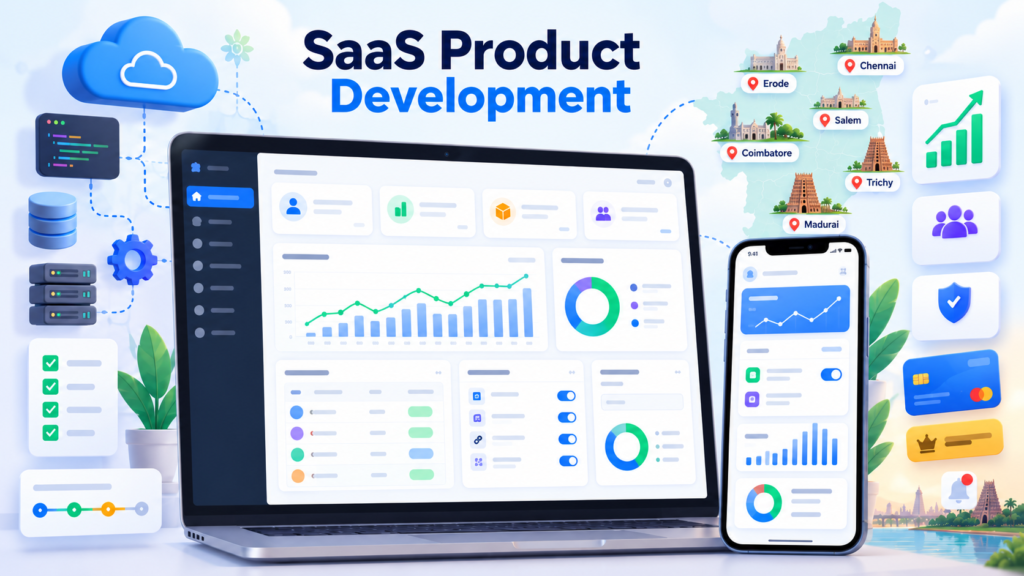
SaaS product development for startups in Tamil Nadu is important for founders who want to turn a software idea into a usable, scalable digital product such as a CRM, business automation platform, reporting tool, HR system, education platform, booking system, marketplace, dashboard or industry-specific cloud software.
Building a successful SaaS product requires much more than writing code.
Founders need to think about:
- The customer problem
- Target audience
- MVP scope
- User onboarding
- UI/UX
- Frontend and backend architecture
- Database design
- User roles
- Subscription or pricing logic
- Payment processing
- Analytics
- Security controls
- Integrations
- Infrastructure
- Product support
For startups across Erode, Chennai, Coimbatore, Tiruppur, Salem, Madurai, Trichy and other parts of Tamil Nadu, SaaS development can create opportunities to build software for both Indian and international customers.
At Greap Technologies, we provide SaaS development services for founders who need MVP development, SaaS web applications, dashboards, subscription systems, APIs, integrations and ongoing product improvements.
Quick Answer: SaaS Product Development for Startups in Tamil Nadu
SaaS product development is the process of building software that customers access over the internet, commonly through a web application and sometimes through connected mobile applications.
A SaaS platform may include:
- User signup and login
- Product onboarding
- Customer dashboard
- Admin dashboard
- Team management
- User roles and permissions
- Plans and billing
- Payments
- Usage limits
- Reports
- Analytics
- Notifications
- API integrations
- Support system
For most early-stage founders, the better strategy is not to build the complete product immediately.
A practical roadmap is:
Problem Validation
↓
MVP Scope
↓
Design + Development
↓
Launch to Early Users
↓
Measure Usage + Feedback
↓
Improve Product
↓
Scale When Demand Is Proven
SaaS Product Development: Service Overview
| Detail | Information |
|---|---|
| Service | SaaS Product Development |
| Company | Greap Technologies |
| Target Audience | Startup founders, entrepreneurs and digital product teams |
| Common Projects | MVPs, SaaS platforms, portals, dashboards, automation tools and B2B software |
| Common Modules | Authentication, dashboard, billing, admin, reports, APIs and analytics |
| Development Approach | MVP-first, modular and requirement-based |
| Service Region | Tamil Nadu and remote projects |
What Is a SaaS Product?
SaaS stands for Software as a Service.
Instead of customers installing traditional software separately on every computer, users normally access the product online.
Examples can include:
- CRM software
- HR platforms
- Marketing reporting systems
- Accounting applications
- Appointment software
- Education platforms
- Project management tools
- Inventory systems
- Business dashboards
- Industry-specific management platforms
SaaS is a delivery model, not automatically a pricing model.
A SaaS business may use:
- Monthly subscription
- Annual subscription
- Per-user pricing
- Usage-based pricing
- Freemium
- Free trial
- Enterprise contracts
- Hybrid pricing
Why SaaS Can Be Attractive for Tamil Nadu Startups
Many businesses still operate with combinations of spreadsheets, email, WhatsApp messages, paper records and disconnected tools.
Startup founders can identify one repeated operational problem and build a focused software solution around it.
Example SaaS Opportunities
- Agency reporting automation
- School administration
- Clinic appointment management
- Retail inventory management
- Manufacturing quotation tracking
- Real estate CRM
- Field-service management
- Restaurant operations
- Dealer order management
The opportunity is strongest when customers experience a repeated problem serious enough that they are willing to change their workflow or pay for a better solution.
Who Can Build a SaaS Product?
Startup Founders
Founders can use SaaS MVP development to validate a software product before investing in a much larger platform.
Digital Agencies
Agencies can productize repeated internal workflows such as reporting, client management, approvals or campaign monitoring.
Education Startups
Possible products include:
- LMS platforms
- Admission systems
- Assessment tools
- Parent portals
- Student dashboards
Healthcare Startups
Possible products include appointment management, clinic operations and patient-facing portals.
Products processing personal health information require stronger privacy, security and compliance planning appropriate to their use case.
Ecommerce Startups
Possible SaaS products include:
- Order management
- Catalogue automation
- Inventory tools
- Seller dashboards
- Analytics tools
HR and Recruitment Startups
Possible products include:
- Recruitment management
- Attendance
- Employee onboarding
- Leave management
- Performance tracking
Manufacturing and B2B Startups
Possible products include:
- Vendor portals
- Dealer systems
- Quotation management
- Production dashboards
- Inventory applications
What Should Happen Before SaaS Development?
1. Define the Problem
Start with one specific problem rather than starting with technology.
Ask:
- What problem occurs repeatedly?
- Who experiences it?
- How are they solving it today?
- What does the problem cost them?
- Why would they switch to a new tool?
2. Define the Target Customer
A product built for “all businesses” is usually difficult to position.
A stronger initial market can be something more focused, such as:
- Digital marketing agencies
- Loan DSAs
- Schools
- Dental clinics
- Textile distributors
- Small manufacturers
3. Study Alternatives
Understand:
- Existing competitors
- Pricing
- Popular features
- Customer complaints
- Manual alternatives
- Market gaps
4. Define the MVP
Identify the smallest product that can solve the core problem and be tested with real users.
What Is a SaaS MVP?
MVP means Minimum Viable Product.
An MVP contains enough functionality to test whether customers actually find the solution useful.
Example CRM MVP
- User login
- Lead creation
- Customer records
- Pipeline
- Follow-up reminders
- Basic dashboard
- Admin controls
Features That Can Wait
- Advanced automation
- Complex AI features
- White-label functionality
- Dozens of integrations
- Advanced analytics
- Native mobile applications
The goal is to validate value before increasing complexity.
SaaS Product Development Stages
Stage 1: Product Discovery
Define:
- Problem
- Audience
- Core workflow
- Competitors
- Business model
- MVP goal
Stage 2: Feature Prioritization
Separate features into:
- Must Have
- Should Have
- Future
Stage 3: Wireframes and User Flows
Plan how users move through:
- Signup
- Onboarding
- Dashboard
- Main feature
- Settings
- Billing
Stage 4: UI/UX Design
A SaaS interface should prioritize clarity and repeated usage rather than only visual decoration.
Important UX areas include:
- Navigation
- Forms
- Tables
- Filters
- Empty states
- Error messages
- Loading states
- Responsive layouts
- Onboarding
Stage 5: Application Architecture
Architecture planning can cover:
- Frontend
- Backend
- Database
- Authentication
- Tenant model
- APIs
- Billing
- Storage
- Infrastructure
- Logging
- Backups
Stage 6: MVP Development
Build the core functionality required to test the product.
Stage 7: QA and Testing
Test:
- Signup
- Login
- Permissions
- Main workflows
- Billing
- Notifications
- Reports
- Responsive behaviour
- API failures
Stage 8: Controlled Launch
Launch first to a smaller group when possible instead of immediately targeting thousands of users.
Stage 9: Product Analytics and Feedback
Measure behaviour and collect feedback before deciding the next development phase.
Stage 10: Product Scaling
Scale infrastructure and features when actual demand requires it.
Important SaaS Product Features
User Registration and Authentication
Authentication options can include:
- Email/password
- Verification
- Password reset
- Supported social login
- Multi-factor authentication where appropriate
User Onboarding
Onboarding is often overlooked.
A new user should quickly understand:
- What to do first
- How to configure the account
- How to get value from the product
Customer Dashboard
Dashboard elements can include:
- Summary cards
- Recent activity
- Charts
- Quick actions
- Notifications
- Usage information
Admin Panel
The SaaS operator may need controls for:
- Users
- Organizations
- Plans
- Payments
- Feature access
- Support
- Notifications
- Reports
- System configuration
Team and Role Management
B2B SaaS products often need:
- Organization accounts
- Team members
- Invitations
- Roles
- Permissions
Billing and Plan Management
Depending on the business model, billing logic may include:
- Trials
- Monthly plans
- Annual plans
- Seat limits
- Usage limits
- Upgrade
- Downgrade
- Cancellation
- Renewal
- Invoices
Payment and recurring-billing capabilities vary by gateway, country, card issuer and business model and should be validated during implementation.
Feature Entitlements
The system needs to understand which customer can access which feature.
Example:
| Plan | Users | Reports | Integrations |
|---|---|---|---|
| Starter | 1 | Basic | Limited |
| Professional | Multiple | Advanced | Available |
Reports and Analytics
Products can provide:
- Operational reports
- Usage reports
- Exports
- Charts
- Date filters
- Team reports
Notifications
Notifications may include:
- In-app alerts
- SMS where needed
- Supported WhatsApp integrations
- Mobile push notifications
API Integrations
Third-party integrations can significantly increase product value.
Examples include:
- Payment platforms
- CRM systems
- Accounting systems
- Communication platforms
- Advertising APIs
- Calendar systems
- Analytics services
Greap also provides API integration services for SaaS platforms and connected software systems.
Multi-Tenant vs Single-Tenant SaaS
This is an important architecture decision.
Multi-Tenant
Multiple customer organizations use the same application platform while their data and access are logically separated.
This model is common in SaaS because operating one product for many customers can simplify deployment and upgrades.
Single-Tenant / Dedicated Environment
A customer may receive a dedicated application or infrastructure environment.
This can be appropriate for certain enterprise, regulatory or isolation requirements.
There is no universally correct answer. The architecture should match the product, customers, security needs and operational model.
SaaS Security and Data Protection
SaaS products process customer and business information, so security should be included in architecture and development decisions.
Relevant controls can include:
- Secure authentication
- Role-based authorization
- Tenant data isolation
- HTTPS
- Input validation
- Secure API authentication
- Rate limiting where appropriate
- Secrets management
- Database access controls
- Audit logs
- Backups
- Dependency updates
- Error handling
- Monitoring
The exact controls should be determined by the data, users, threat model and regulatory requirements of the product.
Logging, Monitoring and Reliability
A production SaaS platform should make it possible to identify problems when they happen.
Useful operational capabilities can include:
- Error logging
- Application monitoring
- API monitoring
- Database monitoring
- Uptime monitoring
- Backup monitoring
- Alerting
These capabilities become increasingly important as active users and integrations grow.
Product Analytics for SaaS Startups
Founders should not measure only total registrations.
Useful metrics can include:
- Signup completion
- Activation rate
- First-value action
- Active users
- Feature usage
- Trial conversion
- Paid conversion
- Retention
- Churn
- Support volume
The correct metrics depend on the product business model.
Types of SaaS Products Startups Can Build
CRM SaaS
- Lead pipeline
- Customer management
- Follow-ups
- Team assignment
- Reports
Marketing SaaS
- Campaign data
- Client dashboards
- Automated reporting
- Scheduled reports
- Performance analytics
HR SaaS
- Employee management
- Leave
- Attendance
- Recruitment
- Onboarding
Education SaaS
- Courses
- Students
- Teachers
- Assessments
- Content
- Reports
Healthcare SaaS
- Appointments
- Schedules
- Patient-facing portals
- Operational dashboards
Ecommerce SaaS
- Orders
- Inventory
- Catalogues
- Customers
- Analytics
Finance SaaS
- Invoicing
- Expenses
- Workflow approvals
- Loan-management workflows
- Financial dashboards
Booking SaaS
- Services
- Availability
- Bookings
- Staff schedules
- Payments
- Reminders
Real Estate SaaS
- Properties
- Leads
- Site visits
- Brokers
- Follow-ups
Manufacturing SaaS
- Quotations
- Orders
- Inventory
- Production
- Vendors
- Dispatch
SaaS Product Development Cost in Tamil Nadu
SaaS product cost depends primarily on product scope rather than the city where the startup is located.
Important cost factors include:
- Number of modules
- User roles
- UI/UX complexity
- Backend architecture
- Tenant architecture
- Billing model
- Integrations
- Reports
- Mobile apps
- Infrastructure
- Testing
| Product Type | Indicative Planning Range |
|---|---|
| Focused SaaS MVP | ₹2,00,000 – ₹8,00,000+ |
| Business SaaS Web Application | ₹5,00,000 – ₹15,00,000+ |
| SaaS with Billing + Team Features | ₹8,00,000 – ₹25,00,000+ |
| Integration-Heavy SaaS | ₹10,00,000 – ₹35,00,000+ |
| SaaS + Mobile Applications | ₹15,00,000 – ₹50,00,000+ |
| Large Enterprise SaaS | ₹25,00,000 – ₹1,00,00,000+ |
Important: These are indicative planning ranges only. They are not fixed Greap quotations or standard Tamil Nadu market prices.
A detailed estimate should be prepared after product discovery and scope definition.
What Additional SaaS Costs Should Founders Plan For?
Development is only one part of SaaS cost.
Recurring or third-party costs can include:
- Cloud infrastructure
- Database hosting
- File storage
- Email services
- SMS / OTP
- WhatsApp integrations
- Payment processing
- Monitoring
- Analytics tools
- Customer support software
- Domain
- Security tools
- Backups
- Maintenance
SaaS Technology Stack
There is no single best SaaS technology stack.
The right stack depends on:
- Product complexity
- Developer expertise
- Expected usage
- Real-time requirements
- Data model
- Integrations
- Hosting strategy
- Maintainability
Example technologies can include:
| Layer | Example Technologies |
|---|---|
| Frontend | Next.js, React |
| Backend | Node.js, Laravel, other suitable frameworks |
| Database | PostgreSQL, MySQL, MongoDB where appropriate |
| Mobile | Flutter, React Native or native development |
| APIs | REST, GraphQL where suitable |
| Infrastructure | Cloud/VPS infrastructure selected to match requirements |
Greap’s own SaaS service currently includes technologies such as React, Next.js, Node.js, MongoDB, AWS, Firebase and subscription-billing integrations depending on the project.
When Should a SaaS Startup Build a Mobile App?
Many SaaS startups should begin with a web application.
A native or cross-platform mobile application can be added when:
- Customers use the product frequently on mobile
- Push notifications are valuable
- Camera/GPS functionality is required
- Offline functionality is important
- Customer demand supports the additional development cost
Greap also provides mobile app development when the SaaS product needs Android or iOS functionality.
SaaS Marketing Website
A strong SaaS product also needs a strong marketing layer.
Useful pages include:
- Homepage
- Features
- Pricing
- Use Cases
- Industries
- Integrations
- About
- Blog
- Contact
- Demo
- Free Trial
- Login
- Signup
- FAQ
SaaS SEO Strategy
SaaS SEO can target problems, solutions, use cases and categories relevant to the product.
Examples
- CRM software for small businesses
- Meta Ads reporting tool
- WhatsApp reporting software for agencies
- Clinic appointment management software
- Inventory management software for retailers
- School management software
Useful SaaS content can include:
- Feature pages
- Use-case pages
- Industry pages
- Comparison pages
- Integration pages
- How-to articles
- Problem-focused content
SaaS Product Launch Checklist
| Requirement | Priority |
|---|---|
| Problem validation | Essential |
| Target customer | Essential |
| MVP scope | Essential |
| User flows | Essential |
| UI/UX | Essential |
| Backend | Essential |
| Database | Essential |
| Admin panel | Usually required |
| Authentication | Essential |
| Tenant model | B2B SaaS dependent |
| Billing | Business-model dependent |
| Product analytics | Recommended |
| Security controls | Essential |
| Backups | Essential for production data |
| Testing | Essential |
| Marketing website | Strongly recommended |
| Feedback system | Recommended |
| Maintenance plan | Essential for production SaaS |
Common SaaS Development Mistakes
1. Building Too Much Before Validation
Large version-one scope increases cost and delays customer feedback.
2. Targeting Everyone
Start with a clearly defined user and problem.
3. Ignoring Onboarding
If users cannot reach value quickly, features alone will not create retention.
4. Weak Admin Tools
The startup team also needs practical ways to manage customers, plans, support and system activity.
5. Hard-Coding Billing Logic
Plan upgrades, downgrades, expiry, usage limits and payment failures early.
6. Poor Tenant Isolation
B2B SaaS products should clearly separate customer organizations and permissions.
7. No Product Analytics
Without product usage data, founders are forced to guess which features matter.
8. Premature Scaling
Do not build infrastructure for millions of users when the first goal is validating the first group of customers.
9. Ignoring Reliability
Logging, monitoring, backups and error handling become part of the actual product experience.
10. No Go-to-Market Plan
Development and customer acquisition should be planned together.
SaaS Product Development Across Tamil Nadu
Greap Technologies supports founders and businesses across Tamil Nadu, including:
Erode, Chennai, Coimbatore, Tiruppur, Salem, Madurai, Trichy, Namakkal, Karur, Dindigul, Hosur, Vellore, Thanjavur and other relevant locations.
However, SaaS development scope and cost are determined mainly by product complexity rather than where the founder is located.
For SEO, avoid creating near-identical pages for every Tamil Nadu city simply by changing the location name.
A stronger strategy is to build one authoritative Tamil Nadu SaaS page and create genuinely unique supporting pages only where there is different search intent or useful local content.
How Greap Technologies Helps SaaS Startups
Greap Technologies’ current SaaS development service focuses on product discovery, architecture, SaaS UI, development, billing flows, QA, launch and ongoing support.
Our SaaS product development support can include:
- Product discovery
- MVP planning
- Feature documentation
- Wireframes
- UI/UX design
- Web application development
- Backend development
- Database architecture
- Authentication
- User and team management
- Admin dashboard
- Billing logic
- Payment integration
- API development
- Third-party integrations
- Reports
- Analytics
- Notifications
- Testing
- Deployment
- Product enhancements
Founders at an earlier stage can also explore Greap’s Startup Solutions for MVPs, SaaS products, web/mobile applications, dashboards and startup software systems.
Related SaaS Development Services
- SaaS Development Services
- Startup Solutions
- Web Application Development
- Custom Software Development
- API Integration Services
- Mobile App Development
Have a SaaS Product Idea?
Share the problem, target users and core product idea with Greap Technologies. We can help you convert it into an MVP feature plan before investing in a large development scope.
Why Choose Greap Technologies for SaaS Product Development?
MVP-First Product Planning
We help separate essential launch features from future ideas so founders can validate the product before increasing scope.
SaaS Web Application Development
Greap develops dashboards, portals, user accounts, APIs and business logic required for browser-based SaaS products.
Admin and Product Operations
We plan the internal tools required to manage users, plans, payments, feature access and product operations.
API and Integration Capability
Supported external systems can be connected through APIs and webhooks based on product requirements.
Startup Development Support
Greap supports founders across MVP planning, launch and future product iterations rather than treating version one as the final product.
SaaS Product Development for Startups in Tamil Nadu – Conclusion
SaaS product development for startups in Tamil Nadu can help founders turn repeated business problems into software products that can serve multiple customers.
But successful SaaS development should not begin with a long feature list.
A stronger approach is:
Validate the Problem → Define the Customer → Build the MVP → Launch → Measure Usage → Collect Feedback → Improve → Scale.
Technology, billing, architecture and infrastructure should support the product strategy rather than replace it.
Greap Technologies helps startups plan and develop SaaS MVPs, web applications, dashboards, subscription systems, APIs and connected software platforms based on real product requirements.
Turn Your SaaS Idea into an MVP
Talk to Greap Technologies about your target user, core workflow, business model and product requirements.
Frequently Asked Questions
1. What is SaaS product development?
SaaS product development is the process of building software that users access online, commonly through a web application, with functionality such as user accounts, dashboards, billing, reports and administration.
2. Why should startups build an MVP first?
An MVP helps founders test whether customers value the core solution before investing in a much larger set of features.
3. Does every SaaS product need subscription pricing?
No. SaaS products can use monthly subscriptions, annual plans, per-seat pricing, usage-based pricing, freemium, enterprise contracts or other business models.
4. What features does a SaaS MVP need?
The exact features depend on the problem. Many MVPs need authentication, the core product workflow, an admin area and enough analytics or feedback capability to evaluate usage.
5. How much does SaaS development cost in Tamil Nadu?
Cost depends on product scope, modules, architecture, billing, integrations, reports, mobile apps and testing. A focused MVP may begin around ₹2,00,000, while larger SaaS platforms can require investments of several lakhs or more.
6. Should a SaaS startup build a web app or mobile app first?
Many B2B SaaS products can begin as web applications. A mobile app can be added when mobile usage, notifications, device capabilities or customer demand justify it.
7. Does SaaS require multi-tenant architecture?
No. Multi-tenancy is common, but some products or enterprise customers may require dedicated environments. The correct architecture depends on the product and customer requirements.
8. Does a SaaS product need a marketing website?
For most commercial SaaS products, a marketing website is important for explaining features, pricing, use cases and helping potential customers request a demo, trial or signup.
9. Can Greap Technologies build SaaS MVPs?
Yes. Greap Technologies provides SaaS and startup development services that can include MVP planning, web application development, dashboards, billing systems, APIs, integrations, QA and launch support.
10. Can a SaaS product be expanded after MVP launch?
Yes. A well-planned MVP can be expanded with additional reports, automation, team functionality, integrations, mobile apps and enterprise features based on validated demand.