
Inventory Software for Textile Shops in Erode
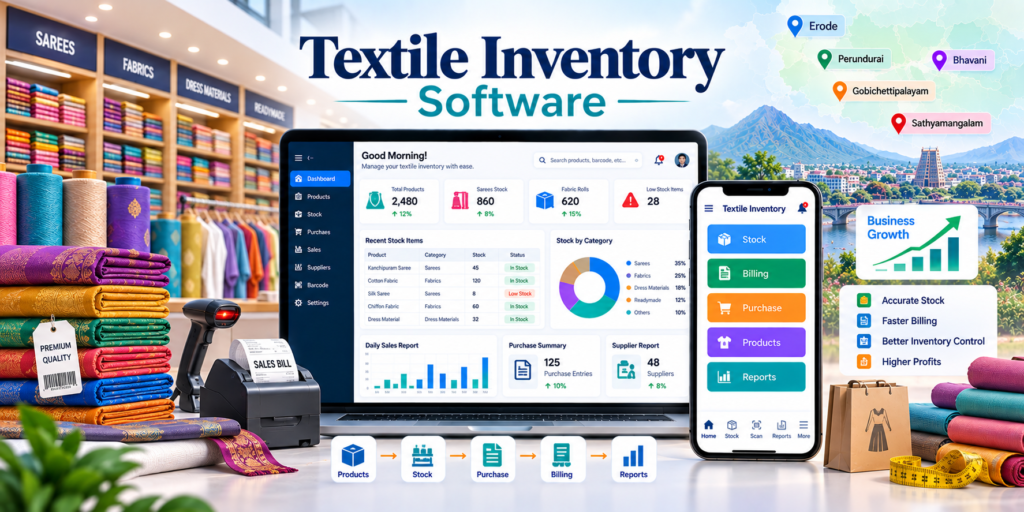
Inventory software for textile shops in Erode helps saree shops, garment stores, fabric shops, textile wholesalers, uniform stores, readymade garment businesses and home textile retailers manage stock, purchase, sales billing, product variants, barcode, returns and business reports in one organized system.
Textile shops usually handle hundreds or thousands of products with different designs, colours, sizes, brands, fabric types and price ranges. Fabric businesses may also need roll-wise and metre-wise stock tracking.
When these records are maintained only through notebooks, spreadsheets or separate billing systems, stock mismatches, duplicate entries, incorrect billing and purchase confusion can happen easily.
At Greap Technologies, we provide inventory software for textile shops in Erode, helping textile businesses build simple, practical and scalable stock-management systems based on their actual shop workflow.
Quick Answer: What Is Textile Inventory Software?
Textile inventory software is a stock and billing management system designed to track textile products from purchase entry through sales, returns and remaining stock.
Depending on the business, textile inventory software can include:
- Product management
- Category management
- Brand management
- Size-wise stock
- Colour-wise stock
- Design-wise stock
- Fabric roll tracking
- Metre-wise stock
- Purchase management
- Supplier management
- Sales billing
- Barcode generation
- Barcode scanning
- Returns and exchanges
- Stock adjustments
- Low-stock alerts
- Customer management
- Staff login
- Role-based access
- Reports and dashboards
The exact features should be configured according to whether the business sells sarees, garments, fabrics, uniforms, home textiles or wholesale products.
Inventory Software for Textile Shops in Erode: Service Overview
| Detail | Information |
|---|---|
| Service | Inventory Software for Textile Shops |
| Company | Greap Technologies |
| Location | Erode, Tamil Nadu |
| Main Audience | Saree shops, garment stores, fabric shops, uniform stores and textile wholesalers |
| Main Goal | Manage textile stock, purchase, billing, returns and reports |
| Core Features | Product variants, barcode, purchase, billing, stock control and reports |
| Best For | Sarees, garments, fabrics, home textiles, uniforms and wholesale textiles |
| Service Area | Erode District and nearby areas |
Why Textile Shops in Erode Need Inventory Software
Textile shops manage products that can vary by colour, size, design, fabric, brand and selling price.
Without proper inventory software, shop owners may find it difficult to know:
- How much stock is currently available?
- Which sizes are available?
- Which colours are available?
- Which designs are selling faster?
- How much fabric remains in a roll?
- Which products need to be reordered?
- Which supplier supplied a particular item?
- Which products were returned or exchanged?
- What is the current stock value?
- Which staff member created or edited a transaction?
Inventory software provides one structured system for managing these daily activities.
What Types of Textile Businesses Need Inventory Software?
1. Saree Shops
Saree stores can manage products by:
- Product code
- Saree type
- Colour
- Design
- Brand
- Cost price
- Selling price
- Barcode
- Available quantity
2. Garment Shops
Garment stores can track shirts, pants, t-shirts, kurtis, dresses, kidswear and other clothing by size and colour.
3. Fabric Shops
Fabric businesses can track:
- Fabric type
- Roll number
- Colour
- Width
- Opening metres
- Cut quantity
- Remaining metres
4. Textile Wholesale Businesses
Wholesalers can manage bulk stock, dealer sales, purchase quantities, product codes and customer-wise sales history.
5. Uniform Stores
Uniform businesses can manage:
- School or company
- Product type
- Size
- Colour
- Stock quantity
- Seasonal demand
6. Home Textile Shops
Home textile stores can manage bedsheets, towels, curtains, pillow covers, blankets, table linen and other furnishing products.
7. Boutique and Fashion Stores
Boutiques can manage collections, sizes, colours, designs, purchase cost, sales price and stock quantity.
8. Readymade Garment Stores
Readymade garment stores can use barcode-based stock and billing for faster daily operations.
9. Textile Showrooms
Larger textile showrooms can add department-wise stock, counter-wise access, multiple staff logins and advanced reports.
10. Textile Businesses Selling Online and Offline
Businesses selling both through a physical shop and ecommerce website may need stock synchronization between online and offline channels.
Benefits of Inventory Software for Textile Shops
1. Better Stock Control
Inventory software can track:
- Opening stock
- Purchase stock
- Sales quantity
- Returned quantity
- Adjusted quantity
- Current balance
- Low-stock products
2. Size-Wise Stock Management
Garment and uniform businesses can maintain stock by sizes such as:
- XS
- S
- M
- L
- XL
- XXL
- Custom sizes
This reduces confusion between total product quantity and actual available variants.
3. Colour-Wise Stock Management
Products can be tracked separately by colour so staff can immediately check availability.
4. Faster Barcode Billing
Barcode-enabled billing can reduce the need to manually search and type every product during checkout.
A typical flow can be:
Scan Product → Product Identified → Quantity Added → Billing → Stock Reduced Automatically
5. Better Purchase Management
Purchase records can include:
- Supplier
- Purchase invoice
- Products received
- Quantity
- Cost price
- Tax details where required
- Purchase date
- Purchase return
6. Better Return and Exchange Tracking
When a customer exchanges a garment or textile item, the software can update the correct product and variant stock.
7. Better Low-Stock Monitoring
Low-stock alerts can help identify products that may need reordering.
8. Better Business Reports
Owners can review reports for:
- Stock
- Purchases
- Sales
- Returns
- Fast-moving products
- Slow-moving products
- Supplier purchases
- Category sales
- Staff activity
Important Features of Textile Inventory Software
1. Product Management
Product details can include:
- Product code
- Product name
- Category
- Brand
- Colour
- Size
- Design
- Fabric/material
- Cost price
- Selling price
- Barcode
- Current stock
2. Product Code / SKU Management
A unique product code or SKU helps distinguish similar-looking products.
For example:
SHIRT-BLUE-L-001
This can represent a specific blue shirt in size L.
3. Category Management
Categories can include:
- Sarees
- Shirts
- T-Shirts
- Kurtis
- Kidswear
- Fabrics
- Bedsheets
- Towels
- Curtains
- Uniforms
4. Size and Colour Variant Management
A single product style can have multiple variants.
Example:
| Colour | M | L | XL |
|---|---|---|---|
| Blue | 8 | 10 | 5 |
| Black | 6 | 7 | 4 |
This provides much better stock visibility than maintaining only one total quantity.
5. Fabric Roll and Metre Tracking
Fabric shops can use roll-level tracking.
Each roll can include:
- Roll number
- Fabric
- Colour
- Width
- Opening metres
- Metres sold
- Remaining metres
When fabric is cut and sold, the remaining balance can be updated.
6. Purchase Management
The purchase module can support:
- Supplier selection
- Purchase invoice
- Product inward
- Cost price
- Purchase return
- Payment reference
- Supplier-wise purchase history
7. Barcode Generation and Printing
Inventory software can generate unique barcodes for products or variants.
Barcode labels can contain:
- Barcode
- Product code
- Product name
- Size
- Price
Label format depends on printer type and business requirements.
8. Barcode Billing
Compatible barcode scanners can be used to identify products during billing.
9. Sales Billing
The billing module can include:
- Product scanning
- Quantity
- Rate
- Discount
- Tax where applicable
- Customer information
- Payment mode
- Invoice printing
10. Returns and Exchanges
The system can record:
- Original invoice
- Returned product
- Returned variant
- Exchange product
- Price difference
- Stock adjustment
11. Stock Adjustment
Authorized users can make controlled adjustments for situations such as:
- Physical stock correction
- Damaged goods
- Missing products
- Opening balance correction
Adjustment history should record who made the change and why.
12. Low-Stock Alerts
Minimum-stock levels can be configured for important products or variants.
13. Customer Management
Customer records can include:
- Name
- Phone number
- Purchase history
- Returns
- Outstanding amount where applicable
14. Supplier Management
Supplier profiles can include:
- Supplier name
- Contact information
- Products supplied
- Purchase history
- Payment references
15. Staff Login and Permissions
Roles can include:
- Owner
- Manager
- Billing Staff
- Inventory Staff
- Purchase Staff
- Administrator
Each user should only have access to the functions required for their role.
Textile Inventory Software Workflow Example
A basic workflow can be:
Purchase → Stock Inward → Barcode Generation → Product Display → Sales Billing → Stock Reduction → Return / Exchange → Reports
Fabric Shop Workflow
Fabric Purchase → Roll Entry → Metre Stock → Fabric Cutting → Billing → Remaining Metres Updated
Garment Shop Workflow
Purchase → Size / Colour Variant Entry → Barcode → Billing → Variant Stock Updated
The workflow should match the actual way employees handle stock inside the shop.
Inventory Software vs Billing Software for Textile Shops
| Feature | Billing Software | Inventory Software |
|---|---|---|
| Main Purpose | Create bills | Manage stock and product movement |
| Product Stock | Basic in some systems | Core focus |
| Size / Colour Variants | May be limited | Can be detailed |
| Fabric Metre Tracking | Usually limited | Can be customized |
| Barcode | May be supported | Can be integrated with stock workflow |
| Purchase Management | Basic | Detailed |
| Returns | Billing-focused | Connected with stock updates |
| Stock Reports | Basic to moderate | Detailed |
Many textile shops need both billing and inventory functionality in one connected system.
Inventory Software vs ERP for Textile Businesses
| Feature | Inventory Software | ERP Software |
|---|---|---|
| Main Purpose | Stock, purchase and sales management | Broader business operations |
| Retail Billing | Strong focus | Can be included |
| Stock Variants | Strong focus | Can be included |
| Production | Usually not required | Core for manufacturers |
| Job Work | Usually limited | Can be detailed |
| MRP | Not normally required | Can be included |
| Best For | Retail and wholesale textile shops | Textile manufacturing businesses |
A textile shop mainly selling finished products may only need inventory and billing software. A textile manufacturer managing production, raw materials and job work may need a more complete ERP system.
Reports Useful for Textile Shop Owners
Inventory software can provide reports such as:
- Current stock report
- Category-wise stock
- Brand-wise stock
- Size-wise stock
- Colour-wise stock
- Purchase report
- Sales report
- Return report
- Stock adjustment report
- Low-stock report
- Fast-moving product report
- Slow-moving product report
- Supplier-wise purchase report
- Staff-wise activity report
Profit reports require correct purchase cost, sales values, returns and other relevant data to be maintained accurately.
Ecommerce Integration for Textile Inventory Software
Textile shops selling through both a physical store and ecommerce website can connect inventory systems where technically suitable.
A possible flow is:
Central Inventory → Physical Store Billing + Ecommerce Orders → Stock Updated
Possible integrations can include:
- WooCommerce
- Shopify
- Custom ecommerce websites
- Product catalogue systems
- Order-management systems
Synchronization behaviour depends on the ecommerce platform, API availability and business workflow.
Explore ecommerce development services for online store requirements.
Accounting Integration
Inventory software can be connected with suitable accounting systems where supported.
Possible data exchange can include:
- Sales invoices
- Purchase invoices
- Customer details
- Supplier details
- Payment references
Accounting, tax filing and statutory reports should be handled according to the requirements of the accounting system and applicable regulations.
Admin Panel Features for Textile Inventory Software
| Module | Purpose |
|---|---|
| Dashboard | View stock and sales overview |
| Products | Manage textile products |
| Categories | Manage product groups |
| Variants | Manage size, colour and design options |
| Suppliers | Manage supplier details |
| Purchases | Manage product inward |
| Stock | View inventory balances |
| Billing | Manage sales transactions |
| Returns | Manage returns and exchanges |
| Barcodes | Generate and print barcode labels |
| Customers | Manage customer records |
| Users & Roles | Control staff access |
| Reports | Analyze stock and sales |
| Settings | Configure software |
Advanced Features for Textile Inventory Software
- Barcode generation
- Barcode label printing
- Barcode scanner integration
- Size-wise stock
- Colour-wise stock
- Design-wise stock
- Fabric roll tracking
- Metre-wise stock
- Multiple price levels
- Wholesale pricing
- Customer credit tracking
- Supplier payment tracking
- Low-stock notifications
- Multiple counters
- Multiple branches
- Stock transfer
- Stock audit
- Ecommerce integration
- Accounting integration
- Analytics dashboard
- Mobile app
Advanced modules should be added according to genuine business requirements.
Textile Inventory Software Development Process
Step 1: Requirement Analysis
Important questions include:
- What textile products do you sell?
- How many products are currently available?
- Do products have sizes?
- Do products have colours?
- Do you sell fabric by metre?
- Do you need barcode billing?
- How are purchases entered?
- Do you allow returns and exchanges?
- How many staff members need login access?
- Do you have multiple branches?
- Do you need ecommerce integration?
- What reports does the owner need?
Step 2: Workflow Planning
Map the complete shop flow:
Purchase → Stock Entry → Product Coding → Barcode → Sales Billing → Returns / Exchanges → Stock Reports
Step 3: Product and Variant Structure
Plan how products will be identified by:
- SKU
- Category
- Brand
- Size
- Colour
- Design
- Fabric
Step 4: UI/UX Design
Billing and stock-entry screens should be simple enough for staff to use quickly.
Step 5: Software Development
Development can include products, purchase, stock, barcode, billing, returns, users and reports.
Step 6: Existing Data Migration
Data can include:
- Product list
- Opening stock
- Suppliers
- Customers
- Prices
- Existing SKUs
Duplicate and outdated data should be cleaned before import.
Step 7: Hardware Testing
Where applicable, test:
- Barcode scanner
- Barcode printer
- Billing printer
- Desktop systems
Step 8: Staff Training
Staff can be trained separately for billing, inventory, purchase and administration.
Step 9: Launch and Improvement
Reports and workflows can be improved after reviewing real shop usage.
Textile Inventory Software Features Checklist
| Feature | Recommendation |
|---|---|
| Product Management | Required |
| Category Management | Required |
| Supplier Management | Required |
| Purchase Management | Required |
| Stock Management | Required |
| Sales Billing | Required |
| Product Codes / SKU | Required |
| Barcode Generation | Recommended |
| Barcode Scanning | Recommended |
| Size-Wise Stock | Based on business type |
| Colour-Wise Stock | Based on business type |
| Fabric Metre Tracking | Based on business type |
| Return and Exchange | Recommended |
| Stock Adjustment | Required |
| Staff Login | Required |
| Role-Based Access | Recommended |
| Low-Stock Alerts | Recommended |
| Reports | Required |
| Mobile Responsive Design | Recommended |
| Ecommerce Integration | Based on requirement |
| Accounting Integration | Based on requirement |
Common Mistakes Textile Shops Should Avoid
1. Managing Stock Only in Notebooks
Manual stock tracking becomes difficult when products and transactions increase.
2. No Product Code System
Every product or important variant should have a consistent identifier.
3. No Size and Colour Tracking
Garment and uniform businesses should know the actual quantity available for each variant.
4. No Barcode Billing
For businesses with large product volumes, barcode-based identification can improve billing speed.
5. Poor Purchase Entries
Incorrect purchase records can affect stock quantity and product costing.
6. No Return and Exchange Tracking
Returns should update the correct product and variant.
7. No Low-Stock Monitoring
Important fast-moving products should have reorder visibility.
8. No Staff-Wise Access
Individual user accounts make transaction history clearer.
9. No Stock Audit
Physical stock should periodically be compared with software stock.
10. Using Complicated Software
Textile shop inventory software should remain practical for billing and stock staff to use daily.
Erode District Textile Inventory Software Strategy
Greap Technologies supports textile shops across:
Erode, Perundurai, Bhavani, Anthiyur, Gobichettipalayam, Sathyamangalam, Modakkurichi, Kodumudi, Nambiyur, Chennimalai, Kavindapadi, Ammapettai, Arachalur, Sivagiri, Punjai Puliampatti, Solar, Surampatti, Veerappanchatram, Nasiyanur and nearby areas.
Location-specific SEO pages should only be created for genuine service areas and should contain unique, locally useful information rather than near-identical content.
How Greap Technologies Helps with Textile Inventory Software Development
Greap Technologies can develop custom inventory software around the actual workflow of textile shops and showrooms.
Our textile inventory software services can include:
- Inventory requirement analysis
- Textile shop workflow planning
- Product management
- Category management
- Variant management
- Supplier management
- Customer management
- Purchase management
- Stock management
- Sales billing
- Barcode generation
- Barcode scanning support
- Fabric metre tracking
- Return and exchange management
- Stock adjustment
- Low-stock alerts
- Staff accounts
- Role-based permissions
- Dashboards and reports
- Data import support
- Billing-printer support based on requirement
- Barcode-printer support based on requirement
- Ecommerce integration
- Accounting/API integration
- Testing and training
- Software maintenance support
Explore related Greap services:
- Custom Software Development
- Ecommerce Development
- API Integration Services
- Website Development Services
- Mobile App Development
Why Choose Greap Technologies?
Textile Shop Workflow Understanding
Inventory software can be planned around textile-specific workflows such as product variants, barcode billing, metre-wise fabric stock and exchanges.
Custom Inventory Software Development
The system can be designed according to the actual product and billing process rather than forcing the shop into a generic workflow.
Simple Billing and Stock Management
Daily billing, purchase and stock updates can be designed for quick staff usage.
Scalable Features
Businesses can begin with products, purchase, stock and billing before adding ecommerce integration, branch management or advanced reports.
Integration Support
Inventory software can connect with suitable ecommerce, accounting and other business systems where supported.
Complete Digital Support
Greap Technologies also provides ERP, CRM, ecommerce websites, mobile apps, SEO and digital marketing services.
Conclusion
Inventory software for textile shops in Erode can help saree shops, garment stores, fabric businesses and textile wholesalers manage products, purchases, billing, variants, returns and stock reports more systematically.
A practical textile inventory system should include product codes, category management, size and colour tracking where required, purchase management, billing, barcode support, stock adjustments, returns, staff access and reports.
Fabric businesses may also benefit from roll-wise and metre-wise tracking, while shops selling through multiple channels can consider ecommerce inventory integration.
Greap Technologies helps textile businesses in Erode develop custom inventory software around their products, shop workflow and growth requirements.
Need Inventory Software for Your Textile Shop in Erode?
Greap Technologies can help you build custom textile inventory software with product management, size and colour tracking, barcode billing, purchases, returns, staff access and reports.
Frequently Asked Questions
1. What is inventory software for textile shops?
Textile inventory software is a system for managing products, variants, purchases, stock, billing, returns, barcodes, suppliers, customers and business reports.
2. Why do textile shops in Erode need inventory software?
Inventory software can help textile shops improve stock visibility, manage product variants, speed up billing and reduce fragmented manual tracking.
3. What features should textile inventory software include?
A textile inventory system can include product management, categories, purchase management, billing, barcode support, size and colour variants, returns, stock adjustments and reports.
4. Can inventory software track size and colour-wise stock?
Yes. Stock can be maintained separately for combinations of product, size and colour depending on the shop’s product structure.
5. Can inventory software support barcode billing?
Yes. The system can support barcode generation, label printing and scanner-based product identification with compatible hardware.
6. Can fabric shops track metre-wise stock?
Yes. Fabric inventory software can track individual rolls, opening metres, cutting quantities and remaining balances.
7. Can Greap Technologies build custom textile inventory software?
Yes. Greap Technologies can develop custom inventory software based on the textile shop’s products, variants, purchase process, billing workflow and reporting requirements.
8. Is inventory software useful for saree shops?
Yes. Saree shops can use inventory software for product codes, collections, colours, purchase records, barcode billing, stock and sales reports.
9. Can textile inventory software connect with ecommerce websites?
Yes. Inventory can be connected with suitable ecommerce platforms depending on API availability, stock-sync requirements and business workflow.
10. Can inventory software improve textile shop operations?
Inventory software can improve stock visibility, billing consistency and reporting when products and transactions are recorded accurately by staff.