Custom Admin Panel for Ecommerce Websites in Erode
Custom admin panel for ecommerce websites in Erode helps online stores, D2C brands, textile ecommerce businesses, retail stores, grocery businesses, jewellery stores, electronics shops, home textile brands, wholesalers and other product-based businesses manage ecommerce operations from one secure backend dashboard.
An ecommerce website is not only about product pages, cart and checkout. The business team also needs a reliable backend to manage products, categories, variants, inventory, orders, customers, payments, shipping, returns, offers, website content and reports.
When these activities depend on spreadsheets, manual messages or limited backend options, everyday ecommerce management can become slow and difficult as product count and order volume increase.
At Greap Technologies, we provide custom admin panel for ecommerce websites in Erode, helping online businesses build practical, secure and scalable backend systems based on their exact product, order and inventory workflow.
Quick Answer: What Is a Custom Ecommerce Admin Panel?
A custom ecommerce admin panel is a secure backend dashboard that allows authorized business owners and staff to manage an ecommerce website without editing the frontend manually.
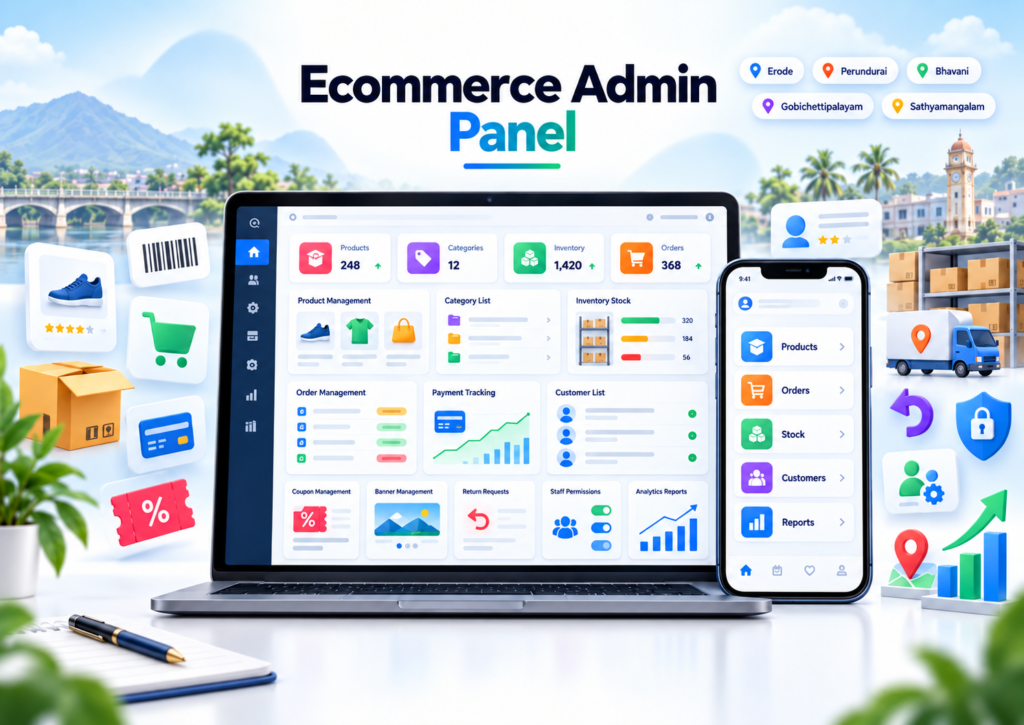
A custom ecommerce admin panel can include:
- Dashboard
- Product management
- Categories and collections
- Product variants
- Inventory management
- Order management
- Customer management
- Payment-status tracking
- Shipping and dispatch
- Returns and exchanges
- Refund tracking
- Coupons and offers
- Banner/content management
- SEO settings
- Staff accounts
- Role-based permissions
- Audit logs
- Reports and analytics
The exact admin-panel structure should depend on the ecommerce business model instead of forcing every online store to use the same workflow.
Custom Admin Panel for Ecommerce Websites in Erode: Service Overview
| Detail | Information |
|---|---|
| Service | Custom Ecommerce Admin Panel Development |
| Company | Greap Technologies |
| Location | Erode, Tamil Nadu |
| Main Audience | Ecommerce stores, D2C brands, retailers, wholesalers and product businesses |
| Main Goal | Manage ecommerce operations from one secure backend |
| Core Modules | Products, inventory, orders, customers, payments, shipping, returns, content and reports |
| Best For | Textile, fashion, grocery, jewellery, electronics, home textiles, furniture, gifts and wholesale ecommerce |
| Service Area | Erode District and nearby areas |
Why Ecommerce Businesses in Erode Need a Custom Admin Panel
A customer may only see the storefront, but the business team works inside the backend every day.
Without a well-planned admin panel, businesses may face:
- Difficult product uploads
- Slow price updates
- Incorrect variant stock
- Stock mismatch
- Confusing order statuses
- Payment-status errors
- Unstructured returns
- No refund visibility
- Limited customer history
- No staff accountability
- No SEO controls
- Dependency on developers for basic updates
- Limited reporting
A custom admin panel gives authorized teams direct control over the ecommerce operations they handle every day.
What Types of Ecommerce Businesses Need Custom Admin Panels?
1. Textile Ecommerce Websites
Textile businesses can manage sarees, fabrics, garments, dress materials, designs, colours, sizes, stock and customer orders.
2. Fashion and Clothing Brands
Fashion brands can manage:
- Sizes
- Colours
- Collections
- Size charts
- New arrivals
- Returns and exchanges
3. Grocery Ecommerce Businesses
Grocery businesses can manage product availability, changing prices, offers, stock, orders and delivery-related information.
4. Jewellery Ecommerce Websites
Jewellery businesses can manage product collections, images, specifications, enquiry-based products, pricing visibility and order requests according to their business model.
5. Electronics Stores
Electronics ecommerce businesses can manage models, specifications, serial-related information where required, stock, warranty information and orders.
6. Home Textile Businesses
Home textile brands can manage bedsheets, curtains, towels, pillow covers, dimensions, colours and stock variants.
7. Furniture Ecommerce Businesses
Furniture companies can manage product dimensions, variations, custom-order enquiries, delivery scheduling and payment status.
8. Gift and Home Décor Brands
Gift brands can manage personalized products, order notes, packaging status, product images and dispatch.
9. Wholesale Ecommerce Businesses
Wholesale businesses can add:
- Bulk order management
- Dealer pricing
- Customer groups
- Quotation workflows
- Dispatch tracking
10. D2C Brands
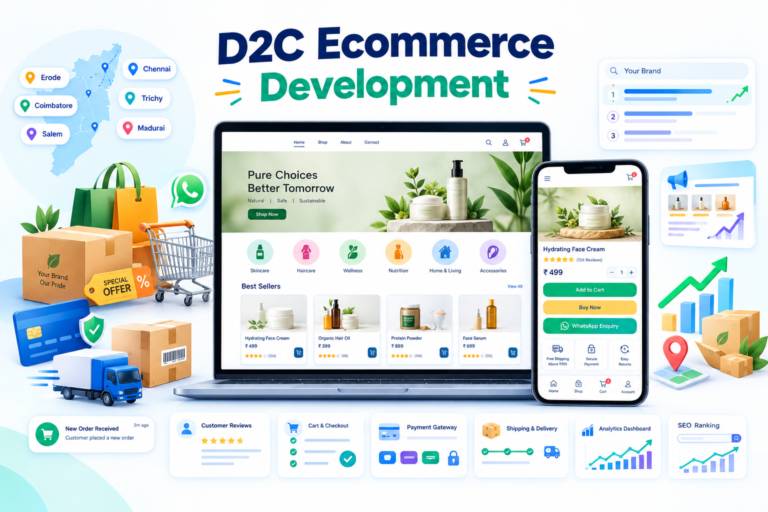
D2C brands can control product launches, homepage banners, promotional offers, order processing, returns and sales analytics.
Benefits of Custom Ecommerce Admin Panel Development
1. Easier Product Management
Authorized staff can add or update:
- Product name
- SKU
- Category
- Images
- Description
- Price
- Offer price
- Variants
- Stock
- Visibility
- SEO fields
2. Better Inventory Control
The admin panel can maintain:
- Available stock
- Reserved stock
- Sold stock
- Returned stock
- Damaged stock
- Variant-wise stock
- Low-stock alerts
- Stock adjustments
3. Faster Order Processing
A structured order workflow can be:
New Order → Payment Check → Confirmed → Picking → Packed → Ready to Ship → Shipped → Delivered → Closed
Exception stages can include:
- Payment failed
- Cancelled
- Delivery failed
- Return requested
- Returned
- Refund pending
- Refunded
4. Better Customer Management
Customer profiles can help authorized support staff review order history, returns and relevant account information.
5. Better Website Content Control
Business teams can update banners, featured products, offers and selected content without requesting a developer for every small change.
6. Better Staff Accountability
Role-based access and activity history can show which staff member performed important backend actions.
7. Better Reports
Owners can review sales, order, stock, customer and product reports from one dashboard.
Important Modules in a Custom Ecommerce Admin Panel
1. Admin Dashboard
A dashboard can show:
- Today’s orders
- Today’s sales
- Pending orders
- Orders ready to ship
- Low-stock products
- Cancelled orders
- Returns
- Payment summary
- Top-selling products
- Sales trends
2. Product Management Module
Product management can include:
- Add product
- Edit product
- Disable product
- SKU
- Images/gallery
- Pricing
- Offer pricing
- Stock
- Variants
- Product status
- SEO fields
For most businesses, disabling or archiving a product is safer than permanently deleting historical products connected to old orders.
3. Category and Collection Management
This module can manage:
- Categories
- Subcategories
- Collections
- Featured collections
- Navigation visibility
- Images
- SEO metadata
4. Product Variant Management
Depending on business type, variants may include:
- Size
- Colour
- Material
- Weight
- Flavour
- Model
- Pack size
Each valid variant can maintain its own SKU, stock quantity and price where required.
5. Inventory Management
A stronger inventory module can distinguish between:
- Physical stock
- Available-to-sell stock
- Reserved stock
- Returned stock
- Damaged stock
Stock rules should clearly define when inventory is reserved, released or restored during order cancellation, payment failure and returns.
6. Order Management
Order records can include:
- Order number
- Customer
- Products
- Quantity
- Order value
- Payment status
- Fulfilment status
- Shipping address
- Courier details
- Tracking reference
- Order notes
- Status history
7. Payment Status Module
Payment statuses can include:
- Pending
- Paid
- Failed
- Cash on Delivery
- Partially paid where applicable
- Refund pending
- Partially refunded
- Refunded
Payment success should be verified through the payment provider’s supported server-side API or webhook rather than relying only on the customer’s browser redirect.
8. Shipping and Dispatch Module
This module can include:
- Packing status
- Courier/provider
- Tracking number
- Shipping label
- Dispatch date
- Delivery status
- Failed delivery
- RTO status where applicable
9. Return and Exchange Management
A return workflow can be:
Return Request → Review → Approved / Rejected → Pickup / Return Shipment → Product Received → Quality Check → Refund / Exchange → Closed
The business’s published return policy should match the workflow implemented in the admin panel.
10. Refund Tracking
Refund records can include:
- Refund reason
- Amount
- Payment reference
- Initiated date
- Status
- Processed by
11. Customer Management
Authorized users can review:
- Customer profile
- Order history
- Addresses
- Returns
- Payment-related order status
- Support notes
12. Coupon and Offer Management
Coupon rules can include:
- Percentage discount
- Flat discount
- Minimum order value
- Start/end dates
- Product/category restrictions
- Usage limits
- Customer eligibility
13. Banner and Content Management
Businesses can manage:
- Homepage banners
- Collection banners
- Announcement bar
- Promotional sections
- Featured products
- FAQs
14. SEO Management
Admin users can control fields such as:
- SEO title
- Meta description
- URL slug
- Canonical settings where required
- Image ALT text
- Indexing/status controls where appropriate
15. Staff and Role Management
Typical roles can include:
- Super Admin
- Store Manager
- Product Manager
- Order Processing Staff
- Inventory Staff
- Customer Support
- Marketing User
- Report-Only User
Role-Based Permissions for Ecommerce Admin Panels
Not every employee should receive full administrative access.
| User | Example Access |
|---|---|
| Owner / Super Admin | Full business settings and reports |
| Product Team | Products, categories, images and pricing |
| Inventory Team | Stock and inventory adjustments |
| Order Team | Orders, packing and shipping |
| Customer Support | Orders, customers, returns and support notes |
| Marketing Team | Banners, coupons and approved content/SEO fields |
| Reports User | Read-only reports |
Permissions should also be enforced through backend authorization rather than relying only on hidden menu items.
Audit Logs and Activity History
Important ecommerce admin actions can maintain an audit trail.
Examples include:
- Product price changed
- Stock adjusted
- Order status changed
- Refund initiated
- Coupon created
- User permission changed
- Content updated
A useful activity record can include the user, action, record, old value, new value and timestamp where appropriate.
Recommended Ecommerce Admin Workflow
A general ecommerce workflow can be:
Product Created → Product Published → Stock Available → Customer Order → Payment Verification → Inventory Reserved → Picking → Packing → Shipping → Delivered → Closed
Cancellation Workflow
Order → Cancellation Request → Eligibility Check → Cancelled → Reserved Stock Released → Refund if Applicable
Return Workflow
Delivered → Return Request → Review → Return Received → Condition Check → Stock Decision → Refund / Exchange → Closed
Returned products should not automatically be added back to sellable stock until their condition has been verified where this matters to the business.
Best Admin Panel Structure for Ecommerce Websites
A general ecommerce admin panel can include:
- Dashboard
- Products
- Categories
- Collections
- Inventory
- Orders
- Customers
- Payments
- Shipping
- Returns
- Refunds
- Coupons
- Banners
- Content
- SEO
- Staff
- Reports
- Settings
For Textile Ecommerce
- Products
- Design / Style
- Size / Colour Variants
- Stock
- Orders
- Returns / Exchanges
- Reports
For Grocery Ecommerce
- Products
- Daily Pricing
- Stock
- Orders
- Delivery Slots
- Offers
- Reports
For Wholesale Ecommerce
- Product Catalogue
- Customer Groups
- Dealer Pricing
- Bulk Orders
- Quotation Requests
- Dispatch
- Payments
Custom Admin Panel vs Ecommerce Website
| Feature | Ecommerce Website | Custom Admin Panel |
|---|---|---|
| Main User | Customers | Business staff |
| Main Purpose | Browse and buy products | Manage store operations |
| Products | Displays products | Creates and controls products |
| Inventory | Shows availability | Manages stock rules and quantities |
| Orders | Customers place orders | Staff processes orders |
| Payments | Customer completes payment | Staff views payment status |
| Reports | Not customer-facing | Management reporting |
Custom Ecommerce Admin Panel vs CMS
| Feature | CMS | Custom Ecommerce Admin Panel |
|---|---|---|
| Main Purpose | Manage content | Manage ecommerce operations |
| Pages / Blogs | Strong focus | Can be included |
| Products | Depends on platform/plugins | Can use custom product logic |
| Orders | Depends on ecommerce module | Custom order workflow |
| Inventory | Platform dependent | Custom inventory rules |
| Permissions | General roles | Workflow-specific roles |
| Reports | Content/platform dependent | Custom ecommerce reports |
Custom Admin Panel vs Order Management Software
| Feature | Ecommerce Admin Panel | Order Management Software |
|---|---|---|
| Products | Strong focus | Usually connected |
| Website Content | Can be included | Usually not core |
| Orders | Included | Strong focus |
| Packing / Shipping | Can be included | Strong focus |
| Returns | Can be included | Strong focus |
| Inventory | Can be core | Can be connected |
| SEO Controls | Can be included | Usually not relevant |
For many custom ecommerce projects, order management can be developed as one module inside the overall admin panel.
Admin Panel Security for Ecommerce Websites
An ecommerce backend can contain customer records, order details, pricing, payment references and business data. Security should be considered from the beginning.
Depending on project scope, controls can include:
- HTTPS
- Secure password hashing
- Multi-factor authentication where appropriate
- Role-based authorization
- Login rate limiting
- Session management
- Audit logs
- Secure file uploads
- Input validation
- Restricted exports
- Database backups
- Access removal for former staff
Payment-card details should generally not be stored directly in the ecommerce admin panel unless the implementation is specifically designed to meet the relevant payment-security requirements. Using established payment providers can reduce unnecessary exposure to sensitive card data.
SEO Controls Inside an Ecommerce Admin Panel
SEO management can be built directly into product and category forms.
Useful fields include:
- Page title
- Meta description
- URL slug
- Image ALT text
- Canonical URL where necessary
- Indexing control where appropriate
- Product status
For ecommerce SEO support, explore SEO Services.
Custom Admin Panel Integrations
Custom admin panel for ecommerce websites in Erode becomes more useful when connected with relevant business tools.
Possible integrations include:
- Ecommerce storefront
- Payment gateway
- Courier/shipping service
- Inventory systems
- Order management systems
- CRM software
- Customer portal
- Accounting software
- WhatsApp communication
- Email notifications
- Analytics tools
- Advertising conversion tracking
- Product feeds
- Mobile applications
Integration capability depends on the APIs, permissions and technical support available from each external provider.
Explore API Integration Services for custom integration requirements.
Advanced Features for Ecommerce Admin Panels
- Multi-warehouse inventory
- Branch-wise stock
- Multi-vendor workflows
- Dealer pricing
- Customer group pricing
- Bulk product import
- Bulk price updates
- Bulk stock updates
- CSV / spreadsheet import and export
- Abandoned checkout tracking
- Shipping label generation
- Invoice PDF generation
- Return workflows
- Refund workflows
- Loyalty points
- Customer wallet, where appropriate
- Review moderation
- Content management
- Advanced SEO fields
- Audit logs
- Notification management
- Analytics dashboard
- Mobile admin access
Advanced functionality should be added based on genuine business requirements, order volume and operational complexity.
Custom Ecommerce Admin Panel Development Process
Step 1: Requirement Analysis
Important questions include:
- What products do you sell?
- How many products are expected?
- Do products have variants?
- How is stock managed?
- When should stock be reserved?
- Do you accept COD?
- Do you handle returns and exchanges?
- Which staff roles are required?
- Do you need coupons and offers?
- Do you need SEO fields?
- Which reports are important?
Step 2: Ecommerce Workflow Planning
Plan:
Product → Stock → Order → Payment → Fulfilment → Delivery → Return / Refund → Reporting
Step 3: Product and Variant Planning
Define category structure, SKUs, variants, prices and stock rules before building product forms.
Step 4: Roles and Permissions
Define what each team can view, create, edit, approve or export.
Step 5: UI/UX Design
Frequently used screens such as product upload, stock update and order processing should remain easy to use.
Step 6: Admin Panel Development
Development can include:
- Login
- Dashboard
- Products
- Inventory
- Orders
- Customers
- Payments
- Returns
- Offers
- Content
- Reports
Step 7: Ecommerce Website Integration
Updates made in the admin panel should synchronize correctly with the customer-facing website.
Step 8: Integration Testing
Test supported payment, shipping, notification and analytics integrations.
Step 9: Security and Permission Testing
Verify that users cannot access unauthorized pages, APIs or data simply by changing URLs or request parameters.
Step 10: Training and Launch
Business users should understand products, orders, returns, stock and permissions before production launch.
Ecommerce Admin Panel Features Checklist
| Feature | Recommendation |
|---|---|
| Secure Admin Login | Required |
| Dashboard | Required |
| Product Management | Required |
| Category Management | Required |
| Product Images | Required |
| Product Variants | Based on business type |
| Inventory Management | Required |
| Order Management | Required |
| Payment Status | Required |
| Shipping / Dispatch | Recommended |
| Customer Management | Recommended |
| Returns / Exchanges | Recommended |
| Refund Tracking | Recommended |
| Coupon Management | Recommended |
| Banner Management | Recommended |
| SEO Fields | Recommended |
| Staff Login | Required for multi-user teams |
| Role-Based Access | Recommended |
| Audit Logs | Recommended |
| Reports | Required |
| Mobile Responsive Design | Required |
| Ecommerce Integration | Required |
| External API Integration | Based on requirement |
Common Ecommerce Admin Panel Mistakes to Avoid
1. Building the Storefront Without Planning the Backend
The customer-facing website and admin workflow should be planned together.
2. Poor Product Variant Structure
Incorrect variant architecture can create stock, pricing and SKU problems later.
3. No Clear Inventory Rules
The system should define exactly when stock is reserved, released and restored.
4. No Order Status History
Important fulfilment changes should be traceable.
5. Giving Every Staff Member Full Access
Access should match responsibilities.
6. No Return and Refund Workflow
Returns should connect correctly with orders, payments and stock.
7. Permanently Deleting Important Historical Records
Archiving or deactivating records is often safer when records are connected to past transactions.
8. No Audit Logs
Critical changes such as price, stock and refund actions should be traceable where appropriate.
9. No SEO Controls
Product and category pages should provide manageable metadata where SEO is important.
10. No Scalability Planning
Future requirements such as warehouses, mobile apps, CRM and additional order channels should be considered during architecture planning.
Erode District Ecommerce Admin Panel Development
Greap Technologies supports ecommerce businesses across:
Erode, Perundurai, Bhavani, Anthiyur, Gobichettipalayam, Sathyamangalam, Modakkurichi, Kodumudi, Nambiyur, Thalavadi, Chennimalai, Kavindapadi, Ammapettai, Arachalur, Sivagiri, Punjai Puliampatti, Solar, Surampatti, Veerappanchatram, Nasiyanur and nearby areas.
Location-specific SEO pages should only be created for genuine service areas and should contain unique ecommerce information rather than repeating identical pages with only location-name changes.
How Greap Technologies Helps with Custom Ecommerce Admin Panels
Greap Technologies can build ecommerce admin panels around the actual product, stock and order workflow of the business.
Our development services can include:
- Requirement analysis
- Ecommerce workflow planning
- UI/UX design
- Secure admin authentication
- Dashboard development
- Product management
- Category and collection management
- Variant management
- Inventory management
- Order management
- Payment-status tracking
- Shipping management
- Returns and exchanges
- Refund tracking
- Customer management
- Coupon and offer management
- Banner/content management
- SEO controls
- Role-based staff access
- Audit logs
- Reports and analytics
- API integrations
- Testing and training
- Maintenance support
Explore related Greap services:
- Ecommerce Development
- Custom Software Development
- Web Application Development
- API Integration Services
- Mobile App Development
- SEO Services
Why Choose Greap Technologies?
Ecommerce Workflow-Based Development
We can structure the backend around products, stock, orders, payments, shipping and returns.
Custom Admin Panel Development
The panel can match the exact business process instead of forcing the team into a generic backend structure.
Simple Staff-Friendly UI
Common tasks such as product upload, stock update and order processing can be designed for fast daily use.
Role-Based Security
Different staff users can receive different levels of access.
Scalable Architecture
The system can be designed to support future modules such as warehouses, mobile apps, CRM or advanced order management.
Complete Digital Support
Greap Technologies also provides ecommerce websites, custom software, CRM, order management systems, SEO and digital marketing support.
Conclusion
Custom admin panel for ecommerce websites in Erode can help online businesses manage products, categories, variants, inventory, orders, customers, payments, returns, content and reports through one centralized backend.
A practical ecommerce admin panel should make frequent operational tasks simple while maintaining clear permissions, accurate stock logic, structured order statuses, secure payment handling and useful management reports.
Businesses can begin with core product, inventory and order modules and later add customer portals, multi-warehouse management, mobile apps, CRM integrations and advanced analytics as needed.
Greap Technologies helps ecommerce businesses in Erode build custom admin panels based on their actual ecommerce workflow, product structure and operational requirements.
Need a Custom Admin Panel for Your Ecommerce Website in Erode?
Greap Technologies can help you build an ecommerce backend with products, variants, inventory, orders, payments, shipping, returns, SEO controls, staff access and reports.
Frequently Asked Questions
1. What is a custom admin panel for ecommerce websites?
A custom ecommerce admin panel is a secure backend dashboard that allows authorized business users to manage products, inventory, orders, customers, payments, offers, content and reports.
2. Why do ecommerce websites in Erode need a custom admin panel?
A custom admin panel can make daily product, inventory and order management easier while giving the business more control over its ecommerce workflow.
3. What features should an ecommerce admin panel include?
Important features can include product management, categories, variants, inventory, orders, payments, shipping, customers, returns, coupons, SEO controls, staff permissions and reports.
4. Can a custom admin panel manage product variants?
Yes. Variants such as size, colour, weight, material, pack size or model can have individual stock, SKU and pricing rules where required.
5. Can the admin panel manage ecommerce orders?
Yes. Orders can be managed through statuses such as new, confirmed, packed, shipped, delivered, cancelled, returned and refunded.
6. Can the admin panel manage inventory?
Yes. It can track available, reserved, sold, returned and damaged stock along with variant-level inventory and adjustments.
7. Can Greap Technologies build a custom ecommerce admin panel?
Yes. Greap Technologies can develop custom ecommerce admin panels based on product structure, inventory rules, order workflow, staff roles and reporting requirements.
8. Can the admin panel include SEO settings?
Yes. Product and category management can include SEO titles, meta descriptions, URL slugs and image ALT text where required.
9. Can an ecommerce admin panel work on mobile?
Yes. A responsive admin panel can allow authorized users to review suitable products, orders and reports from mobile devices.
10. Can the admin panel integrate with payment gateways and shipping providers?
Yes. Supported payment gateways, courier platforms and other business systems can be integrated where suitable APIs and permissions are available.