
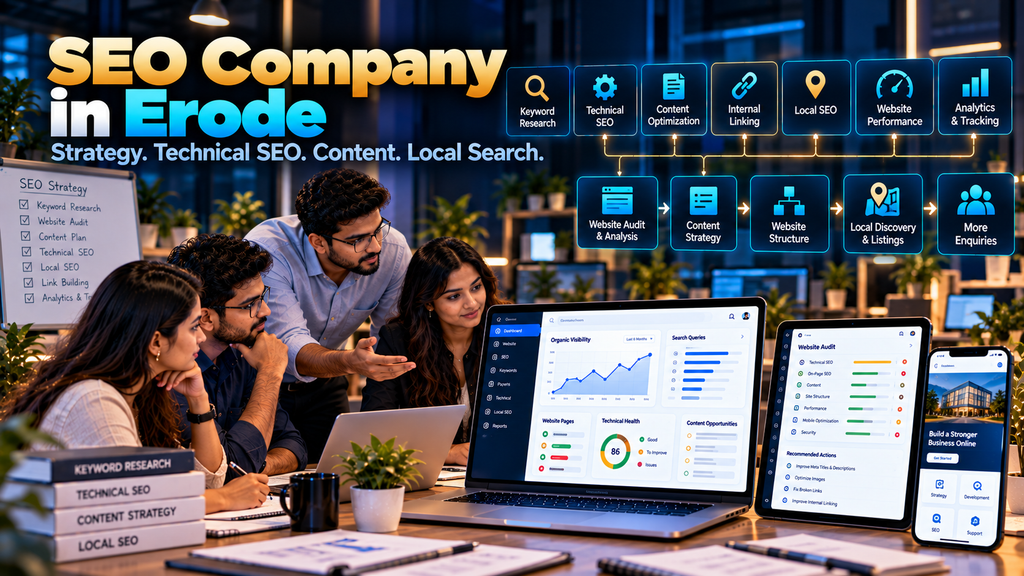
Choosing an SEO company in Erode can be confusing when many providers appear to promise the same result: better Google visibility, more website traffic and more enquiries.
But SEO is not simply about adding keywords to pages or publishing a few blogs every month.
A proper SEO strategy can involve website architecture, technical SEO, search-intent research, service-page optimization, content, internal linking, local search, website performance, measurement and continuous improvement.
More importantly, an SEO company should understand what your business actually wants to achieve before recommending a strategy.
A manufacturer targeting B2B buyers, a local service company targeting customers around Erode and an ecommerce store selling across India may all require different SEO approaches.
This guide explains what business owners should check before hiring an SEO company in Erode, what questions to ask, what warning signs to watch for and how to evaluate SEO pricing, reporting and long-term strategy.
At Greap Technologies, we provide SEO, website development, digital marketing, ecommerce and software solutions for businesses in Erode and nearby areas.
What Does an SEO Company Do?
An SEO company helps improve a website’s ability to be discovered for relevant organic searches while improving the technical and content foundations that support search visibility.
Depending on the website and scope, SEO services can include:
- SEO audits
- Keyword research
- Search-intent analysis
- Competitor research
- Website architecture
- On-page SEO
- Technical SEO
- Local SEO
- Content strategy
- Content optimization
- Internal linking
- Website performance improvements
- Structured data where appropriate
- Search performance analysis
- Conversion measurement
- Ongoing SEO monitoring
The exact work should depend on the website’s condition, business objectives and target market.
Before Hiring an SEO Company, Define Your Goal
Start by identifying what SEO is expected to support.
Possible objectives include:
- Generate relevant local enquiries
- Improve visibility for business services
- Reach B2B buyers
- Increase relevant ecommerce discovery
- Build visibility around specialist services
- Improve an existing website’s organic performance
- Reach additional geographic markets
“We want to rank on Google” is too broad to define an effective SEO strategy.
1. Check Whether the SEO Company Understands Your Business
Before recommending keywords, an SEO company should understand the business.
Useful questions include:
- What products or services do you provide?
- Which services are commercially important?
- Who are your customers?
- Are you B2B, B2C or both?
- Where are your customers located?
- What makes customers choose your business?
- How do enquiries become customers?
SEO should connect search behaviour with real business offerings.
2. Check Whether They Understand Your Target Customer
Keywords represent people searching for something.
An SEO company should consider:
- What problem is the customer trying to solve?
- What terminology does the customer use?
- Are they researching or ready to contact a provider?
- Are they looking locally?
- What information will help them make a decision?
3. Ask for an Initial Website Review
Before proposing extensive SEO work, the existing website should be reviewed.
Potential areas include:
- Website structure
- Service pages
- Technical issues
- Mobile usability
- Performance
- Existing content
- Internal links
- Indexing
- Conversion paths
An SEO strategy for a technically healthy website can differ significantly from one for a website with major structural problems.
4. Check Keyword Research Quality
Keyword research should go beyond producing a spreadsheet containing hundreds of search phrases.
Keywords should be evaluated according to:
- Relevance
- Search intent
- Service alignment
- Geographic intent
- Competition
- Appropriate page type
- Business value
A keyword with high search volume is not automatically the best keyword for your business.
5. Check Whether They Understand Search Intent
Search intent refers to what a user is trying to accomplish with a search.
For example:
“What is technical SEO?” suggests someone primarily looking for information.
“SEO company in Erode” can indicate someone comparing potential service providers.
“SEO services in Erode” can also have strong commercial intent.
Different intentions may require different page types.
6. Check How Keywords Are Mapped to Pages
A good SEO strategy should determine which existing or new page is the most appropriate destination for an important search topic.
For example:
- SEO services → SEO service page
- Website development → website-development page
- Technical SEO checklist → informational guide
- Google Maps SEO → specialized local SEO article
This helps avoid creating several pages that compete for nearly identical intent.
7. Check the On-Page SEO Process
On-page SEO can involve improving how a page communicates its subject and serves visitors.
Areas may include:
- Title
- Main heading
- Supporting headings
- Page copy
- Internal links
- Image context
- ALT attributes where appropriate
- URL structure
- Calls to action
- Structured data where appropriate
Optimization should remain natural and readable.
8. Avoid Keyword Stuffing
Repeatedly inserting the same phrase into every heading and paragraph is not a useful SEO strategy.
A strong page should cover the topic comprehensively using natural language, relevant terminology and clear structure.
9. Check Technical SEO Capability
Technical SEO can influence whether search engines can properly access and understand appropriate website pages.
An SEO company should be able to investigate relevant areas such as:
- Crawling
- Indexing
- XML sitemaps
- Robots directives
- Canonical URLs
- Redirects
- Broken links
- Duplicate URLs
- HTTPS
- Mobile usability
- Website performance
- Structured data
Read Technical SEO Checklist for Business Websites in Erode.
10. Check Crawlability
If important pages cannot be crawled appropriately, content improvements alone may not solve the problem.
Technical reviews should identify whether important URLs can be accessed as intended.
11. Check Indexability
Not every website URL necessarily belongs in search results.
The SEO team should understand which pages should be indexable and investigate unintended indexing or exclusion problems.
12. Check the XML Sitemap
An XML sitemap can help search engines discover important canonical URLs.
The sitemap should focus on URLs the business intends search engines to consider for indexing rather than automatically containing every generated URL.
13. Check Robots Directives
Robots-related configuration should be reviewed carefully.
Incorrect directives can interfere with how crawlers access or index website content.
14. Check Canonical URLs
Canonical signals can help communicate the preferred version of duplicate or substantially similar URLs.
An SEO company should check for incorrect or conflicting canonical configurations.
15. Check Redirects
Redirects can be necessary when URLs change.
A technical SEO review may identify:
- Broken redirects
- Redirect chains
- Incorrect destination URLs
- Old URLs that should redirect
16. Check Broken Links
Broken internal links can create poor user journeys and make website maintenance more difficult.
Important broken links should be identified and corrected appropriately.
17. Check Mobile Usability
Customers searching on mobile devices should be able to read content, navigate pages and complete important actions comfortably.
Review:
- Responsive layout
- Text readability
- Navigation
- Buttons and links
- Forms
- Tables
- Images
18. Check Website Speed
Website performance affects user experience and should be part of a broader technical review.
Optimization may involve:
- Image optimization
- Script review
- CSS optimization
- Caching where appropriate
- Hosting configuration
- Third-party resources
Read Website Speed Optimization Services in Erode.
19. Check Core Web Vitals
Core Web Vitals are measurements related to loading performance, responsiveness and visual stability.
They should be considered as part of the overall page experience rather than treated as a single magic SEO score.
Read Core Web Vitals Optimization for Business Websites in Erode.
20. Check Website Architecture
A clear website architecture can help users and search engines understand how services and information relate.
For example:
Home → Digital Marketing → SEO Services → Supporting SEO Guides
Important pages should not be unnecessarily buried deep within the website.
21. Check Internal Linking Strategy
Internal links help visitors discover related information and establish relationships between website pages.
For example, this SEO article can naturally connect to guides about:
- Technical SEO
- Local SEO
- Google Maps
- Reviews
- Citations
- Website speed
- Core Web Vitals
Internal links should be useful to readers rather than inserted randomly.
22. Check for Orphan Pages
An orphan page has few or no meaningful internal links pointing to it from the rest of the website.
Important pages should normally be integrated into a logical site structure.
23. Check Duplicate Content and URLs
Technical configurations can sometimes generate multiple URLs representing substantially similar content.
An SEO review should investigate relevant duplication and determine whether canonicalization, redirects, URL cleanup or other actions are appropriate.
24. Check Structured Data
Structured data can provide machine-readable information about eligible page content.
It should accurately represent what is visible on the page and use schema types appropriate to the content.
Structured data should not be treated as a guaranteed way to obtain enhanced search presentation.
25. Check Content Strategy
An SEO company should be able to explain why a particular piece of content needs to exist.
A content plan can address:
- Service intent
- Comparison searches
- Problem-based searches
- How-to questions
- Local searches
- Industry-specific questions
26. Check Whether Content Supports Services
Blog content should not exist separately from the commercial website.
A useful structure can look like:
Helpful Article → Relevant Service → Evidence / Information → Enquiry
This allows educational content to support users who later want to evaluate a service provider.
27. Check Content Quality
Useful SEO content should accurately answer the question promised by the title.
Look for:
- Clear structure
- Useful explanations
- Relevant examples
- Decision criteria
- Limitations
- Natural language
- Logical internal links
28. Longer Content Is Not Automatically Better
Article length should follow the information required to answer the topic properly.
A concise page that completely answers a narrow question can be more useful than a very long article filled with repetition.
29. Check Whether Content Is Reviewed Before Publishing
Business content should be reviewed for factual accuracy, service accuracy, brand consistency and inappropriate claims before publication.
This becomes especially important in industries involving technical, legal, financial, medical or other specialist information.
30. Check Local SEO Capability
If your customers are primarily in Erode or surrounding areas, ask how the company approaches local SEO.
Local SEO can involve:
- Website relevance
- Business information
- Local service content
- Business profile management
- Reviews
- Citations
- Local links and mentions where appropriate
31. Check Business Information Accuracy
Important business details should be accurate and consistent where customers rely on them.
This can include:
- Business name
- Address where applicable
- Phone
- Website
- Business hours
32. Check Google Maps and Local Search Strategy
Businesses serving local customers may need a strategy that considers both the website and local business presence.
Read Google Maps SEO for Service Businesses in Erode.
33. Check the Review Strategy
A legitimate review strategy should focus on genuine customer feedback.
Avoid:
- Fake reviews
- Purchased reviews
- Invented customer experiences
- Misleading review activity
Read How to Get More Google Reviews for Your Erode Business.
34. Check Citation Strategy
Local citations can help establish consistent business information across relevant online sources.
Quality and accuracy are more important than creating large numbers of low-value listings.
Read Local Citation Building for Erode Businesses: Complete Guide.
35. Avoid Fake Local Locations
A business should represent genuine locations and service coverage accurately.
Creating misleading addresses or pretending to operate offices where the business has no legitimate presence can create customer and platform problems.
36. Avoid Duplicate Location Pages
If your company serves several nearby towns, do not simply duplicate one page and replace “Erode” with “Bhavani”, “Perundurai” or another town.
Create separate location pages only when they provide meaningful, location-specific value.
37. Check Link-Building Practices
Ask the SEO company to explain how it approaches links and online authority.
Avoid treating backlink quantity as the primary objective.
Relevant editorial mentions, partnerships, useful resources, genuine business citations and other legitimate visibility can be more meaningful than large batches of unrelated links.
38. Be Careful With Cheap Backlink Packages
Offers promising hundreds or thousands of backlinks for a small fixed amount should be evaluated carefully.
Large link counts do not automatically represent meaningful authority.
39. Ask Where Links Come From
You do not necessarily need a list of every future website before work begins, but the agency should be able to explain its general approach.
Ask whether the strategy involves:
- Relevant industry resources
- Business citations
- Digital PR
- Partnership opportunities
- Useful content assets
- Other legitimate outreach
40. Avoid Private or Hidden Link Schemes
Be cautious when an SEO provider refuses to explain its link-building methods while promising large ranking improvements.
You should understand the general type of activity being performed on behalf of your business.
41. Check Competitor Research
Competitor research can help identify:
- Search topics
- Website structure
- Content gaps
- Service positioning
- Local visibility opportunities
The objective should be learning about the search landscape rather than copying competitors.
42. Check Whether Competitors Are Actually Relevant
The business ranking for a keyword is not automatically your real commercial competitor.
An SEO company should distinguish between:
- Search competitors
- Local competitors
- Direct business competitors
- Large informational websites
43. Check SEO Measurement
An SEO campaign should have a defined measurement approach.
Depending on the business, this can include:
- Organic search traffic
- Relevant search queries
- Organic landing pages
- Conversions
- Local enquiries
- Technical issues
- Content performance
44. Rankings Should Not Be the Only KPI
Keyword positions can be useful for understanding visibility, but they should not be the only measure of SEO success.
A business ultimately needs relevant users to discover useful pages and take appropriate next actions.
45. Track Organic Conversions
Where technically possible and appropriate, businesses can measure important actions originating from organic search.
Examples include:
- Contact forms
- Calls
- Relevant messaging enquiries
- Bookings
- Purchases
46. Connect SEO Leads With Sales Feedback
For lead-generation businesses, SEO measurement becomes more useful when marketing receives appropriate feedback about enquiry quality.
A possible workflow is:
Organic Search → Website → Enquiry → CRM → Sales Follow-Up → Outcome
Read WhatsApp CRM and Lead Follow-Up Software for Businesses in Erode.
47. Check Analytics Configuration
Analytics should help answer meaningful questions rather than simply collect data.
Before relying on reports, important events and conversion tracking should be tested.
48. Check Search Performance Tools
Search-performance data can help identify:
- Queries
- Pages receiving search visibility
- Clicks
- Impressions
- Indexing issues
- Other search-related information
The agency should interpret this information rather than simply forwarding screenshots.
49. Ask What Will Be Included in the SEO Report
A useful report may include:
- Work completed
- Technical issues addressed
- Search performance
- Organic landing pages
- Content progress
- Relevant conversions
- Problems identified
- Recommended next actions
50. Avoid Reports Filled Only With Numbers
A report should help the business understand what happened and what should happen next.
Large tables without explanation can make reporting look detailed while providing little decision-making value.
51. Ask Who Will Work on Your SEO
Depending on the project, SEO may involve people working across:
- SEO strategy
- Technical SEO
- Content
- Development
- Analytics
- Local SEO
Ask who is responsible for each part of the engagement.
52. Check Development Capability
Some SEO recommendations require website changes.
Examples include:
- Template changes
- Navigation changes
- Performance improvements
- Structured data
- Redirects
- Technical fixes
- New landing pages
Ask whether the SEO company can implement technical recommendations or whether another developer will be required.
53. SEO and Website Development Should Work Together
SEO should ideally be considered while developing or redesigning a website rather than added only after launch.
Website architecture, URLs, content, mobile layouts, speed and internal linking can all affect the SEO foundation.
Explore Website Development Services.
54. Ask About SEO During a Website Redesign
Website redesigns can affect existing search visibility if important URLs and content are changed without planning.
SEO considerations can include:
- Existing valuable URLs
- Redirect mapping
- Page content
- Metadata
- Internal links
- Canonical URLs
- Sitemaps
- Post-launch checks
55. Check Ecommerce SEO Capability
Ecommerce SEO can involve additional considerations such as:
- Category pages
- Product pages
- Product variants
- Filters
- Faceted navigation
- Out-of-stock products
- Internal search
- Structured product information
- Performance
Explore Ecommerce Development Services.
56. Check B2B SEO Capability
B2B SEO may target lower-volume but commercially important searches.
For example, a manufacturer may need visibility around:
- Specific products
- Manufacturing capabilities
- Industries served
- Technical requirements
- Wholesale supply
- Dealer opportunities
SEO strategy should not automatically prioritize volume over relevance.
57. Check SEO for Local Service Businesses
A local service business may require a combination of:
Service Pages + Local SEO + Business Profile + Reviews + Useful Local Content + Conversion Tracking
The exact combination depends on the business.
58. Ask About AI and Search
Search experiences continue to evolve, including AI-assisted ways of presenting and discovering information.
Businesses should still focus on fundamentals such as:
- Clear website structure
- Accurate information
- Useful content
- Strong service pages
- Descriptive headings
- Relevant internal links
- Accessible crawlable content
- Appropriate structured data
Be cautious of anyone claiming they can guarantee placement in AI-generated answers.
59. Ask About Account Ownership
Your business should understand who controls important digital assets.
These can include:
- Domain
- Website
- Analytics
- Search-performance tools
- Business profiles
- Other marketing accounts
Access arrangements should be clear before work begins.
60. Ask About Content Ownership
Clarify ownership and usage rights for content created during the engagement.
This may include:
- Blog articles
- Service-page content
- Graphics
- Landing pages
- Other SEO assets
Third-party licensed assets may have separate terms.
61. Ask About Communication
SEO is ongoing work, so communication matters.
Clarify:
- Primary contact
- Update frequency
- Approval process
- Reporting frequency
- How technical issues are discussed
- How content is reviewed
62. Ask What Happens in the First Month
Initial SEO work can vary depending on the website.
It may involve:
- Business discovery
- Website audit
- Technical review
- Keyword research
- Competitor research
- Analytics review
- Page mapping
- Content planning
- Priority fixes
The company should be able to explain its priorities.
63. How Much Do SEO Services Cost in Erode?
There is no single SEO price suitable for every business.
Cost can depend on:
- Website size
- Technical condition
- Number of services
- Target locations
- Market competition
- Content requirements
- Local SEO scope
- Ecommerce complexity
- Development requirements
- Reporting and analysis
A small local service website and a large ecommerce website require different levels of work.
64. Why SEO Quotations Differ
Two proposals labelled “SEO services” can contain very different work.
One might include basic page optimization, while another may include:
- Technical audits
- Technical implementation
- Keyword research
- Content strategy
- Content production
- Local SEO
- Website improvements
- Reporting
Compare the actual scope before comparing prices.
65. Cheap SEO vs Expensive SEO
Price alone does not establish SEO quality.
A low-cost service is not automatically poor, and a higher-priced service is not automatically better.
Evaluate:
- Scope
- Strategy
- Technical capability
- Content quality
- Implementation
- Transparency
- Reporting
66. Monthly SEO vs One-Time SEO
Some SEO tasks can be performed as projects, such as a technical audit or migration review.
Other SEO activities may require ongoing work, including:
- Content development
- Technical monitoring
- Search analysis
- Local SEO
- Website improvements
The appropriate model depends on the business objective.
67. How Long Does SEO Take?
There is no universal timeline for SEO results.
Progress depends on factors including:
- Website history
- Technical condition
- Competition
- Content quality
- Search intent
- Market conditions
- Implementation speed
An agency can explain planned work and measurement, but it should be cautious about guaranteeing a specific ranking by a specific date.
68. SEO Is Not a One-Time Ranking Switch
Search visibility can change as websites, competitors, search systems and customer behaviour change.
SEO should therefore be treated as an ongoing process of improving and maintaining the website where continued organic growth is important to the business.
69. Be Careful With Guaranteed #1 Rankings
A specific first-position organic ranking cannot reasonably be guaranteed by an SEO company.
The agency does not control the search engine’s ranking systems or competitors.
Ask for a clear strategy rather than a guaranteed position.
70. Be Careful With “Rank in 7 Days” Claims
Some changes can be discovered or reflected relatively quickly, while other SEO work can take substantially longer.
An exact ranking deadline should not be presented as certain.
71. Be Careful With Guaranteed Traffic
SEO traffic depends on search demand, rankings, click behaviour, seasonality and other factors.
Forecasts can help with planning but should not be presented as guaranteed traffic.
72. Be Careful With Guaranteed Leads
SEO can support lead generation, but lead volume depends on more than organic visibility.
The complete journey includes:
Search Demand → Visibility → Click → Website Experience → Offer → Enquiry → Sales Follow-Up
An SEO provider does not control every stage.
73. Be Careful With Secret SEO Methods
SEO can involve specialist knowledge, but your business should still understand the general work being performed.
“Our method is secret” should not be used to avoid explaining activities that affect your website or brand.
74. Be Careful With Massive Page Creation
Creating hundreds of pages does not automatically create useful search visibility.
Each indexable page should have a clear purpose and provide meaningful value.
75. Be Careful With Fake Case Studies
When reviewing results, look for enough context to understand what was actually achieved.
A screenshot without a timeframe, business context or explanation may not provide enough information to evaluate the work.
Questions to Ask an SEO Company Before Hiring
- How will you understand our business?
- How will you identify our target search audience?
- What will you audit first?
- How do you conduct keyword research?
- How do you map keywords to pages?
- What technical SEO work is included?
- Can you implement technical changes?
- How do you approach local SEO?
- How do you approach content?
- How do you build internal links?
- How do you approach external links?
- How will SEO performance be measured?
- What will reports contain?
- Who will work on our account?
- Who owns our accounts and content?
- What is included in the monthly fee?
- Which costs are separate?
- How will SEO connect with lead generation?
SEO Company Evaluation Checklist
| Area | What to Check |
|---|---|
| Business Understanding | Does the company understand your products, services and customers? |
| Keyword Strategy | Are relevance and intent considered? |
| Technical SEO | Can technical issues be identified and addressed? |
| Content | Is content designed to answer real customer questions? |
| Local SEO | Does the strategy accurately represent locations and service areas? |
| Links | Are link practices explainable and relevant? |
| Measurement | Are meaningful organic outcomes tracked? |
| Reporting | Do reports explain progress and next actions? |
| Transparency | Are methods, costs and responsibilities clear? |
| Expectations | Are promises realistic rather than guaranteed? |
Common Mistakes When Hiring an SEO Company
- Choosing only by the cheapest quotation
- Choosing based on guaranteed rankings
- Focusing only on keyword positions
- Ignoring technical SEO
- Ignoring website quality
- Publishing content without a strategy
- Buying large quantities of low-quality backlinks
- Creating repetitive location pages
- Ignoring local SEO
- Ignoring conversion tracking
- Not connecting leads with sales feedback
- Not clarifying account ownership
- Not reviewing reports
SEO Freelancer vs SEO Company
Both freelancers and companies can provide effective SEO services.
The appropriate choice depends on the project’s requirements.
Consider whether you need:
- SEO strategy
- Technical SEO
- Development
- Content
- Design
- Local SEO
- Analytics
- Ongoing support
Evaluate actual capability, communication and process rather than assuming one provider type is automatically better.
Local SEO Company vs Remote SEO Company
A local SEO company can be useful when a business values direct communication and local-market familiarity.
A remote SEO provider can also be effective when it has the required expertise and communication process.
Location should be considered alongside technical capability, strategy, transparency, content quality and reporting.
SEO for Businesses in Erode
Erode has businesses operating across manufacturing, textiles, retail, construction, professional services, education, healthcare, technology, distribution and other sectors.
The appropriate SEO strategy should reflect the individual company’s customers and market rather than relying on one standard SEO package for every business.
SEO for Manufacturers in Erode
Manufacturing businesses may need SEO around:
- Products
- Manufacturing capabilities
- Materials
- Industries served
- B2B supply
- Technical requirements
A manufacturer’s most valuable keywords may have lower search volume but stronger commercial relevance.
SEO for Local Service Businesses in Erode
Local service businesses may need to connect:
Service Page → Local Relevance → Business Profile → Reviews → Enquiry
Read How to Improve Google Rankings for a Local Business in Erode.
SEO for Ecommerce Businesses
Ecommerce SEO can involve:
- Category architecture
- Product pages
- Technical SEO
- Internal linking
- Content
- Performance
- Structured product information
SEO planning should work alongside the ecommerce platform and product catalogue.
SEO Services in Erode and Nearby Areas
Greap Technologies provides SEO and digital services for businesses in Erode and nearby areas including Perundurai, Bhavani, Gobichettipalayam, Sathyamangalam, Anthiyur, Chennimalai, Modakkurichi, Kavindapadi, Nambiyur, Kodumudi and surrounding locations.
Local SEO should reflect genuine business operations and service coverage rather than repeating location names unnecessarily.
Why Consider Greap Technologies for SEO in Erode?
Greap Technologies combines SEO with website development, software development and digital marketing capabilities.
Depending on your requirements, SEO work can involve:
- Website SEO audit
- Keyword research
- Search-intent analysis
- Competitor research
- On-page SEO
- Technical SEO
- Local SEO
- Content strategy
- Blog planning
- Internal linking
- Website performance
- Analytics
- Conversion tracking
- Website improvements
The appropriate strategy should be determined after reviewing the business, target customers, website and competitive search environment.
Explore SEO Services, Digital Marketing Services, Website Development Services and Greap Technologies.
Final Checklist Before Hiring an SEO Company in Erode
Before signing an SEO agreement, make sure you understand:
- Your SEO objective
- Your target audience
- Your priority products or services
- The website’s current condition
- The keyword strategy
- The technical SEO scope
- The content strategy
- The local SEO strategy
- The link-building approach
- The implementation process
- The reporting process
- The conversion measurement plan
- The monthly deliverables
- The costs
- The account and content ownership arrangements
- The communication process
Conclusion
Choosing an SEO company in Erode should not be based only on who promises the highest ranking, the largest number of backlinks or the cheapest monthly package.
A more useful SEO process connects the entire search journey:
Search Intent → Relevant Page → Useful Content → Good Website Experience → Enquiry → Sales Follow-Up → Measurement
Technical SEO helps create a stronger website foundation. Service pages help explain what your business provides. Useful content can answer customer questions. Local SEO can support businesses serving geographic markets. Measurement helps determine what is happening and where improvements may be required.
Before hiring an SEO company, evaluate its business understanding, technical capability, content strategy, local SEO approach, transparency, reporting and ability to set realistic expectations.
The goal is not simply to collect rankings. It is to build relevant organic visibility around the products, services and information that matter to your customers and business.
Looking for an SEO Company in Erode?
If your business wants to improve technical SEO, service-page visibility, local search, content strategy or organic lead generation, Greap Technologies can review your website and discuss an appropriate SEO approach.
Discuss Your SEO Requirements on WhatsApp
Frequently Asked Questions
1. What does an SEO company in Erode do?
An SEO company can help with website audits, keyword and search-intent research, on-page optimization, technical SEO, local SEO, content strategy, internal linking, website performance and organic-search measurement depending on the agreed scope.
2. How do I choose an SEO company in Erode?
Evaluate its understanding of your business, keyword strategy, technical SEO capability, content quality, local SEO approach, link practices, reporting, transparency and ability to set realistic expectations.
3. How much do SEO services cost in Erode?
SEO cost depends on website size, technical condition, competition, target locations, content requirements, local SEO scope, ecommerce complexity and the amount of implementation required. Compare the work included rather than the price alone.
4. How long does SEO take?
There is no universal timeline. Results depend on the website, competition, technical condition, content, search demand, implementation and other factors. An SEO company can explain its work plan but should avoid guaranteeing a specific ranking date.
5. Can an SEO company guarantee a #1 Google ranking?
A specific organic ranking should not be treated as guaranteed because an SEO provider does not control search ranking systems, competitors or every factor affecting search results.
6. What should an SEO report contain?
A useful report can include work completed, technical issues, search performance, important landing pages, content progress, relevant conversions, problems identified and planned next actions.
7. Is local SEO important for Erode businesses?
Local SEO can be particularly relevant for businesses serving customers within Erode and surrounding areas. The strategy should accurately reflect the business’s genuine location, service area and services.
8. Does SEO require website changes?
Sometimes. Technical fixes, content improvements, internal links, page structure, speed improvements and new service or landing pages may require website changes.
9. Are backlinks still part of SEO?
Links and online mentions can form part of a broader organic visibility strategy, but backlink quantity alone should not be the objective. Relevance, legitimacy and overall website quality matter.
10. Is SEO better than paid advertising?
They serve different purposes. SEO focuses on organic search visibility, while paid advertising uses media budget to reach selected searches or audiences. A business may use either or both depending on its goals.
11. Should SEO focus only on high-volume keywords?
No. Lower-volume searches can sometimes be highly relevant to a particular product, service or B2B requirement. Keyword decisions should consider intent and business relevance as well as search demand.
12. Does Greap Technologies provide SEO services in Erode?
Yes. Greap Technologies provides SEO, website development, digital marketing, ecommerce and related digital services for businesses in Erode and nearby areas.