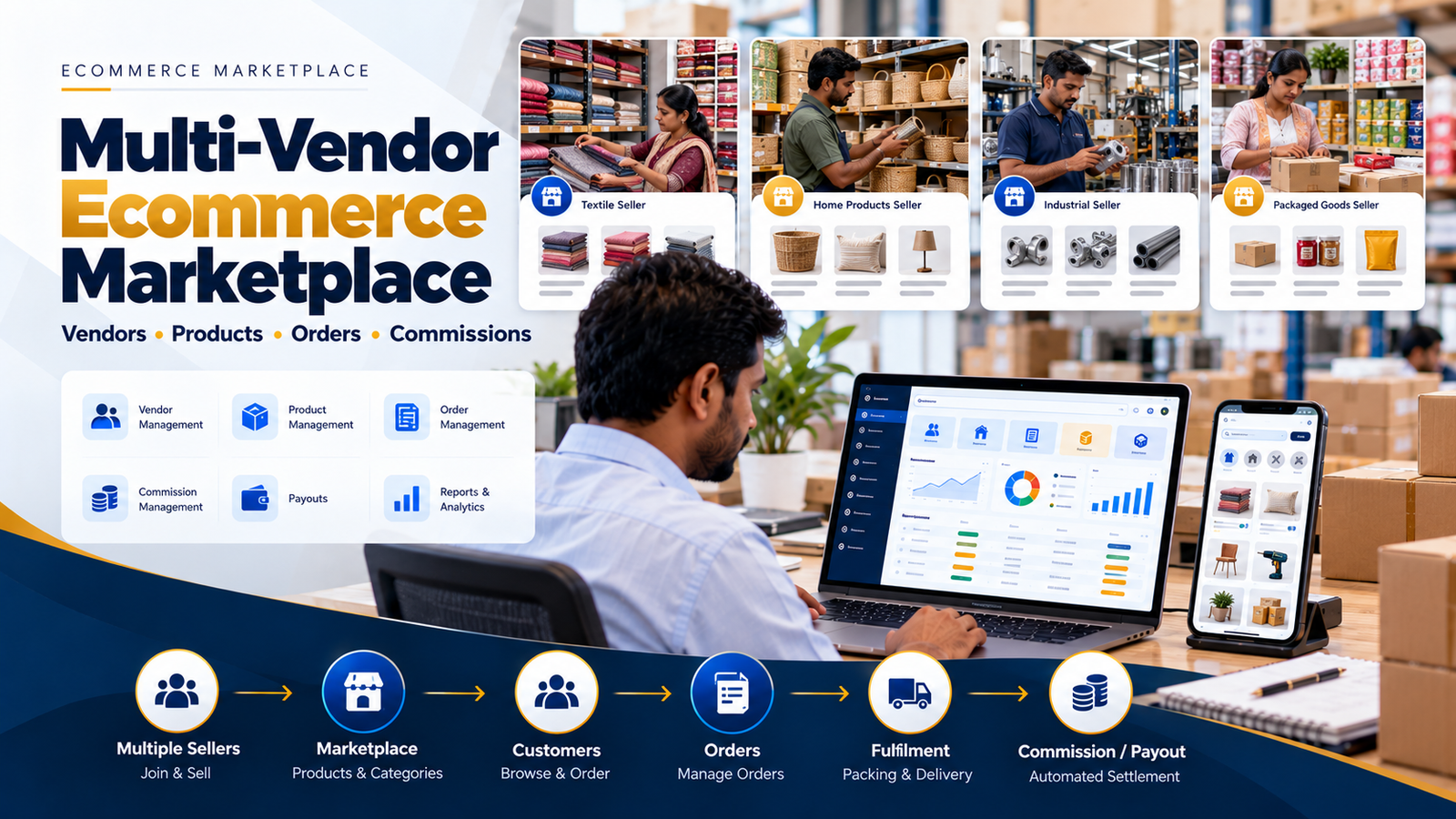
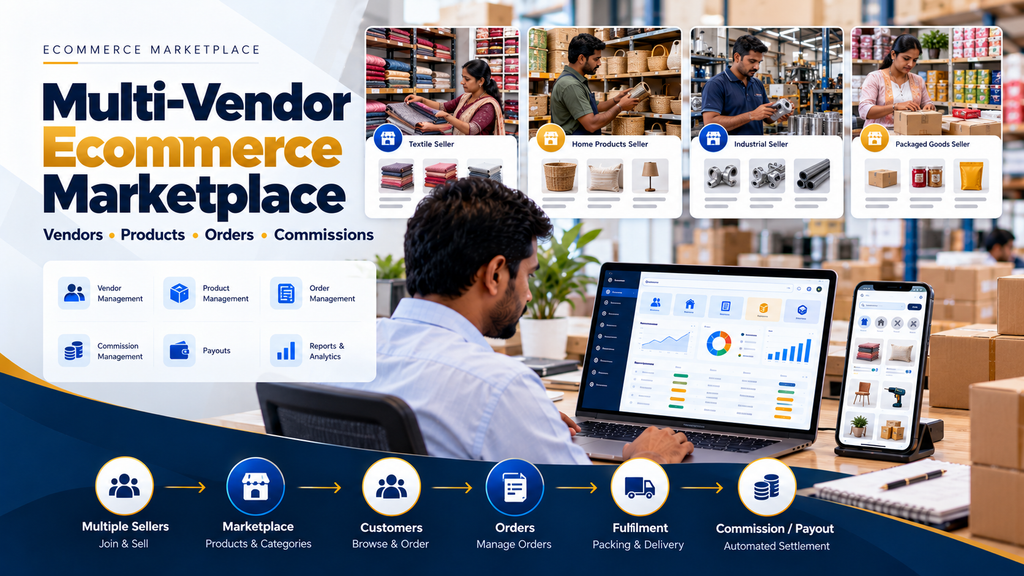
A traditional ecommerce website usually represents one business selling its own products. A multi-vendor marketplace introduces a more complex model: multiple independent sellers can list and sell products through one digital platform while the marketplace operator manages the overall ecosystem.
This makes multi-vendor ecommerce marketplace development in Erode significantly different from building a standard online store.
A marketplace may require vendor registration, seller approval, product moderation, commissions, marketplace orders, seller-specific fulfilment, returns, payouts, customer support, reporting and strong administrative controls.
Before development begins, the business should clearly define who sells, who collects payment, who fulfils orders, who handles returns and how sellers are paid. These decisions affect almost every part of the marketplace architecture.
At Greap Technologies, we develop custom ecommerce websites, B2B platforms and business software for companies in Erode and nearby areas.
What Is a Multi-Vendor Ecommerce Marketplace?
A multi-vendor ecommerce marketplace is a digital platform where multiple independent sellers can offer products or services to customers through a common marketplace.
The platform operator generally manages the marketplace infrastructure while vendors manage permitted parts of their own business activity.
A simplified structure is:
Marketplace Operator → Vendors → Products → Customers → Orders → Fulfilment → Settlement
How Is a Marketplace Different From a Normal Ecommerce Website?
| Standard Ecommerce | Multi-Vendor Marketplace |
|---|---|
| Usually one primary seller | Multiple independent sellers |
| One central product operation | Products can belong to different vendors |
| Orders generally belong to one business | One customer order may involve multiple sellers |
| Simple payment ownership | Marketplace payment and seller settlement can be more complex |
| Central fulfilment is common | Fulfilment may vary by seller |
| Single inventory source may be enough | Inventory may be seller-specific |
| Standard administration | Marketplace and vendor administration are required |
Who Can Build a Multi-Vendor Marketplace?
A marketplace model can potentially be used by businesses creating digital platforms for:
- Textile products
- Garments
- Industrial products
- Building materials
- Home products
- Agricultural products
- Business supplies
- Wholesale products
- Local manufacturers
- Dealer and distributor networks
- Specialized B2B industries
- Other clearly defined marketplace categories
The commercial, tax, seller and operational requirements should be evaluated for the specific marketplace model.
B2C vs B2B Multi-Vendor Marketplace
A marketplace can serve consumers, businesses or both.
B2B marketplaces may require additional features such as:
- Business accounts
- RFQs
- Bulk quantities
- Minimum order quantities
- Account pricing
- Purchase-order references
- Business approvals
- Wholesale order workflows
Typical Multi-Vendor Marketplace Workflow
A basic marketplace flow can look like:
Vendor Registration → Vendor Approval → Product Submission → Product Approval → Marketplace Listing → Customer Order → Vendor Fulfilment → Delivery → Settlement
The exact stages depend on the marketplace’s commercial and fulfilment model.
1. Marketplace Customer Website
The customer-facing website should provide a clear way to discover products from multiple sellers without exposing unnecessary operational complexity.
2. Responsive Marketplace Design
Customers and sellers may access the marketplace from desktops, tablets and mobile devices.
Important workflows should therefore be designed responsively.
3. Marketplace Homepage
The homepage can organize important categories, products, sellers or curated collections according to the marketplace model.
4. Product Categories
A centralized category structure helps prevent each seller from creating unrelated or duplicate category systems.
5. Category Governance
The marketplace operator should control the primary category taxonomy where consistency is important.
6. Marketplace Search
Customers should be able to search across approved products from multiple vendors.
7. Product Filters
Filters should use standardized product attributes where possible.
8. Vendor Registration
Prospective sellers can apply to join the marketplace through a structured registration process.
9. Vendor Application
The application can collect the business information genuinely required by the marketplace operator.
10. Vendor Approval
Registration does not necessarily need to create an active seller account immediately.
Marketplace administrators can review applications before granting seller access.
11. Vendor Terms
Seller onboarding should clearly communicate applicable marketplace rules, responsibilities and commercial terms.
Legal, tax and contractual requirements should be reviewed with appropriate qualified professionals.
12. Vendor Dashboard
Approved sellers can receive a secure dashboard containing the functions relevant to their marketplace activity.
13. Vendor Profile
Each approved seller can maintain permitted business and marketplace profile information.
14. Seller Permissions
Vendors should access only their own permitted information and functionality.
15. Strong Tenant Separation
A multi-vendor platform should be designed so one seller cannot access another seller’s private orders, customer information, commercial data or administrative functionality.
16. Product Submission
Vendors can submit products according to the marketplace’s catalogue structure.
17. Product Approval Workflow
The operator can review seller-submitted products before publishing them where moderation is required.
18. Product Rejection and Revision
Products that do not meet marketplace requirements can remain unpublished and be returned for appropriate correction.
19. Standardized Product Data
Marketplace product forms should encourage consistent product names, categories, units, specifications and other required information.
20. Product Images
Seller-uploaded images can follow marketplace standards for quality, format and representation.
21. Product Variants
Where relevant, sellers can define approved variants such as size, model, specification or another product-specific option.
22. Product SKU
Seller SKUs and marketplace-level identifiers should be planned carefully to prevent collisions between different vendors.
23. Duplicate Products
A marketplace should decide whether multiple sellers can sell against a shared product record or whether each vendor creates an independent listing.
This is an important architecture decision.
24. Shared Catalogue Model
In a shared-catalogue marketplace, the platform can maintain a central product definition while multiple approved sellers provide offers for that product.
25. Independent Listing Model
In other marketplaces, every seller listing can operate as an independent product record.
26. Marketplace Pricing
Pricing ownership should be clearly defined.
Depending on the business model, sellers may control prices, the marketplace may impose pricing rules, or pricing may be managed through another approved process.
27. Avoid Unclear Pricing Ownership
Allowing multiple systems or users to independently modify the same price without clear ownership can create inconsistencies.
28. B2B Pricing
B2B marketplaces may require account-specific, quantity-based or quotation-based pricing.
29. Request for Quotation
For products where fixed pricing is unsuitable, customers can potentially submit an RFQ.
30. Multi-Vendor RFQ
Some B2B marketplace models may route a requirement to appropriate approved sellers.
The exact routing and visibility rules should be carefully defined to protect customer and seller information.
31. Inventory Management
Each seller can maintain appropriate inventory information where inventory is seller-managed.
32. Inventory Source
The marketplace should determine whether stock is:
- Managed manually by sellers
- Maintained centrally
- Received through seller ERP integrations
- Managed through marketplace warehouses
- Handled through a hybrid model
33. Inventory Accuracy
Displaying inventory that is not synchronized with the seller’s actual fulfilment process can create order problems.
34. Marketplace Shopping Cart
A customer may add products from multiple sellers to the same marketplace cart.
35. Multi-Vendor Cart Architecture
Although customers may see one cart, the backend may need to organize items according to their respective sellers.
36. Marketplace Checkout
The checkout should clearly communicate relevant delivery, payment and seller information without making the customer manage unnecessary internal complexity.
37. Parent Order and Seller Orders
One useful architecture is to maintain a marketplace-level customer order and separate seller-specific fulfilment records underneath it.
For example:
Customer Order → Seller A Order + Seller B Order + Seller C Order
38. Why Order Splitting Matters
Different sellers may have different:
- Inventory
- Warehouses
- Processing times
- Shipping methods
- Dispatch dates
- Return workflows
39. Seller Order Dashboard
Each seller should see only the order lines or seller orders assigned to them.
40. Order Acceptance
If the marketplace model requires seller confirmation, orders can move through an appropriate acceptance workflow.
41. Avoid Unnecessary Seller Confirmation
If the marketplace already has reliable inventory and automated fulfilment rules, requiring sellers to manually approve every order may introduce unnecessary delays.
42. Order Status
Seller-specific status changes can feed into the overall marketplace order status.
43. Partial Fulfilment
A multi-vendor order may be fulfilled at different times because individual sellers operate independently.
44. Multiple Shipments
Customers should be able to understand when a marketplace order will arrive through multiple shipments.
45. Seller-Managed Fulfilment
In one model, each vendor stores, packs and dispatches its own products.
46. Marketplace-Managed Fulfilment
In another model, sellers supply inventory to marketplace-operated fulfilment facilities.
47. Hybrid Fulfilment
Some marketplaces may support both seller-managed and marketplace-managed fulfilment.
48. Warehouse Integration
Marketplace-managed inventory can potentially connect with warehouse software.
Read Warehouse Management Software Development in Erode.
49. Picking and Packing
Where the marketplace operates fulfilment, seller and product ownership should remain traceable through picking and packing workflows.
50. Shipping Integration
Marketplace shipping can connect with supported logistics providers or internal transport workflows depending on requirements.
51. Transport and Logistics Integration
Businesses operating their own distribution workflows can potentially connect the marketplace with logistics-management software.
Read Transport and Logistics Management Software Development in Erode.
52. Customer Order Tracking
Customers can access appropriate tracking information for each shipment associated with their marketplace order.
53. Payment Gateway Integration
A marketplace can integrate supported payment providers according to the business model and provider capabilities.
54. Marketplace Payments Are More Complex Than Standard Ecommerce
Collecting money from a customer is only one part of marketplace payment architecture.
The business must also determine how commissions, refunds, seller settlements, taxes and other applicable financial responsibilities are handled.
55. Commission Management
The marketplace can maintain commission rules according to its approved commercial model.
56. Commission Types
Depending on the business model, commission structures may vary by:
- Seller
- Product
- Category
- Order type
- Other approved commercial rules
57. Commission Calculation
Commission logic should be documented clearly and tested carefully because it affects seller settlements and marketplace financial records.
58. Seller Settlement
After applicable marketplace rules are applied, eligible seller amounts can move through an approved settlement process.
59. Do Not Treat a Dashboard Number as a Bank Transfer
Displaying a seller balance in software does not itself transfer funds.
Actual payouts depend on the payment, banking and settlement systems used by the marketplace.
60. Seller Payout Workflow
A conceptual workflow can be:
Customer Payment → Order Processing → Fulfilment → Applicable Return/Settlement Conditions → Commission Calculation → Seller Settlement
61. Payout Status
Seller dashboards can display appropriate settlement status from the authoritative financial process.
62. Payment Provider Capabilities
Marketplace payment and split-settlement functionality depends on the selected payment provider’s supported capabilities, eligibility requirements, APIs and applicable rules.
63. Accounting Integration
Financial records should connect appropriately with the marketplace’s accounting architecture.
64. Avoid Duplicate Financial Records
If accounting software is the authoritative source for invoices, payments or settlements, the marketplace should avoid maintaining conflicting independent financial records.
65. Marketplace Returns
Returns become more complex when products belong to different sellers.
66. Return Request
Customers can submit return requests according to the marketplace’s applicable return policy.
67. Seller-Specific Returns
A return should remain connected with the correct seller, product, order and fulfilment record.
68. Return Approval
The platform should clearly define whether returns are reviewed by the marketplace, seller or another authorized workflow.
69. Refund Coordination
Refund processing should remain connected with the authoritative payment and financial systems.
70. Cancellation Management
Cancellation rules can vary according to whether the product has been accepted, processed, packed or dispatched.
71. Marketplace Customer Accounts
Customers can receive authenticated access to their marketplace activity.
72. Customer Dashboard
A customer dashboard can provide appropriate access to:
- Profile information
- Orders
- Seller-specific shipments
- Order status
- Return requests
- Saved products
- Other permitted marketplace functions
73. Wishlist
Customers can save products for later consideration where this supports the marketplace experience.
74. Reviews and Ratings
A marketplace may include product or seller reviews where appropriate.
75. Review Moderation
The platform should define clear moderation rules and avoid manipulating reviews to create a misleading impression of products or sellers.
76. Verified Purchase Context
Where reviews are linked with marketplace purchases, the platform can distinguish that context appropriately.
77. Seller Ratings
If seller ratings are used, the methodology should be transparent and based on clearly defined marketplace data rather than arbitrary scoring.
78. Marketplace Customer Support
The operator should define which issues are handled centrally and which are handled by individual sellers.
79. Support Ticket Routing
Customer requests can be routed to the appropriate marketplace team or seller depending on the issue.
80. Notifications
Relevant events can trigger appropriate notifications to customers, vendors or administrators through supported channels.
81. Marketplace Admin Panel
Administrators require centralized tools to operate and govern the platform.
82. Vendor Administration
Administrators can review vendor applications, status and marketplace permissions.
83. Product Moderation
Marketplace staff can review seller-submitted products according to defined listing standards.
84. Order Administration
Authorized administrators can review marketplace orders and seller-specific fulfilment status.
85. Commission Administration
Approved users can maintain commission structures according to marketplace commercial rules.
86. Settlement Administration
Financially sensitive settlement functions should have restricted permissions and appropriate auditability.
87. Return Administration
Marketplace administrators can coordinate return and dispute workflows according to defined policies.
88. Role-Based Access Control
A marketplace may require roles such as:
- Customer
- Vendor
- Vendor staff
- Catalogue moderator
- Order administrator
- Customer-support user
- Finance user
- Marketplace manager
- System administrator
89. Vendor Staff Accounts
Larger sellers may require multiple staff accounts with limited responsibilities.
90. Server-Side Authorization
Vendor isolation, customer privacy and administrative restrictions must be enforced on the server rather than relying only on hidden frontend controls.
91. Audit Trails
Important administrative, vendor, product, order, commission and settlement changes can retain appropriate audit information.
92. Marketplace Security
Multi-vendor marketplaces contain information belonging to customers, sellers and the marketplace operator.
Security planning can include:
- HTTPS
- Secure authentication
- Authorization
- Vendor data isolation
- Input validation
- Secure file uploads
- Session security
- Administrative access controls
- Logging
- Backups
- Software updates
- Recovery planning
93. Secure Seller File Uploads
Vendor-uploaded images and documents should be validated and handled securely.
94. Marketplace Scalability
Architecture should account for realistic expected growth in sellers, products, customers, orders and integrations.
95. Avoid Premature Overengineering
A new marketplace does not necessarily need architecture designed for an unrealistic scale from the first day.
The system should be maintainable and capable of evolving based on validated usage.
96. Marketplace Search Engine Optimization
A marketplace can create a large number of product, seller, category and filter URLs, making technical SEO architecture important.
97. Category Page SEO
Important marketplace categories should provide useful information and clear product discovery.
98. Product Page SEO
Approved product listings should provide accurate and useful information rather than thin pages containing only seller-supplied titles.
99. Seller Store Pages
Approved sellers can potentially have marketplace storefront pages containing appropriate public information and products.
100. Duplicate Product Content
Multi-vendor marketplaces can create duplication when many sellers list identical or similar products.
The catalogue architecture should address this intentionally.
101. Filter URL Management
Faceted navigation can generate large numbers of URL combinations.
The marketplace should define which pages should be crawlable and indexable.
102. Canonicalization
Canonical rules should be planned where multiple URLs can represent identical or substantially similar marketplace content.
103. XML Sitemaps
Important indexable category, product, seller and informational pages can be organized appropriately within XML sitemaps.
104. Marketplace Performance
Large numbers of product images, scripts and dynamic components can affect website performance.
105. Image Optimization
Seller-uploaded product images can be processed into appropriate web dimensions and formats while preserving useful product detail.
106. Mobile Marketplace Experience
Product discovery, checkout, customer accounts and important seller workflows should be usable from mobile devices.
107. Accessibility
Navigation, forms, product controls, images and account interfaces should consider accessibility throughout development.
108. Marketplace Analytics
Analytics can help operators understand how customers and sellers use the platform.
109. Marketplace Operational Reports
Depending on the business model, useful reports can include:
- Vendor registrations
- Active vendors
- Product submissions
- Marketplace orders
- Seller-specific orders
- Pending fulfilment
- Returns
- Commission records
- Settlement status
110. Avoid Misleading Seller Rankings
Marketplace reporting can support operational decisions, but arbitrary rankings that lack a transparent methodology can misrepresent seller performance.
111. Marketplace Source-of-Truth Architecture
Complex marketplaces should clearly define which system owns important data.
| Information | Possible Authoritative Source |
|---|---|
| Marketplace Categories | Marketplace |
| Vendor Accounts | Marketplace |
| Product Listings | Marketplace / Seller System |
| Seller Inventory | Marketplace / Seller ERP |
| Customer Orders | Marketplace |
| Seller Fulfilment | Marketplace / Seller System |
| Customer Payments | Payment / Financial System |
| Accounting Records | Accounting System |
| Seller Settlement | Approved Payment / Financial Process |
112. Seller ERP Integration
Larger sellers may require integration between marketplace orders and their own ERP or inventory software.
113. Integration APIs
The marketplace can provide or consume APIs according to the required architecture and security model.
114. External Integration Limitations
Integration feasibility depends on each external system’s supported APIs or other integration methods, authentication, permissions and documentation.
115. Webhooks and Event-Based Integration
Where supported, relevant marketplace events can be used to coordinate systems without repeatedly polling for every change.
116. Integration Failure Handling
Failed synchronization should be logged and recoverable rather than silently creating inconsistent orders or inventory.
117. Multi-Vendor Marketplace MVP
A new marketplace can begin with a focused first version rather than attempting to build every possible feature.
A potential MVP can include:
Vendor Registration → Vendor Approval → Product Submission → Product Approval → Customer Catalogue → Order → Seller Fulfilment → Basic Commission Records
118. Phase Two Features
After validating the basic marketplace workflow, additional functionality can include:
- Advanced seller dashboards
- Automated inventory integrations
- Advanced commission rules
- Return workflows
- Seller settlements
- Shipping integrations
- Seller analytics
119. Phase Three Features
Depending on validated business needs, later development can include:
- B2B RFQ
- Wholesale ordering
- Seller ERP integrations
- Marketplace fulfilment
- Advanced search
- Mobile applications
- Additional automation
120. Marketplace Development Cost in Erode
There is no universal fixed cost for custom multi-vendor marketplace development.
Development cost can depend on:
- Marketplace business model
- Number and type of vendors
- Catalogue complexity
- Product moderation
- Seller dashboards
- Commission logic
- Order splitting
- Inventory requirements
- Fulfilment model
- Shipping integrations
- Payment architecture
- Seller settlement requirements
- Returns
- B2B functionality
- ERP integrations
- Mobile applications
- Migration
- Security
- Testing
- Ongoing maintenance and support
121. Marketplace Development Timeline
Development time depends heavily on the marketplace model, vendor workflows, payments, commissions, fulfilment, integrations and testing requirements.
A detailed discovery phase is important before estimating a realistic implementation schedule.
122. Multi-Vendor Marketplace Development Process
A structured development process can follow:
Business Model Study → Marketplace Workflow Mapping → Requirements → Architecture → UX/UI → Development → Vendor Module → Catalogue → Orders → Payment Integration → Commission / Settlement Workflow → Testing → UAT → Vendor Onboarding → Launch → Monitoring → Support
123. Marketplace User Acceptance Testing
A marketplace should be tested from multiple perspectives rather than testing only the customer storefront.
Important scenarios can include:
- Vendor registration
- Vendor approval
- Vendor rejection
- Seller login
- Product submission
- Product moderation
- Product updates
- Inventory updates
- Multi-vendor cart
- Checkout
- Order splitting
- Seller fulfilment
- Multiple shipments
- Cancellation
- Returns
- Commission calculations
- Settlement status
- Customer permissions
- Seller permissions
- Administrator permissions
- Mobile usability
- Integration failures
Common Multi-Vendor Marketplace Development Mistakes
- Treating the marketplace like a standard ecommerce store
- Starting development before defining the marketplace business model
- Unclear vendor responsibilities
- Weak vendor approval workflows
- No catalogue governance
- Allowing inconsistent product data
- Ignoring duplicate product architecture
- Unclear pricing ownership
- Poor vendor data isolation
- Ignoring multi-vendor order splitting
- Ignoring partial fulfilment
- Unclear fulfilment responsibility
- Incorrect commission logic
- Treating seller balance as equivalent to actual settlement
- Ignoring returns and refunds
- Weak administrative permissions
- Ignoring marketplace security
- Creating uncontrolled filter URLs
- Assuming every seller system supports integration
- Building too many advanced features before validating the marketplace
Questions to Answer Before Building a Multi-Vendor Marketplace
- What products or services will the marketplace sell?
- Who can become a vendor?
- How will vendors be approved?
- Who controls product categories?
- Who creates product listings?
- Will multiple sellers sell the same product?
- Who controls pricing?
- Who manages inventory?
- Can customers purchase from multiple vendors in one checkout?
- How should orders be split?
- Who fulfils each order?
- Who handles shipping?
- Who handles customer support?
- Who handles returns?
- How are commissions calculated?
- When do sellers become eligible for settlement?
- Which payment architecture will be used?
- Do sellers require ERP integrations?
- Is the marketplace B2C, B2B or both?
- Which features are essential for the MVP?
Multi-Vendor Ecommerce Marketplace Development in Erode
Businesses in Erode can consider marketplace platforms for connecting manufacturers, suppliers, wholesalers, dealers and customers through a structured digital ecosystem.
Greap Technologies develops custom ecommerce and marketplace solutions for businesses in Erode and nearby areas including Perundurai, Chennimalai, Bhavani, Anthiyur, Gobichettipalayam, Sathyamangalam, Modakkurichi, Kavindapadi, Kodumudi, Nambiyur and surrounding locations.
The marketplace can be planned around the company’s actual vendor, product, commission, order, fulfilment and settlement requirements rather than using a generic marketplace structure.
Why Consider Greap Technologies for Marketplace Development?
Greap Technologies develops ecommerce platforms and custom software around business workflows.
Depending on requirements, a multi-vendor marketplace project can include:
- Custom marketplace UI/UX
- Responsive customer website
- Vendor registration
- Vendor approval
- Seller dashboard
- Product submission
- Product moderation
- Marketplace catalogue
- Search and filters
- Seller-specific inventory
- Multi-vendor cart
- Order splitting
- Seller fulfilment
- Commission management
- Settlement workflows
- Returns
- Customer accounts
- Admin panel
- Role-based permissions
- Payment integrations
- Shipping integrations
- ERP integrations
- SEO foundations
- Analytics
- Security
- Maintenance and support
Explore Greap Technologies Ecommerce Development Services or visit Greap Technologies.
Final Marketplace Development Checklist
- Define marketplace business model
- Define customer type
- Define vendor eligibility
- Plan vendor onboarding
- Define catalogue ownership
- Define product moderation
- Choose shared or independent listings
- Define pricing ownership
- Define inventory ownership
- Plan multi-vendor cart
- Plan order splitting
- Define fulfilment responsibility
- Plan shipping
- Define commission rules
- Define settlement workflow
- Plan cancellations
- Plan returns and refunds
- Define customer support responsibilities
- Plan role-based access
- Plan vendor data isolation
- Define source-of-truth systems
- Identify integrations
- Plan technical SEO
- Plan security and backups
- Define MVP scope
- Plan UAT and vendor onboarding
Conclusion
Multi-vendor ecommerce marketplace development in Erode involves much more than allowing several sellers to upload products.
A marketplace needs a carefully designed relationship between vendors, products, customers, orders, fulfilment, commissions and settlements.
A typical marketplace flow can look like:
Vendor Onboarding → Product Approval → Marketplace Listing → Customer Order → Seller Order → Fulfilment → Delivery → Commission → Settlement
The most important architecture decisions should be made before development: who owns the catalogue, who sets prices, how inventory is maintained, how orders are split, who fulfils products and how sellers are settled.
Businesses that primarily sell their own products may instead need a standard wholesale ecommerce website. Companies that want independent sellers operating through one platform can consider the multi-vendor marketplace model.
Planning a Multi-Vendor Ecommerce Marketplace in Erode?
If you are planning a marketplace that connects multiple sellers with customers, Greap Technologies can study the proposed business model and plan the customer, vendor, admin, order, commission and integration architecture around your requirements.
Discuss Your Marketplace Project on WhatsApp
Frequently Asked Questions
1. What is a multi-vendor ecommerce marketplace?
It is an ecommerce platform where multiple independent vendors can offer products through one customer-facing marketplace while the platform operator manages the overall marketplace infrastructure and rules.
2. How is a multi-vendor marketplace different from a normal ecommerce website?
A standard ecommerce website commonly has one primary seller. A marketplace must manage multiple vendors, seller-specific products or offers, orders, fulfilment, commissions and settlement workflows.
3. Can every vendor have a separate dashboard?
Yes. Approved vendors can receive secure dashboards for permitted product, inventory, order, fulfilment and settlement information.
4. Can marketplace administrators approve products before they go live?
Yes. A moderation workflow can keep seller-submitted products unpublished until they meet the marketplace’s listing requirements.
5. Can customers order products from multiple sellers at once?
Yes. A multi-vendor cart can provide a unified customer experience while the backend separates relevant items into seller-specific fulfilment records.
6. Can different vendors have different commission rates?
Yes, if the marketplace’s approved commercial model requires it. Commission rules should be clearly defined, permission-controlled and thoroughly tested.
7. Can the marketplace automatically pay sellers?
Seller payout capabilities depend on the chosen payment and financial systems, provider features, eligibility and settlement architecture. A marketplace dashboard balance alone does not constitute an actual transfer of funds.
8. Can sellers manage their own inventory?
Yes. Inventory can be seller-managed, marketplace-managed, integrated from external systems or handled through a hybrid model depending on the marketplace architecture.
9. Can a marketplace support B2B wholesale ordering?
Yes. B2B functionality can include business accounts, RFQs, bulk quantities, minimum-order rules and other approved commercial workflows.
10. Can vendor ERP software integrate with the marketplace?
Potentially. Integration depends on the seller system’s supported APIs or other integration methods, documentation, authentication and permissions.
11. How much does multi-vendor marketplace development cost in Erode?
Cost depends on the marketplace model, vendor workflows, catalogue structure, commissions, payments, settlements, fulfilment, shipping, returns, integrations, security and other requirements. A discovery and requirement study is needed for a meaningful custom estimate.
12. Does Greap Technologies develop multi-vendor marketplaces in Erode?
Yes. Greap Technologies develops custom ecommerce platforms and marketplace software for businesses in Erode and nearby areas based on their vendor, customer, order and integration requirements.
Leave a Reply