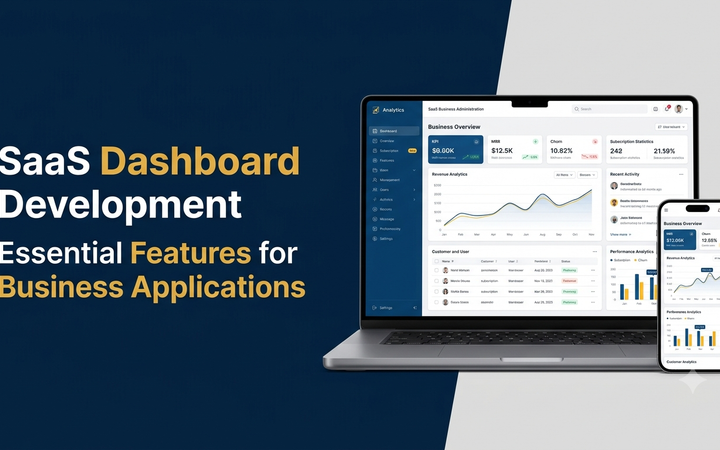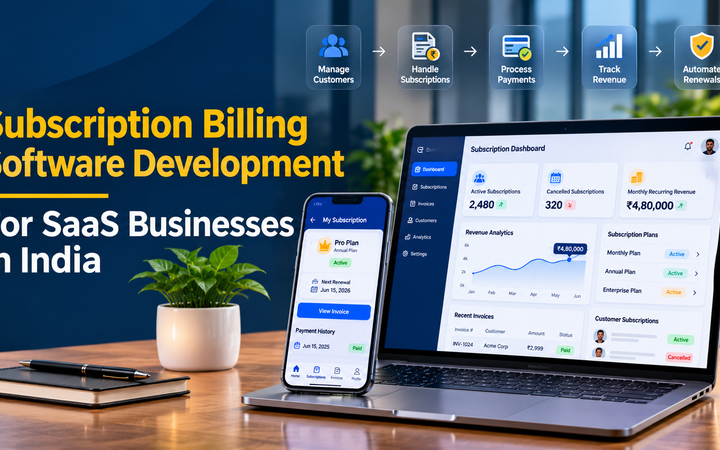
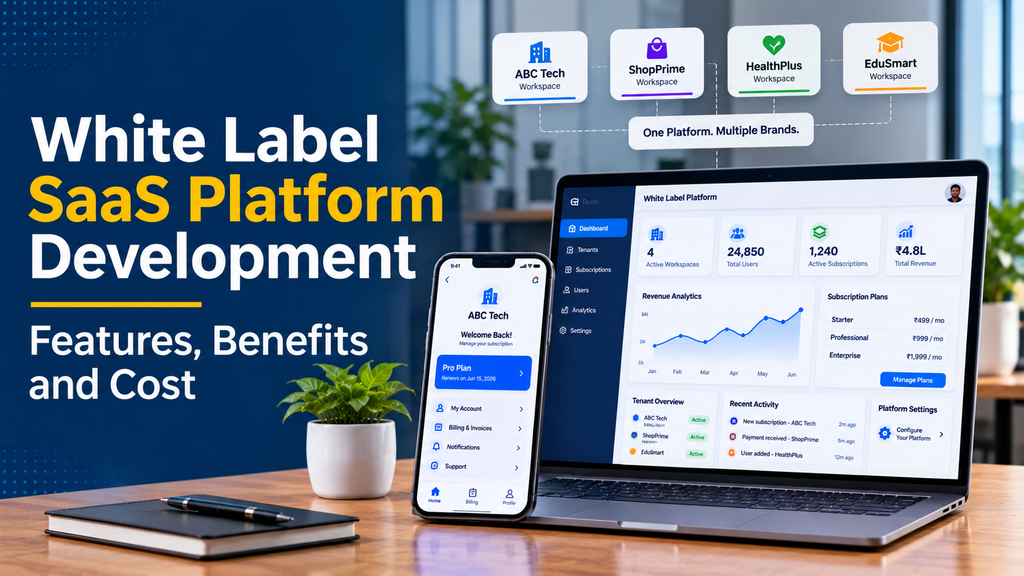
White label SaaS platform development allows businesses to create software once and offer it to multiple customers or business partners under different brand identities. Instead of developing separate applications for every customer, a company can operate one centrally managed platform with individual branding, custom domains, user accounts and subscription plans.
This business model is useful for software companies, digital marketing agencies, IT service providers, consultants and entrepreneurs who want to launch their own branded software products. With the right architecture, a white label SaaS platform can support multiple businesses while keeping their configurations and data separate.
In this guide, we explain how white label SaaS platforms work, their essential features, business benefits, development process, technology considerations and estimated development costs in India.
What Is White Label SaaS Platform Development?
White label SaaS platform development is the process of creating a software-as-a-service product that other businesses can rebrand and provide to their own customers. The original platform provider manages the underlying application, infrastructure and updates, while each reseller or customer presents the product using its own brand.
For example, a software company develops a customer relationship management platform. A marketing agency purchases access and offers it to its clients under the agency’s logo, colours and domain. Another agency can use the same underlying platform with a completely different brand identity.
White labelling is more than changing an application logo. A production-ready platform may also need tenant management, custom domain mapping, branded email notifications, subscription controls, reseller permissions and reliable data isolation.
How Does a White Label SaaS Platform Work?
A white label SaaS product commonly uses a multi-tenant architecture. Each participating business is represented as a tenant within the platform. When users visit a tenant’s assigned domain or subdomain, the application identifies the tenant and loads the appropriate branding, settings, enabled features and data permissions.
- Platform creation: The software provider develops and maintains the main SaaS application.
- Business onboarding: A reseller or customer registers and receives a separate tenant account.
- Brand configuration: The tenant administrator adds a logo, brand colours, domain and other settings.
- Feature assignment: The platform owner assigns subscription plans, feature limits and permissions.
- Customer access: The tenant invites its employees or customers to use the branded application.
- Central management: The platform owner monitors tenants, subscriptions, usage, updates and support.
The application can share a common codebase while maintaining tenant-specific configurations. This makes updates easier to manage than maintaining separate software copies for every customer.
Essential Features of a White Label SaaS Platform
The feature set depends on the business model and the type of software being offered. However, the following capabilities form a useful foundation for most white label SaaS products.
Types of White Label SaaS Business Models
Before development begins, it is important to decide how the platform will reach its customers. Different business models require different account structures, permissions and billing arrangements.
1. Direct White Label SaaS Model
The platform owner sells subscriptions directly to businesses. Each business receives its own branded workspace and manages its employees or customers.
2. Reseller SaaS Model
The platform owner partners with agencies, consultants or software resellers. Partners sell access to the platform under their own brand and may manage multiple customer accounts.
3. Agency SaaS Model
Digital agencies use a branded platform to provide services such as marketing reports, customer portals, appointment management or CRM access to their clients.
4. Industry-Specific White Label SaaS
A company develops software for a particular industry and allows multiple businesses in that industry to use it under their own brand. Examples include salon management, clinic administration, education management and business operations software.
Benefits of White Label SaaS Platform Development
1. Build One Platform for Multiple Customers
A reusable platform reduces the need to develop a completely separate application for every customer. New customers can be onboarded through tenant creation and configuration.
2. Create a New Recurring Revenue Model
Businesses can charge monthly or annual subscription fees. Depending on the business model, revenue can also come from additional users, premium features, usage limits and implementation services.
3. Strengthen Brand Identity
Custom logos, colours, domains and communication templates allow resellers to present a consistent branded experience to their customers.
4. Reduce Repeated Development Work
A shared codebase makes it easier to release common improvements and security updates without separately maintaining multiple application versions.
5. Expand Through Reseller Partnerships
A reseller model can help software providers reach new industries and customer groups through agencies, consultants and channel partners.
6. Manage Customers Centrally
The platform owner can monitor subscriptions, tenant activity, account status and platform usage from a central administration dashboard.
Industries That Can Use White Label SaaS Platforms
White label SaaS is particularly useful when multiple businesses need similar workflows but want their own branding and customer relationships.
- Digital marketing agencies: Client reporting, campaign dashboards and marketing management tools.
- Healthcare businesses: Appointment systems, clinic administration and patient communication platforms, designed with appropriate privacy safeguards.
- Education companies: Learning management systems, student portals and training platforms.
- Retail businesses: Inventory management, order processing and customer engagement software.
- Real estate companies: Property management, lead tracking and customer portals.
- Professional service providers: Client management, appointment scheduling and document management.
- Manufacturing businesses: Production tracking, quality management and supplier portals.
- IT service providers: Helpdesk systems, project management and customer support platforms.
White Label SaaS Architecture: What Should Developers Consider?
Architecture is one of the most important parts of white label SaaS development. A platform may initially support only a few customers, but its design should consider future tenants, growing data volumes, security and maintenance.
Multi-Tenant Architecture
Multi-tenancy allows multiple organisations to use the same application while maintaining separate account contexts and access permissions.
Common database approaches include:
- Shared database and shared schema: Multiple tenants use shared tables, with tenant identifiers and carefully enforced access controls.
- Shared database with separate schemas: Each tenant has a separate schema within a shared database environment.
- Separate database per tenant: Each tenant receives an independent database, which can provide stronger separation but increases infrastructure and operational complexity.
- Hybrid architecture: Smaller tenants share infrastructure while selected enterprise customers receive dedicated resources.
Tenant Data Isolation
Every tenant must only access information that it is authorised to see. This requires consistent tenant-scoped queries, permission checks, secure API endpoints, appropriate database controls and automated testing.
Brand Configuration System
Brand settings should be stored as tenant-specific configuration rather than hardcoded into separate application versions. This makes it easier to update logos, colours, names and other presentation settings.
Custom Domain Routing
The application should identify the tenant from the requested domain and load the correct workspace. Domain verification, HTTPS certificates, DNS configuration and renewal monitoring should be considered.
Scalability and Performance
As more businesses join, the platform should handle increased database activity, background jobs, file storage, API requests and notifications. Monitoring, caching, backups and infrastructure planning help support growth.
Technology Stack for White Label SaaS Development
The technology stack should be selected according to the product’s requirements, expected usage, integrations, development budget and long-term maintenance needs.
| Technology Layer | Possible Technologies |
|---|---|
| Frontend | React.js, Next.js, Vue.js |
| Backend | Laravel, Node.js, NestJS, Python |
| Database | PostgreSQL, MySQL |
| Mobile Applications | Flutter, React Native |
| Cloud Infrastructure | AWS, Google Cloud, Azure or suitable managed hosting |
| Authentication | Secure session management, OAuth and suitable identity services |
| Payments | Razorpay, Stripe or other suitable payment providers |
| Monitoring | Application logs, error monitoring and infrastructure metrics |
Not every platform needs every technology. For example, a business-focused web SaaS product may not require mobile applications in its first release. A focused technology stack can help control development complexity.
White Label SaaS Platform Development Process
A structured development process helps prevent expensive changes and ensures that branding, tenant management and business workflows work together.
Step 1: Business Model and Requirement Analysis
Identify the target customers, reseller structure, subscription model, core workflows and expected platform capabilities.
Step 2: UI/UX Design
Design the super-admin dashboard, reseller portal, tenant workspace and customer-facing application. Plan how branding changes will appear across the platform.
Step 3: Database and Architecture Planning
Define the tenant model, database structure, access permissions, domain routing, feature controls and security requirements.
Step 4: Core Platform Development
Build authentication, tenant onboarding, dashboards, user management, core business features and administration tools.
Step 5: White Label Customisation
Implement tenant-specific logos, themes, domains, notification templates and configurable application settings.
Step 6: Subscription and Payment Integration
Implement subscription plans, payment workflows, invoices, renewals, payment status handling and appropriate access restrictions.
Step 7: Reseller and Reporting Modules
Develop partner management, customer account creation, reseller reporting and commission calculations if required by the business model.
Step 8: Security and Quality Testing
Test tenant isolation, permissions, payment workflows, domain routing, application performance and backup restoration procedures.
Step 9: Deployment and Launch
Configure production infrastructure, monitoring, backups, domain settings and administrator access before onboarding the first customers.
Step 10: Maintenance and Improvements
Monitor platform performance, fix issues, release updates and improve features based on actual customer feedback.
White Label SaaS Platform Development Cost in India
The cost of developing a white label SaaS platform in India depends on its business model, number of user roles, tenant architecture, branding requirements, integrations, security needs and application complexity.
A basic branded application is significantly different from a complete reseller platform with custom domains, automated onboarding, subscription billing and partner revenue management.
| Development Level | Estimated Cost | Typical Scope |
|---|---|---|
| Basic White Label MVP | ₹5 lakh – ₹12 lakh | Core application, tenant accounts, basic branding and administration. |
| Professional White Label SaaS | ₹12 lakh – ₹25 lakh | Advanced branding, custom domains, subscription management and reseller features. |
| Advanced SaaS Platform | ₹25 lakh – ₹50 lakh | Advanced tenant controls, analytics, integrations, automation and revenue management. |
| Enterprise SaaS Platform | ₹50 lakh and above | Complex integrations, advanced security, enterprise access controls and dedicated infrastructure options. |
These are indicative planning ranges for custom development, not fixed quotations or guaranteed market prices. Actual costs can be lower or higher depending on the existing codebase, feature scope, team, infrastructure and delivery requirements. Third-party licences and payment provider charges may be additional.
Factors That Affect White Label SaaS Development Cost
- Number of modules: CRM, billing, reporting, automation and industry-specific workflows increase development effort.
- Tenant architecture: Database separation and advanced tenant controls require additional planning and implementation.
- Branding requirements: Basic logo changes are simpler than a complete branding engine covering emails, PDFs and custom domains.
- Reseller functionality: Partner hierarchies, customer management and commission calculations add complexity.
- Payment integration: Subscription automation, failed-payment handling, refunds and invoices require careful implementation.
- Mobile applications: Android and iOS applications add design, development and testing work.
- Security requirements: Audit logs, SSO, advanced permissions and additional compliance work affect the budget.
- Third-party integrations: External APIs, communication tools and business systems can increase development and maintenance costs.
Ongoing Maintenance and Operational Costs
Launching a white label SaaS platform is only the beginning. The business must also plan for recurring infrastructure, monitoring, security and customer support expenses.
- Cloud hosting and database services.
- Domain registration and SSL-related services where applicable.
- Email and SMS notification services.
- Payment gateway and transaction charges.
- Backup storage and disaster recovery.
- Application monitoring and security updates.
- Technical support and platform maintenance.
A suitable maintenance plan should be estimated according to the number of tenants, storage requirements, traffic, service availability expectations and support arrangements.
Common Mistakes to Avoid
- Building a single-customer application and adding multi-tenancy as an afterthought.
- Allowing tenant data to be accessed without consistent permission checks.
- Maintaining separate code versions for every reseller.
- Ignoring branding in emails, invoices, login screens and password reset pages.
- Launching without testing custom domain configuration and HTTPS.
- Creating subscription plans without clear feature and usage limits.
- Ignoring backups, monitoring and data export requirements.
- Adding too many features before validating the main customer workflow.
How to Choose a White Label SaaS Development Company
Choosing the right development partner is important because white label SaaS products require both software engineering and a clear understanding of recurring-revenue business models.
Before selecting a development company, discuss the following points:
- Experience with multi-tenant SaaS applications.
- Understanding of tenant data isolation and role-based permissions.
- Ability to implement branding and custom domain management.
- Experience with subscription billing and payment integrations.
- Clear development milestones and project documentation.
- Source code ownership and handover terms.
- Hosting, maintenance and post-launch support arrangements.
- Ability to scale the platform as customer numbers grow.
Why Build Your White Label SaaS Platform with Greap Technologies?
Greap Technologies provides website development, custom software development and digital growth solutions for businesses. We can help plan and develop a white label SaaS platform based on your product concept, target customers and business requirements.
Our custom SaaS development approach can include:
- Custom SaaS application development.
- Multi-tenant platform architecture.
- Super-admin and tenant dashboards.
- Custom branding and domain configuration.
- Subscription and payment integration.
- Reseller and customer management.
- Responsive web application development.
- Ongoing maintenance and technical improvements.
Whether you are a startup founder planning a new SaaS product, a software agency looking to offer branded tools or an established business expanding into software subscriptions, the platform should be designed around your actual business model.
Planning to Build Your Own White Label SaaS Platform?
Turn your software idea into a scalable branded platform. Discuss your requirements with Greap Technologies and explore a development approach suited to your business.
Discuss Your Project on WhatsApp Visit Greap TechnologiesCall: +91 70923 30168
Frequently Asked Questions
1. What is a white label SaaS platform?
A white label SaaS platform is software developed by one provider that other businesses can rebrand and offer to their customers using their own logo, colours, domain and business identity.
2. How much does white label SaaS development cost in India?
A custom white label SaaS MVP may require an indicative budget of ₹5 lakh to ₹12 lakh. More advanced platforms with reseller management, custom domains, subscription billing and integrations can cost considerably more.
3. Can each customer have their own logo and domain?
Yes. A properly designed white label platform can support tenant-specific logos, colours, application names, subdomains or custom domains, depending on the selected features.
4. What is the difference between white label SaaS and multi-tenant SaaS?
Multi-tenant SaaS describes an architecture in which multiple organisations use one platform with separated data and permissions. White label SaaS adds customer-specific branding and may also include reseller and partner management capabilities.
5. Can I sell the same SaaS software to multiple businesses?
Yes. That is one of the main advantages of a white label SaaS model. Multiple businesses can use the same core platform with their own branding and subscription arrangements.
6. Can white label SaaS support monthly and yearly subscriptions?
Yes. The platform can support monthly, quarterly or yearly subscription plans, depending on the billing requirements and payment provider integration.
7. Is customer data separate in a white label SaaS platform?
It should be. Tenant isolation must be implemented through appropriate database design, access controls, API permissions and security testing. A logo or branding change alone does not provide data separation.
8. Can a white label SaaS platform include Android and iOS apps?
Yes. Mobile applications can be included as part of the project. The branding model, app distribution approach, account structure and maintenance requirements should be planned separately.
9. How long does it take to develop a white label SaaS platform?
A focused MVP may take a few months, while a platform with advanced reseller management, billing, custom domains and enterprise integrations can take considerably longer. The timeline depends on the agreed scope and testing requirements.
10. Who should consider white label SaaS development?
Software companies, digital agencies, IT service providers, consultants, startups and industry-specific solution providers can consider this model when they want to offer a reusable software product under their own brand.