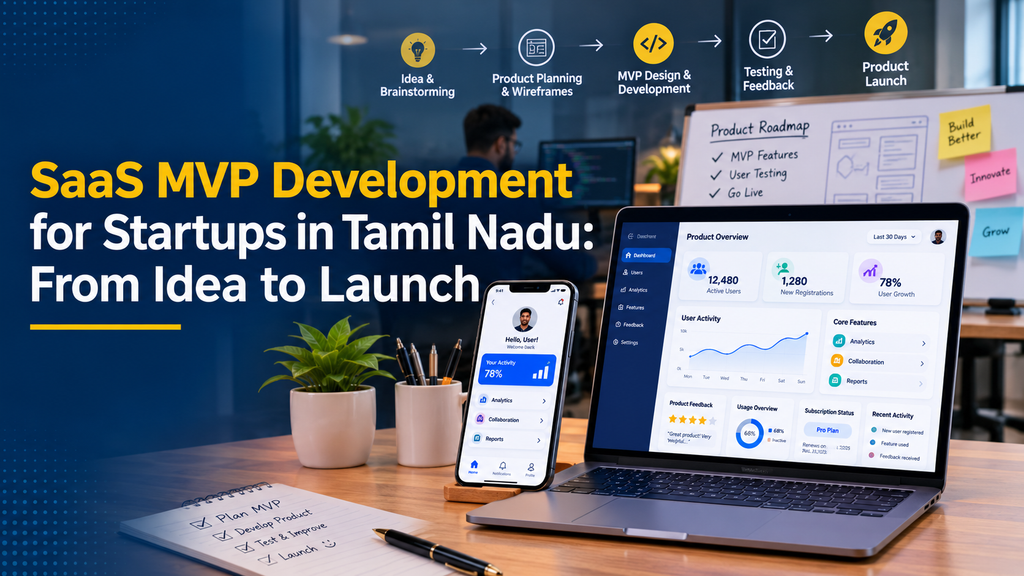
Many startups begin with a software idea that could solve a specific business problem. It may be a cloud-based CRM, appointment booking platform, inventory management system, educational application or industry-specific SaaS product.
However, building a complete software platform before understanding customer needs can require significant time, money and development effort. Startups need a practical way to test their ideas before investing heavily in a full product.
This is where Minimum Viable Product (MVP) development becomes useful. A SaaS MVP focuses on the essential features required to launch an initial working product, collect feedback and understand whether the solution meets real customer requirements.
SaaS MVP Development for Startups in Tamil Nadu helps entrepreneurs transform software ideas into functional cloud-based products through a structured development and launch process.
What Is a SaaS MVP?
MVP stands for Minimum Viable Product. It is an early, usable version of a product developed with enough functionality to solve a specific customer problem and collect meaningful feedback.
A SaaS MVP is delivered as a software service, commonly through a web application that customers access using their browsers.
For example, an entrepreneur planning to build a complete cloud-based inventory management platform may begin with a smaller version containing:
- Customer registration and login.
- Product and category management.
- Stock entry and stock updates.
- Basic sales and purchase records.
- Simple inventory reports.
- Administrator dashboard.
Advanced integrations, complex analytics and additional modules can be introduced after understanding how the initial customers use the product.
Why Should Startups Build an MVP Before a Full SaaS Product?
A startup may have many ideas about what its future application should include. However, not every planned feature is essential for the first release.
Building an MVP creates an opportunity to validate important assumptions before committing to a larger development project.
1. Validate the Product Idea
Test whether the proposed software solves a real problem for the intended customer group.
2. Control Initial Development Scope
Focus on essential features instead of building every planned module immediately.
3. Collect Customer Feedback
Understand user expectations through actual product usage and customer conversations.
4. Improve Product Decisions
Use feedback and usage patterns to decide which features should be improved or developed next.
5. Plan Future Investment
Better understand development priorities and ongoing infrastructure requirements.
6. Prepare for Product Growth
Build a foundation that can evolve as customer needs and product requirements become clearer.
SaaS Product Ideas for Startups in Tamil Nadu
Tamil Nadu has diverse business sectors, including manufacturing, textiles, healthcare, education, retail, logistics, agriculture and professional services. Startups can explore SaaS opportunities by identifying operational challenges within these industries.
1. Inventory and Billing SaaS
Build a cloud-based application for retailers, distributors and wholesalers to manage products, stock, sales, purchases and invoices.
2. Textile Management SaaS
Develop software for textile businesses to organise production records, orders, inventory, job work and business reporting.
3. Clinic Management SaaS
Create a platform for clinics to manage appointments, patient records, billing, doctors and daily operations. Healthcare applications must be designed with suitable privacy and security controls.
4. School Management SaaS
Develop a cloud-based system for student information, attendance, fees, examinations, communication and administrative activities.
5. CRM and Sales Management SaaS
Create a customer relationship management platform with lead tracking, follow-up reminders, sales pipelines and customer records.
6. Employee Management SaaS
Build an application for employee profiles, attendance, leave requests, department management and internal business processes.
7. Appointment Booking SaaS
Develop a booking platform for salons, service providers, consultants, clinics and other appointment-based businesses.
Essential Features of a SaaS MVP
The features included in an MVP depend on the product idea and its target customers. However, many SaaS applications require a common set of foundation modules.
User Registration and Login
Allow customers to create accounts, sign in and securely access the application.
User and Role Management
Provide suitable permissions for administrators, managers, employees and other user categories.
Main Business Functionality
Develop the core module that solves the primary problem the SaaS product is designed to address.
Admin Dashboard
Provide a centralised interface to manage application information, users and important activities.
Database and Data Management
Store customer and application records using an appropriate database structure.
Responsive User Interface
Ensure that users can access essential features from desktops, tablets and mobile browsers.
Notifications
Add relevant email or in-app notifications for registration, important updates and business activities.
Basic Reports
Include the reports required to understand the main purpose and usage of the application.
Backup and Security
Implement secure authentication, access control, data protection and suitable backup procedures.
Should You Build a Single-Tenant or Multi-Tenant SaaS MVP?
The architecture should be selected based on the product’s intended customer model and future requirements.
Single-Tenant Application
A single-tenant application provides a separate application environment or deployment for an individual customer. It can be suitable when each customer needs dedicated infrastructure or extensive customisation.
Multi-Tenant Application
A multi-tenant application allows multiple customers to use a shared software platform while maintaining appropriate separation of their data and access.
| Factor | Single-Tenant | Multi-Tenant |
|---|---|---|
| Application environment | Dedicated per customer | Shared application platform |
| Data organisation | Separate customer environment | Tenant-aware data separation |
| Customisation | Can be highly customer-specific | Usually controlled through tenant settings |
| Operations | More individual environments to manage | Shared platform operations |
| Common use case | Dedicated enterprise deployments | Subscription-based SaaS products |
For a SaaS product targeting multiple businesses with similar requirements, a multi-tenant design may be a practical choice. However, tenant isolation must be designed and tested carefully.
From Idea to Launch: SaaS MVP Development Process
Successful MVP development begins with understanding the business problem rather than immediately starting software coding.
Step 1: Understand the Startup Idea
Define the problem your product will solve, who will use it and why customers may need it. Identify the primary business objective.
Step 2: Identify the Target Customers
Define the intended customer group, industry, organisation size and expected user requirements. Speak with potential customers where possible.
Step 3: Research Existing Solutions
Study competing products, existing workflows, customer complaints and gaps that your product could address.
Step 4: Prepare the MVP Feature List
Separate essential launch features from advanced features that can be introduced in later releases.
Step 5: Create Wireframes and UI Design
Plan the main screens, navigation, user journeys and dashboard layout before implementation.
Step 6: Select the Technology Stack
Choose suitable frontend, backend, database and hosting technologies based on the product’s requirements and development budget.
Step 7: Develop the Application
Build authentication, user management, the core business module, dashboard and required supporting functionality.
Step 8: Test the MVP
Test important user journeys, permissions, data handling, responsive layouts and application performance.
Step 9: Deploy the Product
Configure hosting, domain, SSL, database, backups, monitoring and production deployment.
Step 10: Collect Feedback and Improve
Observe how initial users interact with the product. Prioritise improvements based on customer feedback and actual usage.
Recommended Technology Stack for SaaS MVP Development
Startups should select technologies that support reliable development, future maintenance and the product’s expected technical requirements.
Frontend Development
- React.js for interactive web applications.
- Next.js for applications requiring its routing, rendering and server-side capabilities.
- Vue.js for component-based frontend development.
Backend Development
- Laravel with PHP.
- Node.js with suitable backend frameworks.
- Python with Django or FastAPI.
- Java with Spring Boot for suitable enterprise projects.
Database
- PostgreSQL.
- MySQL.
Hosting and Deployment
- Cloud hosting or suitable VPS infrastructure.
- Managed database services where required.
- Object storage for uploaded files.
- Automated backups.
- Application monitoring and error logging.
The best technology stack is not necessarily the one with the most tools. It is the one that supports the product requirements without introducing unnecessary complexity.
How Much Does SaaS MVP Development Cost in Tamil Nadu?
SaaS MVP development cost depends on the application’s features, number of user roles, design requirements, architecture, integrations and testing scope.
The following figures are illustrative development budget ranges for planning purposes. Actual quotations may vary based on the project specification and development team.
| MVP Type | Estimated Development Cost |
|---|---|
| Basic SaaS MVP | ₹50,000 – ₹1,00,000 |
| Standard SaaS MVP | ₹1,00,000 – ₹2,00,000 |
| Multi-Tenant SaaS MVP | ₹1,50,000 – ₹3,00,000 |
| Advanced SaaS MVP with Integrations | ₹3,00,000 – ₹5,00,000+ |
What Affects the Development Cost?
- Number of screens and application modules.
- Complexity of the core business functionality.
- Single-tenant or multi-tenant architecture.
- User registration and role management.
- Subscription and payment gateway integration.
- Third-party APIs and external services.
- Custom UI/UX design requirements.
- Mobile application requirements.
- Security and testing requirements.
- Hosting and deployment configuration.
How Long Does It Take to Build a SaaS MVP?
The timeline depends on the number of essential features, design complexity, integrations and testing requirements.
| Development Stage | Indicative Timeline |
|---|---|
| Requirement Planning | 3–5 days |
| Wireframes and UI Design | 5–8 days |
| Backend and Database Development | 10–18 days |
| Frontend Development | 10–18 days |
| Testing and Deployment | 5–10 days |
A relatively simple SaaS MVP may take around 4–8 weeks. More complex products can require additional development time. Some activities can also run in parallel.
Common Mistakes Startups Should Avoid
Building Too Many Features Initially
Adding every possible feature can increase development time and make the first release harder to validate. Prioritise the main customer problem.
Skipping Customer Research
Developing based only on assumptions may result in a product that does not match actual user expectations. Speak with potential customers before finalising the scope.
Ignoring User Experience
A product with useful functionality can still be difficult to adopt if its navigation and workflows are confusing.
Choosing Technology Without a Clear Reason
Select technologies according to product requirements, team capability and long-term maintenance needs.
Neglecting Security
Authentication, permissions, secure data handling, backups and testing should be part of the MVP plan.
Not Planning for Maintenance
After launch, software needs updates, bug fixes, monitoring and technical support. Include these responsibilities in the project plan.
How to Prepare Your SaaS Product for Launch
Before making an MVP available to customers, review the important product and operational requirements.
- Complete core feature testing.
- Verify registration and login workflows.
- Check user permissions and data access.
- Test the application on mobile and desktop.
- Configure the domain and SSL certificate.
- Set up production database and backups.
- Configure error monitoring and application logs.
- Prepare onboarding instructions.
- Test payment flows if payments are included.
- Prepare a customer feedback process.
- Document known limitations and support channels.
What Happens After the SaaS MVP Launch?
Launching the MVP is the beginning of product learning, not the end of development.
Startups should observe how customers use the product, identify problems and prioritise improvements.
Useful post-launch activities include:
- Monitor registrations and active users.
- Understand which features customers use most.
- Collect customer feedback and support requests.
- Identify points where users leave important workflows.
- Fix usability and reliability issues.
- Improve onboarding and help documentation.
- Plan the next development release.
- Review infrastructure usage and operating costs.
Product decisions should be based on customer feedback and meaningful usage information rather than simply increasing the number of features.
Why Choose Custom SaaS MVP Development?
No-code tools and ready-made platforms can help validate some ideas. However, a custom MVP may be more suitable when the product requires specific workflows, business logic, integrations or a foundation for future development.
Custom development can provide:
- Product-specific features and workflows.
- Control over application design and functionality.
- Custom user roles and permissions.
- Flexible database and architecture planning.
- Integration with external business systems.
- Subscription and billing functionality.
- Room for future product improvements.
SaaS MVP Development by Greap Technologies
Greap Technologies provides website development, custom software development and digital growth solutions for businesses.
We can help entrepreneurs, startups and established businesses turn their software ideas into functional web-based products through a structured development process.
Our SaaS MVP development scope can include:
- Startup idea and requirement analysis.
- MVP feature planning.
- UI/UX design and wireframes.
- Frontend and backend development.
- Database design.
- User authentication and role management.
- Tenant management where required.
- Subscription and payment integration.
- Admin dashboard development.
- Testing and deployment.
- Ongoing software maintenance.
Have a SaaS Startup Idea? Let’s Plan Your MVP.
Discuss your software idea, essential features, development timeline and budget with Greap Technologies.
Discuss Your SaaS MVPWebsite: www.greap.in
Phone: +91 70923 30168
Frequently Asked Questions
1. What is SaaS MVP development?
SaaS MVP development is the process of building an initial working version of a cloud-based software product with the essential features needed to solve a specific customer problem.
2. Why should startups build an MVP first?
An MVP helps startups test their product idea, collect customer feedback, understand user needs and prioritise future development.
3. How much does SaaS MVP development cost in Tamil Nadu?
A basic SaaS MVP may have an illustrative development budget of ₹50,000 to ₹1,00,000. More advanced applications can require a higher investment depending on features and architecture.
4. How long does it take to build a SaaS MVP?
A relatively simple SaaS MVP may take approximately 4–8 weeks. The timeline depends on functionality, design, integrations and testing.
5. What features should a SaaS MVP include?
Common features include registration, login, user management, the main business module, dashboard, database, responsive design and basic reporting.
6. Can I develop a multi-tenant SaaS MVP?
Yes. A SaaS MVP can use multi-tenant architecture when the product is intended to serve multiple independent customer organisations.
7. Which technology is suitable for SaaS MVP development?
Technologies such as Laravel, Node.js, React, Next.js, PostgreSQL and MySQL can be used. The right stack depends on the product requirements.
8. Can I add more features after launching the MVP?
Yes. An MVP is intended to provide a foundation for future improvements. New modules can be added based on customer feedback and product priorities.
9. Can a SaaS MVP include subscription payments?
Yes. Subscription plans, payment gateway integration, invoices and renewal management can be included when required by the product’s business model.
10. Is a mobile app necessary for a SaaS MVP?
Not always. A responsive web application may be sufficient for the first release. Dedicated Android or iOS applications can be considered based on customer requirements.
11. What should I prepare before contacting a development company?
Prepare a short explanation of the problem, target customers, essential features, expected workflows and approximate budget. A detailed technical specification is not required to start a discussion.
12. Can Greap Technologies help develop a SaaS MVP?
Greap Technologies can discuss your startup idea, MVP scope, application features, development requirements and project budget.