Subscription-based businesses need more than a payment collection page. They need a reliable system to manage plans, recurring payments, renewals, invoices, customer access and billing records. As SaaS companies grow, handling these activities manually can become difficult and time-consuming.
Subscription billing software development in India helps SaaS businesses automate their billing operations through a centralised platform. Whether you offer monthly software plans, annual licences, usage-based pricing or enterprise subscriptions, a custom billing system can support your business model.
What Is Subscription Billing Software?
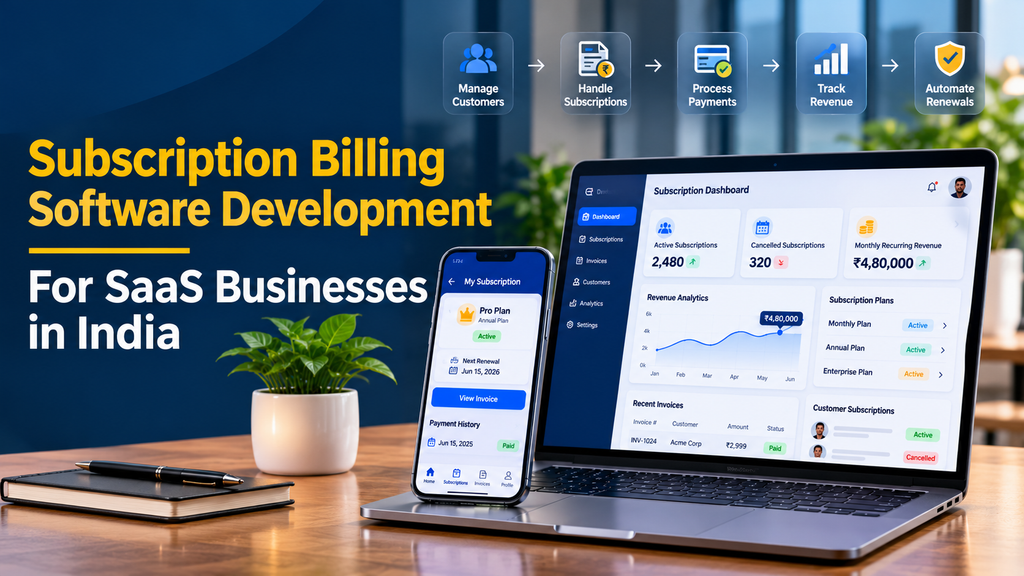
Subscription billing software is an application that manages recurring payments and customer subscriptions. It allows a business to create pricing plans, register subscribers, generate invoices, monitor payment status and manage renewals from one system.
For example, imagine a company offering inventory management software to small businesses. Customers can subscribe to a monthly or annual plan. The billing platform records their selected plan, tracks the subscription period, initiates eligible recurring payment processes and updates the subscription after payment confirmation.
Instead of maintaining separate spreadsheets for customers, invoices and renewals, the business can manage these activities through a unified dashboard.
Why Do SaaS Businesses Need Subscription Billing Software?
A growing SaaS company may have hundreds or thousands of subscribers using different plans and billing cycles. Manual tracking can lead to missed renewals, incorrect invoices, delayed follow-ups and confusing customer records.
A dedicated billing platform helps businesses:
- Manage monthly, quarterly and annual subscription plans.
- Organise customer subscriptions and billing histories.
- Automate eligible recurring payment workflows.
- Generate invoices and payment receipts.
- Track successful, pending and failed transactions.
- Manage upgrades, downgrades and plan changes.
- Monitor renewals, cancellations and subscription status.
- Understand recurring revenue and customer activity.
- Reduce repetitive administrative work.
Types of Subscription Billing Models
The billing model should match the way your SaaS product delivers value. A custom subscription billing application can support one or multiple pricing approaches.
1. Fixed Monthly Subscription
Customers pay a fixed amount every month to access a particular software plan. This model is suitable for CRM tools, business applications and productivity platforms.
2. Annual Subscription
Customers pay for a full year of software access. Businesses can offer annual plans with different pricing and renewal conditions.
3. Tier-Based Pricing
Different plans provide different features, user limits, storage capacity or service levels. Common examples include Starter, Professional and Enterprise plans.
4. Usage-Based Billing
Customers are charged according to measurable usage, such as API requests, transactions, storage consumption or processed records.
5. Per-User Pricing
The subscription amount depends on the number of users or seats included in the account. This is common in team-based business software.
6. Hybrid Pricing
Combines a fixed subscription fee with usage-based charges or additional feature costs. It can support more flexible SaaS pricing.
Essential Features of SaaS Subscription Billing Software
1. Subscription Plan Management
Administrators should be able to create and manage multiple pricing plans. Each plan may include its name, price, billing interval, included features, user limits, trial availability and plan status.
2. Customer and Subscriber Management
Maintain customer profiles with contact information, subscription details, billing history, invoices and payment status. Role-based access can help teams view only the information relevant to their responsibilities.
3. Recurring Payment Integration
Integrate suitable payment gateways to support recurring payment workflows where the gateway, payment method and customer authorisation permit them. The application should process payment notifications and update subscription records based on verified transaction results.
4. Automated Invoice Generation
Generate invoices for subscription purchases, renewals, upgrades and applicable additional charges. Invoices should include relevant customer details, invoice numbers, dates, line items, taxes and payment status.
5. Free Trial Management
Some SaaS companies offer trial access before asking customers to purchase a subscription. The system can manage trial start dates, expiry dates, plan restrictions and conversion into paid subscriptions.
6. Subscription Upgrade and Downgrade
Customers may need to change their plans as their requirements evolve. The billing engine should apply the configured rules for plan changes, including effective dates, price differences and any applicable prorated adjustments.
7. Failed Payment Management
Payments can fail because of insufficient funds, expired payment methods, bank restrictions or other transaction issues. The application can record failures, notify customers and support configurable retry or follow-up workflows.
8. Cancellation and Refund Management
Provide clear subscription cancellation workflows. Depending on the business rules, cancellation may take effect immediately or at the end of the current billing period. Refunds should be recorded separately with their status and transaction references.
9. Revenue and Subscription Analytics
Give administrators a useful view of subscription performance through metrics such as active subscriptions, new customers, cancellations, renewal rates and recurring revenue.
10. Email and Notification Automation
Send appropriate notifications for subscription activation, successful payments, invoice availability, upcoming renewals, failed payments, trial expiry and cancellation confirmation.
Important Billing Metrics for SaaS Businesses
A billing dashboard should help business owners understand subscription performance rather than simply display transaction records.
| Metric | What It Measures | Why It Matters |
|---|---|---|
| MRR | Monthly Recurring Revenue | Tracks normalised monthly subscription revenue. |
| ARR | Annual Recurring Revenue | Helps understand the annualised recurring revenue base. |
| Churn Rate | Customer or subscription loss over a period | Highlights customer retention challenges. |
| ARPU | Average Revenue Per User | Shows average revenue generated per user or account. |
| Renewal Rate | Subscriptions renewed during a period | Helps measure renewal performance. |
| Payment Success Rate | Successful payments compared with attempted payments | Helps identify payment collection issues. |
Metric definitions should be consistent. For example, MRR calculations should account for billing frequency, discounts and subscription changes according to the company’s chosen reporting rules.
GST and Invoicing Considerations for Subscription Businesses in India
Indian SaaS businesses should consider applicable tax requirements while designing their billing software. Depending on the nature of the service, customer location, registration status and transaction type, GST treatment and invoicing requirements may differ.
A billing platform may support:
- Configurable tax rates and tax categories.
- Customer billing names and addresses.
- GSTIN collection where applicable.
- Separate tax components where relevant.
- Invoice numbering and billing-period records.
- Credit notes and adjustment records.
- Downloadable invoice documents.
- Reports that help finance teams review billing data.
Payment Gateway Integration for SaaS Billing
Payment gateway integration is an important part of a subscription billing platform. The right provider depends on your business model, customer locations, payment methods, recurring payment requirements and commercial eligibility.
Before choosing a provider, evaluate:
- Support for the payment methods your customers use.
- Recurring payment and mandate capabilities where required.
- Payment status notifications and webhook support.
- Refund and transaction reconciliation facilities.
- Integration documentation and developer support.
- Settlement reporting and applicable fees.
- Security requirements and regulatory obligations.
A robust integration should verify payment notifications, handle duplicate events safely and maintain a clear transaction history. Do not treat a browser redirect or a customer-facing success message as sufficient proof that a payment has succeeded.
How Does a Subscription Billing Workflow Work?
A typical SaaS subscription workflow connects the customer, subscription record, payment provider and billing application.
- Customer selects a plan: The customer reviews available pricing plans and chooses a suitable subscription.
- Account registration: The customer provides the required account and billing information.
- Payment authorisation: The payment provider handles the applicable payment authorisation process.
- Subscription activation: The application activates the subscription after verifying the payment or other permitted activation condition.
- Invoice generation: The billing system creates the relevant invoice or receipt.
- Renewal tracking: The system tracks the subscription period and configured renewal date.
- Payment status update: Verified payment events update the transaction and subscription records.
- Customer notification: The system sends relevant billing and subscription notifications.
Admin Dashboard, Customer Portal and Billing Team Access
A custom subscription billing application can provide different interfaces for administrators, customers and internal teams.
Admin Dashboard
- Subscription overview
- Plan and pricing management
- Customer records
- Payment and invoice tracking
- Refund and cancellation records
- Reports and user permissions
Customer Billing Portal
- View current subscription
- Compare available plans
- View invoices and receipts
- Check payment history
- Manage permitted plan changes
- Request cancellation or support
Finance Team Interface
- Invoice review
- Payment reconciliation
- Transaction reports
- Credit note records
- Tax-related billing data
Support Team Interface
- Customer subscription lookup
- Payment issue visibility
- Renewal status
- Customer communication history
- Support request tracking
Technology Stack for Custom Subscription Billing Software
The technology stack depends on the expected subscriber volume, integration requirements, application complexity and development team’s expertise. A practical architecture may include:
| Application Layer | Possible Technologies | Purpose |
|---|---|---|
| Frontend | React, Next.js, Vue.js | Admin dashboard and customer portal. |
| Backend | Laravel, Node.js, Django | Billing logic, APIs and business workflows. |
| Database | PostgreSQL, MySQL | Customer, subscription and transaction records. |
| Payment Integration | Suitable payment gateway APIs | Payment processing and transaction updates. |
| Background Jobs | Redis queues, scheduled workers | Renewal checks, notifications and background tasks. |
| Infrastructure | Cloud hosting and managed services | Deployment, monitoring and scalability. |
The architecture should keep payment processing, subscription lifecycle management, invoice generation and customer access control organised as separate responsibilities. This makes future improvements easier.
Security Requirements for Subscription Billing Software
Billing applications handle sensitive customer and transaction information. Security should be part of the system design from the beginning.
- Use HTTPS for communication between clients and servers.
- Apply role-based access control for administrative users.
- Validate payment gateway notifications and webhook signatures.
- Use idempotency controls to prevent duplicate transaction processing.
- Do not store raw card details or CVV data in the application database.
- Use the payment provider’s approved tokenisation or hosted payment flow.
- Maintain audit logs for important billing actions.
- Protect APIs with authentication, authorisation and rate limiting.
- Encrypt sensitive data where appropriate.
- Maintain secure backups and a tested recovery process.
- Monitor unusual activity and application errors.
Custom Subscription Billing Software vs Ready-Made Tools
Ready-made billing platforms can be useful when their features and pricing match your business requirements. Custom development may be suitable when the business needs specialised workflows, integrations or greater control over the application.
| Factor | Ready-Made Platform | Custom Software |
|---|---|---|
| Initial setup | Often faster | Requires development and testing |
| Custom workflows | Limited to available configuration | Can be built around business requirements |
| Integrations | Depends on provider support | Can support selected business systems |
| Ownership and control | Subject to provider terms | Depends on the agreed software ownership model |
| Maintenance | Provider maintains its platform | Requires an ongoing maintenance plan |
| Pricing | May include recurring platform or transaction fees | Development and infrastructure costs apply |
The best choice depends on your expected transaction volume, business processes, development budget, integration needs and long-term product roadmap.
Subscription Billing Software Development Cost in India
The cost of developing subscription billing software in India depends on the number of modules, payment integrations, billing rules, reporting requirements, security needs and customer portal complexity.
The following ranges are illustrative early-stage planning estimates. They are not standard market rates or a fixed development quotation.
| Development Scope | Indicative Budget | Typical Scope |
|---|---|---|
| Basic billing MVP | ₹1.5 lakh – ₹3 lakh | Plans, customer records, basic billing and payment integration. |
| Business billing platform | ₹3 lakh – ₹7 lakh | Subscriptions, invoices, renewals, notifications and reports. |
| Advanced SaaS billing system | ₹7 lakh – ₹15 lakh+ | Usage billing, advanced workflows, customer portal and analytics. |
| Enterprise billing platform | ₹15 lakh onwards | Complex integrations, multiple products, advanced controls and scalability. |
Actual pricing may be lower or higher depending on the requirements. Payment gateway charges, cloud hosting, SMS or email services, third-party licences, taxes and ongoing maintenance may be separate.
Factors That Influence Development Cost
- Number of subscription plans and pricing models.
- Complexity of recurring payment workflows.
- Number of payment gateway integrations.
- GST and invoice configuration requirements.
- Customer portal and administrator dashboard features.
- Usage metering and pricing calculation requirements.
- Reporting, analytics and data export functionality.
- Security, testing, deployment and maintenance requirements.
How Long Does It Take to Develop Subscription Billing Software?
Development time depends on the scope and complexity of the billing system. A basic MVP can be delivered sooner than a platform with multiple pricing models, advanced payment workflows and enterprise integrations.
| Project Stage | Indicative Duration |
|---|---|
| Requirement analysis and planning | 1–2 weeks |
| UI/UX design and architecture | 1–3 weeks |
| Core development | 3–8 weeks |
| Payment and invoice integration | 1–3 weeks |
| Testing and deployment | 1–3 weeks |
These stages may overlap. The overall timeline should be confirmed after reviewing the requirements and third-party integration dependencies.
Common Mistakes to Avoid During Development
- Ignoring billing edge cases: Plan changes, failed payments, refunds and cancellations need clear rules.
- Using unreliable payment confirmation: Verify gateway events on the server before updating records.
- Not planning for duplicate events: Webhooks and retry operations should be safe to process more than once.
- Building unclear invoices: Invoice details should be consistent and easy for customers to understand.
- Overcomplicating the first release: Start with the essential billing workflows and expand based on real requirements.
- Ignoring reconciliation: Payment records should be compared with gateway settlement information.
- Neglecting security: Protect customer information, administrative access and payment-related workflows.
- Not testing subscription lifecycle changes: Test renewals, upgrades, downgrades, cancellations and failed transactions.
How to Choose a Subscription Billing Software Development Company in India
Selecting the right development partner is important because billing software contains business-critical workflows. Before starting a project, evaluate the development team’s technical approach and understanding of subscription-based business models.
Consider these questions:
- Can the team understand and document your subscription pricing rules?
- Can it integrate your preferred payment gateway?
- Does it understand invoice and GST-related requirements?
- Can it build both administrator and customer interfaces?
- How will failed payments, duplicate notifications and refunds be handled?
- Will the application support future growth and new pricing models?
- What testing, documentation and maintenance services are included?
Why Consider Custom Software Development with Greap Technologies?
Greap Technologies provides website development, software development and digital growth solutions for businesses. For SaaS companies planning a custom subscription billing platform, the development process can begin with understanding the product, pricing structure, customer journey and billing requirements.
A project may include:
- Custom SaaS billing dashboard development.
- Subscription plan and customer management.
- Payment gateway API integration.
- Invoice and billing history management.
- Recurring payment workflow implementation.
- Customer portal and administrator access.
- Reports, notifications and business integrations.
- Deployment and ongoing maintenance planning.
Rather than starting with unnecessary features, define the essential billing workflows first. A clearly scoped MVP can help your business validate its subscription model before expanding the platform.
Conclusion
Subscription billing software plays an important role in the operations of modern SaaS businesses. It connects subscription plans, customers, payment processing, invoices, renewals and business reporting through a centralised application.
For SaaS companies in India, a well-designed billing platform should support the required pricing model, suitable payment integrations, clear invoice workflows, security controls and future scalability. Whether you are launching a new SaaS product or improving an existing billing process, choosing the right architecture and development scope can make a meaningful difference.
Greap Technologies can help businesses plan and develop custom software solutions based on their operational and product requirements.
Frequently Asked Questions
1. What is subscription billing software?
Subscription billing software manages recurring subscriptions, customer plans, payment records, invoices, renewals and cancellations through a centralised application.
2. How much does subscription billing software development cost in India?
The cost depends on the project scope. An illustrative basic MVP may start around ₹1.5 lakh, while advanced and enterprise platforms can require substantially larger budgets.
3. Can custom billing software support monthly and yearly subscriptions?
Yes. A custom system can support monthly, quarterly, annual or other configured billing intervals, depending on the business requirements.
4. Can subscription billing software integrate with Indian payment gateways?
Yes. It can integrate with suitable payment providers that support the required payment methods and recurring payment workflows. Availability depends on provider terms, account eligibility and applicable rules.
5. Can the system generate GST invoices?
A billing application can be designed to generate invoices with configurable tax information. The tax treatment and invoice format should be reviewed against the business’s applicable GST obligations.
6. What is the difference between subscription billing and recurring payments?
Recurring payments refer to collecting payments at repeated intervals. Subscription billing is broader: it also manages plans, billing cycles, customer subscriptions, invoices, renewals, changes and cancellations.
7. Can customers upgrade or downgrade their subscription plans?
Yes. The application can provide plan-change workflows with configurable effective dates, billing adjustments and access permissions.
8. Can subscription billing software support usage-based pricing?
Yes. A suitable platform can record measurable product usage and calculate charges using configured pricing rules. This requires additional usage tracking and billing logic.
9. How long does it take to build a custom billing system?
A basic system may take several weeks, while an advanced platform can require several months. The timeline depends on integrations, billing complexity, testing and project scope.
10. Can Greap Technologies develop custom SaaS billing software?
Greap Technologies can discuss custom software development requirements for subscription plans, billing dashboards, payment integrations, invoices and related business workflows.
Planning a Custom SaaS Billing Platform?
Build a subscription billing solution around your SaaS product, pricing model and business workflows. Discuss your requirements with Greap Technologies.
Discuss Your Project on WhatsApp Visit Greap TechnologiesCall: +91 70923 30168