Food Delivery App Development in Tamil Nadu: Complete Business Guide
Starting an online food delivery business requires more than developing a mobile application. Restaurant owners, cloud kitchen operators and entrepreneurs need to coordinate menus, customer orders, food preparation, payments, delivery employees, customer support and daily business operations.
A food delivery platform connects these activities through a digital ordering system. Customers can explore restaurants or menus, place food orders, select delivery addresses and receive order status updates. Restaurants can manage incoming orders, while delivery employees can receive pickup and delivery assignments.
For example, a restaurant in Erode may receive food orders through phone calls, WhatsApp messages and walk-in customers. During busy periods, employees may need to manually confirm orders, communicate with the kitchen, calculate bills and arrange deliveries.
A properly designed food delivery app in Tamil Nadu can help organize these workflows through connected applications and management panels.
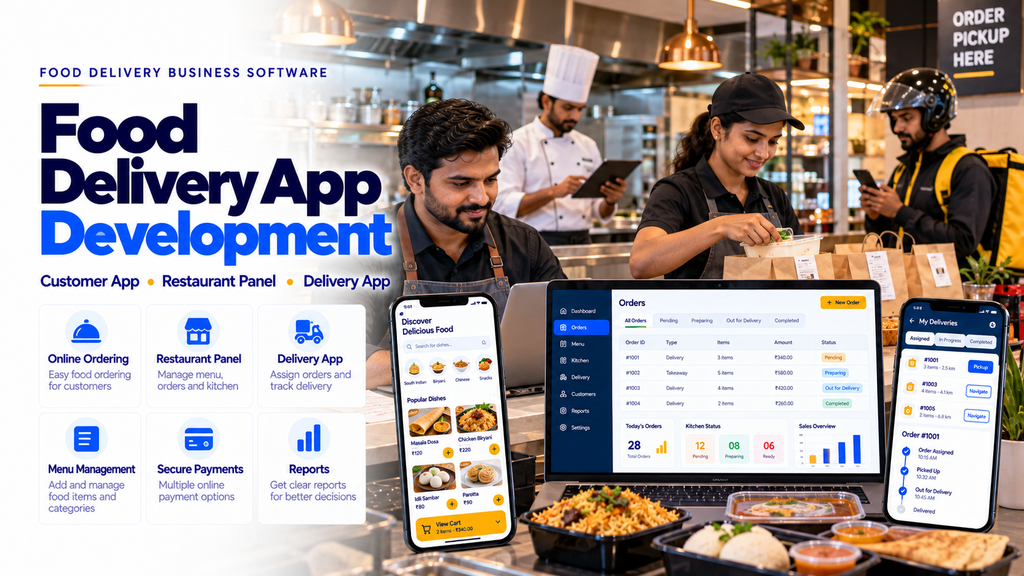
Depending on the business model, a food delivery system may include a customer Android application, customer iOS application, restaurant management panel, waiter application, chef application, delivery partner application and centralized super admin panel.
This complete guide explains food delivery app business models, essential features, application architecture, development costs, revenue opportunities, implementation stages and launch considerations for businesses across Tamil Nadu.
What Is a Food Delivery App?
A food delivery app is a digital platform that allows customers to browse food menus, place orders and request delivery or pickup from participating restaurants or food businesses.
A typical platform may connect three main groups:
- Customers: Browse menus, order food and check order status.
- Restaurants: Receive orders, prepare food and coordinate handover.
- Delivery Partners: Collect prepared orders and deliver them to customers.
A centralized administration system may manage platform settings, participating restaurants, customers, payments, delivery operations and reports.
Why Businesses in Tamil Nadu Consider Food Delivery Apps
Restaurants and food businesses may want additional ways for customers to place orders without depending entirely on telephone calls or third-party ordering platforms.
A food delivery application may help with:
- Digital menu availability
- Online food ordering
- Centralized order records
- Kitchen order communication
- Delivery assignment
- Customer order history
- Payment tracking
- Restaurant reporting
- Direct customer communication
Business results depend on customer demand, delivery coverage, restaurant participation, service quality, pricing and marketing.
1. Food Delivery Business Models
Single-Restaurant Food Delivery App
This model is designed for one restaurant or food business. Customers order directly from that restaurant.
Multi-Restaurant Food Delivery Marketplace
This model allows multiple restaurants to list menus and accept orders through one platform.
Cloud Kitchen Delivery App
This model supports food businesses that primarily prepare orders for delivery or takeaway.
Restaurant Chain Delivery App
This model supports restaurant businesses operating multiple branches.
Hyperlocal Food Delivery Platform
This model focuses on food delivery within defined neighbourhoods or service areas.
Pickup and Takeaway Ordering App
This model allows customers to order food digitally and collect it directly from the restaurant.
2. Applications Required for a Food Delivery Platform
| Application | Users | Main Purpose |
|---|---|---|
| Customer App | Food customers | Browse menus and place orders |
| Super Admin Panel | Platform owner | Manage the complete system |
| Restaurant / Branch Panel | Restaurant employees | Manage menus and orders |
| Waiter App | Restaurant waiters | Manage dine-in table orders |
| Chef / Kitchen App | Kitchen employees | Prepare and update food orders |
| Delivery Partner App | Delivery employees | Manage pickup and delivery |
| Food Ordering Website | Customers | Browser-based food ordering |
Not every food delivery business needs every application. The required modules depend on the business model and operating procedures.
3. Food Delivery Customer App Features
The customer application should make food ordering simple and understandable.
Customer Registration
- Mobile number registration
- Supported OTP verification
- Customer profile
- Saved addresses
- Account settings
Restaurant Discovery
- Restaurant listings
- Food categories
- Search
- Location-based availability
- Restaurant information
- Operating hours
Digital Food Menu
- Food names
- Food descriptions
- Product images
- Prices
- Available variants
- Optional add-ons
- Availability status
Shopping Cart
- Add food items
- Update quantities
- Select permitted add-ons
- View item totals
- Review delivery charges
- View applicable taxes
- Review final payable amount
Checkout
- Delivery address
- Pickup or delivery selection
- Supported payment methods
- Order instructions
- Order confirmation
Order Tracking
Order History
- Previous orders
- Order details
- Invoice access
- Reorder options
- Support requests
4. Super Admin Panel Features
The super admin panel helps the platform owner manage overall food delivery operations.
Potential modules include:
- Platform dashboard
- Restaurant management
- Branch management
- Customer management
- Menu category management
- Order management
- Delivery management
- Payment records
- Commission configuration
- Settlement reports
- Offers and coupons
- Refund management
- Business reports
- User roles and permissions
- Application settings
5. Restaurant Management Panel
Restaurant management panels help restaurant owners and employees handle daily online orders.
Potential features include:
- Restaurant profile
- Business hours
- Food categories
- Menu items
- Food variants
- Optional add-ons
- Incoming orders
- Order acceptance
- Kitchen order status
- Pickup readiness
- Restaurant sales reports
6. Restaurant Branch Management
Restaurant chains may need branch-specific management.
Potential features include:
- Branch profiles
- Branch operating hours
- Branch-specific menus
- Branch pricing
- Order allocation
- Branch employees
- Branch sales reports
7. Waiter Application Features
Restaurants offering dine-in service may use a waiter application to record table orders.
Potential features include:
- Waiter login
- Table selection
- Menu access
- Food order entry
- Item quantity updates
- Kitchen order submission
- Table order status
- Billing requests
A waiter application is optional for delivery-only businesses.
8. Chef and Kitchen Application Features
A chef or kitchen application can help kitchen employees view and update food preparation orders.
Potential features include:
- Kitchen order queue
- Food item details
- Preparation instructions
- Order priority
- Preparing status
- Ready status
- Order completion records
Kitchen applications should be designed for clear visibility and fast operation in busy restaurant environments.
9. Kitchen Order Ticket Management
A Kitchen Order Ticket, commonly called KOT, communicates food orders to kitchen employees.
Potential features include:
- Order reference numbers
- Food item details
- Item quantities
- Preparation notes
- Order timestamps
- Kitchen status
- Supported printer integration
Restaurant-specific KOT workflows may differ between dine-in, takeaway and delivery orders.
10. Delivery Partner Application Features
The delivery partner app helps authorized delivery employees manage assigned food orders.
Potential features include:
- Secure login
- Assigned deliveries
- Restaurant pickup details
- Customer delivery information
- Navigation integration
- Pickup confirmation
- Delivery status updates
- Proof of delivery where appropriate
- Completed delivery history
- Delivery settlement records
Location tracking should use appropriate permissions and privacy safeguards.
11. Restaurant Onboarding Management
Multi-restaurant platforms need a process for registering participating restaurants.
Potential features include:
- Restaurant registration
- Business information
- Authorized document collection
- Approval workflows
- Restaurant account activation
- Menu setup
- Operating area configuration
Required business and food safety documentation should be reviewed according to applicable regulations.
12. Food Menu Management
Restaurants should be able to maintain accurate digital menus.
Potential features include:
- Menu categories
- Food item names
- Descriptions
- Prices
- Images
- Variants
- Add-ons
- Availability status
Menu information should reflect actual products, prices and availability.
13. Food Variants and Add-On Management
Some food items may be available in different sizes or configurations.
Examples include:
- Pizza sizes
- Biryani portions
- Additional toppings
- Extra side dishes
- Beverage choices
The application should calculate item totals accurately according to the customer’s selections.
14. Restaurant Order Management
Order management connects customers, restaurants and delivery operations.
Potential features include:
- Incoming orders
- Restaurant acceptance
- Order rejection with recorded reasons
- Kitchen preparation status
- Pickup readiness
- Delivery assignment
- Order completion
- Cancellation records
15. Food Delivery Zone Management
Delivery zone management helps define where restaurants or the platform can fulfil orders.
Potential features include:
- Service areas
- Supported postal codes
- Restaurant delivery coverage
- Delivery distance rules
- Zone-based charges
- Address eligibility checks
Service areas should reflect actual delivery capacity.
16. Delivery Assignment Management
Delivery assignment connects ready food orders with available delivery employees.
Potential features include:
- Unassigned orders
- Available delivery employees
- Manual assignment
- Supported automated assignment rules
- Pickup status
- Delivery status
17. Real-Time Food Delivery Tracking
Food delivery platforms may provide order status updates or live delivery location information.
Potential features include:
- Restaurant order confirmation
- Preparation status
- Pickup confirmation
- Delivery progress
- Location updates where permitted
- Delivery completion
Real-time location tracking depends on device permissions, connectivity and appropriate privacy controls.
18. Food Delivery Payment Integration
Food ordering applications may integrate with supported payment service providers.
Potential features include:
- Payment initiation
- Transaction confirmation
- Payment status
- Refund processing
- Transaction references
- Payment reconciliation
Payment processing requirements and charges depend on the selected provider.
19. Cash on Delivery Management
Some food delivery businesses may offer cash on delivery.
Potential features include:
- Cash on delivery selection
- Amount payable
- Collection confirmation
- Delivery employee settlement records
- Cash reconciliation
Cash handling procedures should be documented and authorized.
20. Restaurant Commission Management
Multi-restaurant marketplaces may earn revenue through agreed commission arrangements.
Potential features include:
- Restaurant commission configuration
- Order-linked commission records
- Commission calculations
- Settlement reports
- Payment adjustments
Commission terms should be transparent and contractually agreed upon.
21. Restaurant Settlement Management
Marketplace platforms may need to calculate amounts payable to participating restaurants.
Potential features include:
- Restaurant sales totals
- Agreed commissions
- Applicable adjustments
- Refund records
- Settlement amounts
- Payment references
- Settlement history
Settlement logic should be reviewed for applicable accounting, tax and payment regulations.
22. Delivery Partner Settlement Management
Delivery businesses may need to maintain payment records for delivery employees or contractors.
Potential features include:
- Completed delivery records
- Approved delivery fee rules
- Payment summaries
- Adjustments
- Settlement records
- Payment history
Employment and contractor arrangements should follow applicable legal requirements.
23. Food Delivery Coupon Management
Food delivery platforms may offer promotional discounts.
Potential features include:
- Coupon creation
- Discount conditions
- Minimum order values
- Eligible restaurants
- Validity dates
- Usage limits
Offer terms should be clear and consistent with applicable consumer protection requirements.
24. Customer Loyalty Features
Food delivery businesses may want features that support repeat ordering.
Potential features include:
- Order history
- Reorder options
- Customer preferences
- Approved loyalty programmes
- Reward records
Customer information should be used transparently and with appropriate permissions.
25. Restaurant Reviews and Ratings
Some platforms may allow customers to share feedback about completed orders.
Potential features include:
- Order-linked reviews
- Customer ratings
- Restaurant responses
- Review moderation
- Abuse reporting
Reviews should reflect genuine customer experiences. Platforms should not fabricate ratings or testimonials.
26. Food Delivery Notifications
Notifications may help customers and restaurant employees receive order updates.
Potential notifications include:
- Order placed
- Restaurant confirmation
- Food preparation
- Pickup readiness
- Out for delivery
- Order delivered
- Refund updates
27. SMS and WhatsApp Integration
Food delivery platforms may use supported messaging services for transactional updates and customer support.
Potential features include:
- Order confirmation messages
- Delivery notifications
- Support links
- Approved message templates
- Communication history
SMS and WhatsApp services may require provider approval and separate usage charges.
28. Food Delivery Customer Support
Customer support is important when orders are delayed, unavailable or incorrect.
Potential features include:
- Support requests
- Order-linked complaints
- Restaurant contact options
- Delivery issue reports
- Refund requests
- Resolution status
29. Food Order Cancellation and Refunds
Food delivery platforms should maintain clear cancellation and refund procedures.
Potential features include:
- Cancellation requests
- Cancellation reasons
- Restaurant cancellation records
- Refund eligibility
- Refund approval
- Refund status
Policies should reflect applicable consumer protection requirements and clearly disclosed commercial terms.
30. Restaurant POS Integration
Some restaurants may want online food orders to connect with an existing POS system.
Potential integration features include:
- Online order synchronization
- Menu synchronization
- Order status updates
- Billing references
- Kitchen order communication
Integration depends on the POS provider’s available APIs and technical compatibility.
31. Kitchen Display System Integration
A kitchen display system can show incoming food orders on a digital screen.
Potential features include:
- Kitchen order queue
- Food item details
- Preparation notes
- Preparing status
- Ready status
- Order completion history
32. Food Delivery Website Development
Food delivery businesses may also offer ordering through a responsive website.
Potential website features include:
- Restaurant listings
- Digital menus
- Customer login
- Shopping cart
- Checkout
- Order tracking
- Customer support
A website provides an additional ordering channel for customers who prefer using a browser.
33. Android Food Delivery App Development
Android applications may be developed using native technologies or suitable cross-platform frameworks.
Important considerations include:
- Android compatibility
- Application performance
- Secure authentication
- Notification support
- Device permissions
- Google Play requirements
- Ongoing maintenance
34. iOS Food Delivery App Development
Food delivery businesses may also require iPhone applications.
Important considerations include:
- Supported iOS versions
- iPhone interface design
- Payment integration
- Push notifications
- App Store requirements
- Security testing
- Compatibility updates
35. Flutter Food Delivery App Development
Flutter is one possible framework for developing applications that target Android and iOS.
Potential advantages include:
- Shared codebase
- Reusable interface components
- Consistent cross-platform design
- Support for multiple mobile platforms
Technology selection should consider performance, required device features, developer expertise and long-term maintenance.
36. Ready-Made vs Custom Food Delivery App Development
| Ready-Made Food Delivery App | Custom Food Delivery App |
|---|---|
| Prebuilt application modules | Modules designed for business requirements |
| May offer faster setup | Requires development and testing |
| Customization depends on licensing and code | Supports tailored workflows |
| Dependent on vendor updates | Maintenance follows the development agreement |
| Licensing and configuration costs | Custom development and support costs |
Before selecting a ready-made solution, review licensing, source code access, security, supported integrations, update history and maintenance requirements.
37. Food Delivery App Development Cost in Tamil Nadu
Food delivery app development cost depends on the number of applications, business model, integrations, design requirements and technical complexity.
Major cost factors include:
- Customer Android application
- Customer iOS application
- Super admin panel
- Restaurant management panel
- Waiter application
- Chef application
- Delivery partner application
- Food ordering website
- Payment gateway integration
- Delivery tracking
- Commission and settlement modules
- Multi-restaurant functionality
- Restaurant POS integration
- Security testing
- Hosting
- Maintenance
A single-restaurant ordering app generally has fewer requirements than a multi-restaurant marketplace with restaurant onboarding, commission settlements and delivery assignment.
Businesses should request a detailed quotation identifying one-time development charges and recurring operating expenses.
38. Illustrative Food Delivery App Development Budget
The following figures are broad planning estimates in Indian rupees, not a quotation from Greap Technologies. Actual vendor pricing can differ significantly depending on the technology, licensing, features, design, quality assurance and integrations.
| Project Type | Illustrative Development Budget |
|---|---|
| Basic single-restaurant ordering solution | ₹40,000 – ₹1,50,000 |
| Single-restaurant app with delivery management | ₹1,00,000 – ₹3,00,000 |
| Multi-restaurant marketplace using a configurable ready-made platform | ₹1,00,000 – ₹4,00,000+ |
| Custom multi-restaurant food delivery platform | ₹5,00,000 – ₹20,00,000+ |
These estimates are intended only to illustrate how scope can affect development budgets. They are not verified market averages or guaranteed prices.
Hosting, payment gateway charges, SMS usage, map services, developer accounts, maintenance, marketing and operational expenses may be additional.
39. Food Delivery App Development Timeline
Development timelines depend on application modules, integrations, customization and testing.
A configurable ready-made solution may be deployed faster than a fully custom multi-restaurant marketplace.
A complex platform with Android and iOS applications, restaurant management, delivery tracking, commission settlements and third-party integrations generally requires additional development and testing.
Milestones and acceptance criteria should be agreed upon before development begins.
40. Food Delivery Business Revenue Models
Food delivery businesses may generate revenue through one or more commercial models.
Restaurant Commissions
The platform may charge participating restaurants an agreed commission on eligible transactions.
Delivery Fees
Customers may pay a clearly disclosed delivery charge.
Restaurant Subscription Plans
Participating restaurants may subscribe to approved software or marketplace services.
Promotional Listings
Restaurants may purchase clearly identified promotional placement where the platform supports it.
Software Licensing
Businesses developing food delivery software may offer licensed applications or management tools to restaurant operators.
Revenue models should be evaluated against operating expenses, payment processing costs, customer acquisition and applicable regulations.
41. Food Delivery Business Operating Costs
App development is only one part of operating a food delivery business.
Additional expenses may include:
- Server hosting
- Payment processing
- SMS and notification services
- Map and location services
- Customer support
- Delivery operations
- Restaurant onboarding
- Marketing
- Refunds and service recovery
- Application maintenance
Businesses should prepare an operating budget before launching.
42. Food Delivery Startup Planning
Entrepreneurs planning a food delivery startup in Tamil Nadu should validate their business model before investing in a large platform.
Important questions include:
- Which city or service area will the platform cover?
- How many restaurants are expected to participate?
- Who will manage deliveries?
- How will restaurants receive payments?
- What commission or subscription model will be used?
- How will customers receive support?
- What happens when orders are delayed or cancelled?
- What is the planned marketing budget?
43. Single-Restaurant App vs Multi-Restaurant Marketplace
| Single-Restaurant App | Multi-Restaurant Marketplace |
|---|---|
| One restaurant or brand | Multiple participating restaurants |
| Centralized menu management | Separate restaurant menus |
| Simple restaurant order flow | Restaurant onboarding and approvals |
| Direct restaurant revenue | Potential commission and settlement workflows |
| Lower operational complexity | More complex operations and support |
44. Food Delivery App Security
Food delivery platforms may process customer contact details, delivery addresses, order records and payment references.
Important safeguards include:
- Secure authentication
- Role-based permissions
- Protected API endpoints
- Appropriate encryption
- Secure session handling
- Input validation
- Audit logs
- Secure payment provider integration
- Protected backups
- Regular security updates
Payment card information should be processed through appropriately compliant payment providers rather than unnecessarily stored by the food delivery application.
45. Food Delivery Customer Data Privacy
Food delivery businesses should protect customer information and use it only for appropriate purposes.
Important considerations include:
- Clear privacy notices
- Purpose-based data collection
- Consent where required
- Restricted employee access
- Appropriate location permissions
- Secure data storage
- Data retention policies
- Secure deletion procedures
Applicable Indian data protection requirements should be reviewed before launch.
46. Food Safety and Restaurant Compliance
Food delivery platforms should account for applicable food safety, business and consumer protection requirements.
Depending on the business model, considerations may include:
- Restaurant food safety registration or licensing
- Accurate restaurant information
- Clear menu prices
- Applicable tax treatment
- Order receipts and invoices
- Customer complaint handling
- Refund policies
- Food handling and packaging requirements
Businesses should verify current FSSAI and other applicable requirements with appropriate professional guidance.
47. Food Delivery App Development Process
- Business Analysis: Understand the food delivery model.
- Requirement Planning: Define customer, restaurant and delivery modules.
- UI/UX Design: Design user-friendly interfaces.
- Database Planning: Structure restaurants, menus, orders and payments.
- Backend Development: Implement secure application services.
- Mobile Development: Develop required Android and iOS applications.
- Admin Panel Development: Build management workflows.
- Payment Integration: Connect supported payment services.
- Delivery Integration: Implement order assignment and tracking.
- Testing: Verify realistic ordering scenarios.
- Security Review: Test permissions and sensitive data handling.
- Deployment: Release the required applications.
- Training: Train restaurant and delivery employees.
- Maintenance: Monitor and improve the platform.
48. Food Delivery App Development in Erode
Restaurants, cloud kitchens, hotels and food delivery entrepreneurs in Erode may explore mobile ordering applications based on their business requirements.
Relevant local areas include:
- Erode
- Perundurai
- Bhavani
- Anthiyur
- Gobichettipalayam
- Sathyamangalam
- Modakkurichi
- Kodumudi
- Nambiyur
- Chennimalai
- Kavindapadi
- Ammapettai
- Arachalur
- Sivagiri
- Punjai Puliampatti
- Thalavadi
Actual delivery coverage should be defined by each business’s operational capacity.
49. Food Delivery App Development Across Tamil Nadu
Food delivery businesses in different parts of Tamil Nadu may require different operating models depending on restaurant density, customer demand and delivery logistics.
Potential target markets include:
- Chennai
- Coimbatore
- Madurai
- Tiruchirappalli
- Salem
- Erode
- Tiruppur
- Vellore
- Thanjavur
- Dindigul
- Karur
- Namakkal
- Tirunelveli
- Thoothukudi
- Hosur
- Nagercoil
Businesses should evaluate each target market individually rather than assuming identical demand or delivery costs across the state.
50. How to Choose a Food Delivery App Development Company in Tamil Nadu
Before selecting a development provider, consider:
- Understanding of restaurant workflows
- Customer app usability
- Restaurant management features
- Delivery app capabilities
- Payment integration knowledge
- Multi-restaurant marketplace experience
- Application security
- Testing procedures
- Source code and licensing terms
- Deployment support
- Maintenance arrangements
51. Common Food Delivery App Development Mistakes
- Launching without validating demand
- Building unnecessary features before defining core requirements
- Complicated checkout
- Inaccurate restaurant menus
- Unclear delivery fees
- Unrealistic delivery time promises
- Missing restaurant order confirmation
- Weak cancellation and refund handling
- Incorrect payment reconciliation
- Unclear restaurant settlements
- Ignoring customer data privacy
- Skipping realistic order testing
- Failing to train restaurant employees
- Ignoring maintenance costs
52. Food Delivery App Launch Checklist
- Choose the business model.
- Define the launch city and service area.
- Identify participating restaurants.
- Plan restaurant onboarding.
- Define customer app requirements.
- Plan restaurant management features.
- Decide whether waiter and chef apps are needed.
- Plan delivery operations.
- Configure payment options.
- Define commissions and settlements.
- Set delivery fees.
- Prepare cancellation and refund policies.
- Review applicable business and food safety requirements.
- Implement security safeguards.
- Test real ordering scenarios.
- Prepare app store listings.
- Train restaurant and delivery employees.
- Plan marketing and customer support.
- Maintain the platform after launch.
53. How Greap Technologies Can Help
Greap Technologies can help restaurant businesses and food delivery entrepreneurs discuss custom food ordering and delivery software requirements.
Depending on the agreed project scope, solutions may include:
- Food delivery app requirement analysis
- Customer Android application
- Customer iOS application
- Super admin panel
- Restaurant management panel
- Branch management panel
- Waiter application
- Chef and kitchen application
- Delivery partner application
- Online food ordering website
- Menu management
- Restaurant order management
- Payment integration
- Delivery management
- Commission and settlement modules
- Application deployment support
- Security testing and maintenance
Explore Greap Technologies for mobile app development, restaurant software, ecommerce applications and custom business software solutions.
Conclusion
Food delivery app development in Tamil Nadu involves business planning, restaurant management, customer ordering, kitchen workflows, delivery coordination, payments and ongoing platform maintenance.
A complete food delivery system may include a customer application, restaurant panel, super admin panel, delivery partner application and optional waiter and chef applications.
Development costs vary according to the number of applications, integrations, customization, business model and security requirements.
Restaurant owners and entrepreneurs should begin with a clear business model, realistic delivery operations, appropriate food safety compliance, transparent pricing and a defined development scope.
A well-planned implementation can help food businesses create an organized digital ordering and delivery experience.
Planning a Food Delivery App in Tamil Nadu?
Greap Technologies can help you discuss customer ordering apps, restaurant management panels, waiter and chef applications, delivery partner apps and custom food delivery platform requirements.
Frequently Asked Questions
1. What is a food delivery app?
A food delivery app allows customers to browse restaurant menus, place food orders and receive order status updates through a digital platform.
2. How much does food delivery app development cost in Tamil Nadu?
Cost depends on the business model, required applications, payment integrations, delivery tracking, customization, security and maintenance.
3. What applications are required for a food delivery business?
A typical platform may include a customer app, super admin panel, restaurant management panel and delivery partner app.
4. Can food delivery apps support Android and iOS?
Yes. Food delivery applications can be developed for Android and iOS using suitable native or cross-platform technologies.
5. Can a food delivery app manage multiple restaurants?
Yes. Multi-restaurant platforms can support restaurant onboarding, separate menus, orders, commissions and settlements.
6. Can food delivery apps integrate online payments?
Yes. Supported payment providers can be integrated according to their onboarding and technical requirements.
7. Can restaurants use waiter and chef applications?
Yes. Waiter applications can manage table orders, while chef applications can manage kitchen preparation workflows.
8. Can food delivery apps provide live tracking?
Location tracking is possible with suitable integrations, device permissions, connectivity and privacy safeguards.
9. Can a cloud kitchen use a food delivery app?
Yes. Cloud kitchens can use food ordering applications to manage menus, customer orders, preparation and delivery coordination.
10. How long does food delivery app development take?
Development time depends on application modules, integrations, customization, testing and deployment requirements.
11. Is a ready-made food delivery app better than custom development?
Ready-made solutions may suit standard requirements, while custom development may be appropriate for specialized workflows and business models.
12. Does Greap Technologies develop food delivery apps?
Greap Technologies can help assess food delivery software requirements and develop suitable applications according to the agreed project scope.