
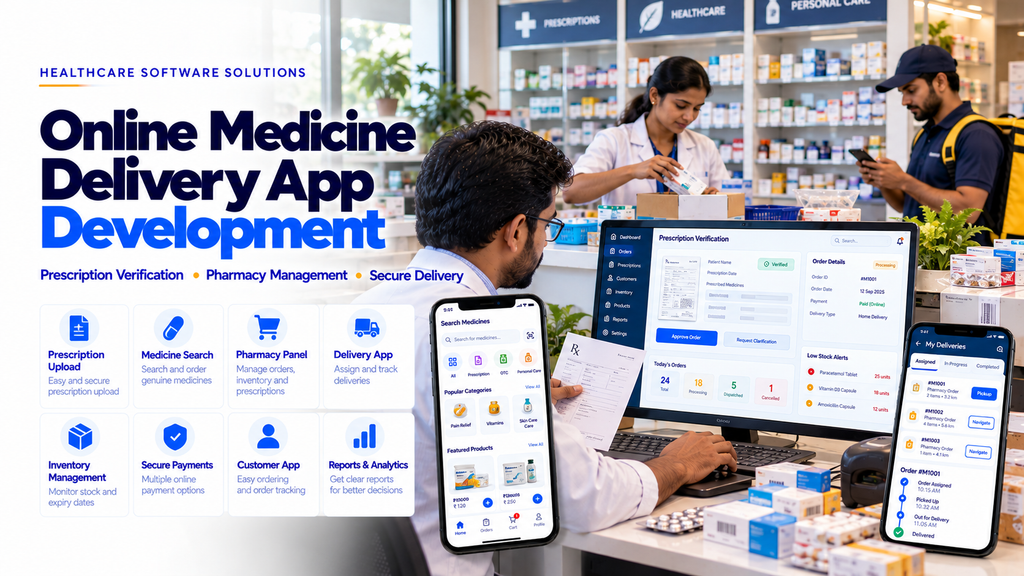
Online Medicine Delivery App Development: Features and Compliance
Digital ordering platforms are changing how businesses manage customer requests, inventory, payments and deliveries. Pharmacies also use software to organize prescription records, medicine stock, billing and customer communication.
However, an online medicine delivery app cannot be treated like an ordinary grocery or food delivery application. Medicines are regulated products, and pharmacy operations must follow applicable licensing, prescription, dispensing, storage and professional requirements.
For a licensed pharmacy, the purpose of digital software is to support authorized operations while keeping qualified pharmacists responsible for professional decisions.
An online pharmacy platform may include a customer application, prescription submission system, pharmacist review dashboard, pharmacy inventory management, administration panel and delivery coordination tools.
This guide explains the essential software features, security considerations, development planning and regulatory questions involved in online medicine delivery app development in India.
What Is an Online Medicine Delivery App?
An online medicine delivery app is a digital interface through which a pharmacy business may manage customer requests, prescription documentation, order records and delivery coordination, subject to applicable law.
The platform does not replace a qualified pharmacist or provide independent authorization to dispense medicines.
Its functions may include:
- Customer account management
- Pharmacy information
- Prescription document submission
- Pharmacist review workflows
- Inventory availability checks
- Order status management
- Billing records
- Delivery coordination
- Customer support
Why Pharmacy Software Requires Special Planning
Pharmacy applications may handle sensitive information, including prescriptions, customer identities and health-related records.
They also interact with physical operations such as medicine storage, expiry management, stock verification and pharmacist supervision.
For this reason, development should begin with a regulatory and operational requirements assessment rather than simply copying the features of a conventional shopping app.
1. Types of Pharmacy Software Platforms
Single-Pharmacy Management Platform
Supports one licensed pharmacy with customer records, inventory, prescription review and order administration.
Multi-Branch Pharmacy Platform
Supports several authorized pharmacy branches with location-specific inventory, employees and operational records.
Pharmacy Inventory and Billing Software
Focuses on medicine stock, batch information, expiry dates, invoices and purchase records.
Prescription Management Platform
Helps authorized pharmacy staff organize prescription submissions, review status and relevant documentation.
Pharmacy Delivery Coordination Software
Supports the logistics of orders that have already been reviewed and authorized through the appropriate pharmacy process.
2. Applications and Management Panels
| Module | Primary Users | Purpose |
|---|---|---|
| Customer App | Customers | Account, documentation and order status |
| Pharmacist Dashboard | Authorized pharmacists | Professional review and approval workflow |
| Pharmacy Admin Panel | Pharmacy management | Inventory, billing and operations |
| Branch Panel | Authorized branch employees | Branch-specific stock and records |
| Delivery Management | Authorized logistics staff | Approved dispatch and delivery status |
| Super Admin Panel | Platform administrators | Permissions, configuration and audit oversight |
3. Customer Application Features
A pharmacy customer application should prioritize clarity, accessibility and privacy.
Possible features include:
- Secure registration and login
- Customer profile
- Pharmacy contact information
- Prescription document submission
- Submission acknowledgement
- Pharmacist review status
- Approved order summaries
- Delivery status where legally permitted
- Receipts and transaction history
- Customer support
- Privacy settings
Customer-facing interfaces should not imply that submitting a prescription guarantees dispensing or delivery.
4. Prescription Upload and Document Management
Prescription management is a central feature of pharmacy software.
A suitable system may support secure document uploads, submission timestamps, access controls and review records.
Important safeguards include:
- Encrypted document transmission
- Restricted document access
- Clear review status
- Document quality checks
- Audit history
- Appropriate retention controls
Uploading a prescription is not the same as verifying its validity. Professional review remains essential.
5. Pharmacist Verification Dashboard
The pharmacist dashboard should support qualified staff in reviewing relevant information before any regulated dispensing decision.
Potential features include:
- Pending review queue
- Secure prescription viewing
- Relevant customer records
- Review notes
- Approval or rejection status
- Authorized reviewer identification
- Review timestamps
- Audit logs
The system should prevent ordinary administrative users or delivery personnel from overriding professional review decisions.
6. Pharmacy Inventory Management
Inventory software helps pharmacies maintain organized stock records.
Potential features include:
- Product master records
- Stock quantities
- Batch identification
- Expiry dates
- Purchase records
- Supplier records
- Stock adjustments
- Inventory reports
Inventory records should be reconciled with actual stock through appropriate pharmacy procedures.
7. Batch and Expiry Tracking
Medicine inventory requires careful attention to batches and expiry dates.
Software may help authorized employees identify:
- Batch-wise stock records
- Approaching expiry dates
- Expired inventory
- Stock requiring review
- Relevant supplier records
Physical inspection, storage controls and professional procedures remain necessary.
8. Pharmacy Billing and Invoice Management
Pharmacy billing software may help maintain authorized transaction records.
Potential features include:
- Invoice creation
- Transaction references
- Applicable tax configuration
- Payment records
- Authorized refunds
- Sales reporting
Tax treatment and recordkeeping requirements should be verified with qualified professionals.
9. Pharmacy Branch Management
Businesses operating multiple licensed premises may require branch-level administration.
Possible features include:
- Branch profiles
- Branch-specific permissions
- Separate inventory records
- Authorized employee accounts
- Branch reporting
- Operational audit history
Software configuration must reflect each branch’s actual licence conditions and authorized operations.
10. Delivery Management Features
Delivery coordination should begin only after the pharmacy has completed the required professional and regulatory checks.
Potential software features include:
- Approved dispatch queue
- Delivery assignment
- Delivery status updates
- Handover records
- Proof of delivery where appropriate
- Exception reporting
- Delivery completion records
Some products may require special handling or may not be eligible for a particular delivery model. Those decisions require legal and professional review.
11. Storage and Temperature Monitoring
Some medicines have specific storage requirements.
Depending on the pharmacy’s operations, software may integrate with authorized monitoring systems to record:
- Storage temperature readings
- Equipment alerts
- Inspection records
- Corrective action documentation
Digital monitoring supports but does not replace appropriate physical storage equipment and procedures.
12. Role-Based Access Control
Pharmacy applications should distinguish the responsibilities of different users.
| Role | Example Authorized Access |
|---|---|
| Customer | Own account and relevant order records |
| Pharmacist | Prescription review and professional records |
| Pharmacy Manager | Authorized inventory and operational reports |
| Delivery Employee | Minimum necessary delivery information |
| System Administrator | Technical configuration and access administration |
Permissions should follow the principle of least privilege.
13. Pharmacy Data Security
Healthcare-related information requires strong protection.
Important software safeguards include:
- Secure authentication
- Multifactor authentication for sensitive roles
- Encrypted communications
- Appropriate encryption at rest
- Protected prescription storage
- Access logging
- Secure API design
- Regular security updates
- Protected backups
- Incident response procedures
14. Patient and Customer Privacy
Pharmacy applications may process sensitive information relating to customer identities, prescriptions and transactions.
Privacy planning should address:
- Clear privacy notices
- Lawful purposes for processing
- Data minimization
- Access restrictions
- Retention and deletion policies
- Customer rights and request handling
- Security incident procedures
Indian digital personal data protection requirements should be reviewed according to the provisions in force at the time of implementation.
15. Pharmacy Licensing and Legal Compliance
Software developers and pharmacy operators must distinguish technical functionality from legal permission to operate.
Important regulatory considerations include:
- Applicable pharmacy and drug-sale licensing
- Prescription and dispensing requirements
- Qualified pharmacist supervision
- Drug category restrictions
- Recordkeeping requirements
- Storage and handling requirements
- Applicable consumer protection rules
- Data protection obligations
Indian pharmacy operations are subject to the Drugs and Cosmetics Act, 1940, the Drugs Rules, 1945, and other applicable laws and conditions.
Online pharmacy regulation should be reviewed carefully because draft e-pharmacy proposals must not be confused with enacted requirements.
Before launching any online medicine ordering or delivery service, the operator should obtain advice from appropriate regulatory and legal professionals.
16. Prescription-Only Medicine Controls
Some medicine categories are subject to specific prescription and recordkeeping requirements.
Software should support applicable restrictions through:
- Product classification controls
- Restricted workflow permissions
- Mandatory professional review
- Audit trails
- Appropriate record retention
- Blocked unauthorized fulfilment
These safeguards must be configured according to applicable law and the pharmacy’s authorized activities.
17. Regulatory Audit Logs
Audit logs can help authorized personnel review important system activity.
Possible events include:
- Account access
- Prescription review actions
- Inventory changes
- Order status changes
- Administrative permission changes
- Relevant billing adjustments
Audit records should be protected against unauthorized modification.
18. Pharmacy Software Integration
Existing pharmacies may already use billing or inventory systems.
Possible integrations include:
- Pharmacy billing software
- Inventory systems
- Accounting software
- Approved payment providers
- Notification services
- Authorized delivery management systems
Integration feasibility depends on the existing provider’s technical interfaces and contractual permissions.
19. Android and iOS Application Development
Pharmacy-related customer applications may be developed for Android and iOS using suitable native or cross-platform technologies.
Development planning should consider:
- Accessible interface design
- Secure authentication
- Document upload reliability
- Device compatibility
- Notification permissions
- Privacy disclosures
- Application store policies
- Long-term maintenance
20. Ready-Made vs Custom Pharmacy Software
| Ready-Made Software | Custom Development |
|---|---|
| Existing standard modules | Workflows based on documented requirements |
| May be quicker to configure | Requires design and testing |
| Customization may be limited | Can support specialized operations |
| Vendor-dependent maintenance | Support governed by the development agreement |
| Requires licensing and security review | Requires technical and compliance review |
Neither approach guarantees regulatory compliance without proper operational assessment.
21. Online Medicine Delivery App Development Cost
Development cost depends on the number of modules, security requirements, integrations and complexity of the pharmacy workflow.
Important cost factors include:
- Customer Android application
- Customer iOS application
- Pharmacist review dashboard
- Pharmacy administration panel
- Inventory and batch tracking
- Branch management
- Document storage
- Delivery coordination
- Payment integration
- Security testing
- Hosting and backups
- Maintenance
A basic pharmacy inventory system and a multi-branch digital pharmacy platform will have different development requirements and budgets.
Businesses should request a scope-based quotation rather than relying on a universal development price.
22. Development Process
- Business Requirements: Identify the licensed pharmacy’s operating model.
- Compliance Review: Confirm applicable requirements with qualified professionals.
- Workflow Design: Define pharmacist, administrator and customer responsibilities.
- UI/UX Design: Create accessible application interfaces.
- Database Planning: Structure secure records and permissions.
- Backend Development: Implement application services.
- Mobile Development: Build required customer applications.
- Admin Development: Implement pharmacy management modules.
- Integration: Connect approved third-party systems.
- Testing: Verify permissions, workflows and error handling.
- Security Review: Evaluate sensitive data protection.
- Deployment: Release only after necessary approvals and readiness checks.
- Maintenance: Monitor performance and security.
23. Common Pharmacy App Development Mistakes
- Treating medicine delivery like ordinary ecommerce
- Assuming software automatically establishes legal compliance
- Missing pharmacist approval controls
- Allowing excessive employee access
- Inadequate prescription document protection
- Weak inventory and expiry management
- Missing audit trails
- Unclear data retention policies
- Insufficient security testing
- Ignoring maintenance requirements
- Launching before regulatory review
24. Pharmacy Software Development in Erode and Tamil Nadu
Licensed pharmacies and healthcare businesses in Erode may require software for inventory management, prescription records, billing and authorized order coordination.
Greap Technologies can discuss pharmacy software requirements for businesses in Erode, Perundurai, Bhavani, Anthiyur, Gobichettipalayam, Sathyamangalam and other parts of Tamil Nadu.
Each implementation should reflect the pharmacy’s actual operating permissions and business requirements.
25. How Greap Technologies Can Help
Greap Technologies can help healthcare businesses evaluate software requirements for pharmacy administration, inventory management, secure documentation and customer-facing applications.
Depending on the agreed project scope, development may include:
- Pharmacy software requirement analysis
- Customer application development
- Pharmacist dashboard development
- Pharmacy admin panel
- Inventory and expiry management
- Branch management
- Prescription document management
- Role-based permissions
- Audit logging
- Approved integrations
- Security testing
- Deployment and maintenance support
Regulatory authorization and professional dispensing responsibilities remain with the appropriately licensed business and qualified professionals.
Explore Greap Technologies for custom healthcare software and mobile application development.
Conclusion
Online medicine delivery app development requires careful coordination between software engineering, pharmacy operations, information security and regulatory compliance.
Features such as secure prescription documentation, pharmacist review dashboards, batch-wise inventory, expiry tracking, role-based permissions and audit logs can support responsible pharmacy administration.
However, an application cannot replace a licensed pharmacy, qualified pharmacist or applicable legal requirements.
Businesses should confirm their operating model and regulatory obligations before commissioning an online pharmacy platform.
Planning Pharmacy Management Software in Erode?
Greap Technologies can help you discuss secure pharmacy management, inventory tracking, pharmacist dashboards and custom healthcare software requirements.
Frequently Asked Questions
1. What is an online medicine delivery app?
It is a digital platform that may support customer requests, pharmacy documentation, pharmacist review, inventory records and authorized delivery coordination.
2. Is an online medicine delivery app legal in India?
Legality depends on the actual business model, pharmacy licences, applicable drug-sale and dispensing rules, product categories and current regulatory requirements. Legal review is necessary before launch.
3. Does an app replace pharmacist verification?
No. Software can support documentation and review workflows, but it does not replace required professional supervision.
4. Can pharmacy software manage prescriptions?
Yes. Software can securely store submissions, manage review status and maintain authorized audit records.
5. Can pharmacy software track medicine expiry dates?
Yes. Inventory modules can support batch identification, expiry alerts and stock review records.
6. Can one system manage multiple pharmacy branches?
Yes. Multi-branch software can provide separate inventory, employee permissions and operational reporting for authorized branches.
7. What security features are important?
Secure authentication, encryption, restricted document access, audit logs, backups and regular security testing are important safeguards.
8. How much does pharmacy app development cost?
Cost depends on required applications, inventory modules, document management, integrations, security and maintenance.
9. Can pharmacy software support delivery coordination?
Yes. Software may coordinate orders that have completed the required pharmacy review and are eligible for delivery under applicable rules.
10. Does Greap Technologies develop pharmacy software?
Greap Technologies can assess pharmacy management and healthcare software requirements and propose development according to the agreed scope.