Grocery Delivery App Development in Erode: Features and Development Cost
Running a grocery business involves much more than keeping products on shelves. Supermarkets, provision stores, grocery wholesalers and neighbourhood grocery shops need to manage product availability, customer orders, billing, stock, packing, delivery and customer communication.
For businesses planning to sell groceries online, a mobile application can provide customers with a convenient way to browse products, place orders, choose delivery addresses and review order updates.
Imagine a supermarket in Erode receiving grocery orders through phone calls and WhatsApp messages. Employees may need to manually confirm products, calculate totals, check stock, collect addresses and coordinate deliveries.
As order volumes grow, these manual activities can become difficult to manage consistently.
A properly designed grocery delivery app in Erode can bring customer ordering, supermarket management and delivery coordination into one connected system.
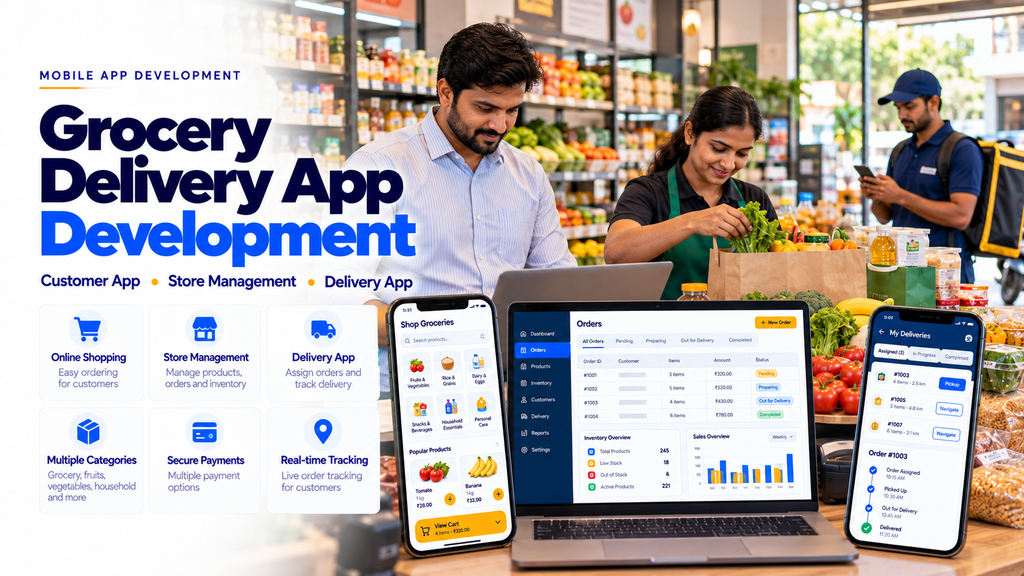
Depending on the business model, a grocery delivery platform may include a customer mobile application, supermarket admin panel, branch management panel, delivery partner application and website ordering system.
This guide explains the features, application modules, development options, cost factors and important considerations involved in grocery delivery app development.
What Is a Grocery Delivery App?
A grocery delivery app is a mobile application that allows customers to order groceries and household essentials from a store or online grocery business.
Customers may use the app to:
- Browse grocery categories
- Search for products
- View product prices
- Select quantities
- Add products to a cart
- Choose a delivery address
- Select a delivery option
- Place an order
- Make supported payments
- Check order status
On the business side, the application can connect with order management, inventory, packing, delivery and reporting modules.
Why Grocery Businesses in Erode Are Exploring Delivery Apps
Customers may prefer different shopping methods depending on their schedules, location and needs.
Some customers visit supermarkets directly, while others may prefer to order groceries from home.
Grocery delivery apps can help businesses offer an additional ordering channel while maintaining their physical stores.
Potential business benefits include:
- Online product visibility
- Digital customer ordering
- Centralized order records
- Reduced manual order entry
- Better stock visibility
- Organized packing workflows
- Delivery assignment records
- Customer order history
- Sales and operational reports
Results depend on customer demand, product availability, delivery operations, app usability and ongoing marketing.
Types of Grocery Delivery Applications
1. Single-Store Grocery Delivery App
A single-store application is designed for one grocery shop or supermarket.
It may include one customer app, one admin panel and delivery management features.
2. Multi-Branch Supermarket Delivery App
A multi-branch application can help supermarket businesses manage multiple outlets.
Features may include branch-wise inventory, order allocation, branch staff accounts and location-based fulfilment.
3. Multi-Vendor Grocery Marketplace
A multi-vendor platform allows multiple independent grocery sellers to operate through one application.
It may require vendor registration, commission rules, separate seller dashboards, marketplace payments and centralized administration.
4. Hyperlocal Grocery Delivery App
A hyperlocal application focuses on deliveries within defined service areas.
It may include delivery zones, address eligibility, order assignment and delivery fee configuration.
5. Grocery Ordering App with Store Pickup
Some grocery businesses may offer online ordering with customer pickup rather than home delivery.
This model can be suitable when a store wants digital ordering without managing a delivery fleet.
Applications Required for a Grocery Delivery Business
The number of applications depends on the business model and operational requirements.
| Application | Primary Users | Main Purpose |
|---|---|---|
| Customer App | Grocery shoppers | Browse products and place orders |
| Super Admin Panel | Business owner | Manage the platform |
| Store / Branch Panel | Store employees | Manage products, stock and orders |
| Delivery Partner App | Delivery employees | Manage assigned deliveries |
| Website / Web Ordering | Customers | Browse or order through a browser |
1. Grocery Customer Mobile App Development
The customer application is the main shopping interface.
It should be designed to help customers find groceries, understand prices and place orders without unnecessary steps.
Customer Registration and Login
- Customer registration
- Mobile number login
- Supported OTP verification
- Profile management
- Account settings
Grocery Home Screen
- Product categories
- Featured products
- Promotional banners
- Frequently purchased items
- Product search
- Store information
Product Catalogue
- Product names
- Product images
- Product descriptions
- Available pack sizes
- Prices
- Stock availability
- Applicable product information
Shopping Cart
- Add to cart
- Update quantities
- Remove products
- View order subtotal
- Review delivery charges
- View applicable taxes
- Review final amount
Customer Checkout
- Delivery address selection
- Delivery eligibility check
- Delivery slot selection where supported
- Order notes
- Payment option selection
- Order confirmation
Customer Order Tracking
Customers may view order status updates such as:
Actual status updates depend on how the store and delivery teams use the system.
Customer Order History
- Previous orders
- Order details
- Invoice access
- Order status
- Reorder options
Customer Notifications
Notifications may be sent for order confirmation, packing, dispatch, delivery and approved promotional communication.
2. Grocery Super Admin Panel Development
The super admin panel helps the business owner manage the overall grocery delivery platform.
Potential features include:
- Business dashboard
- Store and branch management
- Employee accounts
- Customer management
- Product categories
- Product catalogue
- Inventory overview
- Order management
- Delivery management
- Offers and coupons
- Payment records
- Refund records
- Business reports
- Application settings
- Role-based permissions
For multi-vendor marketplaces, additional seller and commission modules may be required.
3. Grocery Store and Branch Management Panel
A branch management panel helps store employees manage daily grocery fulfilment activities.
Potential features include:
- Branch dashboard
- Branch product availability
- Stock updates
- Incoming orders
- Order acceptance
- Picking lists
- Packing status
- Substitution requests
- Delivery handover
- Branch reports
Branch employees should access only the records and functions required for their responsibilities.
4. Grocery Delivery Partner App Development
A delivery partner application helps authorized delivery employees manage assigned orders.
Potential features include:
- Secure delivery employee login
- Assigned orders
- Pickup details
- Customer delivery address
- Navigation integration
- Order pickup confirmation
- Delivery status updates
- Proof of delivery where appropriate
- Completed delivery history
- Delivery-related payment records
Location information should be handled transparently and only for appropriate operational purposes.
5. Grocery Product Category Management
Grocery stores may organize products into categories such as:
- Rice and grains
- Pulses and lentils
- Cooking oils
- Spices and masala
- Fruits
- Vegetables
- Dairy products
- Packaged foods
- Snacks
- Beverages
- Household essentials
- Personal care products
Categories should reflect the actual products sold by the store.
6. Grocery Product Variant Management
Some grocery products are sold in different quantities and package sizes.
Examples include:
- Rice in different bag sizes
- Cooking oil in different pack sizes
- Spices in different weights
- Vegetables sold by weight
- Packaged grocery items sold by unit
The system may support unit-specific prices, stock records and product variants.
7. Grocery Inventory Management
Inventory management helps supermarkets track product availability.
Potential features include:
- Product stock quantities
- Branch-wise stock
- Stock receipts
- Stock adjustments
- Low-stock alerts
- Reserved stock
- Stock movement history
- Inventory reports
Stock accuracy depends on timely updates and appropriate physical verification.
8. Grocery Expiry and Batch Tracking
Some grocery products require batch and expiry tracking.
Potential features include:
- Batch numbers
- Manufacturing information where applicable
- Expiry dates
- Stock quantities by batch
- Expiry alerts
- Stock rotation records
Expiry and food safety requirements should be reviewed according to the products sold.
9. Grocery Order Management
The order management module helps stores organize customer purchases.
Potential features include:
- Incoming orders
- Order confirmation
- Product availability checks
- Picking and packing
- Order cancellation
- Refund requests
- Dispatch status
- Delivery completion
10. Grocery Picking and Packing Management
Store employees may need a structured process to prepare customer orders.
Potential features include:
- Order picking lists
- Product quantity verification
- Out-of-stock identification
- Customer-approved substitutions
- Packing confirmation
- Ready-for-dispatch status
This can help employees follow a consistent order preparation workflow.
11. Grocery Delivery Zone Management
Delivery zone management helps businesses define supported service locations.
Potential features include:
- Delivery zones
- Serviceable postal codes
- Delivery distance rules
- Zone-specific charges
- Minimum order values
- Delivery eligibility checks
Delivery areas should be configured according to actual store coverage and delivery capacity.
12. Grocery Delivery Slot Management
Some grocery businesses may allow customers to select delivery time windows.
Potential features include:
- Available delivery slots
- Slot capacity limits
- Same-day delivery options
- Scheduled deliveries
- Delivery cutoff times
- Slot availability updates
Delivery promises should reflect realistic packing and transport capacity.
13. Grocery Delivery Assignment Management
Order assignment helps store employees coordinate deliveries.
Potential features include:
- Unassigned deliveries
- Available delivery employees
- Manual assignment
- Supported automatic assignment rules
- Pickup confirmation
- Delivery status
14. Grocery Delivery Tracking
Delivery tracking can help customers and store managers review order progress.
Depending on the implementation, the system may support:
- Order status tracking
- Delivery employee assignment
- Pickup confirmation
- Location updates with appropriate permissions
- Delivery completion
Real-time location tracking requires suitable device permissions, network connectivity and privacy safeguards.
15. Grocery Online Payment Integration
Grocery delivery applications may support suitable payment methods through authorized payment providers.
Potential features include:
- Online payment initiation
- Payment confirmation
- Transaction references
- Payment status
- Refund processing
- Payment reconciliation
Payment gateway charges, onboarding requirements and supported payment methods depend on the selected provider.
16. Cash on Delivery Management
Some grocery businesses may offer cash on delivery.
Potential features include:
- Cash on delivery selection
- Amount payable
- Collection confirmation
- Delivery employee settlement records
- Cash reconciliation reports
Cash handling procedures should be clearly documented and authorized.
17. Grocery Coupon and Offer Management
Grocery stores may use approved promotional offers.
Potential features include:
- Coupon creation
- Discount configuration
- Minimum order conditions
- Coupon validity dates
- Usage limits
- Eligible products
- Promotion reports
Offers should display clear conditions and comply with applicable consumer protection requirements.
18. Grocery Customer Loyalty Features
Some grocery businesses may want loyalty or repeat-order features.
Potential features include:
- Customer purchase history
- Approved loyalty programmes
- Reward records
- Reorder options
- Customer preferences
Customer communication and data use should follow applicable privacy requirements.
19. Grocery Push Notification Management
Push notifications may help customers receive order updates.
Potential notifications include:
- Order confirmation
- Order packing
- Dispatch updates
- Delivery completion
- Refund updates
- Opted-in promotional messages
Notification preferences should be respected.
20. Grocery SMS and WhatsApp Integration
Grocery businesses may want to communicate order information through supported messaging services.
Potential features include:
- Order confirmation messages
- Delivery updates
- Customer support links
- Approved message templates
- Communication logs
WhatsApp Business API and SMS services may involve provider approval, usage charges and applicable messaging policies.
21. Grocery Customer Support Management
Customer support features may help stores organize order-related questions.
Potential features include:
- Customer enquiries
- Order-linked support requests
- Product issue reports
- Delivery complaints
- Refund requests
- Support status
22. Grocery Refund and Cancellation Management
Order cancellations and refunds should follow clear store policies and applicable consumer requirements.
Potential features include:
- Cancellation requests
- Cancellation reasons
- Refund eligibility
- Refund approvals
- Refund status
- Transaction references
23. Grocery Product Substitution Management
Grocery stores may encounter unavailable products after an order is placed.
Potential features include:
- Out-of-stock identification
- Alternative product suggestions
- Customer approval
- Price difference calculation
- Updated order totals
Substitutions should be confirmed according to the customer’s preferences and the store’s policies.
24. Grocery Multi-Branch Management
Supermarkets operating several branches may require centralized management.
Potential features include:
- Branch profiles
- Branch-specific products
- Branch inventory
- Branch order allocation
- Employee access
- Branch delivery zones
- Branch sales reports
25. Multi-Vendor Grocery Marketplace Features
Businesses planning a grocery marketplace may need additional modules.
Potential features include:
- Vendor registration
- Vendor approval
- Vendor dashboards
- Vendor product management
- Vendor orders
- Commission configuration
- Settlement records
- Marketplace reporting
Multi-vendor marketplaces generally require more complex operational and financial workflows than single-store applications.
26. Grocery Delivery App Admin Dashboard
A management dashboard can help business owners review important operational information.
Potential modules include:
- Today’s orders
- Pending orders
- Orders being packed
- Out-for-delivery orders
- Completed orders
- Product stock
- Customer records
- Sales summaries
27. Grocery Sales Reports
Sales reporting can help supermarkets review recorded transactions.
Potential reports include:
- Daily sales
- Monthly sales
- Product-wise sales
- Category-wise sales
- Branch-wise sales
- Payment method summaries
- Refund summaries
28. Grocery Inventory Reports
Inventory reports can help stores review product availability.
Potential reports include:
- Current stock
- Low-stock products
- Out-of-stock products
- Branch-wise stock
- Stock adjustments
- Expiry-related records
29. Grocery Delivery Reports
Delivery reports can help businesses review fulfilment operations.
Potential reports include:
- Assigned deliveries
- Completed deliveries
- Pending deliveries
- Cancelled deliveries
- Delivery zone summaries
- Delivery-related payment records
30. Grocery Delivery App with Website Ordering
Some grocery businesses may want both a mobile application and a website.
A grocery ordering website may include:
- Grocery product catalogue
- Product search
- Shopping cart
- Customer login
- Checkout
- Order tracking
- Contact information
- Delivery policy
A responsive website can provide another ordering option for customers who prefer not to install an application.
31. Grocery App Development for Android
Android grocery applications may be developed using native Android technologies or suitable cross-platform frameworks.
Important considerations include:
- Supported Android versions
- Device compatibility
- Application performance
- Secure authentication
- Push notifications
- App store requirements
- Maintenance and updates
32. Grocery App Development for iOS
Grocery businesses may also want an iOS application for customers using Apple devices.
Important considerations include:
- Supported iOS versions
- iPhone interface design
- Secure authentication
- Payment integration
- Push notifications
- App Store review requirements
- Ongoing compatibility updates
33. Grocery Delivery App Development Using Flutter
Flutter is one possible framework for developing mobile applications that target Android and iOS.
Potential advantages include:
- Shared application codebase
- Consistent interface development
- Reusable UI components
- Support for Android and iOS
Framework selection should consider performance requirements, device features, integrations, developer expertise and long-term maintenance.
34. Grocery Delivery App Development Using Ready-Made Solutions
Some grocery businesses may consider licensed ready-made applications instead of building every feature from the beginning.
Ready-made solutions may provide:
- Customer ordering applications
- Admin panels
- Store management
- Delivery management
- Basic payment integrations
Before choosing a ready-made solution, businesses should verify licensing, source code availability, update support, security, payment compatibility and customization restrictions.
35. Custom Grocery App vs Ready-Made Grocery App
| Ready-Made Grocery App | Custom Grocery App |
|---|---|
| Prebuilt functionality | Features based on business requirements |
| May offer faster initial setup | Requires development and testing |
| Customization may be limited | Supports tailored workflows |
| Dependent on vendor updates | Maintenance follows the agreed development arrangement |
| Licensing and configuration costs | Custom development and ongoing support costs |
The right choice depends on the business model, budget, required features, long-term plans and technical support needs.
36. Grocery Delivery App Development Cost in Erode
The cost of grocery delivery app development in Erode depends on the number of applications, complexity of features, development approach, integrations and maintenance requirements.
Important cost factors include:
- Customer Android application
- Customer iOS application
- Super admin panel
- Store or branch management panel
- Delivery partner application
- Grocery ordering website
- Product and inventory management
- Online payment integration
- Delivery zone configuration
- Live tracking requirements
- SMS and notification services
- Multi-vendor functionality
- UI/UX customization
- Security requirements
- Testing and deployment
- Hosting and maintenance
A basic single-store grocery application may require fewer modules than a multi-branch or multi-vendor grocery marketplace.
Businesses should request an itemized quotation identifying development fees, hosting, third-party services, app publishing costs and recurring maintenance charges.
37. Example Grocery App Cost Structure
A grocery delivery project quotation may separate charges by application or platform component.
| Component | Typical Scope | Pricing Consideration |
|---|---|---|
| Customer Android App | Products, cart, checkout and orders | Feature complexity |
| Customer iOS App | iPhone shopping experience | Platform compatibility and testing |
| Super Admin Panel | Central platform management | Modules and permissions |
| Branch Panel | Store orders and inventory | Branch workflows |
| Delivery Partner App | Pickup and delivery management | Tracking and integrations |
| Website | Landing page or online ordering | Design and ecommerce functionality |
| Hosting | Server and infrastructure | Traffic, storage and support |
| Maintenance | Updates and technical support | Agreed service scope |
Actual pricing should be determined after confirming the required features, application platforms and delivery workflow.
38. Grocery App Development Timeline
Development timelines vary depending on project scope.
A ready-made grocery solution with limited customization may require less implementation effort than a fully custom application.
A complete multi-vendor platform with Android, iOS, vendor management, delivery tracking and complex financial settlements generally requires more design, development and testing.
Before development begins, the business should agree on requirements, milestones, testing procedures and deployment responsibilities.
39. Grocery Delivery App Development Process
- Business Requirement Analysis: Understand the store and delivery model.
- Feature Planning: Define customer, admin, store and delivery modules.
- UI/UX Design: Design responsive and mobile-friendly interfaces.
- Database Planning: Structure product, customer, order and stock records.
- Backend Development: Build secure application services.
- Mobile App Development: Develop the required applications.
- Admin Panel Development: Implement management workflows.
- Payment Integration: Connect supported payment services.
- Delivery Integration: Implement delivery management.
- Functional Testing: Test real grocery ordering workflows.
- Security Testing: Review authentication and data access.
- Deployment: Release the website and applications.
- Training: Train store and delivery employees.
- Maintenance: Support updates and improvements.
40. Grocery Delivery App Security
Grocery applications may store customer contact details, delivery addresses, order records and payment references.
Important safeguards include:
- Secure authentication
- Role-based permissions
- Appropriate encryption
- Secure session management
- Input validation
- Protected API endpoints
- Secure payment provider integration
- Audit logs
- Regular backups
- Security updates
Payment card information should be handled through appropriately compliant payment providers rather than unnecessarily stored in the grocery application.
41. Grocery App Customer Data Privacy
Grocery businesses should protect customer information, including phone numbers, delivery addresses and order histories.
Important considerations include:
- Purpose-based data collection
- Appropriate privacy notices
- Consent where required
- Restricted employee access
- Secure data storage
- Data retention policies
- Customer account management
- Secure deletion procedures
Applicable Indian data protection requirements should be reviewed before deployment.
42. Grocery App Hosting and Server Requirements
Grocery delivery platforms typically require backend hosting and database infrastructure.
Hosting requirements depend on:
- Number of customers
- Number of products
- Order volume
- Image storage
- Database size
- API traffic
- Security requirements
- Backup needs
Hosting should be selected according to actual application requirements and expected usage.
43. Grocery Delivery App Maintenance
After deployment, grocery applications may require regular technical maintenance.
Maintenance activities may include:
- Security updates
- Bug fixes
- Operating system compatibility updates
- Application performance monitoring
- Server monitoring
- Database maintenance
- Backup verification
- Feature improvements
Maintenance costs depend on the agreed service scope and required work.
44. Grocery App Publishing on Google Play and Apple App Store
Businesses planning to publish mobile applications should account for app store requirements.
Important considerations include:
- Developer account registration
- App ownership
- Store listing information
- Application screenshots
- Privacy policy
- Required disclosures
- Platform testing
- App review and approval
Developer programme fees and publishing policies are set by the respective platform providers and may change.
45. Grocery Delivery App Development for Local Businesses in Erode
Different grocery businesses may need different application features.
Small Grocery Shops
May require a basic product catalogue, customer ordering, order management and local delivery.
Supermarkets
May require larger product catalogues, inventory management, offers, packing workflows and delivery assignment.
Multi-Branch Supermarkets
May require branch-specific stock, order routing, employee access and centralized reporting.
Organic Grocery Businesses
May require product information, scheduled deliveries and repeat-order features.
Grocery Delivery Startups
May require scalable order management, delivery zones, customer acquisition features and marketplace functionality.
46. Grocery Delivery App Development Across Erode District
Grocery stores, supermarkets and online delivery businesses across Erode district may explore mobile applications based on customer demand, delivery capacity and business requirements.
Relevant locations include:
- Erode
- Perundurai
- Bhavani
- Anthiyur
- Gobichettipalayam
- Sathyamangalam
- Modakkurichi
- Kodumudi
- Nambiyur
- Chennimalai
- Kavindapadi
- Ammapettai
- Arachalur
- Sivagiri
- Punjai Puliampatti
- Thalavadi
- Solar
- Surampatti
- Veerappanchatram
- Nasiyanur
Delivery availability should be determined by the actual service area of each grocery business.
47. How to Choose a Grocery Delivery App Development Company in Erode
Before selecting a development provider, consider:
- Understanding of grocery ordering workflows
- Experience with mobile applications
- Customer app usability
- Admin and store management features
- Inventory management capabilities
- Delivery management workflows
- Payment integration knowledge
- Security practices
- Testing procedures
- Application ownership and licensing
- Deployment support
- Maintenance arrangements
48. Common Grocery Delivery App Development Mistakes
- Launching without validating customer demand
- Adding too many features before defining core workflows
- Ignoring product stock accuracy
- Complicated customer checkout
- Unclear delivery charges
- Unrealistic delivery time promises
- Missing substitution workflows
- Weak cancellation and refund processes
- Incorrect payment status handling
- Ignoring customer data privacy
- Skipping realistic order testing
- Failing to train store employees
- Ignoring maintenance and updates
49. Grocery Delivery App Launch Checklist
- Define the grocery delivery business model.
- Identify the target service area.
- Prepare the product catalogue.
- Configure product prices and units.
- Plan inventory management.
- Define customer ordering workflows.
- Set delivery charges and policies.
- Define packing and substitution procedures.
- Choose payment options.
- Plan customer support.
- Define cancellation and refund policies.
- Set employee roles and permissions.
- Test Android and iOS compatibility where applicable.
- Test real ordering scenarios.
- Prepare app store information.
- Train store and delivery employees.
- Plan marketing and customer onboarding.
- Maintain and update the application.
50. How Greap Technologies Can Help
Greap Technologies can help grocery businesses discuss mobile app development requirements, including customer ordering, supermarket management, delivery applications and online grocery platforms.
Depending on the agreed project scope, solutions may include:
- Grocery delivery app requirement analysis
- Customer Android app development
- Customer iOS app development
- Super admin panel development
- Store and branch management panels
- Delivery partner applications
- Product catalogue management
- Inventory management
- Grocery order management
- Delivery management
- Online payment integration
- Grocery ordering websites
- Application deployment support
- Security testing and maintenance
Explore Greap Technologies for grocery delivery app development, ecommerce solutions, mobile applications and business software development.
Conclusion
Grocery delivery app development in Erode can help supermarkets, provision stores and grocery businesses offer online ordering, organize customer purchases, manage inventory and coordinate deliveries.
A grocery delivery platform may include a customer application, super admin panel, store management panel, delivery partner application and optional online ordering website.
Development cost depends on the business model, application platforms, feature requirements, integrations, security, testing and maintenance.
Before investing in a grocery delivery application, businesses should define their operational requirements, delivery areas, product catalogue, payment policies and customer support procedures.
A requirements-based approach can help businesses choose between a ready-made grocery delivery solution and a custom-developed application.
Need a Grocery Delivery App in Erode?
Greap Technologies can help you discuss customer grocery apps, supermarket admin panels, delivery partner apps, inventory management and custom grocery ecommerce requirements.
Frequently Asked Questions
1. What is a grocery delivery app?
A grocery delivery app allows customers to browse groceries, place orders, select delivery addresses and receive order updates through a mobile application.
2. How much does grocery delivery app development cost in Erode?
Development cost depends on the customer app, admin panel, delivery app, payment integrations, inventory features, customization and maintenance requirements.
3. What applications are required for a grocery delivery business?
A typical system may include a customer app, super admin panel, store management panel and delivery partner app. A website may also be included.
4. Can a grocery delivery app support Android and iOS?
Yes. Grocery applications can be developed for Android and iOS using suitable native or cross-platform technologies.
5. Can grocery delivery apps manage supermarket inventory?
Yes. Inventory modules can maintain product stock, branch availability, stock adjustments and low-stock alerts.
6. Can customers pay online through a grocery app?
Yes. Supported online payment services can be integrated according to the selected payment provider’s requirements.
7. Can grocery apps support cash on delivery?
Yes. Cash on delivery can be offered with suitable collection and reconciliation workflows.
8. Can one grocery app manage multiple supermarket branches?
Yes. Multi-branch applications can support branch-wise inventory, order allocation and centralized reporting.
9. Can a grocery delivery app track delivery employees?
Delivery applications can support order status updates and, where appropriate, location tracking with suitable permissions and privacy safeguards.
10. How long does grocery delivery app development take?
Development time depends on the application modules, customization, integrations, testing and deployment requirements.
11. Is a ready-made grocery app better than custom development?
Ready-made applications may suit businesses with standard requirements, while custom development may be appropriate for specialized workflows and integrations.
12. Does Greap Technologies develop grocery delivery apps in Erode?
Greap Technologies can help assess grocery delivery app requirements and develop suitable applications according to the agreed project scope.