Multi-Vendor Delivery App Development for Local Businesses in Erode
Local businesses in Erode operate across many categories, including supermarkets, restaurants, grocery shops, bakeries, retail stores and specialty product businesses. Each business has its own customers, products, operating hours and delivery requirements.
Customers may want to order from these businesses without visiting multiple stores. At the same time, local shop owners may want an online sales channel without developing a separate mobile application for every store.
A multi-vendor delivery app connects multiple participating businesses through one digital marketplace. Customers can discover local vendors, browse products, place orders and receive delivery updates through a single application.
Vendors can manage their own products and orders, while the platform owner can supervise vendors, payments, commissions, delivery assignments and overall marketplace operations.
For entrepreneurs planning a hyperlocal delivery business in Erode, this model may support grocery delivery, food delivery, retail shopping and other eligible local delivery services.
However, developing a successful marketplace requires more than attractive app screens. The platform must support reliable vendor onboarding, order management, product availability, payment reconciliation, delivery coordination, customer support and appropriate security.
This guide explains the business models, essential applications, features, development costs, operational challenges and launch considerations involved in multi-vendor delivery app development in Erode.
What Is a Multi-Vendor Delivery App?
A multi-vendor delivery app is an online marketplace that allows multiple independent businesses to offer eligible products or services through one platform.
For example, a local delivery marketplace may allow customers to browse participating grocery stores, restaurants and retail shops.
Each vendor may have a separate management panel for products, prices, availability and orders.
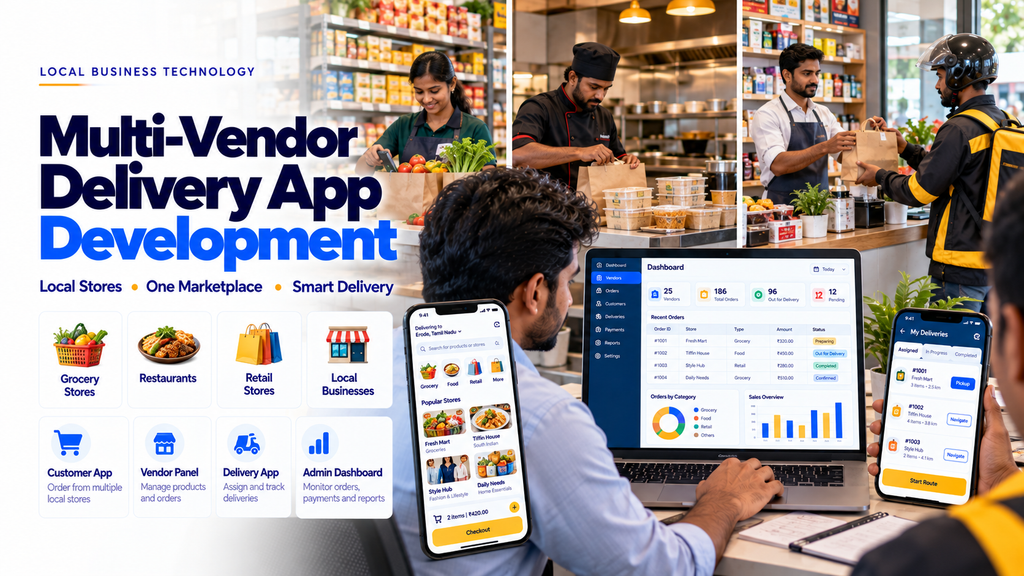
The platform owner manages the overall marketplace through a super admin panel, while delivery employees use a delivery application to handle assigned orders.
Why Local Businesses in Erode May Need a Multi-Vendor Marketplace
Many local businesses use telephone calls, messaging applications or individual websites to receive customer orders.
These methods may work for smaller order volumes, but managing multiple vendors through manual processes can become difficult.
A properly implemented marketplace can help with:
- Centralized local business discovery
- Online product and service listings
- Digital customer ordering
- Vendor-specific order management
- Delivery coordination
- Payment and commission records
- Customer support
- Business reporting
Business success depends on local demand, vendor participation, service quality, customer acquisition and sustainable delivery operations.
1. Types of Multi-Vendor Delivery Businesses
Grocery Delivery Marketplace
Connects participating supermarkets and grocery shops with customers ordering groceries and household essentials.
Food Delivery Marketplace
Connects participating restaurants, bakeries and eligible food businesses with customers ordering prepared food.
Retail Delivery Marketplace
Allows participating local retailers to list eligible products for customer ordering and delivery.
Hyperlocal Shopping Marketplace
Combines multiple local business categories within a defined delivery area.
Multi-Store Ecommerce Marketplace
Supports several vendors selling products through a centralized online shopping platform.
Specialized Delivery Marketplace
Focuses on a particular category, such as flowers, gifts or other eligible locally deliverable products.
Regulated products, including medicines, may require additional licensing, verification and restrictions before being offered through a marketplace.
2. Applications Required for a Multi-Vendor Delivery Platform
| Application | Users | Main Purpose |
|---|---|---|
| Customer App | Marketplace customers | Discover vendors and place orders |
| Super Admin Panel | Platform owner | Manage the marketplace |
| Vendor Panel | Participating businesses | Manage products and orders |
| Delivery Partner App | Delivery employees | Manage pickup and delivery |
| Marketplace Website | Customers | Browse vendors and order online |
The exact application structure depends on the selected marketplace software and business requirements.
3. Customer Mobile App Features
The customer app is the main interface for exploring local vendors and placing orders.
Customer Registration
- Mobile number registration
- Supported OTP verification
- Customer profile
- Saved delivery addresses
- Account settings
Vendor Discovery
- Nearby participating vendors
- Vendor categories
- Vendor search
- Business information
- Operating hours
- Delivery availability
Product Browsing
- Product categories
- Product images
- Product descriptions
- Prices
- Variants
- Availability
Shopping Cart
- Add products
- Update quantities
- Remove items
- Review item totals
- View delivery charges
- View applicable taxes
- Review final payable amount
Checkout
- Delivery address
- Delivery eligibility
- Supported payment methods
- Order notes
- Order confirmation
Order History
- Previous orders
- Order details
- Invoices or receipts
- Order status
- Support requests
4. Super Admin Panel Features
The super admin panel helps the platform owner manage the complete marketplace.
Potential modules include:
- Marketplace dashboard
- Vendor registration and approval
- Vendor categories
- Product moderation
- Customer management
- Order management
- Delivery management
- Payment records
- Commission configuration
- Vendor settlements
- Refund management
- Coupons and offers
- Customer support
- Reports
- User roles and permissions
- Platform settings
5. Vendor Management Panel Features
Each participating vendor may receive a separate dashboard.
Potential features include:
- Vendor profile
- Business information
- Operating hours
- Product catalogue
- Product pricing
- Stock availability
- Incoming orders
- Order acceptance
- Order preparation
- Pickup readiness
- Sales summaries
- Settlement records
Vendor access should be restricted to the vendor’s own authorized business records.
6. Vendor Registration and Approval
A multi-vendor marketplace needs a process for onboarding participating businesses.
Potential features include:
- Vendor registration forms
- Business information collection
- Required document submission
- Administrative verification
- Vendor approval
- Vendor account activation
- Business category assignment
Required verification depends on the vendor category and applicable regulations.
7. Vendor Category Management
Marketplace administrators may organize participating businesses into categories.
Examples include:
- Grocery stores
- Supermarkets
- Restaurants
- Bakeries
- Fruit and vegetable stores
- Household goods stores
- Flower shops
- Gift shops
- Other eligible retail businesses
Categories should reflect the actual marketplace business model.
8. Multi-Vendor Product Management
Vendors need tools to maintain accurate product information.
Potential features include:
- Product creation
- Product categories
- Product images
- Descriptions
- Prices
- Variants
- Availability status
- Product updates
The platform may also require moderation rules to prevent prohibited or misleading listings.
9. Vendor Inventory Management
Some marketplaces may include stock management features.
Potential features include:
- Available quantities
- Stock adjustments
- Low-stock alerts
- Out-of-stock status
- Stock movement history
- Inventory reports
Inventory accuracy depends on timely updates by participating vendors and suitable synchronization with any external systems.
10. Multi-Vendor Order Management
Order management is one of the most important parts of a delivery marketplace.
Potential features include:
- Customer order creation
- Vendor-specific order routing
- Vendor order acceptance
- Order preparation status
- Pickup readiness
- Delivery assignment
- Order completion
- Cancellation records
11. Multi-Vendor Cart Management
One important business decision is whether customers can purchase products from multiple vendors in a single checkout.
Possible approaches include:
- One vendor per order
- Multiple vendors with separate orders
- Combined checkout with vendor-wise order splitting
Combined checkout requires careful planning for delivery charges, payment allocation, cancellations, refunds and vendor settlements.
12. Order Splitting and Vendor Routing
When customers purchase from more than one vendor, the platform may need to create separate fulfilment records.
Potential features include:
- Vendor-wise order items
- Separate preparation status
- Separate pickup locations
- Delivery fee calculation
- Vendor-specific cancellations
- Vendor settlement records
13. Delivery Partner App Features
The delivery partner app helps delivery employees manage assigned pickups and deliveries.
Potential features include:
- Secure delivery employee login
- Assigned orders
- Vendor pickup details
- Customer delivery information
- Navigation integration
- Pickup confirmation
- Delivery status updates
- Proof of delivery where appropriate
- Completed delivery history
- Settlement records
14. Delivery Zone Management
Hyperlocal marketplaces should define their service areas.
Potential features include:
- Delivery zones
- Supported postal codes
- Vendor-specific delivery areas
- Delivery distance rules
- Delivery charge configuration
- Address eligibility checks
Delivery coverage should reflect actual operational capacity.
15. Delivery Assignment Management
Delivery assignment helps coordinate available delivery employees with customer orders.
Potential features include:
- Unassigned orders
- Available delivery employees
- Manual assignment
- Supported automated assignment rules
- Pickup confirmation
- Delivery completion
16. Multi-Pickup Delivery Management
Some marketplaces may need delivery employees to collect products from more than one vendor.
Potential features include:
- Multiple pickup locations
- Pickup sequence
- Vendor readiness status
- Delivery destination
- Order handover records
Multi-pickup delivery is more complex than delivering one order from one store and should be evaluated carefully.
17. Real-Time Delivery Tracking
Customers and administrators may want visibility into delivery progress.
Potential features include:
- Order status updates
- Pickup confirmation
- Out-for-delivery status
- Location updates where permitted
- Delivery completion
Real-time tracking requires suitable device permissions, network connectivity and privacy safeguards.
18. Delivery Fee Management
Delivery fees may depend on the marketplace business model.
Possible configurations include:
- Flat delivery charges
- Zone-based charges
- Distance-based charges
- Minimum order requirements
- Vendor-specific delivery rules
- Approved promotional delivery discounts
Customers should see applicable delivery charges before confirming an order.
19. Online Payment Integration
Multi-vendor delivery applications may integrate supported payment services.
Potential features include:
- Payment initiation
- Payment confirmation
- Transaction references
- Payment status
- Refund processing
- Payment reconciliation
Marketplace payment collection and vendor payouts must be designed according to the selected provider’s capabilities and applicable regulations.
20. Cash on Delivery Management
Some marketplaces may offer cash on delivery.
Potential features include:
- Cash on delivery selection
- Amount payable
- Collection confirmation
- Delivery employee cash records
- Settlement reports
Cash handling and settlement procedures should be documented clearly.
21. Vendor Commission Management
Multi-vendor marketplace owners may charge agreed commissions.
Potential features include:
- Vendor commission rates
- Category-specific commission rules
- Order-linked commission calculations
- Commission reports
- Settlement adjustments
Commission terms should be transparent and agreed upon with participating vendors.
22. Vendor Settlement Management
Marketplace platforms may need to calculate amounts payable to vendors.
Potential features include:
- Vendor sales totals
- Agreed commissions
- Refund adjustments
- Applicable deductions
- Settlement amounts
- Payment references
- Settlement history
Settlement processes should be reviewed for accounting, tax and payment compliance.
23. Marketplace Subscription Plans
Some marketplaces may offer paid vendor subscription plans.
Potential features include:
- Vendor subscription plans
- Plan pricing
- Plan validity
- Feature access rules
- Renewal records
- Subscription reports
24. Marketplace Revenue Models
Multi-vendor delivery businesses may use one or more revenue models.
Vendor Commissions
Charge an agreed commission on eligible vendor transactions.
Delivery Charges
Collect disclosed delivery fees from customers.
Vendor Subscription Fees
Offer paid vendor plans with defined services.
Promotional Listings
Offer clearly identified promotional placement where appropriate.
Software Licensing
License marketplace software to eligible business operators under agreed terms.
Revenue models should be evaluated against delivery, support, payment processing and customer acquisition costs.
25. Marketplace Coupon Management
Promotional tools may include:
- Coupon creation
- Discount conditions
- Eligible vendors
- Minimum order values
- Validity dates
- Usage limits
Offer conditions should be clear to customers.
26. Customer Loyalty Features
Some marketplaces may support repeat purchasing through:
- Order history
- Reorder options
- Approved loyalty programmes
- Reward records
- Customer preferences
Customer information should be used appropriately and with required permissions.
27. Vendor Reviews and Ratings
Marketplace platforms may allow customers to provide feedback about completed purchases.
Potential features include:
- Order-linked reviews
- Vendor ratings
- Vendor responses
- Review moderation
- Abuse reporting
Reviews should reflect genuine customer experiences rather than fabricated testimonials.
28. Customer Notifications
Notifications may help customers receive order updates.
Potential notifications include:
- Order confirmation
- Vendor acceptance
- Order preparation
- Pickup confirmation
- Out-for-delivery status
- Delivery completion
- Refund updates
29. SMS and WhatsApp Integration
Multi-vendor marketplaces may use supported messaging services for transactional communication.
Potential features include:
- Order confirmation messages
- Delivery updates
- Customer support links
- Approved message templates
- Communication logs
Messaging providers may require approval and charge separately for usage.
30. Marketplace Customer Support
Customer support is important when orders involve multiple independent vendors.
Potential features include:
- Order-linked support requests
- Vendor complaints
- Delivery complaints
- Product issue reports
- Refund requests
- Support status tracking
31. Cancellation and Refund Management
Multi-vendor marketplaces should define clear cancellation and refund policies.
Potential features include:
- Order cancellation requests
- Vendor cancellation records
- Partial cancellations
- Refund eligibility
- Refund approval
- Refund status
- Vendor settlement adjustments
Policies should comply with applicable consumer protection requirements.
32. Multi-Vendor Marketplace Website
Some businesses may offer browser-based ordering in addition to mobile applications.
Potential features include:
- Vendor listings
- Product catalogue
- Customer login
- Shopping cart
- Checkout
- Order history
- Order tracking
- Customer support
33. Android Multi-Vendor App Development
Android applications may be developed using native Android technologies or suitable cross-platform frameworks.
Important considerations include:
- Device compatibility
- Application performance
- Secure authentication
- Notification support
- Location permissions
- Google Play requirements
- Ongoing updates
34. iOS Multi-Vendor App Development
Businesses may also require an iPhone application.
Important considerations include:
- Supported iOS versions
- Interface design
- Payment integration
- Notifications
- App Store requirements
- Security testing
- Compatibility updates
35. Flutter Multi-Vendor App Development
Flutter is one possible framework for building Android and iOS applications.
Potential advantages include:
- Shared codebase
- Reusable interface components
- Consistent cross-platform design
- Support for multiple mobile platforms
Technology selection should consider application requirements, integrations, performance and long-term maintenance.
36. Ready-Made vs Custom Multi-Vendor Delivery App
| Ready-Made Solution | Custom Development |
|---|---|
| Prebuilt marketplace modules | Features based on specific requirements |
| May offer faster setup | Requires development and testing |
| Customization may be restricted | Supports tailored workflows |
| Dependent on vendor updates | Maintenance follows the development agreement |
| Licensing and configuration costs | Custom development and support costs |
Before using a ready-made platform, review licensing, source code access, update support, security and integration compatibility.
37. Multi-Vendor Delivery App Development Cost in Erode
Development cost depends on the number of applications, marketplace features, vendor workflows, delivery management and integrations.
Major cost factors include:
- Customer Android app
- Customer iOS app
- Super admin panel
- Vendor panel
- Delivery partner app
- Marketplace website
- Vendor onboarding
- Product catalogue management
- Multi-vendor checkout
- Order splitting
- Payment integration
- Vendor commissions
- Settlement management
- Delivery tracking
- Security testing
- Hosting and maintenance
A basic single-category marketplace may require fewer features than a platform supporting groceries, food, retail products, multiple vendors per order and multi-pickup delivery.
Businesses should request a detailed quotation that separates one-time development charges from recurring operating expenses.
38. Example Multi-Vendor App Budget Structure
| Component | Typical Scope | Cost Consideration |
|---|---|---|
| Customer App | Vendor browsing, cart, checkout | Platform and feature complexity |
| Super Admin Panel | Marketplace management | Administrative modules |
| Vendor Panel | Products, orders and reports | Vendor workflows |
| Delivery Partner App | Pickup and delivery | Tracking and assignment features |
| Marketplace Website | Browser-based shopping | Ecommerce requirements |
| Hosting | Server and database | Usage and infrastructure |
| Maintenance | Updates and support | Agreed service scope |
Actual pricing should be determined after confirming the business model and required features.
39. Multi-Vendor Delivery App Development Timeline
Development timelines depend on the platform’s complexity, number of applications, integrations and testing requirements.
A configurable ready-made solution may require less implementation effort than a fully custom marketplace.
A custom platform supporting multiple vendor categories, complex checkout rules, commissions, settlements and delivery coordination generally requires additional design, development and testing.
Project milestones should be agreed upon before development begins.
40. Multi-Vendor Marketplace Development Process
- Business Analysis: Define the marketplace model.
- Vendor Planning: Identify participating business categories.
- Feature Planning: Define customer, vendor, admin and delivery modules.
- UI/UX Design: Design clear ordering workflows.
- Database Planning: Structure vendors, products, orders and settlements.
- Backend Development: Build secure application services.
- Mobile Development: Develop required applications.
- Admin Panel Development: Implement marketplace management.
- Payment Integration: Connect supported payment providers.
- Delivery Integration: Implement assignment and tracking.
- Functional Testing: Test vendor-specific orders.
- Security Testing: Review authentication and permissions.
- Deployment: Release the applications and website.
- Vendor Training: Train participating businesses.
- Maintenance: Monitor and improve the platform.
41. Multi-Vendor Marketplace Security
Multi-vendor platforms require particular attention to data access because multiple independent businesses use the same system.
Important safeguards include:
- Secure authentication
- Vendor data isolation
- Role-based permissions
- Protected APIs
- Appropriate encryption
- Secure session management
- Input validation
- Audit logs
- Protected backups
- Security updates
Payment information should be processed through appropriately compliant providers.
42. Customer and Vendor Data Privacy
Marketplace platforms may collect customer contact information, delivery addresses, vendor details, order records and payment references.
Important considerations include:
- Clear privacy notices
- Purpose-based data collection
- Consent where required
- Restricted employee access
- Vendor-specific data permissions
- Appropriate location permissions
- Secure storage
- Data retention policies
- Secure deletion procedures
Applicable Indian data protection requirements should be reviewed before deployment.
43. Marketplace Hosting and Server Requirements
Hosting requirements depend on:
- Number of vendors
- Number of products
- Number of customers
- Order volume
- Product image storage
- API traffic
- Database size
- Security requirements
- Backup needs
Infrastructure should be selected according to actual usage and expected growth.
44. Multi-Vendor Delivery App Maintenance
Marketplace applications require ongoing technical support after launch.
Maintenance may include:
- Security updates
- Bug fixes
- Operating system compatibility updates
- Server monitoring
- Database maintenance
- Backup verification
- Performance improvements
- Feature updates
Maintenance costs depend on the agreed support arrangement.
45. Multi-Vendor Delivery App for Grocery Businesses
A grocery marketplace may connect several supermarkets and provision stores.
Potential features include:
- Grocery categories
- Product variants
- Stock availability
- Grocery ordering
- Picking and packing
- Delivery assignment
46. Multi-Vendor Delivery App for Restaurants
A restaurant marketplace may connect multiple food businesses.
Potential features include:
- Restaurant listings
- Digital menus
- Food variants and add-ons
- Restaurant order acceptance
- Kitchen preparation status
- Pickup and delivery
47. Multi-Vendor Delivery App for Retail Stores
A retail marketplace may allow participating local shops to list eligible products.
Potential features include:
- Retail vendor profiles
- Product catalogues
- Product variants
- Order management
- Inventory availability
- Pickup and delivery
48. Multi-Vendor Delivery App Development Across Erode District
Businesses and entrepreneurs across Erode district may explore local delivery marketplaces based on demand, vendor participation and delivery capacity.
Relevant locations include:
- Erode
- Perundurai
- Bhavani
- Anthiyur
- Gobichettipalayam
- Sathyamangalam
- Modakkurichi
- Kodumudi
- Nambiyur
- Chennimalai
- Kavindapadi
- Ammapettai
- Arachalur
- Sivagiri
- Punjai Puliampatti
- Thalavadi
- Solar
- Surampatti
- Veerappanchatram
- Nasiyanur
Marketplace delivery areas should be configured according to actual business coverage.
49. How to Choose a Multi-Vendor App Development Company in Erode
Before selecting a development provider, consider:
- Understanding of marketplace business models
- Vendor management capabilities
- Customer app usability
- Order splitting requirements
- Commission and settlement features
- Delivery management workflows
- Payment integration knowledge
- Security practices
- Testing procedures
- Source code and licensing terms
- Deployment support
- Maintenance arrangements
50. Common Multi-Vendor Marketplace Mistakes
- Launching without validating local demand
- Onboarding vendors without clear agreements
- Complicated customer checkout
- Incorrect product availability
- Unclear delivery charges
- Missing vendor order confirmation
- Poor order splitting logic
- Incorrect commission calculations
- Weak vendor settlement procedures
- Unclear cancellation and refund policies
- Ignoring customer data privacy
- Skipping real-world delivery testing
- Failing to train vendors
- Ignoring maintenance costs
51. Multi-Vendor Delivery App Launch Checklist
- Define the marketplace business model.
- Choose the launch area.
- Identify vendor categories.
- Plan vendor onboarding.
- Define customer app features.
- Define vendor management features.
- Plan delivery operations.
- Decide whether multi-vendor checkout is required.
- Configure delivery fees.
- Choose payment options.
- Define commissions and settlements.
- Prepare cancellation and refund policies.
- Review applicable business regulations.
- Implement security safeguards.
- Test real marketplace orders.
- Prepare app store information.
- Train vendors and delivery employees.
- Plan marketing and customer support.
- Maintain the platform after launch.
52. How Greap Technologies Can Help
Greap Technologies can help local businesses and entrepreneurs discuss multi-vendor marketplace and delivery application requirements.
Depending on the agreed project scope, solutions may include:
- Multi-vendor app requirement analysis
- Customer Android app development
- Customer iOS app development
- Super admin panel development
- Vendor management panels
- Delivery partner applications
- Marketplace website development
- Vendor onboarding
- Product catalogue management
- Multi-vendor order management
- Commission and settlement modules
- Payment integration
- Delivery zone management
- Delivery assignment
- Application deployment support
- Security testing and maintenance
Explore Greap Technologies for mobile app development, ecommerce platforms, delivery management software and custom business applications.
Conclusion
Multi-vendor delivery app development in Erode can help entrepreneurs and local business networks create digital marketplaces connecting multiple participating stores with customers.
A complete platform may include a customer application, super admin panel, vendor management panel, delivery partner application and optional ordering website.
Development cost depends on the number of applications, vendor categories, order workflows, payment integration, delivery management and customization.
Before investing in a multi-vendor platform, businesses should define their marketplace model, vendor agreements, delivery coverage, commission structure, customer support process and technical requirements.
A phased implementation can help marketplace owners validate their operations before introducing additional categories and advanced features.
Planning a Multi-Vendor Delivery App in Erode?
Greap Technologies can help you discuss customer ordering apps, vendor dashboards, super admin panels, delivery partner applications and custom marketplace software requirements.
Frequently Asked Questions
1. What is a multi-vendor delivery app?
A multi-vendor delivery app connects multiple participating businesses through one platform where customers can browse products, place orders and receive delivery updates.
2. How much does multi-vendor delivery app development cost in Erode?
Cost depends on the required applications, vendor features, checkout workflows, payment integration, delivery tracking, customization and maintenance.
3. What applications are required for a multi-vendor delivery business?
A typical platform may include a customer app, super admin panel, vendor panel and delivery partner app.
4. Can one app support grocery, food and retail vendors?
Yes. A marketplace can support multiple vendor categories, although each category may require different product, order and delivery workflows.
5. Can vendors manage their own products and orders?
Yes. Vendor panels can provide authorized access to product catalogues, stock availability, incoming orders and reports.
6. Can the marketplace charge vendor commissions?
Yes. Commission modules can calculate agreed marketplace charges and maintain vendor settlement records.
7. Can customers order from multiple vendors?
Yes, if the platform is designed for multi-vendor checkout and includes appropriate order splitting, delivery and settlement workflows.
8. Can multi-vendor delivery apps support Android and iOS?
Yes. Applications can be developed for Android and iOS using suitable native or cross-platform technologies.
9. Can delivery employees receive orders through an app?
Yes. Delivery partner applications can display assigned orders, pickup information, navigation options and delivery status updates.
10. How long does multi-vendor delivery app development take?
Development time depends on the application modules, marketplace workflows, integrations, testing and deployment requirements.
11. Is a ready-made multi-vendor app better than custom development?
Ready-made solutions may suit standard requirements, while custom development may be more suitable for specialized workflows and complex integrations.
12. Does Greap Technologies develop multi-vendor delivery apps in Erode?
Greap Technologies can help assess multi-vendor marketplace requirements and develop suitable applications according to the agreed project scope.