Web Application Development for Logistics Businesses in Erode
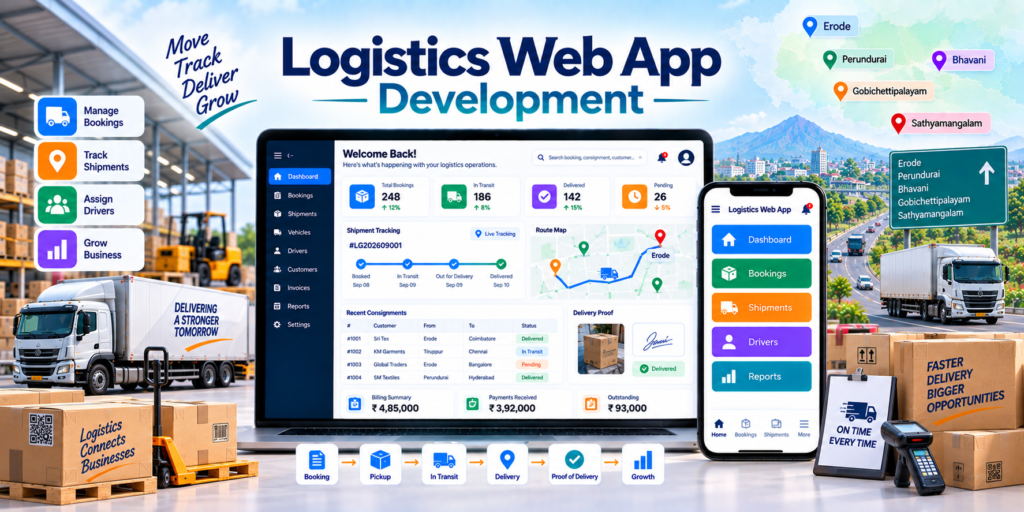
Web application development for logistics businesses in Erode helps transport companies, courier services, parcel businesses, delivery companies, fleet owners, warehouse operators, freight companies and goods carriers manage bookings, shipments, vehicles, drivers, customers, billing and reports through one online system.
Logistics businesses handle continuous coordination between customers, booking teams, branches, drivers, vehicles, warehouses, delivery staff and accounts teams. A single shipment may involve booking, pickup, consignment creation, vehicle allocation, transit updates, proof of delivery, invoice generation and payment follow-up.
When these activities are managed through phone calls, notebooks, Excel sheets and separate WhatsApp conversations, tracking becomes more difficult as shipment volume and staff count increase.
At Greap Technologies, we provide web application development for logistics businesses in Erode, helping logistics companies build practical, secure and scalable applications around their actual transport and delivery workflows.
Quick Answer: What Is Web Application Development for Logistics Businesses?
Logistics web application development means creating custom browser-based software that helps logistics companies manage bookings, consignments, shipments, vehicles, drivers, routes, delivery status, billing, payments and customer tracking.
A custom logistics web application can include:
- Admin dashboard
- Booking management
- LR / consignment management
- Shipment tracking
- Pickup management
- Fleet management
- Driver management
- Trip management
- Branch management
- Warehouse operations
- Proof of delivery
- COD tracking
- Return / RTO tracking
- Billing and invoices
- Payment follow-up
- Customer portal
- Driver access
- Staff login
- Role-based permissions
- Reports and analytics
The required modules should depend on whether the business operates in transport, courier, parcel delivery, fleet management, warehousing, freight or ecommerce logistics.
Web Application Development for Logistics Businesses in Erode: Service Overview
| Detail | Information |
|---|---|
| Service | Web Application Development for Logistics Businesses |
| Company | Greap Technologies |
| Location | Erode, Tamil Nadu |
| Main Audience | Transport companies, courier services, parcel businesses, fleet owners, warehouses and delivery companies |
| Main Goal | Digitize bookings, shipment movement, fleet, delivery and billing workflows |
| Core Modules | Bookings, consignments, fleet, drivers, trips, POD, billing, customer portal and reports |
| Best For | Transport, courier, parcel, freight, warehousing, delivery and goods-carrier businesses |
| Service Area | Erode District and nearby areas |
Why Logistics Businesses in Erode Need Web Applications
Logistics companies need accurate coordination across different stages of shipment movement.
Without a centralized logistics application, it can become difficult to know:
- Which pickup requests are pending?
- Which bookings are confirmed?
- Which LR or consignment belongs to each customer?
- Which shipments are in transit?
- Which branch currently has a parcel?
- Which vehicle is available?
- Which driver is assigned?
- Which deliveries are delayed?
- Which shipments have proof of delivery?
- Which COD amounts are pending?
- Which invoices remain unpaid?
- Which vehicle documents require renewal?
- What expenses belong to each trip?
- Which customer complaints are still open?
A logistics web application can bring these records into one system and provide role-specific views for operations, drivers, accounts, customers and management.
What Types of Logistics Businesses Can Use Web Applications?
1. Transport Companies
Transport companies can manage goods bookings, LR numbers, vehicle allocation, driver assignment, dispatch, delivery and billing.
2. Courier Services
Courier businesses can manage:
- Parcel bookings
- Pickup requests
- Tracking numbers
- Transit scans
- Delivery status
- Proof of delivery
- Returns
3. Parcel Service Businesses
Parcel companies can manage branch-wise bookings, parcel movement, customer notifications and delivery status.
4. Fleet Owners
Fleet businesses can track vehicles, drivers, trips, fuel, maintenance, documents and utilization.
5. Local Delivery Businesses
Delivery companies can manage pickup orders, delivery staff, route assignment, delivery status and customer updates.
6. Warehouse Businesses
Warehouse operators can manage inward goods, storage locations, customer stock, outward dispatch and storage-related records.
7. Freight Companies
Freight companies can manage customer enquiries, quotations, shipments, transport partners, documentation and delivery updates.
8. Ecommerce Logistics Businesses
Ecommerce logistics providers can manage pickups, delivery shipments, COD, failed delivery, return shipments and RTO workflows.
9. B2B Logistics Providers
B2B providers can manage contract customers, recurring deliveries, monthly billing and customer-wise reports.
10. Multi-Branch Logistics Companies
Businesses with multiple branches can centralize booking, branch transfers, shipment status and management reports.
Benefits of Web Application Development for Logistics Businesses
1. Better Booking Management
Booking records can include:
- Booking number
- Customer
- Pickup address
- Delivery address
- Goods description
- Weight
- Quantity
- Chargeable weight, where required
- Booking charges
- Payment mode
- Assigned branch
- Booking status
2. Better Shipment Tracking
A shipment can move through clearly defined milestones such as:
Booked → Pickup Scheduled → Picked Up → Origin Branch → In Transit → Destination Branch → Out for Delivery → Delivered
Additional exception statuses can include:
- Delivery delayed
- Delivery failed
- Address issue
- Customer unavailable
- Return initiated
- RTO
3. Better Fleet Utilization
Fleet records can help identify which vehicles are available, assigned, under maintenance or unavailable.
4. Better Driver Accountability
Driver activity can be linked with trips, vehicles, delivery updates and expenses.
5. Better Proof of Delivery
Proof of delivery can include:
- Delivery date
- Delivery time
- Receiver name
- Signature
- Photo
- Delivery remarks
The exact POD method should be selected according to the business workflow and customer requirements.
6. Better Billing and Payment Tracking
Bookings, trips or customer contracts can be connected with invoices and payment follow-up.
7. Better Customer Communication
Customers can receive or view shipment updates without calling the office repeatedly.
8. Better Management Reports
Owners can review booking, shipment, fleet, driver, branch, payment and delivery performance from centralized reports.
Important Modules in Logistics Web Applications
1. Admin Dashboard
A logistics dashboard can show:
- Today’s bookings
- Pickup requests
- In-transit shipments
- Pending deliveries
- Delivered shipments
- Failed deliveries
- Available vehicles
- Active trips
- Payments pending
- Customer support issues
2. Booking Management Module
The booking module can include:
- New booking
- Customer details
- Pickup and delivery address
- Goods details
- Weight and quantity
- Service type
- Charges
- Payment mode
- Booking status
3. LR / Consignment Management
Transport businesses can generate and manage LR or consignment references.
Records can include:
- LR number
- Booking reference
- Consignor
- Consignee
- Origin
- Destination
- Goods details
- Vehicle
- Transport charges
- Current status
4. Shipment Tracking Module
Shipment history can contain:
- Tracking number
- Status
- Branch/location
- Date and time
- Updated by
- Remarks
- POD
5. Fleet Management Module
Fleet records can include:
- Vehicle registration number
- Vehicle type
- Capacity
- Ownership type
- Assigned driver
- Vehicle status
- Maintenance history
- Insurance information
- Permit information
- Document expiry dates
6. Driver Management Module
Driver profiles can include:
- Name
- Phone number
- Licence information
- Assigned vehicle
- Trip history
- Expenses
- Documents
- Status
Access to personally identifiable driver data should be restricted to authorized users.
7. Trip Management Module
Trip records can include:
- Trip number
- Vehicle
- Driver
- Origin
- Destination
- Shipments assigned
- Start date/time
- Completion date/time
- Trip status
- Expenses
8. Branch Management
Multi-branch businesses can track:
- Origin branch
- Destination branch
- Branch bookings
- Parcel movement
- Branch users
- Branch collections
- Branch reports
9. Warehouse Module
Where required, warehouse operations can include:
- Goods inward
- Storage location
- Customer goods
- Pending dispatch
- Goods outward
- Stock movement
10. Billing and Invoice Module
Billing functionality can include:
- Booking charges
- Transport charges
- Additional charges
- Invoice generation
- Payment status
- Outstanding amount
- Receipt reference
- Customer-wise billing history
11. Proof of Delivery Module
POD can be linked directly to the shipment so staff and authorized customers can verify delivery completion.
12. Customer Portal
A secure customer portal can include:
- Customer login
- Shipment tracking
- Booking history
- Invoice downloads
- Payment status
- Proof of delivery
- Support tickets
- Service requests
13. Reports and Analytics
Reports can include:
- Daily booking report
- Shipment status report
- Pending delivery report
- Branch-wise booking report
- Vehicle utilization report
- Driver trip report
- Fuel/expense report
- Customer-wise billing report
- Outstanding payment report
- Delivery success report
Recommended Logistics Workflow
A standard transport workflow can be:
Booking → LR Generation → Pickup → Vehicle Allocation → Driver Assignment → Dispatch → Transit → Destination Branch → Delivery → POD → Billing → Payment Follow-Up
Courier Workflow
Parcel Booking → Tracking Number → Pickup → Sorting → Transit → Destination Hub → Out for Delivery → Delivered → POD
Failed Delivery / RTO Workflow
Out for Delivery → Delivery Failed → Reattempt / RTO Decision → Return Movement → Origin / Seller Received → Closed
Fleet Trip Workflow
Trip Created → Vehicle Assigned → Driver Assigned → Trip Started → Delivery / Route Updates → Trip Completed → Expenses Recorded → Settlement / Billing
The actual statuses should match the business’s real operating process.
Web Application vs Website for Logistics Businesses
| Feature | Website | Logistics Web Application |
|---|---|---|
| Main Purpose | Marketing and enquiries | Operational management |
| Main Users | Public visitors | Staff, drivers, customers and admins |
| Booking | Basic enquiry form | Structured booking workflow |
| Shipment Tracking | Can show tracking data | Manages tracking data |
| Fleet | Not normally included | Can be included |
| Drivers | Not normally included | Can be included |
| Billing | Usually not included | Can be included |
| Reports | Limited | Operational reports |
A logistics business can use a public website to attract customers and a secure web application to manage operations.
Logistics Web Application vs ERP Software
| Feature | Logistics Web Application | Logistics ERP |
|---|---|---|
| Main Meaning | Custom browser-based logistics system | Broader integrated logistics business system |
| Bookings | Can be core | Included |
| Shipments | Can be core | Included |
| Fleet | Optional or core | Can be integrated |
| Warehouse | Optional | Can be included |
| Accounts | Basic billing/payment tracking | Broader integration |
| Reports | Custom operational reports | Broader business reports |
A logistics ERP can itself be developed as a custom web application when the business requires a wider integrated system.
Logistics Web Application vs CRM Software
| Feature | Logistics CRM | Logistics Web Application |
|---|---|---|
| Main Purpose | Enquiries and customer follow-ups | Operational shipment management |
| Lead Management | Strong focus | Can be included |
| Bookings | Limited | Core feature |
| Shipment Tracking | Limited | Core feature |
| Fleet / Drivers | Not main focus | Can be included |
| Billing | Limited | Can be included |
GPS and Map Integration for Logistics Applications
Logistics applications can integrate map or location services where supported.
Possible use cases include:
- Pickup location
- Delivery location
- Driver position
- Trip route
- Distance calculation
- Estimated route planning
- Service-area mapping
True live GPS tracking generally requires a driver mobile app, GPS device or supported tracking provider that regularly sends location data to the backend.
Location tracking should be implemented with appropriate permissions, access controls and clear business policies.
Driver Mobile Access
Drivers or delivery staff may need a mobile-friendly interface or dedicated mobile app.
Possible driver functions include:
- View assigned trips
- View pickup details
- View delivery details
- Update shipment status
- Upload POD
- Add delivery remarks
- Record trip expenses
- Navigate to customer location
A responsive web interface may be sufficient for simpler workflows, while more advanced offline, GPS or device-based requirements may benefit from a dedicated mobile application.
COD and Collection Tracking
Courier and ecommerce logistics businesses may need Cash on Delivery tracking.
COD functionality can include:
- COD amount
- Collected amount
- Collection date
- Driver/delivery partner
- Settlement status
- Merchant/customer settlement reference
COD settlement functionality should include clear reconciliation rules to reduce payment confusion.
Vehicle Maintenance and Document Reminders
Fleet-based businesses can use reminders for:
- Insurance expiry
- Permit expiry
- Fitness-related records where applicable
- Service due date
- Tyre replacement
- Maintenance schedule
The application can support reminders, but businesses remain responsible for maintaining legally required transport documentation and compliance.
Logistics Web Application Security
Logistics applications can contain customer addresses, phone numbers, shipment information, driver details and commercial records.
Appropriate security controls can include:
- HTTPS
- Secure password hashing
- Role-based access control
- Branch-level access restrictions
- Customer data isolation
- Session management
- Audit logs
- User activity history
- Secure file uploads
- Input validation
- Database backups
- Restricted document access
Drivers, branch staff, accounts users and customers should only be able to access information required for their roles.
Web Application Design Style for Logistics Businesses
| User Type | Primary Requirement |
|---|---|
| Business Owner | Dashboard, revenue and operational reports |
| Operations Manager | Bookings, shipments, vehicles and drivers |
| Booking Staff | Fast booking and LR entry |
| Branch Staff | Shipment receipt and movement updates |
| Dispatch Team | Vehicle allocation and trip status |
| Driver | Assigned trips and delivery updates |
| Accounts Team | Invoices, COD and pending payments |
| Customer | Tracking, invoices and POD |
Useful design principles include:
- Fast booking screens
- Clear shipment statuses
- Quick tracking search
- Role-specific dashboards
- Mobile-responsive screens
- Simple driver interfaces
- Branch and date filters
- Exportable reports
Web Application Development for Logistics Businesses in Erode: Integrations
Web application development for logistics businesses in Erode becomes more useful when logistics operations are connected with suitable external systems.
Possible integrations include:
- Company website
- Online booking forms
- Customer portal
- CRM software
- ERP software
- Accounting software
- Payment gateway
- Maps/location services
- GPS providers
- WhatsApp notifications
- Email notifications
- SMS services
- Barcode / QR scanning
- Document storage
- Mobile apps
Integration capability depends on the APIs, permissions and technical support provided by each external system.
Explore API integration services for suitable custom integration requirements.
Advanced Features for Logistics Web Applications
- Online booking
- Automatic tracking number generation
- LR PDF generation
- Barcode labels
- QR shipment tracking
- Branch scanning
- Customer portal
- Driver portal/app
- POD upload
- Digital signature
- GPS integration
- Route planning
- COD management
- RTO management
- Driver settlement
- Fuel expense tracking
- Vehicle maintenance reminders
- Warehouse management
- Multi-branch operations
- WhatsApp notifications
- Email/SMS notifications
- Audit logs
- Analytics dashboard
Advanced modules should be implemented according to genuine operational requirements and order volume.
Logistics Web Application Development Process
Step 1: Requirement Analysis
Important questions include:
- What type of logistics business do you operate?
- Do you handle transport, courier, parcel, freight or delivery?
- How are bookings created today?
- Do you use LR numbers?
- Do you have multiple branches?
- Do you own vehicles?
- Do drivers need mobile access?
- Do customers need tracking?
- Do you collect COD?
- Do you need POD?
- Do you need warehouse operations?
- What reports does management need?
Step 2: Workflow Mapping
Document the complete booking-to-delivery process before development.
Step 3: Status Planning
Define consistent statuses for:
- Booking
- Pickup
- Transit
- Branch movement
- Delivery
- Failed delivery
- Return / RTO
Step 4: Role and Permission Planning
Define access for:
- Owner
- Admin
- Booking staff
- Operations
- Branch staff
- Drivers
- Accounts
- Customers
Step 5: UI/UX Design
Daily operational tasks should be quick and simple for staff and drivers.
Step 6: Web Application Development
Core modules can be developed before optional GPS, warehouse or advanced automation features.
Step 7: Existing Data Migration
Existing data can include:
- Customers
- Vehicles
- Drivers
- Branches
- Routes
- Open shipments
- Invoices
- Staff users
Data should be reviewed and cleaned before import.
Step 8: Testing
Test workflows such as:
- Booking creation
- Tracking number/LR creation
- Pickup status
- Vehicle allocation
- Driver assignment
- Branch transfer
- Delivery update
- POD
- RTO
- Billing
- Customer tracking
- User permissions
Step 9: Staff and Driver Training
Different training should be provided according to user responsibilities.
Step 10: Launch and Improvement
After launch, workflow stages, reports and automation can be refined based on actual operational data.
Logistics Web Application Features Checklist
| Feature | Recommendation |
|---|---|
| Admin Dashboard | Required |
| Staff Login | Required |
| Role-Based Access | Recommended |
| Booking Management | Required |
| LR / Consignment Management | Based on business type |
| Shipment Tracking | Required |
| Customer Management | Required |
| Fleet Management | Based on business type |
| Driver Management | Based on business type |
| Trip Management | Recommended for fleet operations |
| Branch Management | Based on requirement |
| Warehouse Module | Based on business type |
| Proof of Delivery | Recommended |
| COD Tracking | Based on business model |
| RTO / Return Tracking | Recommended for courier/ecommerce logistics |
| Billing and Invoices | Recommended |
| Payment Tracking | Recommended |
| Customer Portal | Recommended |
| Driver Mobile Access | Based on requirement |
| GPS / Map Integration | Based on requirement |
| Reports | Required |
| Audit Logs | Recommended |
| Mobile Responsive Design | Required |
Common Mistakes Logistics Businesses Should Avoid
1. Managing Bookings Only Through Calls and WhatsApp
Unstructured booking records become harder to manage as shipment volume increases.
2. No Consistent Tracking Status
All staff should use the same shipment-status workflow.
3. No Proof of Delivery
POD provides an important record of shipment completion.
4. No Branch Movement History
Multi-branch courier and parcel businesses should record each movement clearly.
5. No Vehicle Document Reminders
Fleet owners should maintain vehicle and driver documentation systematically.
6. No COD Reconciliation
Collected COD amounts should be clearly reconciled and settled.
7. No Driver Role Restrictions
Drivers should only access trips and customer details relevant to their assigned work.
8. No Exception Tracking
Failed deliveries, delays and returns should use structured statuses instead of free-form messages only.
9. No Useful Management Reports
Owners should be able to review bookings, deliveries, fleet usage, collections and outstanding payments.
10. Building Too Many Features in the First Phase
Businesses can start with bookings, tracking and billing before adding GPS, warehouse or advanced automation modules.
Erode District Logistics Web Application Development Strategy
Greap Technologies supports logistics businesses across:
Erode, Perundurai, Bhavani, Anthiyur, Gobichettipalayam, Sathyamangalam, Modakkurichi, Kodumudi, Nambiyur, Thalavadi, Chennimalai, Kavindapadi, Ammapettai, Arachalur, Sivagiri, Punjai Puliampatti, Solar, Surampatti, Veerappanchatram, Nasiyanur and nearby areas.
Location-specific SEO pages should only be created for genuine service areas and should provide unique logistics-related value instead of repeating identical content with different location names.
How Greap Technologies Helps Logistics Businesses
Greap Technologies can develop custom logistics web applications around the actual transport, booking and delivery workflow of the business.
Our logistics web application development services can include:
- Requirement analysis
- Workflow mapping
- UI/UX design
- Admin dashboard
- Staff login
- Role-based permissions
- Booking management
- LR / consignment management
- Shipment tracking
- Customer management
- Fleet management
- Driver management
- Trip management
- Branch management
- Warehouse modules
- Proof of delivery
- COD / RTO tracking
- Billing and payments
- Customer portal
- Driver access
- Map/GPS integrations
- WhatsApp/email/SMS integrations
- Reports and analytics
- Data migration
- Testing and training
- Maintenance support
Explore related Greap services:
- Web Application Development
- Custom Software Development
- API Integration Services
- Mobile App Development
- Website Development Services
Why Choose Greap Technologies?
Logistics Workflow-Based Development
We can design the application around booking, pickup, shipment, branch movement, delivery, POD, billing and payment workflows.
Custom Web Application Development
The system can match your actual logistics process instead of forcing staff into a generic workflow.
Scalable Architecture
You can begin with booking and shipment tracking before adding fleet, branches, warehouse, customer portal or mobile apps.
Role-Based Secure Access
Operations staff, branch users, drivers, accounts teams and customers can receive different access permissions.
Integration Support
The logistics application can connect with supported maps, GPS, payment, accounting and communication systems where required.
Complete Digital Support
Greap Technologies also provides websites, CRM, ERP, customer portals, mobile applications, SEO and digital marketing services.
Conclusion
Web application development for logistics businesses in Erode can help transport, courier, parcel, fleet and delivery companies organize bookings, shipments, vehicles, drivers, branches, delivery updates, invoices and reports in one structured system.
A practical logistics web application should make booking easy for staff, provide clear shipment-status history, support reliable delivery updates and give management useful operational reports.
Depending on business requirements, the system can later expand with customer tracking portals, driver mobile apps, GPS integration, warehouse management, COD reconciliation and advanced analytics.
Greap Technologies helps logistics businesses in Erode develop custom web applications based on their shipment flow, fleet structure, branches, customer requirements and growth plans.
Need a Custom Web Application for Your Logistics Business in Erode?
Greap Technologies can help you build a logistics web application with bookings, shipment tracking, LR management, fleet, drivers, POD, billing, customer portal and reports.
Frequently Asked Questions
1. What is web application development for logistics businesses?
It is the development of custom browser-based software for managing logistics bookings, consignments, shipments, vehicles, drivers, deliveries, billing and reports.
2. Why do logistics businesses in Erode need web applications?
A logistics web application can help centralize booking and shipment information, improve operational visibility and reduce fragmented manual tracking.
3. What features can a logistics web application include?
A logistics web application can include booking management, shipment tracking, LR management, fleet, drivers, trips, customer portal, billing, proof of delivery and reports.
4. Can a logistics web application provide shipment tracking?
Yes. The application can maintain shipment milestones such as booked, picked up, in transit, destination branch, out for delivery, delivered and returned.
5. Can logistics software manage vehicles and drivers?
Yes. Fleet and driver modules can manage vehicles, assignments, trips, maintenance records, driver documents and operational history.
6. Can customers track shipments through a portal?
Yes. A secure customer portal can provide tracking, booking history, invoices, POD and support information for authorized customer accounts.
7. Can logistics applications include GPS tracking?
Yes. Location integration can be added where supported. Continuous live tracking generally requires a driver app, GPS device or external tracking provider that sends location data to the system.
8. Can Greap Technologies build custom logistics web applications?
Yes. Greap Technologies can develop custom logistics applications based on booking flow, shipment stages, fleet operations, branch structure and reporting requirements.
9. Can logistics applications manage COD and return shipments?
Yes. COD collection, settlement status, failed deliveries, return movement and RTO can be tracked based on the business workflow.
10. Can logistics web applications work on mobile?
Yes. Responsive web applications can support mobile use, and dedicated driver or customer mobile apps can also be developed when more advanced mobile functions are required.