
Choosing an ecommerce development company in Erode is an important decision for a business planning to sell products online, accept digital orders, build a direct-to-customer channel or create a B2B ordering platform.
An ecommerce website is more than a digital product catalogue.
Customers need to discover products, understand specifications, compare suitable options, add products to a cart, complete checkout and receive clear information about their order.
Behind that customer experience, the business may need to manage products, categories, prices, inventory, payments, shipping, taxes, orders, customers, promotions, returns and integrations.
That means ecommerce development requires both a customer-facing storefront and a reliable operational workflow behind it.
This guide explains what business owners should understand before choosing an ecommerce development company in Erode.
At Greap Technologies, we provide ecommerce development, website development, custom software and digital growth solutions for businesses in Erode and nearby areas.
What Is Ecommerce Website Development?
Ecommerce website development is the process of planning, designing, developing, configuring, testing and maintaining a website through which customers can browse products and complete supported online purchasing workflows.
Depending on the business, an ecommerce platform may include:
- Product catalogue
- Product categories
- Search
- Product filters
- Product detail pages
- Pricing
- Product variants
- Shopping cart
- Checkout
- Customer accounts
- Payment integration
- Shipping integration
- Order management
- Inventory
- Coupons and promotions
- Transactional notifications
- Returns workflows
- Analytics
- SEO foundations
- Third-party integrations
Why Ecommerce Development Requires Proper Planning
A normal business website may primarily explain the company and generate enquiries.
An ecommerce website must support transactions and operational processes.
A simplified customer journey may look like:
Visitor → Product Discovery → Product Page → Cart → Checkout → Payment → Order → Fulfilment → Delivery
Each stage needs to be planned carefully.
Who Can Consider Ecommerce Development in Erode?
Ecommerce can be considered by businesses such as:
- Retailers
- Manufacturers
- Wholesalers
- Distributors
- Fashion businesses
- Home and lifestyle brands
- Industrial-product businesses
- Food-product brands where appropriate
- Consumer-product companies
- Specialty product sellers
- Businesses moving from offline to online sales
However, the ecommerce model should match how the business actually sells.
1. Define Your Ecommerce Business Model
Before choosing technology, define who will purchase through the website.
Common models include:
- B2C — Business to Consumer
- B2B — Business to Business
- Wholesale ecommerce
- Dealer ecommerce
- Distributor ordering
- Direct-to-customer ecommerce
- Hybrid B2B and B2C
A consumer fashion store and an industrial B2B ordering portal should not automatically use the same ecommerce workflow.
2. Define the Main Ecommerce Goal
Businesses should identify what they want the platform to accomplish.
Possible objectives include:
- Sell products directly online
- Accept repeat customer orders
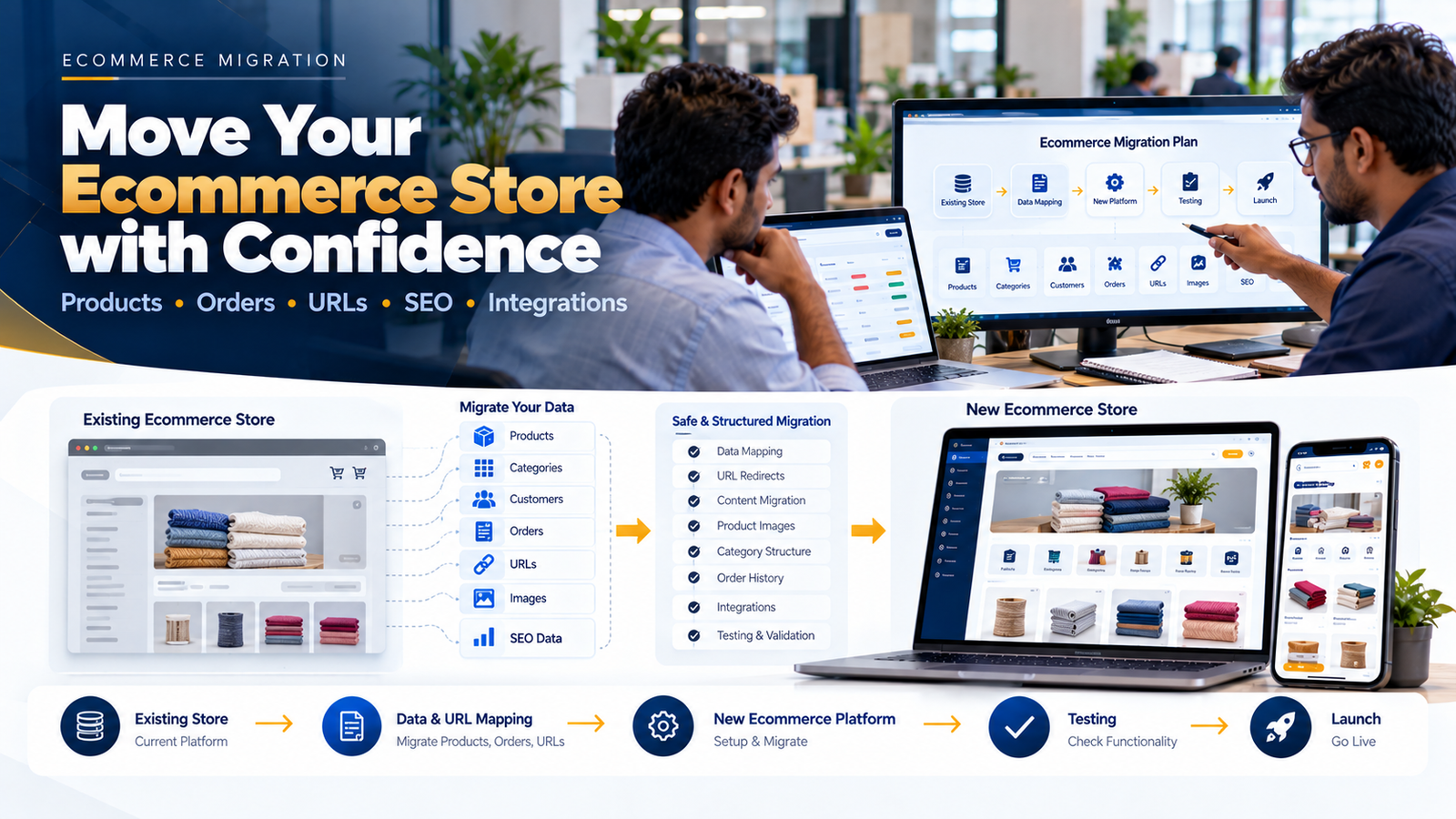
- Reach customers outside the local market
- Support existing offline stores
- Build a direct sales channel
- Accept dealer orders
- Generate product enquiries
- Accept quotation requests
- Provide a digital product catalogue
3. Decide Whether You Need Ecommerce or a Catalogue Website
Not every product business needs online checkout.
A catalogue website may be appropriate when customers need to review products and contact the company for pricing or quotations.
Ecommerce is more appropriate when the purchasing process can reasonably be completed online.
| Catalogue Website | Ecommerce Website |
|---|---|
| Product information | Product information |
| Categories | Categories |
| Search and filters | Search and filters |
| Enquiry / RFQ | Cart and checkout |
| Salesperson interaction | Online ordering |
| Quotation-oriented | Transaction-oriented |
4. Choose the Right Ecommerce Platform
Platform selection should follow business requirements rather than popularity alone.
Possible approaches include:
- Shopify
- WooCommerce
- Custom ecommerce development
- Other appropriate ecommerce platforms
Important selection factors include:
- Catalogue size
- Product complexity
- Content requirements
- Checkout requirements
- B2B requirements
- Integrations
- Customization
- Team capability
- Maintenance expectations
- Budget
5. Shopify Ecommerce Development
Shopify provides a hosted ecommerce platform with built-in store-management capabilities and an ecosystem of themes and applications.
It can be considered by businesses that value a managed ecommerce environment and whose requirements fit the platform and available extensions.
Businesses should still evaluate:
- Required features
- Theme customization
- Application dependencies
- Recurring platform costs
- Integration requirements
- B2B requirements
- Content requirements
6. WooCommerce Ecommerce Development
WooCommerce is an ecommerce solution built around WordPress.
It can be suitable when a business wants ecommerce capabilities alongside flexible WordPress content management.
WooCommerce projects also require appropriate attention to:
- Hosting
- Updates
- Plugins
- Security
- Performance
- Backups
- Compatibility
Read WooCommerce Website Development for Businesses in Erode.
7. Shopify vs WooCommerce
Neither Shopify nor WooCommerce is universally better.
The appropriate choice depends on the business.
| Factor | Shopify | WooCommerce |
|---|---|---|
| Hosting Model | Hosted platform | Typically self-managed or managed WordPress hosting |
| Content Management | Built-in platform tools | WordPress-based |
| Customization | Within platform architecture | Flexible WordPress ecosystem and custom development |
| Maintenance | Core platform managed by provider | Website owner/team manages WordPress environment |
| Extensions | App ecosystem | Plugin ecosystem |
| Suitability | Depends on requirements | Depends on requirements |
For a more detailed comparison, read Shopify vs WooCommerce: Which Is Better for Erode Businesses?.
8. Custom Ecommerce Development
Custom ecommerce development can be considered when standard platforms do not comfortably support the required business process.
Examples may include:
- Special pricing logic
- Complex B2B workflows
- Dealer ordering
- Custom quotation processes
- Special approval workflows
- ERP-connected ordering
- Special product configuration
- Custom customer portals
Custom development generally requires more planning, development and ongoing technical ownership than configuring a standard ecommerce platform.
9. B2C Ecommerce Development
A B2C store typically focuses on making product discovery and checkout straightforward for individual consumers.
Important areas may include:
- Product presentation
- Categories
- Search
- Filters
- Variants
- Cart
- Checkout
- Payment
- Shipping
- Customer account
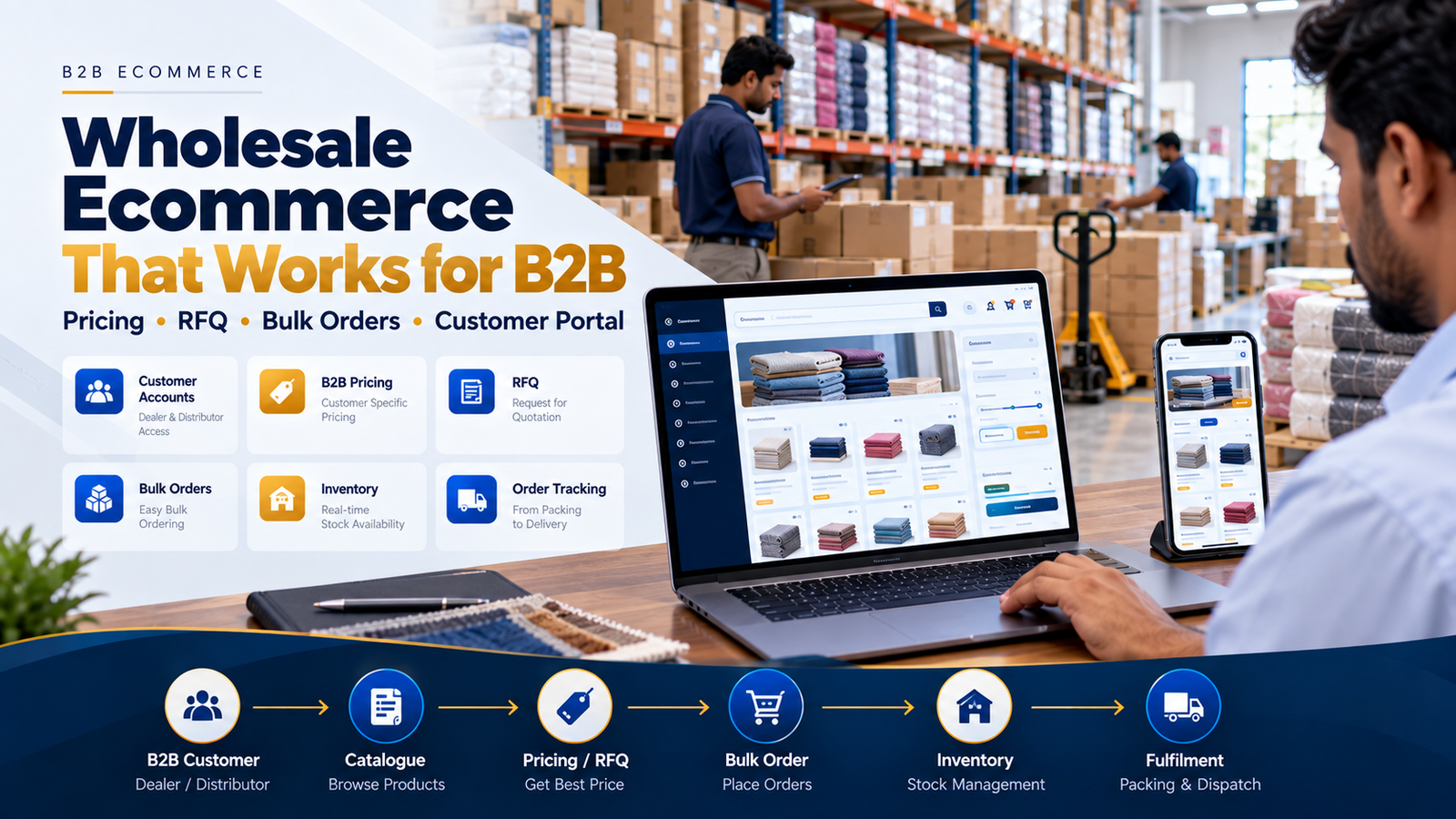
10. B2B Ecommerce Development
B2B ecommerce may require a different purchasing experience.
Features can include:
- Business customer accounts
- Dealer login
- Wholesale pricing
- Customer-specific pricing
- Minimum order quantities
- Bulk ordering
- RFQ
- Quotation workflows
- Purchase orders
- Approval workflows
- Quick reorder
- Order history
Explore B2B Ecommerce Website Development for Wholesalers and Manufacturers in Erode.
11. Product Catalogue Architecture
The product catalogue is one of the foundations of an ecommerce store.
Before development, define:
- Product categories
- Subcategories
- Product attributes
- Variants
- Brands where applicable
- Specifications
- Images
- Pricing
- Inventory behaviour
12. Product Category Structure
Categories should make sense to customers rather than only reflecting the company’s internal organization.
A clear category structure can also support crawlability and internal linking when implemented appropriately.
13. Product Detail Pages
A useful product page can include relevant information such as:
- Product name
- Images
- Description
- Price where applicable
- Variants
- Specifications
- Availability information
- Shipping information where appropriate
- Purchase or enquiry action
The exact content depends on the product.
14. Product Images
Product images can strongly influence how customers understand an item online.
Image planning should consider:
- Image quality
- Consistent presentation
- Multiple useful views
- Appropriate dimensions
- Compression
- Modern image formats where suitable
- ALT text where appropriate
15. Product Variants
Products may be available in multiple:
- Sizes
- Colours
- Materials
- Pack quantities
- Specifications
Variant architecture should be planned carefully because it can affect inventory, URLs, product data and the customer experience.
16. Product Search
Search becomes increasingly important as the catalogue grows.
Depending on requirements, search can consider:
- Product name
- SKU
- Category
- Brand
- Relevant product attributes
17. Product Filters
Filters can help customers narrow large catalogues.
Examples include:
- Category
- Price
- Brand
- Size
- Colour
- Material
- Technical specifications
Filter URLs should also be planned carefully to avoid unnecessary crawlable URL combinations.
18. Shopping Cart
The cart should clearly show what the customer intends to purchase.
Useful information can include:
- Product
- Variant
- Quantity
- Price
- Relevant charges
- Order total
19. Ecommerce Checkout
Checkout should collect the information required to complete the order without introducing unnecessary steps.
Depending on the business, checkout may involve:
- Customer information
- Delivery address
- Billing information
- Shipping method
- Payment method
- Order review
20. Guest Checkout vs Customer Accounts
Some stores allow customers to purchase without creating a full account, while others require authentication for particular workflows.
The appropriate choice depends on:
- Business model
- Customer type
- Repeat-order needs
- B2B requirements
- Data requirements
21. Payment Gateway Integration
An ecommerce store may integrate with supported payment providers.
The available payment methods depend on the selected provider, business eligibility, region, account configuration and current provider capabilities.
The website should not directly handle sensitive payment credentials unnecessarily when a secure supported payment flow is available.
22. Cash on Delivery
Some businesses may choose to provide Cash on Delivery for eligible orders or locations.
COD availability should follow the company’s actual fulfilment and risk-management process rather than being enabled automatically for every order.
23. Shipping Management
Shipping rules can depend on:
- Customer location
- Product type
- Weight
- Order value
- Courier availability
- Delivery zone
The appropriate shipping model should be defined before checkout development is finalized.
24. Courier Integration
An ecommerce website can potentially connect with supported courier or logistics providers.
Depending on available APIs, integrations may support:
- Shipment creation
- Shipping labels
- Tracking information
- Delivery status
Exact capabilities depend on the selected logistics provider.
25. Local Delivery
Businesses serving Erode and nearby areas may require their own local-delivery workflow.
This can include configured:
- Delivery areas
- Postal codes
- Delivery charges
- Order conditions
- Delivery scheduling where appropriate
26. Order Management
After checkout, the business needs a structured order-management process.
Typical order statuses can include:
New → Confirmed → Processing → Packed → Shipped → Delivered
Actual statuses should reflect the company’s fulfilment workflow.
27. Order Notifications
Customers may receive appropriate transactional updates regarding their order.
Depending on configured communication channels, notifications can relate to:
- Order confirmation
- Payment status
- Shipment
- Delivery
- Other relevant transactional events
28. Inventory Management
Ecommerce inventory needs to have a clearly defined source of truth.
For a small store, the ecommerce platform itself may maintain stock.
For larger businesses, stock may originate from:
- ERP
- Inventory software
- Warehouse management software
The architecture should avoid multiple systems independently changing stock without a defined synchronization process.
29. Warehouse Integration
Businesses with dedicated warehouse operations may connect ecommerce orders with warehouse workflows.
A possible flow can be:
Online Order → Warehouse → Picking → Packing → Dispatch → Delivery
Read Warehouse Management Software Development in Erode.
30. ERP Integration
Established businesses may need ecommerce information to connect with an ERP.
Potential data exchange can involve:
- Products
- Customers
- Inventory
- Prices
- Orders
- Order status
Integration feasibility depends on the ERP’s APIs, supported interfaces, permissions and architecture.
31. Accounting Integration
Some businesses may need approved ecommerce transaction information to move into accounting workflows.
The required integration depends on the accounting platform and the company’s financial process.
Accounting and tax treatment should be configured according to the business’s applicable requirements and professional advice where necessary.
32. CRM Integration
Not every ecommerce visitor completes an order immediately.
Businesses with enquiry-driven or B2B sales can connect relevant customer enquiries with CRM workflows.
A journey may look like:
Ecommerce Website → Enquiry / RFQ → CRM → Sales Follow-Up → Quotation → Order
Read WhatsApp CRM and Lead Follow-Up Software for Businesses in Erode.
33. WhatsApp Integration
An ecommerce website can provide supported business messaging contact options for customers who need assistance.
More advanced CRM or messaging integration should use official supported business technologies and appropriate platform APIs.
34. Dealer and Distributor Integration
Manufacturers selling through dealer networks may need ecommerce to work alongside their dealer-management platform.
A possible workflow can be:
Dealer Login → Product Catalogue → Dealer Pricing → Order → Inventory → Dispatch
Explore Dealer and Distributor Management Software Development in Erode.
35. Production Integration for Manufacturers
Manufacturers operating make-to-order or stock-based production may need confirmed ecommerce demand to connect with production planning.
This should use clearly defined business rules rather than automatically sending every online order into manufacturing.
A broader workflow can be:
Ecommerce Order → Inventory Check → Production Requirement if Applicable → Finished Goods → Dispatch
Read Production Management Software for Manufacturing Companies in Erode.
36. Transport and Logistics Integration
Businesses managing their own delivery fleet or logistics operations may connect ecommerce orders with transport workflows.
A possible journey is:
Order → Warehouse → Dispatch → Vehicle / Logistics → Delivery
Explore Transport and Logistics Management Software Development in Erode.
37. Ecommerce UI/UX Design
An ecommerce interface should make it easy for customers to move between discovery and purchase.
Important areas include:
- Navigation
- Categories
- Search
- Filters
- Product pages
- Cart
- Checkout
- Customer account
Design should support product understanding and purchasing rather than adding visual complexity without a clear purpose.
38. Mobile Ecommerce Development
Ecommerce interfaces should be responsive across relevant screen sizes.
Mobile testing should include:
- Navigation
- Search
- Filters
- Product galleries
- Variant selection
- Add-to-cart actions
- Cart
- Checkout
- Forms
- Payment flow
39. Ecommerce Mobile App vs Responsive Website
A dedicated ecommerce mobile app is not automatically necessary for every business.
A well-designed responsive ecommerce website may be sufficient for many companies.
An app can be considered when there is a clear requirement for app-specific functionality or a customer usage pattern that supports the additional investment and maintenance.
40. Ecommerce Website Speed
Ecommerce stores can become heavy because they contain product images, scripts, applications, tracking tools and dynamic functionality.
Performance planning can include:
- Image optimization
- Modern image formats
- Responsive images
- Script management
- CSS optimization
- Caching where appropriate
- Hosting or platform performance
- Third-party application review
41. Core Web Vitals for Ecommerce
Core Web Vitals can help evaluate important aspects of page loading, interaction responsiveness and visual stability.
Common ecommerce performance challenges can involve:
- Large hero images
- Product galleries
- Third-party applications
- Tracking scripts
- Dynamic cart elements
- Layout shifts
Performance should be considered throughout development rather than only after launch.
42. Ecommerce SEO
Ecommerce SEO involves helping search engines discover, understand and appropriately index relevant store pages while creating useful pages for customers.
Areas can include:
- Category structure
- Product pages
- URLs
- Titles and descriptions
- Internal linking
- Product information
- Image optimization
- Structured data where appropriate
- Canonicalization
- Indexing controls
- Performance
Explore SEO Services in Erode.
43. Ecommerce Category Page SEO
Category pages can be important product-discovery and organic-search pages.
A useful category page may contain:
- Clear category heading
- Relevant products
- Useful filters
- Supporting category information where helpful
- Internal links
Category content should help users rather than being filled with repetitive keywords.
44. Product Page SEO
Product pages should accurately describe the product being sold.
Where appropriate, they can include:
- Descriptive product title
- Useful product description
- Specifications
- Images
- Availability information
- Relevant structured data
- Related internal links
45. Avoid Copying Manufacturer Product Descriptions Blindly
If many websites use exactly the same product description, your page may provide little additional value to shoppers.
Where possible, add genuinely useful information such as:
- Accurate specifications
- Applications
- Dimensions
- Material details
- Compatibility
- Installation or usage information where appropriate
- Original product photography
46. Ecommerce URL Structure
URLs should be understandable and manageable.
Product filtering, sorting, tracking parameters and other dynamic functionality can create many URL combinations.
The development team should consider which URLs should be crawlable and indexable.
47. Canonical URLs
Canonical tags can help indicate preferred URLs where duplicate or substantially similar ecommerce URLs exist.
Canonical strategy should match the actual store architecture rather than applying the same rule blindly to every page.
48. Ecommerce XML Sitemap
The sitemap should help search engines discover relevant indexable store URLs.
Depending on the store, this may include:
- Categories
- Products
- Important content pages
- Relevant blog content
49. Structured Data for Ecommerce
Appropriate structured data can help search engines understand eligible ecommerce information.
Markup should accurately represent visible page content.
Do not add fabricated prices, availability, ratings or reviews to structured data.
50. Ecommerce Content Marketing
Not every potential customer searches directly for a product name.
Useful content can answer questions customers have before purchasing.
Examples include:
- Buying guides
- Product comparisons
- Selection guides
- How-to content
- Application guides
- Frequently asked product questions
A useful journey can be:
Google Search → Helpful Guide → Relevant Product Category → Product → Purchase / Enquiry
51. Ecommerce Internal Linking
Internal linking can connect:
- Categories to products
- Products to relevant categories
- Blogs to products
- Buying guides to categories
- Related products
- Relevant support content
Links should be useful to customers rather than added solely for SEO.
52. Ecommerce Analytics
Measurement can help a business understand how customers interact with the store.
Depending on the analytics setup, ecommerce events may include:
- Product views
- Add-to-cart actions
- Checkout activity
- Completed purchases
- Other relevant ecommerce interactions
Tracking should be tested rather than assuming that every analytics event is recorded correctly.
53. Ecommerce Conversion Rate
Conversion rate can be a useful business metric, but it should be interpreted carefully.
It can vary according to:
- Industry
- Product
- Traffic source
- Customer intent
- Price
- Device
- Season
- Business model
A development company should not promise a specific conversion rate without evidence and appropriate context.
54. Cart Abandonment
Customers may leave checkout for many reasons.
Possible issues can include:
- Unexpected charges
- Complex checkout
- Payment issues
- Shipping limitations
- Customer uncertainty
- Technical problems
Analytics and user feedback can help identify actual issues rather than assuming one universal cause.
55. Ecommerce Security
Ecommerce websites handle important customer and transaction-related information.
Security planning can include:
- HTTPS
- Secure authentication
- Role-based access
- Input validation
- Secure payment integration
- Software updates
- Dependency management
- Secure APIs
- Backup procedures
- Logging and monitoring where appropriate
56. Customer Data Privacy
Businesses should understand what customer information their ecommerce website collects and why it is required.
Access to customer information should be limited according to legitimate business responsibilities.
Applicable privacy, consumer, tax and ecommerce requirements should be reviewed by the business with appropriate professional guidance where necessary.
57. User Roles and Permissions
Different employees may require different levels of access.
| User | Example Access |
|---|---|
| Store Administrator | Configured store administration |
| Product Team | Product and catalogue management |
| Order Team | Authorized order workflows |
| Warehouse Team | Relevant fulfilment information |
| Marketing Team | Authorized content and campaign functions |
| Management | Authorized reports and dashboards |
58. Ecommerce Backups
Backup planning should consider relevant:
- Products
- Content
- Configuration
- Customer records
- Orders
- Custom code
- Database information
Backup responsibilities depend on the platform and hosting architecture.
59. Ecommerce Maintenance
An online store requires ongoing operational and technical attention.
Depending on the platform, maintenance can involve:
- Software updates
- Application or plugin updates
- Security work
- Backup checks
- Performance checks
- Product updates
- Bug fixes
- Integration monitoring
- Checkout testing
60. Shopify Maintenance
Although Shopify manages its core hosted platform, merchants may still need to maintain:
- Theme customizations
- Applications
- Product information
- Navigation
- Tracking
- Integrations
- Store configuration
Read Shopify Store Maintenance and Support Services in Erode.
61. WooCommerce Maintenance
WooCommerce maintenance can involve the broader WordPress environment.
This may include:
- WordPress updates
- WooCommerce updates
- Theme updates
- Plugin updates
- Compatibility testing
- Security
- Backups
- Performance
62. Testing Before Ecommerce Launch
An ecommerce website should be tested using realistic customer journeys.
Testing can include:
- Registration where applicable
- Login
- Search
- Filters
- Product variants
- Cart
- Coupons where applicable
- Checkout
- Payment
- Shipping
- Order creation
- Emails or transactional notifications
- Mobile layouts
- Integrations
63. Test Failed Payment Scenarios
Testing should not cover only successful transactions.
The team should understand what happens when:
- A payment fails
- A payment is interrupted
- A customer retries
- A callback is delayed
- Order and payment states do not initially match
The exact handling depends on the payment provider and ecommerce architecture.
64. Test Inventory Behaviour
Businesses should test when stock is reserved or reduced and what happens when orders are cancelled, refunded or fail.
This is especially important when multiple sales channels share inventory.
65. Test Mobile Checkout
The complete purchase journey should be tested on relevant mobile screen sizes.
Do not assume that a checkout working on desktop will automatically provide a good mobile experience.
66. Ecommerce Website Migration
Businesses moving from an existing ecommerce platform may need to migrate:
- Products
- Categories
- Images
- Customers where appropriate
- Orders where appropriate
- Content
- URLs
- Metadata
Migration planning should consider both data integrity and existing search visibility.
67. Redirect Planning During Ecommerce Migration
If important category or product URLs change, appropriate redirects may be required.
Old URLs should be mapped carefully rather than redirecting every removed page automatically to the homepage.
68. Ecommerce Scalability
Scalability should be considered in relation to realistic business expectations.
Factors may include:
- Product catalogue growth
- Order volume
- Traffic
- Integrations
- Additional locations
- B2B requirements
- New sales channels
Scalability does not mean building every possible future feature immediately.
69. Multi-Location Ecommerce
Businesses operating multiple warehouses or stores may require location-aware inventory and fulfilment workflows.
The implementation depends on the ecommerce platform and inventory architecture.
70. Multi-Language Ecommerce
Some businesses may require ecommerce content in multiple languages.
Multi-language planning can affect:
- URLs
- Navigation
- Product content
- SEO
- Content maintenance
Languages should be introduced when they serve an actual customer requirement rather than only to create more indexable pages.
71. Ecommerce Website Ownership
Before starting development, understand the ownership and access model.
Clarify responsibility for:
- Domain
- Hosting where applicable
- Platform account
- Theme
- Applications or plugins
- Custom source code
- Product data
- Customer data
- Analytics accounts
72. Third-Party Ecommerce Costs
Development cost may not be the only cost of operating an online store.
Depending on the selected architecture, additional costs may include:
- Platform subscription
- Hosting
- Domain
- Premium themes
- Applications or plugins
- Payment-provider charges
- Shipping services
- Email services
- External APIs
- Maintenance
These should be identified during project planning where possible.
73. Ecommerce Support After Launch
Ask the development company what support is available after the store goes live.
Clarify support for:
- Technical bugs
- Checkout issues
- Payment integration issues
- Theme changes
- Product support
- Third-party integration problems
- Performance work
- Future enhancements
74. Ecommerce Development Process
A structured ecommerce project can follow a process such as:
Discovery → Requirements → Platform Selection → Catalogue Planning → UI/UX → Development → Integrations → Product Data → Testing → Launch → Support
The exact process should be adapted to project complexity.
75. Questions to Ask an Ecommerce Development Company
Before choosing a development partner, consider asking:
- Which ecommerce platform fits our requirements and why?
- Have you worked with similar ecommerce requirements?
- How will our catalogue be structured?
- How will mobile checkout work?
- What payment integrations are supported?
- How will shipping work?
- How will inventory be managed?
- Can the store integrate with our ERP or existing software?
- What ecommerce SEO foundations are included?
- How is website performance handled?
- What security practices are relevant?
- What recurring third-party costs should we expect?
- Who owns the domain, platform accounts and custom code?
- What testing happens before launch?
- What support is available after launch?
Ecommerce Development Company Evaluation Checklist
| Area | What to Evaluate |
|---|---|
| Business Understanding | Does the team understand how your business sells? |
| Platform Selection | Can they explain why the proposed platform fits? |
| UI/UX | Is product discovery and purchasing straightforward? |
| Mobile | Is the full shopping journey responsive? |
| Payments | Are supported secure payment workflows planned? |
| Shipping | Does fulfilment match the business model? |
| Inventory | Is there a clear stock source of truth? |
| SEO | Are category, product and technical foundations considered? |
| Performance | Are images, scripts and third-party applications managed? |
| Security | Are appropriate security controls planned? |
| Integrations | Are ERP, CRM or warehouse requirements understood? |
| Ownership | Are accounts, data and custom-code responsibilities clear? |
| Support | Is post-launch support defined? |
Common Ecommerce Development Mistakes
- Choosing a platform before defining requirements
- Using a poor product-category structure
- Uploading incomplete product information
- Ignoring mobile checkout
- Adding too many unnecessary applications or plugins
- Ignoring website speed
- Ignoring SEO during development
- Not defining inventory ownership
- Not testing failed payments
- Not testing shipping rules
- Not planning redirects during migration
- Not clarifying recurring costs
- Not planning post-launch maintenance
Freelancer vs Ecommerce Development Company
Both freelancers and development companies can deliver ecommerce projects.
The decision should consider the actual project rather than the label.
Evaluate:
- Platform experience
- UI/UX capability
- Backend development
- Payment integration experience
- Shipping requirements
- ERP or API integration
- SEO understanding
- Testing process
- Support availability
How Much Does Ecommerce Website Development Cost in Erode?
There is no single development cost for every online store.
Project scope can depend on:
- Platform
- Catalogue size
- Product complexity
- UI/UX design
- Customer accounts
- Payment integration
- Shipping
- B2B functionality
- Custom development
- ERP integration
- Warehouse integration
- Data migration
- SEO requirements
- Testing
A small online catalogue with checkout has a very different scope from a B2B ecommerce platform connected to ERP, warehouse and dealer-management systems.
How Long Does Ecommerce Development Take?
Development time depends on the complexity of the project.
Factors can include:
- Platform selection
- Design
- Number of products
- Product-data readiness
- Custom functionality
- Payment setup
- Shipping setup
- Integrations
- Data migration
- Testing
- Client approvals
A realistic timeline should be prepared after requirements are documented.
Should You Launch Ecommerce in Phases?
For larger ecommerce projects, a phased approach can be practical.
A possible sequence is:
- Core catalogue
- Product pages
- Cart and checkout
- Payments
- Shipping
- Order management
- SEO and analytics foundations
- ERP or warehouse integrations
- Advanced B2B or customer features
The actual sequence should follow technical dependencies and business priorities.
Ecommerce Development for Manufacturers in Erode
Manufacturers may use ecommerce differently from conventional retail businesses.
The platform may need:
- Technical product specifications
- Bulk ordering
- MOQ
- RFQ
- Dealer accounts
- Customer-specific pricing
- Quotation workflows
- Inventory integration
- Production integration
Ecommerce Development for Wholesalers in Erode
Wholesalers may need to support large orders, repeat purchasing and business-specific pricing.
Features can include:
- Wholesale customer accounts
- Bulk ordering
- Tiered pricing
- Quick reorder
- Order history
- Credit or payment workflows where appropriate
- Sales-representative support
Ecommerce Development for Retail Businesses in Erode
Retail businesses may use ecommerce to complement physical stores or create a separate online sales channel.
The website can connect product discovery, online payment and delivery through one digital customer journey.
Ecommerce Development in Erode and Nearby Areas
Greap Technologies provides ecommerce and website-development services for businesses in Erode, Perundurai, Bhavani, Gobichettipalayam, Sathyamangalam, Anthiyur, Chennimalai, Modakkurichi, Kavindapadi, Nambiyur, Kodumudi and nearby areas.
Local SEO should reflect genuine service coverage rather than creating many near-identical pages for every nearby location.
Why Consider Greap Technologies for Ecommerce Development in Erode?
Greap Technologies provides ecommerce development, website development, custom software and digital growth services for businesses in Erode and nearby areas.
Depending on project requirements, ecommerce development can include:
- Ecommerce strategy and requirement analysis
- Platform selection
- UI/UX design
- Responsive development
- Shopify development
- WooCommerce development
- Custom ecommerce development
- B2B ecommerce
- Product catalogue development
- Cart and checkout
- Payment integration
- Shipping integration
- Customer accounts
- Order management
- Inventory integration
- ERP integration
- CRM integration
- Warehouse integration
- SEO-oriented architecture
- Performance optimization
- Analytics implementation
- Testing
- Maintenance and support
The ecommerce platform and architecture should be selected from the business requirements rather than forcing every store onto the same technology.
Explore Greap Technologies, Ecommerce Development Services, Website Development Services, SEO Services in Erode and Digital Marketing Services.
Final Checklist Before Choosing an Ecommerce Development Company
Before approving your project, confirm that you understand:
- Your ecommerce business model
- Your target customers
- Your platform choice
- Your catalogue structure
- Your payment workflow
- Your shipping process
- Your inventory source
- Your order-management process
- Your required integrations
- Your mobile experience
- Your SEO requirements
- Your security responsibilities
- Your data ownership
- Your recurring platform costs
- Your maintenance requirements
- Your post-launch support
Conclusion
Choosing an ecommerce development company in Erode should begin with your business model, customers and operational requirements rather than a platform name.
A well-planned ecommerce system connects the customer-facing store with the processes required to fulfil orders:
Discovery → Product → Cart → Checkout → Payment → Order → Inventory → Fulfilment → Delivery
For more complex businesses, the same platform may also connect with:
- CRM
- ERP
- Warehouse management
- Dealer management
- Production management
- Transport and logistics
The right development partner should be able to explain the trade-offs between platforms, clarify third-party dependencies, plan integrations realistically and build around the way your business actually sells.
Looking for an Ecommerce Development Company in Erode?
If you are planning a new online store, B2B ecommerce platform, Shopify store, WooCommerce website or custom ecommerce system, Greap Technologies can discuss your requirements and help define an appropriate development approach.
Discuss Your Ecommerce Project on WhatsApp
Frequently Asked Questions
1. What does an ecommerce development company do?
An ecommerce development company can help plan, design, develop, configure, test and maintain an online store, including product catalogues, cart, checkout, payments, shipping, orders and required integrations.
2. Which ecommerce platform is suitable for a business in Erode?
The appropriate platform depends on catalogue size, business model, B2B or B2C requirements, customization, integrations, content needs, maintenance expectations and budget. Shopify, WooCommerce and custom development each fit different requirements.
3. Is Shopify better than WooCommerce?
Neither platform is universally better. Shopify provides a hosted ecommerce environment, while WooCommerce operates within WordPress and offers a different level of technical ownership and customization. The choice should follow the project’s requirements.
4. Can an ecommerce website accept online payments?
Yes. Ecommerce websites can integrate with supported payment providers, subject to provider availability, account approval, business eligibility and technical compatibility.
5. Can ecommerce integrate with inventory or ERP software?
Potentially. Products, inventory, customers, orders and other approved information can be exchanged when the external system provides suitable APIs or other supported integration methods.
6. Can manufacturers use ecommerce?
Yes. Manufacturers can use B2C, B2B, wholesale, dealer or RFQ-based ecommerce depending on how their products are sold.
7. Can wholesalers have different prices for different customers?
Yes, when the chosen ecommerce platform or custom architecture supports customer-specific, group-based or tiered pricing requirements.
8. Is ecommerce SEO included during website development?
SEO foundations such as site architecture, URLs, metadata implementation, crawlability, internal linking, product information and performance can be considered during development. Ongoing organic visibility also depends on content, competition, authority and other factors.
9. How much does ecommerce website development cost in Erode?
Cost depends on platform, design, catalogue complexity, checkout requirements, payments, shipping, B2B functionality, custom development, integrations, migration, SEO requirements and ongoing support.
10. How long does ecommerce development take?
The timeline depends on design, catalogue size, product-data readiness, custom functionality, payment and shipping setup, integrations, testing and approval cycles.
11. Does an ecommerce website need maintenance?
Yes. The type of maintenance varies by platform and can include updates, security work, backups, product changes, integration monitoring, checkout testing and performance work.
12. Does Greap Technologies provide ecommerce development in Erode?
Yes. Greap Technologies provides ecommerce website development, Shopify and WooCommerce development, B2B ecommerce, custom web development and related digital services for businesses in Erode and nearby areas.