Before creating SEO pages, blog articles or location-based content, an Erode business needs to understand one important question:
What are potential customers actually searching for?
A website development company may describe its service as “digital solutions.”
A customer may search for website development company in Erode.
A manufacturer may describe a system internally as “sales automation.”
A customer may search for dealer management software in Erode.
A dental clinic may use the term “oral healthcare,” while a potential patient may search for a specific dental service in their location.
This difference between business terminology and customer search language is why local keyword research for Erode businesses matters.
Local keyword research is not simply:
Service + Erode
A stronger process is:
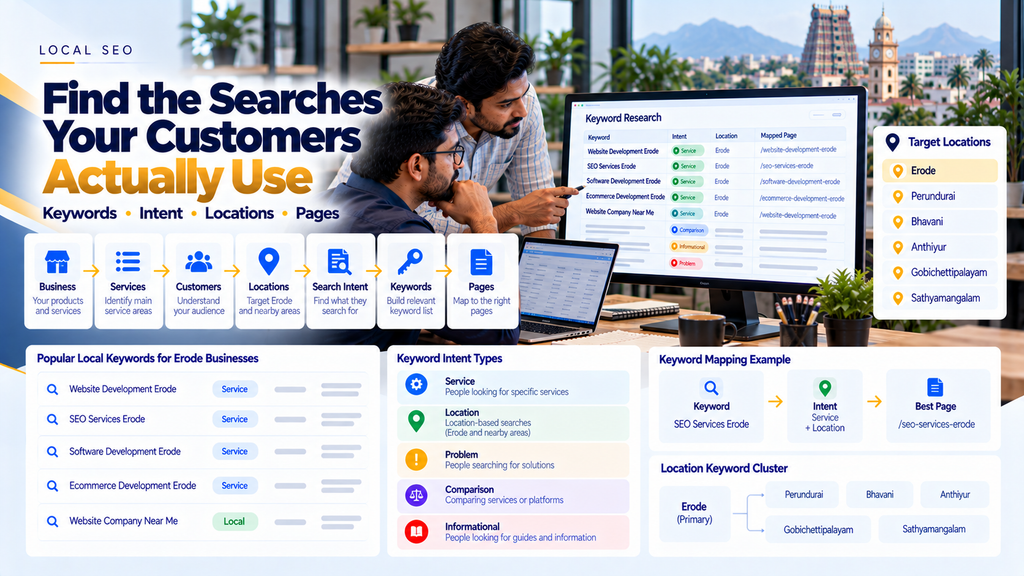
Business → Services → Customers → Problems → Search Intent → Locations → Keywords → Pages
This guide explains how businesses in Erode can research local keywords, understand search intent, organize keywords into groups and map them to useful website pages without unnecessary keyword stuffing.
What Is Local Keyword Research?
Local keyword research is the process of identifying search terms that potential customers may use when looking for products or services within a particular geographic market.
For an Erode business, these searches may include:
- Service + Erode
- Product + Erode
- Business type + Erode
- Service + nearby town
- Service + near me
- Problem + service
- Industry + service
- Specific service variations
- Questions related to the service
Why Is Local Keyword Research Important?
Keyword research helps connect the language used by your business with the language used by potential customers.
Without research, businesses can make several mistakes.
They may optimize for terms nobody relevant is likely to use.
They may create several pages targeting exactly the same search intent.
They may overlook valuable service-specific searches.
They may create dozens of unnecessary location pages.
They may attract informational visitors to pages intended to generate enquiries.
Keyword research helps create a clearer relationship:
Search → Intent → Relevant Page → Useful Information → Appropriate CTA
Local Keyword Research Is More Than Search Volume
Search volume can be useful when available, but it should not be the only factor used to select keywords.
For a local business, a highly specific search may have relatively limited search activity but still be commercially relevant.
For example:
software company
is broad.
manufacturing ERP software development in Erode
is much more specific.
The second search may represent a person with a clearer requirement.
Local SEO therefore requires evaluating:
- Relevance
- Search intent
- Geographic relevance
- Business value
- Specificity
- Competition
- Existing website coverage
- Available supporting content
Start With the Business, Not the Keyword Tool
Before opening a keyword research platform, understand the business itself.
Write down:
- What the business sells
- Which services it provides
- Who the customers are
- Which industries it serves
- Which locations it genuinely serves
- Which problems customers want solved
- Which services generate meaningful enquiries
- Which services the business wants to grow
This creates the foundation for keyword research.
Step 1: List Your Core Services
Begin with the actual services customers can purchase.
For example, a technology company might offer:
- Website development
- Ecommerce development
- Software development
- Mobile app development
- SEO services
- Digital marketing
These become seed topics rather than the final keyword list.
Step 2: Break Broad Services Into Specific Services
Broad keywords can hide more specific customer requirements.
For example:
Website Development
can expand into:
- Business website development
- Ecommerce website development
- Corporate website development
- B2B website development
- Product catalogue website development
- WordPress website development
- WooCommerce development
- Shopify development
Each represents a potentially different search intent.
Step 3: Add Relevant Location Modifiers
After identifying services, research how geographic terms may combine with them.
Examples include:
- Website development in Erode
- Website development company in Erode
- SEO company in Erode
- Software development company in Erode
- Ecommerce development in Erode
Location modifiers can indicate that the searcher is looking for a provider serving a particular area.
Step 4: Research Nearby Location Searches
Businesses serving wider areas around Erode may also investigate demand associated with nearby towns.
Depending on genuine service coverage, this may include locations such as:
- Erode
- Perundurai
- Bhavani
- Anthiyur
- Gobichettipalayam
- Sathyamangalam
- Modakkurichi
- Kodumudi
- Nambiyur
- Chennimalai
- Kavindapadi
- Ammapettai
- Arachalur
- Sivagiri
- Punjai Puliampatti
- Thalavadi
- Nasiyanur
- Surampatti
- Veerappanchatram
However, identifying a town does not automatically mean the website needs a separate page for it.
Do Not Create a Location Page for Every Keyword Automatically
This is one of the most important parts of local keyword research.
Imagine a business finds these searches:
- Website development Erode
- Website developers Erode
- Website company Erode
- Web development company Erode
- Website design company Erode
That does not necessarily mean five separate pages are needed.
If the searches represent substantially the same intent, one strong page may be able to cover the topic naturally.
The decision should be based on search intent and page purpose, not simply keyword wording.
Step 5: Understand Search Intent
Search intent describes what a person is trying to accomplish with a search.
Local keyword research becomes much more useful when keywords are grouped by intent.
Commercial / Service Intent
The searcher is evaluating a provider or service.
Examples:
- SEO company in Erode
- Website development company in Erode
- Mobile app development company in Erode
Transactional Intent
The searcher is closer to taking a specific action.
This can vary considerably by industry.
Examples might include booking, ordering, requesting a quote or contacting a service provider.
Informational Intent
The searcher wants to understand something.
Examples:
- How much does a business website cost?
- How does local SEO work?
- What should an SEO audit include?
- Shopify vs WooCommerce
Comparison Intent
The searcher is comparing options.
Examples:
- Shopify vs WooCommerce
- Custom website vs WordPress
- SEO vs Google Ads
Navigational Intent
The searcher is trying to find a particular business, brand, website or destination.
Step 6: Group Keywords by Intent
Do not maintain a keyword spreadsheet containing thousands of disconnected phrases.
Organize related keywords into clusters.
For example:
| Keyword Group | Likely Page Type |
|---|---|
| Website development company in Erode | Main service page |
| Ecommerce development in Erode | Specific service page |
| Technical SEO services in Erode | Specific SEO service / guide |
| How to choose a web development company | Blog / guide |
| Shopify vs WooCommerce | Comparison article |
Step 7: Build Service Keyword Clusters
A service cluster starts with one core business service and expands into closely related needs.
For example:
SEO Services
↓
SEO Audit
Technical SEO
On-Page SEO
Local SEO
Keyword Research
Website Speed
Core Web Vitals
This creates a much clearer SEO architecture than repeatedly publishing articles around variations of “SEO company in Erode.”
Step 8: Research Long-Tail Keywords
Long-tail keywords are more specific search phrases.
For example:
software company
is broad.
dealer management software development in Erode
is more specific.
textile dealer and distributor management software in Erode
is even more specific.
Specific searches can help businesses build pages around genuine services and customer requirements.
Step 9: Research Problem-Based Keywords
Customers do not always search for the name of a service.
Sometimes they search for the problem.
For example:
Service Keyword: Website speed optimization
Problem Search: Why is my website loading slowly?
Service Keyword: SEO audit
Problem Search: Why is my website not appearing on Google?
Service Keyword: Cart recovery
Problem Search: Why are customers leaving checkout?
Problem-based searches are especially useful for blog and educational content.
Step 10: Research Question Keywords
Questions can reveal what customers need to understand before buying.
Common patterns include:
- What is…
- How does…
- How much…
- Why does…
- Which is better…
- How to…
- What should…
- Do I need…
These questions can become supporting articles or sections within larger guides.
Step 11: Research Industry-Specific Keywords
B2B businesses can combine their service expertise with industry requirements.
For example:
- Textile ERP software
- Garment production software
- Powerloom management software
- Dyeing unit management software
- Manufacturing ERP software
- Warehouse management software
- Transport management software
Industry-specific searches can be more useful than generic software-development keywords when the business genuinely provides those solutions.
Step 12: Research Product and Service Terminology
Your internal business terminology may differ from customer terminology.
Talk to:
- Sales teams
- Customer-support teams
- Business owners
- Existing customers
- Project managers
Look at the words customers use when asking questions.
These conversations can reveal useful keyword ideas that keyword tools alone may not show clearly.
Step 13: Review Existing Search Performance
If the website already receives organic search impressions, existing search data can reveal useful opportunities.
Review:
- Queries generating impressions
- Queries generating clicks
- Pages receiving impressions
- Unexpected queries
- Relevant searches where the page may not fully match intent
This can help identify opportunities based on the website’s existing visibility.
Step 14: Review Your Existing Website Pages
Before creating new pages, identify what already exists.
Create an inventory containing:
- Page URL
- Page purpose
- Primary topic
- Target intent
- Primary keyword group
- Supporting keywords
- Current organic visibility
- Recommended action
This prevents unnecessary duplicate pages.
Step 15: Create a Keyword Map
A keyword map connects keyword groups with specific website pages.
A simple model is:
Keyword Cluster → Search Intent → Existing/New Page → Primary Topic → Supporting Terms
For example:
| Keyword Cluster | Intent | Recommended Page |
|---|---|---|
| SEO services Erode | Commercial | SEO service page |
| Technical SEO Erode | Commercial / Informational | Technical SEO page or guide |
| SEO audit Erode | Commercial | SEO audit page or detailed service guide |
| Local keyword research Erode | Informational / Commercial | Keyword research guide |
| How to improve local rankings | Informational | Blog article |
One Primary Intent Per Page
A useful SEO principle is to give each important page a clear primary purpose.
This does not mean using only one keyword.
A single page can naturally cover multiple closely related phrases when they share the same intent.
For example, a page about website development in Erode may naturally discuss terms such as:
- Website development in Erode
- Web development company in Erode
- Website developers in Erode
- Business website development
You do not automatically need a separate page for every wording variation.
Keyword Research for Homepage SEO
The homepage should communicate the core business clearly.
A company offering multiple digital services might use the homepage to establish broader business relevance, while dedicated pages target individual services.
For example:
Homepage → Website, Software & Digital Marketing Company
↓
Website Development Page
Software Development Page
Ecommerce Development Page
SEO Services Page
Digital Marketing Page
This creates clearer page responsibilities.
Keyword Research for Service Pages
Service pages usually target commercially relevant service searches.
Research should consider:
- Core service
- Service variations
- Customer type
- Industry
- Location where relevant
- Features
- Problems solved
- Related questions
Keyword Research for Blog Articles
Blogs should support customer research rather than simply repeat service-page keywords.
A useful content journey can look like:
Problem Search → Educational Article → Relevant Service → Enquiry
For example:
“Why is my website slow?”
↓
Website Speed Guide
↓
Website Speed Optimization Service
Keyword Research for Location Pages
A location page should exist because there is a meaningful reason for users in that location to have a dedicated page.
Before creating one, ask:
- Do we genuinely serve this location?
- Is the service relevant there?
- Can we provide useful location-specific information?
- Will the page have a purpose beyond replacing the town name?
- Does it overlap heavily with another page?
Should You Target “Near Me” Keywords?
Customers frequently use location-sensitive searches such as “near me.”
However, businesses do not need to repeatedly insert “near me” into unnatural website sentences.
Instead, strengthen genuine local relevance through:
- Accurate business information
- Clear service areas
- Relevant local pages where justified
- Google Business Profile
- Local citations
- Customer reviews
- Useful service content
Local Keyword Research for Google Maps SEO
Keyword research can also help a business understand the services and categories customers associate with it.
However, Google Maps optimization should not become an exercise in stuffing keywords into a business name.
Business information should remain accurate.
Read Google Maps SEO for Service Businesses in Erode.
Local Keyword Research for Google Business Profile Content
Keyword research can help businesses understand which services deserve clear representation in their website and business information.
The priority should remain accurate, customer-friendly information rather than forced keyword repetition.
Local Keyword Research for Ecommerce Businesses
Ecommerce keyword research can operate at several levels:
Category → Subcategory → Product Type → Product → Attribute / Use Case
For example:
Footwear → Men’s Footwear → Running Shoes → Product → Size / Material / Use
Not every variation should automatically become an indexable page.
Keyword research should work together with category architecture and technical SEO.
Read Ecommerce Category Page SEO: Complete Optimization Guide.
Local Keyword Research for Manufacturers
Manufacturing companies often have different search patterns from local consumer businesses.
Potential keyword dimensions include:
- Product
- Material
- Application
- Industry
- Manufacturing capability
- Wholesale requirement
- Supplier intent
- Geographic market
B2B keyword research should reflect how buyers actually search for manufacturers, products and capabilities.
Local Keyword Research for Software Companies
Software businesses can organize keywords around business problems and industries.
For example:
Software Development
↓
Business Software
↓
Manufacturing Software / Textile Software / Warehouse Software / Logistics Software
↓
Specific Operational Requirement
This can create highly relevant content without forcing every topic into one generic “software company” page.
Local Keyword Research for Healthcare and Professional Services
For clinics and other professional service businesses, keyword research should accurately reflect the services genuinely offered.
Avoid creating misleading pages for treatments, qualifications or capabilities that the business does not provide.
Accuracy is more important than simply targeting a keyword.
How to Evaluate a Local Keyword
Before targeting a keyword, ask:
- Is it relevant to our real service?
- What is the likely search intent?
- Is the location relevant to our actual coverage?
- Do we already have a page for this intent?
- What type of page would best answer the search?
- Can we provide genuinely useful information?
- Does the keyword have business value?
- Would targeting it create unnecessary duplication?
Search Volume vs Business Value
Do not automatically select a keyword because it has the largest estimated search volume.
Consider this simplified example:
| Keyword Type | Specificity | Possible Business Intent |
|---|---|---|
| Software | Very broad | Unclear |
| Software company Erode | More specific | Commercial |
| Manufacturing software Erode | Specific | Commercial |
| Textile ERP software Erode | Highly specific | Potentially strong B2B relevance |
Actual value depends on the business and the searcher’s requirement.
Do Not Trust Keyword Volume as an Exact Number
Keyword research tools can provide useful estimates, but businesses should avoid treating estimated volume as an exact count of future customers.
Different tools can report different estimates.
Local and highly specific searches may also have limited data.
Use keyword metrics as decision inputs rather than guarantees.
Competitor Keyword Research
Competitor analysis can help identify topics your website may have overlooked.
Review businesses appearing for relevant searches and examine:
- Services they cover
- Page types
- Topics
- Categories
- Questions answered
- Industries targeted
- Content gaps
Do not simply copy their keywords or content.
The objective is to understand the search landscape and identify opportunities relevant to your own business.
Keyword Gap Analysis
A keyword gap is a relevant topic or search intent that the business could legitimately address but currently does not cover well.
For example, a website may already have:
- Website Development
- Software Development
- SEO Services
but lack dedicated content for:
- Ecommerce Development
- Technical SEO
- SEO Audits
- Website Maintenance
If these are genuine services, they may represent useful content opportunities.
Keyword Cannibalization
Keyword cannibalization can occur when multiple website pages compete unnecessarily for substantially the same intent.
For example:
- SEO company in Erode
- SEO agency in Erode
- Best SEO company Erode
- SEO experts Erode
Creating a separate near-identical page for every phrase can weaken the website’s structure.
Instead:
Group Related Keywords → Understand Shared Intent → Choose the Best Page → Optimize Naturally
Avoid Keyword Stuffing
Local keyword research tells you what topics matter.
It does not mean every keyword should be repeated throughout the page.
A sentence such as:
“We are the best SEO company Erode providing SEO services Erode for Erode businesses looking for SEO Erode.”
is not useful writing.
Write naturally for customers while making the page topic clear.
Use Keywords Naturally in Important Page Elements
Where appropriate, a primary topic can inform:
- Page title
- H1
- URL
- Introduction
- Relevant headings
- Body content
- Internal-link context
- Image ALT text when genuinely descriptive
The goal is clarity, not repetition.
Local Keyword Research and Internal Linking
Keyword research can help reveal relationships between pages.
For example:
SEO Services
↓
SEO Audit
↓
Technical SEO
↓
Website Speed / Core Web Vitals
and:
SEO Services
↓
On-Page SEO
↓
Keyword Research / Content Optimization / Internal Linking
This creates a logical topic structure for users and search engines.
Local Keyword Research and SEO Audits
Keyword research should also be part of a broader SEO audit.
An audit can determine:
- Which keywords existing pages appear for
- Which pages have unclear intent
- Where multiple pages overlap
- Which important services lack pages
- Which content should be updated
- Which keyword opportunities align with the business
Read SEO Audit Services in Erode: What a Professional Audit Should Include.
Local Keyword Research and On-Page SEO
Keyword research identifies what the page should address.
On-page SEO then communicates that topic clearly through:
Title → H1 → URL → Content → Headings → Images → Internal Links → CTA
Read On-Page SEO Services in Erode: Complete Business Guide.
Local Keyword Research and Technical SEO
Keyword research can identify the right pages to create, but technical SEO helps ensure those pages are accessible and indexable as intended.
Both areas are therefore connected.
Read Technical SEO Services in Erode: Why Your Website Needs Them.
How to Prioritize Local Keywords
A simple prioritization framework is:
Business Relevance + Search Intent + Location Relevance + Existing Coverage + Opportunity + Ability to Create a Useful Page
High-volume but irrelevant searches should not automatically receive priority.
Build a Local Keyword Research Spreadsheet
A useful keyword research sheet can contain:
| Field | Purpose |
|---|---|
| Keyword | Search phrase being researched |
| Topic Cluster | Main subject or service |
| Intent | Commercial, informational, comparison, etc. |
| Location | Relevant geographic modifier |
| Page Type | Service, location, category, product or blog |
| Existing URL | Current page if available |
| Target URL | Page selected for the keyword cluster |
| Priority | Business/search priority |
| Status | Existing, update, create, merge or review |
Example Local Keyword Map for an Erode Technology Business
| Topic | Keyword Direction | Page Type |
|---|---|---|
| Website Development | Website development company in Erode | Service Page |
| Ecommerce | Ecommerce development company in Erode | Service Page |
| Software | Software development company in Erode | Service Page |
| SEO | SEO company in Erode | Service Page |
| Technical SEO | Technical SEO services in Erode | Service Guide |
| SEO Audit | SEO audit services in Erode | Service Guide |
| Keyword Research | Local keyword research for Erode businesses | Educational Guide |
How Often Should Keyword Research Be Updated?
Keyword research should not be treated as a one-time document that is never reviewed again.
Revisit it when:
- New services are launched
- New products are added
- The business enters a new market
- The website is redesigned
- Search performance changes significantly
- Customer terminology changes
- New competitors enter the search landscape
- New content opportunities become apparent
Common Local Keyword Research Mistakes
- Choosing only high-volume keywords
- Ignoring search intent
- Creating one page for every keyword variation
- Creating near-identical town pages
- Targeting locations the business does not genuinely serve
- Ignoring long-tail keywords
- Ignoring problem-based searches
- Ignoring customer terminology
- Copying competitor keyword strategies blindly
- Keyword stuffing
- Targeting the same intent across multiple pages
- Ignoring existing website rankings
- Creating blogs that compete with service pages
- Using keyword-tool numbers as guaranteed traffic forecasts
- Failing to map keywords to URLs
Local Keyword Research Checklist for Erode Businesses
- List core business services
- Break services into specific offerings
- Identify customer types
- Identify industries served
- Define genuine service locations
- Collect seed keywords
- Research location modifiers
- Research service variations
- Research customer problems
- Research questions
- Research long-tail terms
- Classify search intent
- Review current website pages
- Review existing search visibility
- Research relevant competitors
- Identify content gaps
- Group related keywords
- Check keyword cannibalization
- Map keyword clusters to URLs
- Prioritize by business value and relevance
- Create useful pages
- Build internal links
- Measure performance
- Review and update the strategy
Local Keyword Research for Erode and Nearby Areas
Businesses serving customers across Erode district can research location demand for areas such as:
- Erode
- Perundurai
- Bhavani
- Anthiyur
- Gobichettipalayam
- Sathyamangalam
- Modakkurichi
- Kodumudi
- Nambiyur
- Chennimalai
- Kavindapadi
- Ammapettai
- Arachalur
- Sivagiri
- Punjai Puliampatti
- Thalavadi
- Nasiyanur
- Surampatti
- Veerappanchatram
This list should be treated as a research starting point rather than an instruction to create a separate SEO page for every location.
Create location-specific content only where it serves a genuine customer and business purpose.
How Greap Technologies Can Help With Local Keyword Research
Greap Technologies can combine keyword research with website structure, on-page SEO, technical SEO and content planning for businesses targeting Erode and wider markets.
Depending on the project, the process can include:
- Business and service analysis
- Seed keyword research
- Local keyword research
- Service keyword research
- Long-tail keyword research
- Search-intent classification
- Competitor search analysis
- Keyword-gap analysis
- Existing page analysis
- Keyword cannibalization review
- Keyword clustering
- Keyword-to-page mapping
- Service-page planning
- Location-page planning
- Blog topic research
- Internal-link planning
- On-page SEO recommendations
- Local SEO strategy
- SEO audit integration
Explore Greap Technologies SEO Services, Digital Marketing Services or visit Greap Technologies.
A Better Local Keyword Strategy
Instead of:
Find Keyword → Repeat Keyword Everywhere → Create More Similar Pages
use:
Understand Business
↓
Understand Customer
↓
Research Searches
↓
Understand Intent
↓
Group Related Keywords
↓
Map Clusters to Pages
↓
Create Useful Content
↓
Build Internal Links
↓
Measure Search Performance
↓
Improve Based on Evidence
Conclusion
Local keyword research for Erode businesses is not about finding as many keywords as possible.
It is about identifying the searches that connect real customer needs with genuine business services.
A strong keyword strategy should connect:
Business → Customer → Service → Problem → Location → Search Intent → Keyword Cluster → Relevant Page
This approach can help businesses avoid keyword stuffing, duplicate pages and unnecessary location content.
It also provides a clearer foundation for service pages, blog articles, local SEO, internal linking and future content planning.
Keyword research does not guarantee rankings, traffic or enquiries.
Search visibility depends on many factors, including competition, relevance, website quality, technical accessibility, content, local signals and other search systems.
The goal is therefore not to chase every possible keyword.
The goal is to identify the searches that matter to the business and create the most useful page for each meaningful search intent.
Need Local Keyword Research for Your Erode Business?
If you are unsure which services, keywords, locations and content topics your website should target, Greap Technologies can review your business, existing website and search opportunities to create a structured keyword and page plan.
Discuss Your Keyword Research Requirements
Frequently Asked Questions
1. What is local keyword research?
Local keyword research identifies search terms that potential customers may use when looking for products or services within a particular geographic market. It also considers search intent, service relevance and the most appropriate page for each keyword group.
2. How do I find local SEO keywords for my Erode business?
Start with your real services, customer requirements and service areas. Expand these into service variations, location terms, problems, questions and long-tail searches. Then group the terms by intent and map them to appropriate website pages.
3. Should every local keyword have a separate page?
No. Closely related keywords with the same search intent can often be covered by one strong page. Creating separate near-identical pages for every keyword variation can create unnecessary duplication.
4. Should I create a page for every town in Erode district?
Not automatically. A location page should have a genuine customer and business purpose. Avoid simply copying the same page and replacing the town name.
5. Should I target “near me” keywords?
Near-me searches can be relevant to local businesses, but there is usually no need to repeat the phrase unnaturally throughout website content. Accurate business information, genuine local relevance, appropriate service areas and a properly maintained business profile are more useful foundations.
6. What are long-tail local keywords?
Long-tail keywords are more specific searches, such as a particular service, industry and location combination. They may have narrower demand but can represent more clearly defined customer requirements.
7. What is keyword mapping?
Keyword mapping is the process of assigning related keyword groups and search intents to the most appropriate website URLs. It helps reduce overlap and gives each important page a clear purpose.
8. What is keyword cannibalization?
Keyword cannibalization generally refers to situations where multiple pages compete unnecessarily for substantially the same search intent. Reviewing and consolidating overlapping pages can create a clearer website structure.
9. Is search volume the most important keyword metric?
No. Search volume can be useful, but local businesses should also consider relevance, intent, location, business value, competition and whether they can create a genuinely useful page for the search.
10. Can local keyword research improve Google rankings?
Keyword research can improve the relevance and organization of an SEO strategy, but it cannot guarantee rankings. Search performance depends on many technical, content, competitive and local factors.
11. How often should keyword research be updated?
Review keyword research when services change, new products are introduced, the business enters new markets, the website is redesigned or search data reveals new customer terminology and opportunities.
12. Does Greap Technologies provide keyword research in Erode?
Greap Technologies can provide keyword research as part of an agreed SEO scope, including service research, local keyword analysis, search-intent classification, keyword clustering, keyword mapping and content planning for relevant business requirements.