Customers do not always contact a business immediately after discovering it.
Before making an enquiry, they may search for a problem, compare different solutions, read about a service, check examples, understand pricing factors and evaluate whether a company appears trustworthy.
Useful content can support this decision-making process.
This is where content marketing services in Erode can help businesses build a structured content system around the questions, problems and requirements of their potential customers.
Content marketing is not simply publishing random blog articles every week.
A stronger approach connects:
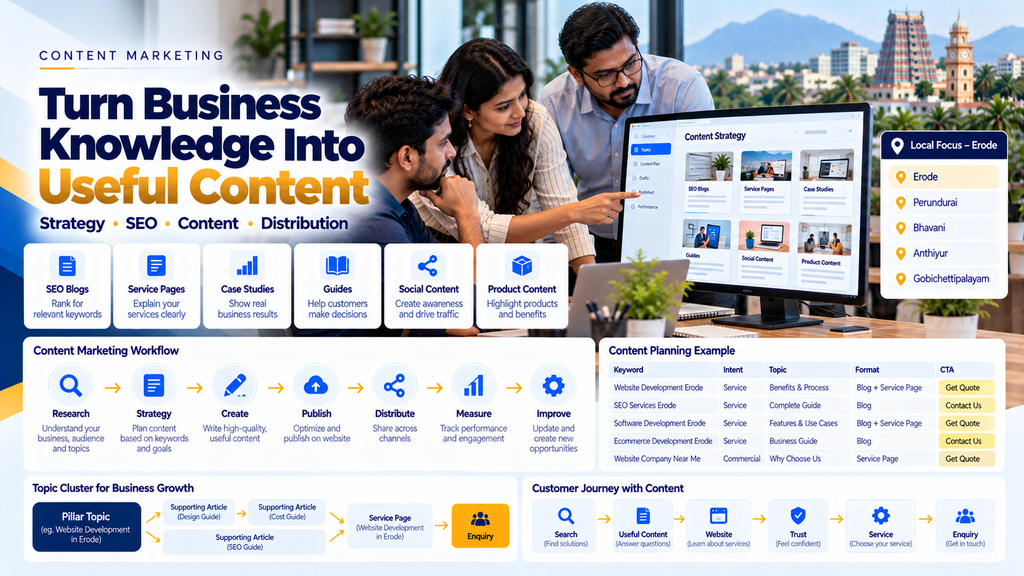
Customer Need → Keyword & Intent Research → Content Strategy → Useful Content → Distribution → Relevant Service → Enquiry → Measurement
For businesses in Erode, content marketing can support SEO, local visibility, service education, B2B lead generation, sales conversations and long-term website development.
However, content marketing does not guarantee rankings, leads or revenue.
The objective is to create useful content that supports the wider marketing and customer journey.
This guide explains what content marketing includes, how businesses can build a content strategy and what to check before choosing a content marketing company in Erode.
What Is Content Marketing?
Content marketing is the planned creation, publication and distribution of useful content for a defined audience.
Content can take many forms, including:
- Blog articles
- Service pages
- Industry guides
- Case studies
- Product content
- Comparison articles
- Frequently asked questions
- Videos
- Social media content
- Email content
- Infographics
- Checklists
- Downloadable resources
The format should depend on the audience and the purpose of the content.
Why Do Erode Businesses Need Content Marketing?
Potential customers often research before making business decisions.
Imagine a manufacturer looking for new business software.
The buyer may search for:
- What is manufacturing ERP?
- Production management software features
- ERP vs separate business software
- Manufacturing ERP software in Erode
- How much does custom ERP development cost?
- How to choose an ERP development company?
A company that provides useful information throughout this research journey has more opportunities to demonstrate its expertise and connect the visitor with an appropriate service.
Content Marketing Is More Than Blogging
Blogging is one component of content marketing.
A complete strategy can connect different content types:
Homepage
↓
Service Pages
↓
Industry / Solution Pages
↓
Blog Articles & Guides
↓
Case Studies / Proof
↓
Conversion Pages & CTAs
Content can also be adapted for social media, email and other appropriate channels.
How Content Marketing Can Support Business Growth
Content marketing can support growth in several ways when it is connected to genuine customer requirements.
1. Increase Search Visibility Opportunities
Every useful topic can create an additional opportunity for the website to be relevant to a search.
This does not mean publishing hundreds of pages.
It means covering meaningful customer topics with the right page type.
2. Explain Your Services
Complex services are difficult to sell when customers do not understand them.
Content can explain:
- What the service does
- Who needs it
- How it works
- Important features
- Implementation considerations
- Common problems
- Pricing factors
- How to evaluate providers
3. Build Business Trust
Useful, accurate content can help potential customers understand how a business approaches its work.
Trust should come from genuine expertise, transparent information and real evidence rather than unsupported claims.
4. Support Lead Generation
Content can connect informational visitors with appropriate commercial next steps.
For example:
Search Question → Helpful Article → Relevant Service → Case Study → Enquiry
5. Support Sales Teams
Sales teams repeatedly answer similar customer questions.
Well-developed content can provide useful resources that sales teams can share with prospects.
6. Support Other Marketing Channels
A detailed guide can be repurposed into:
- LinkedIn posts
- Short social posts
- Videos
- Email content
- Sales resources
- Infographics
This helps businesses get more value from the research behind each major piece of content.
Content Marketing and SEO
Content marketing and SEO frequently work together.
SEO research can identify what customers are searching for.
Content marketing determines how the business can answer those searches usefully.
A simplified process is:
Keyword Research → Search Intent → Content Topic → Best Format → Optimization → Internal Links → Distribution → Measurement
Step 1: Understand the Business
A content strategy should begin with the business rather than a list of trending keywords.
Understand:
- Core services
- Products
- Customer types
- Industries served
- Geographic markets
- Business strengths
- Common customer questions
- Sales objections
- Important conversion actions
Step 2: Understand the Target Audience
Different customers need different information.
A textile manufacturer looking for ERP software has a different research journey from a consumer looking for an ecommerce product.
A useful audience profile can consider:
- Customer type
- Industry
- Problem
- Decision-making role
- Level of existing knowledge
- Questions
- Concerns
- Buying stage
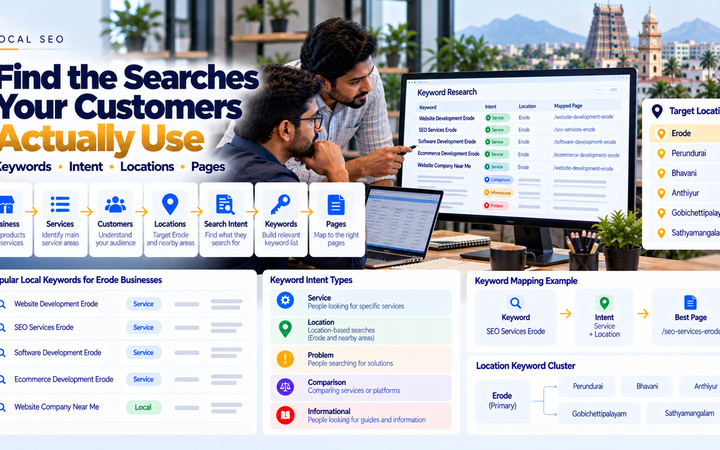
Step 3: Research Keywords
Keyword research can help identify how potential customers describe their needs.
Research can include:
- Service keywords
- Location keywords
- Industry keywords
- Problem-based searches
- Question searches
- Comparison searches
- Long-tail keywords
Read Local Keyword Research for Erode Businesses.
Step 4: Understand Search Intent
Do not create content based only on the words inside a keyword.
Understand what the searcher wants.
Informational Intent
The user wants to learn.
Example:
What is technical SEO?
Commercial Investigation
The user is evaluating a solution or provider.
Example:
SEO audit services in Erode
Comparison Intent
The user is comparing options.
Example:
Shopify vs WooCommerce
Transactional Intent
The user is closer to taking an action such as purchasing, booking or requesting a quote.
Step 5: Map the Customer Journey
Content should support different stages of the decision process.
A simplified B2B journey may look like:
Problem Awareness → Research → Solution Education → Provider Evaluation → Enquiry → Decision
Different content types can support different stages.
Top-of-Funnel Content
This content often addresses broad problems and educational questions.
Examples:
- How-to guides
- Educational articles
- Checklists
- Common mistakes
- Industry explanations
Middle-of-Funnel Content
This content helps potential customers evaluate approaches and solutions.
Examples:
- Comparison articles
- Feature guides
- Implementation guides
- Buying guides
- Case studies
Bottom-of-Funnel Content
This content supports customers who are closer to contacting or choosing a provider.
Examples:
- Service pages
- Solution pages
- Industry pages
- Portfolio pages
- Case studies
- Pricing-factor guides
- Request-a-quote pages
Step 6: Build Content Pillars
A content pillar is a major topic related to the business.
For a digital technology company, pillars might include:
- Website Development
- Ecommerce Development
- Software Development
- SEO
- Digital Marketing
- Business Automation
Each pillar can then contain narrower supporting topics.
Step 7: Build Topic Clusters
Topic clusters help organize related content logically.
For example:
SEO Services
↓
SEO Audit
Technical SEO
On-Page SEO
Local Keyword Research
Google Maps SEO
Website Speed
Core Web Vitals
These pages can support each other through relevant internal links.
Step 8: Perform a Content Gap Analysis
A content gap exists when an important customer topic is not adequately covered by the website.
To identify gaps, review:
- Current services
- Existing website pages
- Customer questions
- Keyword research
- Sales conversations
- Search performance
- Relevant competitor topics
A gap should only become content when it is genuinely relevant to the business and audience.
Step 9: Create a Content Map
Before writing, map each topic to the right type of page.
| Search / Topic | Intent | Content Type |
|---|---|---|
| SEO company in Erode | Commercial | Service page |
| Technical SEO services in Erode | Commercial / Educational | Service guide |
| What should an SEO audit include? | Informational / Commercial | Detailed guide |
| How to improve Google rankings locally | Informational | Blog guide |
| Shopify vs WooCommerce | Comparison | Comparison article |
Step 10: Create a Content Calendar
A content calendar helps businesses plan topics rather than publishing randomly.
It can include:
- Topic
- Target audience
- Search intent
- Keyword cluster
- Content format
- Author or owner
- Planned publication date
- Internal links
- CTA
- Distribution channels
- Update status
Quality Is More Important Than Publishing Frequency
A business does not necessarily need to publish every day.
A smaller number of useful, accurate and strategically connected articles can be more valuable than a large collection of repetitive content.
Publishing frequency should depend on:
- Available expertise
- Research capacity
- Content quality
- Business goals
- Topic opportunities
- Distribution capacity
SEO Blog Writing Services
SEO blog content should satisfy a real reader need while also being structured so search engines can understand the topic.
A useful blog can include:
- Clear topic
- Search-intent alignment
- Descriptive title
- Logical heading structure
- Original explanations
- Examples
- Useful internal links
- Relevant CTA
Do Not Write Blogs Only for Keywords
A keyword should guide the topic, not control every sentence.
Instead of asking:
“How many times should we repeat this keyword?”
ask:
“What does someone searching this phrase actually need to know?”
This creates more useful content.
Service Page Content Marketing
Service pages are important commercial content assets.
A useful service page can explain:
- What the service is
- Who it is for
- Problems addressed
- Scope or features
- Process
- Relevant examples
- Frequently asked questions
- Next steps
The exact structure should reflect the service rather than follow a rigid word-count template.
Content Marketing for Local SEO
Businesses targeting Erode should create content that reflects genuine local relevance.
Possible content areas include:
- Local service guides
- Industry-specific resources
- Relevant local case studies
- Local business questions
- Service-area information
- Local customer success stories where permission is available
Avoid Creating Near-Identical Location Content
Businesses serving multiple towns sometimes duplicate one article and replace only the location name.
For example:
Website Development in Erode
Website Development in Bhavani
Website Development in Perundurai
Website Development in Anthiyur
If each page contains essentially the same information, the website gains little unique value from the duplication.
Location content should have a genuine reason to exist.
Content Marketing for B2B Businesses
B2B customers may research extensively before contacting a supplier or service provider.
Useful B2B content can include:
- Industry guides
- Technical explainers
- Feature comparisons
- Implementation guides
- Case studies
- Process explanations
- ROI considerations without fabricated claims
- Integration guides
- Buyer checklists
Content Marketing for Manufacturers in Erode
Manufacturing companies can use content to explain products, capabilities and applications.
Potential content areas include:
- Product guides
- Material guides
- Manufacturing processes
- Applications
- Industry use cases
- Product comparisons
- Quality processes
- Frequently asked technical questions
- Buyer guides
Technical claims should reflect the manufacturer’s real processes and capabilities.
Content Marketing for Textile Businesses
Erode has businesses operating across textile-related sectors.
Relevant content opportunities can vary by business but may include:
- Product categories
- Yarn-related educational content
- Fabric information
- Garment manufacturing topics
- Wholesale buying guides
- B2B ordering information
- Production-related guides
- Product-care information where relevant
Content should accurately reflect the company’s actual products and processes.
Content Marketing for Ecommerce Businesses
Ecommerce content extends beyond blog articles.
Important content assets include:
- Category descriptions
- Product descriptions
- Buying guides
- Comparison guides
- Product FAQs
- Usage guides
- Shipping information
- Return information
- Educational articles
Read Ecommerce Category Page SEO: Complete Optimization Guide and Ecommerce Product Page SEO: How to Rank Products on Google.
Content Marketing for Software Companies
Software businesses often need to explain complex solutions before a prospect is ready to request a demonstration or quotation.
Content can cover:
- Business problems
- Software features
- Workflows
- Integrations
- Implementation considerations
- Industry-specific requirements
- Custom vs ready-made solutions
- Data migration
- Support and maintenance
Case Studies as Content Marketing
Case studies can help demonstrate how a business approaches real work.
A useful case study can include:
Client Context → Problem → Requirements → Approach → Implementation → Outcome
Use genuine information and obtain appropriate permission before publishing identifiable customer information.
Do not fabricate clients, results, percentages or testimonials.
Comparison Content
Comparison articles can help customers evaluate alternatives.
Examples include:
- Shopify vs WooCommerce
- WordPress vs custom development
- Custom ERP vs ready-made ERP
- SEO vs paid advertising
A comparison should explain trade-offs rather than forcing every reader toward the same answer.
Pricing Content
Pricing-related content can be useful when customers regularly ask about cost.
If exact prices vary, explain the factors affecting cost instead of inventing a universal number.
For example:
- Project scope
- Number of pages
- Custom functionality
- Integrations
- Design requirements
- Content requirements
- Support requirements
Content Marketing and Internal Linking
Publishing articles without connecting them to relevant pages can create isolated content.
Internal links should help users move naturally between related topics.
For example:
Local Keyword Research
↓
Content Marketing
↓
On-Page SEO
↓
Technical SEO
↓
SEO Audit
Relevant pages can also link back to broader service pages.
Content Marketing and On-Page SEO
After useful content has been created, on-page SEO helps communicate the page topic clearly.
This can include:
- Title
- H1
- URL
- Headings
- Body content
- Images
- Internal links
- Meta description
Read On-Page SEO Services in Erode: Complete Business Guide.
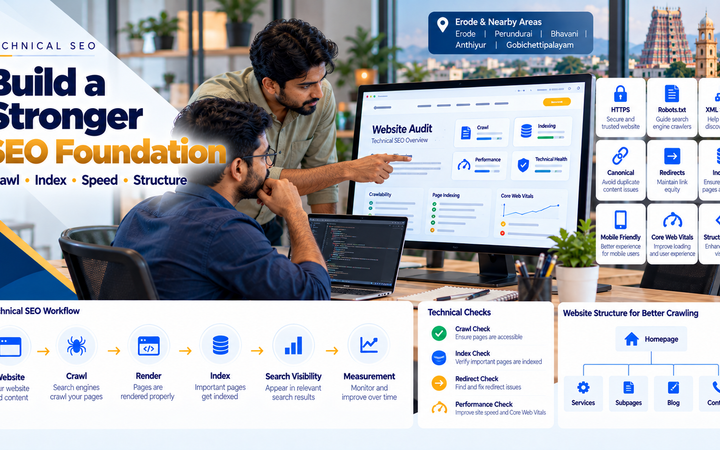
Content Marketing and Technical SEO
Content also needs a technically reliable website foundation.
A strong article provides limited search value if the page is unintentionally blocked, noindexed or poorly connected.
Read Technical SEO Services in Erode: Why Your Website Needs Them.
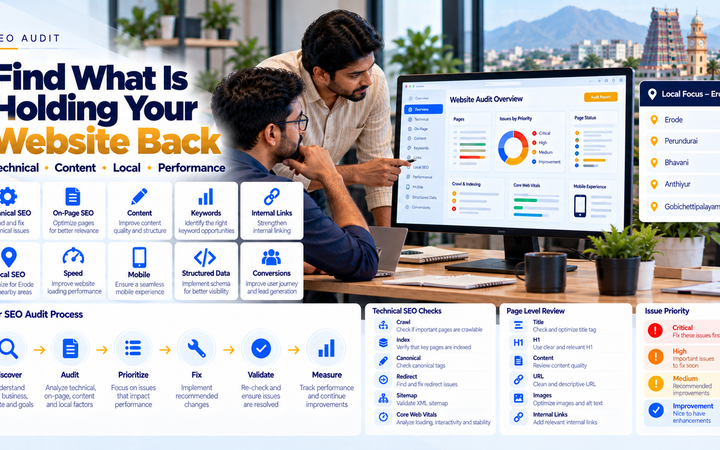
Content Marketing and SEO Audits
An SEO audit can identify content-related problems such as:
- Missing service topics
- Thin pages
- Duplicate content
- Keyword cannibalization
- Weak internal linking
- Outdated content
- Pages targeting unclear intent
- Content receiving impressions but few clicks
Read SEO Audit Services in Erode: What a Professional Audit Should Include.
Content Distribution
Publishing a page is not always the end of the process.
Depending on the audience, relevant content can be distributed through:
- Other relevant social channels
- WhatsApp where appropriate and permitted
- Sales conversations
- Industry communities where appropriate
- Internal website links
Repurpose Content Instead of Starting From Zero
One well-researched article can support several formats.
For example:
Detailed Guide
↓
LinkedIn Post
↓
Carousel
↓
Short Video
↓
↓
Sales Resource
The content should be adapted to each format rather than copied mechanically.
Updating Existing Content
Content marketing is not limited to creating new pages.
Existing pages can sometimes provide better opportunities.
Review:
- Outdated information
- Old screenshots
- Broken links
- Missing sections
- Changed services
- Search intent
- Internal links
- Calls to action
- Search performance
Do Not Delete Old Content Without Reviewing It
An older article may still receive traffic, links or search impressions.
Before removing it, determine whether it should be:
- Updated
- Expanded
- Consolidated
- Redirected to a genuinely relevant replacement
- Removed if it no longer provides value and no appropriate replacement exists
Measuring Content Marketing Performance
Content marketing should be measured according to its purpose.
Possible measurements include:
- Organic search impressions
- Organic clicks
- Landing-page visits
- Engaged visits
- Internal-link journeys
- Service-page visits from content
- Contact actions
- Quote requests
- Qualified enquiries
- Purchases where relevant
Not every article should be judged only by direct last-click leads.
Content Marketing Metrics Should Match the Funnel Stage
An educational article and a service page serve different purposes.
| Content Type | Possible Measurement Focus |
|---|---|
| Educational Guide | Search visibility, useful engagement, next-page journey |
| Comparison Article | Engagement, service-page progression, enquiries |
| Service Page | Relevant organic traffic, CTA interaction, enquiries |
| Case Study | Engagement, sales support, enquiry progression |
| Product / Category Content | Product discovery and ecommerce conversion journey |
Content Marketing Does Not Guarantee Google Rankings
Publishing content does not automatically result in rankings.
Search performance can depend on factors such as:
- Search intent
- Content usefulness
- Competition
- Website architecture
- Technical SEO
- Internal linking
- Website authority and external signals
- Local relevance where applicable
A content marketing company should therefore avoid promising guaranteed first-page rankings simply because a certain number of blogs will be published.
Content Marketing and AI-Generated Content
AI tools can assist with parts of a content workflow, but businesses should not treat automatic generation as a substitute for business knowledge, verification and editorial review.
Content should be checked for:
- Accuracy
- Business relevance
- Unsupported claims
- Outdated information
- Repetition
- Generic wording
- Brand consistency
- Customer usefulness
Human Expertise Should Remain Part of the Process
Subject-matter knowledge can make content more useful.
For example, a software article can benefit from developer and project-team input.
A manufacturing article can benefit from information provided by production teams.
An SEO article can benefit from actual website and search analysis.
This creates content grounded in real business knowledge rather than generic summaries.
A Practical Content Marketing Workflow
A structured process can follow:
1. Business Research
↓
2. Audience Research
↓
3. Keyword & Search Intent Research
↓
4. Content Gap Analysis
↓
5. Topic Clustering
↓
6. Content Calendar
↓
7. Research & Drafting
↓
8. Subject-Matter Review
↓
9. SEO Optimization
↓
10. Publishing & Internal Linking
↓
11. Distribution
↓
12. Measurement
↓
13. Update & Improve
Common Content Marketing Mistakes
- Publishing without a strategy
- Writing only for keywords
- Ignoring search intent
- Publishing several articles targeting the same topic
- Creating near-identical location pages
- Keyword stuffing
- Copying competitor articles
- Publishing inaccurate AI-generated information
- Using fake statistics
- Creating fake case studies
- Creating fake customer reviews
- Making unsupported business claims
- Ignoring internal links
- Ignoring service pages
- Publishing without distribution
- Never updating old articles
- Measuring only traffic
- Failing to connect content with enquiries
- Publishing large quantities of low-value content
- Expecting every article to generate immediate leads
Content Marketing Checklist for Erode Businesses
- Define business goals
- Define target customers
- List core services
- Identify genuine service areas
- Research customer questions
- Perform keyword research
- Classify search intent
- Audit existing content
- Identify content gaps
- Create topic clusters
- Map keywords to pages
- Create a content calendar
- Choose the correct format
- Research the topic properly
- Use business expertise
- Write useful original content
- Optimize on-page elements
- Add relevant internal links
- Add an appropriate CTA
- Publish
- Distribute
- Measure performance
- Update useful content over time
Content Marketing Services Across Erode District
Businesses targeting customers across Erode district may develop content around genuine markets and service areas, including:
- Erode
- Perundurai
- Bhavani
- Anthiyur
- Gobichettipalayam
- Sathyamangalam
- Modakkurichi
- Kodumudi
- Nambiyur
- Chennimalai
- Kavindapadi
- Ammapettai
- Arachalur
- Sivagiri
- Punjai Puliampatti
- Thalavadi
- Nasiyanur
- Surampatti
- Veerappanchatram
Businesses should not automatically create a separate article or service page for every location in this list.
Local content should reflect genuine service coverage and provide meaningful information for the intended audience.
How Greap Technologies Can Help With Content Marketing
Greap Technologies can combine content planning with SEO, website development and digital marketing to create a connected content system rather than isolated blog posts.
Depending on the agreed project scope, content marketing work can include:
- Content strategy
- Audience research
- Keyword research
- Search-intent analysis
- Content audit
- Competitor content research
- Content-gap analysis
- Topic clustering
- Keyword mapping
- Content calendar planning
- SEO blog content
- Service-page content
- Industry content
- B2B content
- Ecommerce content
- Case-study planning
- On-page SEO
- Internal-link planning
- Content updates
- Content repurposing
- Content performance review
Explore Greap Technologies Digital Marketing Services, SEO Services, Website Development Services or visit Greap Technologies.
How to Choose a Content Marketing Company in Erode
1. Do They Understand Your Business?
The agency should understand what you sell before creating content.
2. Do They Research the Audience?
Content should address customer needs rather than simply satisfy a publishing schedule.
3. Do They Understand Search Intent?
Keywords with different intentions should not automatically be targeted with the same type of page.
4. Do They Create a Content Strategy?
Ask how individual articles connect with services, topic clusters and business goals.