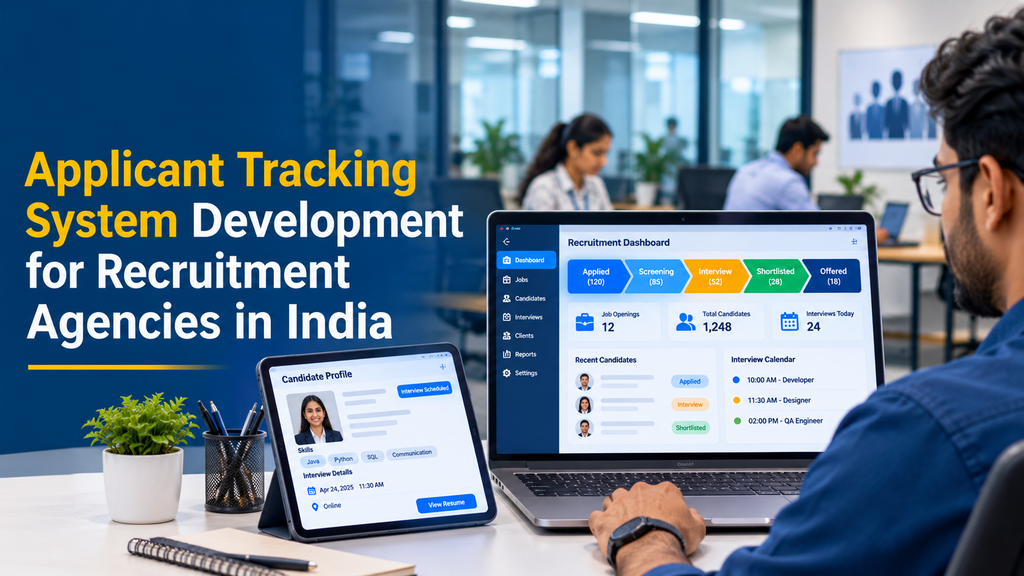
An Applicant Tracking System (ATS) is recruitment management software that helps recruitment agencies organise job openings, candidate profiles, resumes, interviews, client requirements and placement activities in one platform. Custom ATS development allows agencies to design recruitment workflows around their own hiring processes, business model and client requirements.
Recruitment agencies in India often manage multiple clients, vacancies and candidate databases at the same time. Recruiters may receive applications through job portals, email, referrals, social media and company websites. Without a central system, candidate information can become scattered across spreadsheets, inboxes and messaging applications.
A well-designed ATS brings this information into a structured recruitment pipeline. It helps recruiters understand each candidate’s progress, coordinate interviews, maintain client communication and review placement performance.
What Is an Applicant Tracking System?
An Applicant Tracking System is a software application used to collect, organise, search and track job applicants throughout the recruitment process. It creates a central record for each candidate and connects that record to relevant job openings and recruitment activities.
Recruiters can use the system to record applications, review resumes, update candidate status, schedule interviews and document feedback. Recruitment managers can monitor vacancy progress, recruiter workloads and placement outcomes through reports.
For an agency, an ATS can be more than an internal hiring tool. It can also support client management, job order tracking, candidate submissions, interview coordination and placement follow-up.
Why Do Recruitment Agencies in India Need an ATS?
A recruitment agency may work with several companies across different industries. Each client can have different job requirements, screening criteria, interview processes and reporting expectations.
1. Centralised candidate database
Candidate details can be stored in a searchable database instead of separate files and spreadsheets. Recruiters can review previous applications and identify suitable profiles for new vacancies, subject to the candidate’s permissions and applicable data-use requirements.
2. Better recruitment pipeline visibility
A candidate’s progress can be displayed through defined stages such as Applied, Screening, Shortlisted, Interview, Offered and Placed. Recruiters and managers can quickly identify pending actions.
3. Improved recruiter coordination
When multiple recruiters work on different vacancies, task assignment and activity history help reduce duplicated effort and missed follow-ups.
4. Faster candidate search
Search filters can help recruiters locate candidates based on skills, experience, location, job category, notice period or other relevant criteria. These filters should support human review rather than automatically treating a keyword match as proof of suitability.
5. More organised client communication
Agencies can maintain company profiles, job requirements, candidate submissions, interview updates and feedback in one system. This creates a more consistent record of recruitment activity.
Essential Modules of Applicant Tracking Software
1. Candidate registration and profile management
Candidate management is the foundation of an ATS. Each applicant should have a structured profile that can be updated throughout the recruitment process.
- Candidate name and contact information
- Resume and supporting documents
- Education and work experience
- Skills and professional qualifications
- Preferred job roles and locations
- Availability and notice-period information where relevant
- Application and communication history
- Candidate consent and data-handling records
Candidate information should be collected only for defined recruitment purposes. Agencies should establish appropriate access, retention and deletion practices.
2. Resume upload and document management
Recruitment agencies receive resumes in formats such as PDF and DOCX. An ATS can provide secure document storage and connect each resume to a candidate profile.
- Resume upload and replacement
- Document preview and download permissions
- Candidate profile attachments
- Document version history where required
- Resume search and filtering
- Duplicate profile review
3. Resume parsing and information extraction
Resume parsing uses document-processing technology to identify information such as contact details, education, work experience and skills. Extracted information can populate candidate fields and reduce repetitive data entry.
Parsing is not always accurate. Resume layouts, tables, scanned documents and different writing styles can affect extraction quality. Recruiters should be able to review and correct extracted information before using it.
4. Job requisition and vacancy management
This module allows agencies to record the hiring requirements received from clients or internal departments.
- Job title and department
- Client company and contact person
- Job description and responsibilities
- Required skills and experience
- Employment type and work location
- Vacancy count
- Salary range where authorised
- Priority and target dates
- Assigned recruiter or recruitment team
- Job status and closure details
5. Candidate sourcing and application management
Candidates may come from multiple channels. The system can record the source of each application and connect it to the relevant vacancy.
- Agency website application forms
- Recruiter-created candidate profiles
- Employee or professional referrals
- Manually imported candidate records
- Supported job portal integrations
- Source-wise application reporting
External job portal integrations depend on each provider’s available APIs, permissions and commercial terms. An ATS should not assume that every portal allows unrestricted candidate-data access.
6. Recruitment pipeline and candidate status tracking
A recruitment pipeline provides a visual view of applicants moving through the hiring process. Agencies can configure stages according to their workflow.
| Pipeline stage | Purpose |
|---|---|
| New Application | Record a newly received candidate application. |
| Initial Screening | Review the profile against the vacancy requirements. |
| Shortlisted | Identify candidates selected for the next recruitment step. |
| Client Submitted | Record a candidate profile shared with the client. |
| Interview Scheduled | Track the interview date, participants and status. |
| Interview Feedback | Store feedback and the next action. |
| Offer Stage | Track offer-related progress and decisions. |
| Placed or Closed | Record the final outcome and closure reason. |
The agency should be able to configure stage names and transitions. A candidate may also be considered for more than one vacancy, so the system should distinguish the candidate’s main profile from each individual job application.
7. Interview scheduling and calendar management
Interview coordination often involves candidates, recruiters and client representatives. An ATS can centralise scheduling information and help teams manage changes.
- Interview date and time
- Online or in-person interview type
- Interviewer and client contact
- Calendar integration where supported
- Interview confirmation and reminders
- Rescheduling and cancellation records
- Interview feedback forms
8. Client and company management
Recruitment agencies need a structured way to manage their client relationships. A client management module can store company details, contact persons, job orders and recruitment history.
- Company profile and industry
- Client contact information
- Job requisitions and vacancy history
- Candidate submissions
- Interview feedback and status
- Client communication notes
- Recruitment agreement references
9. Offer and placement management
The final stages of recruitment should also be recorded. This module can track offer progress, candidate decisions and placement confirmation.
- Offer status and relevant dates
- Candidate acceptance or rejection
- Joining date and confirmation
- Placement status
- Replacement or guarantee-period tracking where contractually applicable
- Recruitment fee records where relevant
10. Recruiter task and follow-up management
A task management module helps recruiters organise pending actions. Examples include reviewing a resume, contacting a candidate, confirming an interview or requesting client feedback.
Tasks can have assigned owners, due dates, priority levels and completion status. Managers can review overdue tasks without needing to check every recruiter’s individual spreadsheet.
11. Reports and recruitment analytics
Reports help agency owners understand recruitment activity and identify process bottlenecks.
- Open vacancies by client
- Applications received by source
- Candidate movement through pipeline stages
- Interview schedules and outcomes
- Recruiter-wise activity reports
- Vacancy closure and placement reports
- Pending client feedback
- Offer and joining status
- Recruitment fee and placement reports where configured
Metrics such as time-to-fill, source effectiveness and interview conversion can be calculated when the system captures consistent and complete data. Reports should explain their calculation methods rather than present unsupported performance claims.
How Does an ATS Work in a Recruitment Agency?
A typical recruitment workflow connects the client’s hiring requirement to candidate sourcing, screening, interviews and final placement.
- Create the client record: Add the company profile and relevant contact details.
- Record the job requirement: Enter the vacancy, job description, skills and other agreed criteria.
- Source candidates: Add applicants from supported channels and record their source.
- Review candidate profiles: Examine resumes, experience and relevant qualifications.
- Shortlist candidates: Move suitable profiles to the next stage after recruiter review.
- Submit profiles to clients: Share authorised candidate information through the agreed process.
- Schedule interviews: Record interview details and communicate updates.
- Track feedback and offers: Update the candidate’s application status.
- Confirm placement: Record the joining outcome and close the recruitment workflow.
ATS Software vs Recruitment CRM
Applicant tracking systems and recruitment CRM platforms have overlapping features, but their main purposes can differ. An ATS focuses on managing applications and hiring stages, while a recruitment CRM often places greater emphasis on relationships with candidates, clients and talent communities.
| Area | Applicant Tracking System | Recruitment CRM |
|---|---|---|
| Primary focus | Applications and recruitment stages | Candidate and client relationships |
| Candidate records | Application-linked profiles | Long-term talent relationship records |
| Job management | Vacancies and hiring pipelines | Client opportunities and hiring needs |
| Communication | Interview and application updates | Ongoing engagement and follow-ups |
| Analytics | Hiring-stage and vacancy reports | Relationship and engagement reports |
Many recruitment agencies benefit from combining ATS and CRM capabilities in a single platform. The right design depends on whether the agency mainly handles active vacancies, long-term talent pools, client relationship management or all three.
Advanced Features for Modern ATS Development
AI-assisted resume matching
AI-assisted matching can compare job requirements with information extracted from candidate resumes and suggest profiles for recruiter review. It should be treated as a decision-support feature, not as an automatic hiring decision.
Agencies should test matching quality, explain relevant criteria and monitor whether the system produces unfair outcomes. Recruiters must retain meaningful control over screening and selection.
Automated candidate communication
The system can support approved email or messaging templates for application acknowledgements, interview confirmations and status updates. Automated communication should be configured carefully so that candidates receive accurate information and can reach a recruiter when necessary.
Duplicate candidate detection
Similar email addresses, phone numbers or resume details can help identify potential duplicate profiles. The system should flag possible matches for human review rather than merging records automatically without confirmation.
Candidate self-service portal
A candidate portal can allow applicants to submit resumes, update selected profile information, review application progress where appropriate and manage communication preferences.
Client portal
A secure client portal can let authorised company representatives review submitted candidates, provide feedback and view interview progress. Access should be limited to the client’s own recruitment requirements and permitted records.
Multi-branch and multi-team support
Larger agencies may need separate branches, recruitment teams, client portfolios and permission groups. A configurable access model helps the organisation manage these structures without exposing every record to every user.
Web Application and Mobile ATS Development
A web-based ATS is often suitable for agency administrators, recruiters and managers who work with multiple vacancies and candidate records. A mobile application can complement it by supporting selected tasks while recruiters are away from their desks.
Admin web application
- Dashboard and user management
- Client and job management
- Candidate database
- Recruitment pipeline configuration
- Reports and system settings
- Role permissions and audit history
Recruiter workspace
- Assigned vacancies and candidates
- Resume search and review
- Candidate status updates
- Interview coordination
- Tasks and follow-ups
- Recruiter activity reports
Candidate mobile experience
- Registration and profile updates
- Resume submission
- Application forms
- Relevant application notifications
- Interview information
- Communication preferences
A mobile application is not essential for every first version. A responsive web application can be a practical starting point, with dedicated mobile apps added when there is a clear business need.
Third-Party Integrations for an ATS
Integrations can reduce repetitive work and connect recruitment operations with other business systems. The availability and cost of each integration depend on the provider’s API, permissions and commercial terms.
- Email services: Application notifications, interview communication and recruiter correspondence.
- Calendar services: Interview scheduling and calendar events.
- Video meeting platforms: Interview links and meeting coordination.
- Job portals: Supported vacancy publishing or candidate application exchange.
- Messaging providers: Approved WhatsApp or SMS notifications through supported services.
- Document storage: Secure resume and attachment management.
- HR or payroll systems: Selected candidate or joining information transfer where required.
Data Privacy and Security in Recruitment Software
Recruitment platforms process personal information such as names, contact details, employment history, resumes and interview records. This makes privacy and security important parts of ATS development.
For agencies operating in India, the system design should take account of applicable privacy and data-protection requirements, including relevant provisions of the Digital Personal Data Protection framework as brought into force. Organisations should obtain appropriate legal guidance on their obligations and implementation dates.
Important technical and operational controls include:
- Clear privacy notices and appropriate consent workflows
- Defined purposes for collecting candidate information
- Role-based access for recruiters, managers and clients
- Secure storage and transfer of resumes
- Audit logs for sensitive profile changes and downloads
- Retention and deletion rules
- Backup and restoration procedures
- Secure authentication and session controls
- Data export and correction workflows
Agencies should avoid keeping candidate records indefinitely without a defined purpose. Candidate information should not be shared with clients or third parties beyond the authorised recruitment process.
Technology Stack for Custom ATS Development
The technology stack should be selected according to expected users, application complexity, integration needs, performance and long-term maintenance.
| Application layer | Possible technologies |
|---|---|
| Frontend | React, Next.js or Vue.js |
| Backend | Laravel, Node.js or Django |
| Database | PostgreSQL or MySQL |
| Mobile application | Flutter or React Native |
| Document storage | Secure cloud object storage or managed file storage |
| Hosting | Managed cloud infrastructure or suitable VPS environments |
| Search | Database search or dedicated search services, depending on scale |
A well-structured database is particularly important because candidate profiles, applications, job openings, interviews and client records are related but distinct entities. Separating these records helps maintain accurate recruitment history and supports future expansion.
How Much Does Applicant Tracking System Development Cost in India?
ATS development cost depends on the number of modules, user roles, candidate volume, integrations, resume processing requirements, mobile applications and reporting complexity.
The following are illustrative planning ranges for custom software development in India, not fixed market prices or a Greap Technologies quotation.
| Development scope | Illustrative cost range |
|---|---|
| Basic candidate and job management | ₹40,000–₹70,000 |
| Candidate database, resume upload and recruitment pipeline | ₹60,000–₹1 lakh |
| ATS with interviews, client and recruiter management | ₹85,000–₹1.5 lakh |
| Advanced ATS with reports and automation | ₹1.2–₹2.2 lakh |
| ATS with resume parsing and supported integrations | ₹1.5–₹3 lakh+ |
| Enterprise recruitment platform with portals and mobile apps | ₹2.5–₹6 lakh+ |
These ranges are broad planning estimates. Actual cost may change based on UI/UX design, data migration, cloud infrastructure, resume parsing services, email or messaging charges, job portal APIs, third-party licences, security testing, taxes and ongoing maintenance.
How to Choose an ATS Development Company
Selecting a development partner is an important decision because recruitment software becomes part of the agency’s daily operations. Before starting development, evaluate the following:
- Workflow understanding: Can the team understand your client, candidate and recruiter processes?
- Scalable architecture: Can the system support more candidates, users and vacancies over time?
- Usability: Can recruiters complete frequent tasks without unnecessary steps?
- Data protection: Are privacy, permissions, document security and backups considered?
- Integration capability: Can the application connect to the required external services through supported methods?
- Reporting: Can managers obtain useful and clearly defined recruitment metrics?
- Testing: Are candidate workflows, permissions, imports and integrations tested before launch?
- Ownership and maintenance: Are source-code ownership, hosting responsibilities, support and future updates clearly agreed?
Why Build a Custom ATS Instead of Using Multiple Tools?
Some recruitment agencies manage candidates in spreadsheets, communicate through email, schedule interviews through calendar applications and maintain client details in separate CRM software. This approach may work initially, but it can become difficult to maintain as the agency grows.
A custom ATS can bring these workflows together, reducing repeated data entry and giving recruiters a shared view of each vacancy. It can also be designed around the agency’s own placement model, commission records, client reporting and team structure.
However, custom development is not always necessary. Agencies with straightforward needs may find an existing ATS more economical. Custom software is worth evaluating when the agency has specialised workflows, integration needs, data requirements or a long-term product strategy that existing tools do not support.
Applicant Tracking System Development for Indian Recruitment Agencies
Recruitment agencies in India serve different industries, including IT, manufacturing, healthcare, retail, finance, logistics and business services. Their workflows may involve permanent hiring, contract staffing, temporary placements or bulk recruitment.
An ATS should be configured for the agency’s actual recruitment model. For example, a staffing company may require employee deployment and contract tracking, while an executive search firm may place greater emphasis on confidential candidate profiles and client relationship management.
Greap Technologies provides website and custom software development services for businesses. We can help recruitment agencies plan a web-based ATS with candidate management, job tracking, recruiter workflows, interview coordination, client records and business reports.
Planning a Custom Applicant Tracking System?
Build a recruitment platform around your agency’s hiring workflow, candidate database, client requirements and reporting needs.
Discuss your ATS project with Greap Technologies.
Visit Greap Technologies | Discuss on WhatsApp | Call 70923 30168
Frequently Asked Questions
1. What is ATS software used for?
ATS software is used to manage job openings, candidate applications, resumes, screening, interviews, hiring stages and recruitment outcomes in a central system.
2. Can an ATS be developed specifically for a recruitment agency?
Yes. A custom ATS can be designed around the agency’s client structure, recruiter roles, job workflows, candidate database, placement process and reporting requirements.
3. Does an applicant tracking system support resume parsing?
It can. Resume parsing extracts selected information from uploaded documents and helps populate candidate profiles. Recruiters should review extracted data because document formats and layouts can affect accuracy.
4. Can ATS software manage multiple client companies?
Yes. A recruitment agency ATS can maintain separate client profiles, job requirements, submitted candidates, interview feedback and recruitment histories.
5. Can candidates apply through the agency website?
Yes. A candidate application form can be connected to the ATS so that submitted information and resumes are stored against the appropriate application.
6. Can an ATS include AI-based candidate matching?
Yes. AI-assisted matching can compare resume information with job requirements and suggest relevant profiles. Recruiters should review recommendations and remain responsible for hiring decisions.
7. Can recruiters use ATS software on mobile devices?
Yes. A responsive web application can work on mobile browsers, and a dedicated mobile application can be developed when additional mobile features are required.
8. Can ATS software integrate with job portals?
Integrations may be possible where a job portal provides an appropriate API or authorised integration method. Availability depends on the provider’s technical and commercial policies.
9. Is candidate information secure in an ATS?
Security depends on the application’s design and operation. Role-based access, secure document storage, audit logs, backups, retention controls and appropriate privacy practices are important safeguards.
10. How much does custom ATS development cost in India?
Development cost depends on modules, integrations, resume processing, user roles, candidate portals and mobile requirements. A basic system may require a smaller budget than an enterprise recruitment platform. A detailed estimate should be prepared after reviewing the agency’s workflow.
Conclusion
Applicant tracking system development can help recruitment agencies organise candidate information, manage vacancies, coordinate interviews and monitor placement activity through a central platform. The most effective ATS is one that supports the agency’s actual recruitment workflow while keeping candidate data secure and accessible only to authorised users.
Whether an agency needs a simple candidate tracking application or a broader recruitment management platform, a phased development approach can help establish essential features first and expand the system as requirements grow. Greap Technologies can help plan and develop custom software based on these business needs.