Paper manufacturing involves multiple connected production activities, including raw material procurement, pulp preparation, paper machine operations, drying, finishing, cutting, roll handling, quality inspection and finished goods dispatch. Monitoring these activities accurately is essential for maintaining consistent production records and understanding manufacturing performance.
For paper mills in Tamil Nadu, managing production through paper registers and disconnected spreadsheets can make it difficult to track machine output, material consumption, shift performance, paper quality and inventory movements.
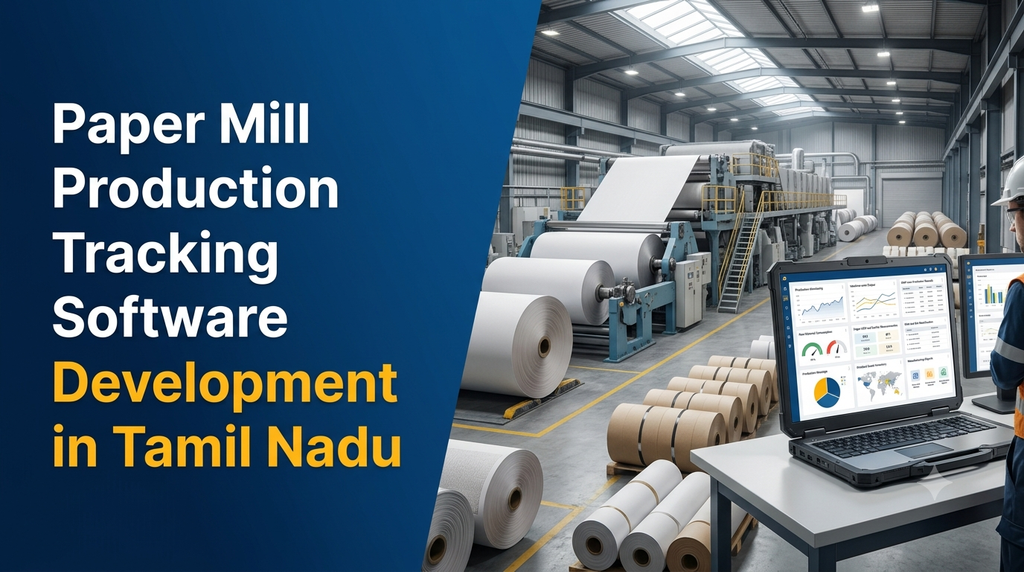
Paper mill production tracking software helps manufacturers record and monitor production activities through a centralised digital system. It connects production planning, machine records, raw material inventory, paper roll tracking, quality control and management reports.
What Is Paper Mill Production Tracking Software?
Paper mill production tracking software is a specialised manufacturing management system used to record and monitor paper production from raw material preparation to finished paper products.
The application connects different departments so that production managers can understand what materials were consumed, how much paper was produced, which machines were used, what quality measurements were recorded and how much finished stock is available.
Depending on the factory’s requirements, the software may include:
- Raw material inventory management.
- Pulp preparation and material consumption records.
- Production planning and work orders.
- Paper machine and shift monitoring.
- Machine downtime records.
- Paper GSM and quality inspection.
- Production wastage and yield tracking.
- Paper reel and roll identification.
- Finished goods inventory.
- Customer orders and dispatch.
- Production cost reporting.
- Management dashboards.
Why Paper Mills in Tamil Nadu Need Production Tracking Software
Paper manufacturing businesses may operate continuous production lines, multiple machines, different paper grades and several finishing processes. Each operation generates important production information.
A connected production tracking system helps businesses organise this information and make operational decisions using recorded data.
1. Centralised production records
Production information from different shifts and machines can be maintained in one system. Managers can review historical production records without collecting information manually from separate registers.
2. Better raw material visibility
The system can record raw material receipts, consumption, transfers and available stock. This helps production planners understand whether sufficient material is available for scheduled orders.
3. Machine-wise production monitoring
Manufacturers can maintain separate output records for each paper machine or production line, making it easier to compare production activity across equipment.
4. Improved quality record management
Paper quality measurements and inspection results can be associated with production batches or individual reels. This helps teams review quality history.
5. Production loss visibility
Recording rejected output, trim waste, process losses and other wastage categories helps manufacturers understand where material is being consumed or lost.
6. Faster reporting
Management can review shift-wise production, machine output, raw material usage, finished goods and dispatch information through dashboards and reports.
Essential Features of Paper Mill Production Tracking Software
1. Raw material inventory management
Paper mills may use different raw materials depending on the manufacturing process, including recycled paper, pulp, virgin fibre, chemicals, additives and packaging materials.
The inventory module can manage:
- Raw material registration.
- Supplier and purchase records.
- Received quantities and units.
- Material grade and specifications.
- Warehouse and storage locations.
- Material issue to production.
- Consumption records.
- Minimum stock alerts.
- Material transfer and stock adjustments.
- Supplier-wise purchase history.
2. Pulp preparation and stock management
Where pulp preparation is part of the factory’s process, the system can record material inputs, preparation batches, process stages and available pulp stock.
- Pulp preparation batch number.
- Raw material input details.
- Recorded input quantity.
- Preparation date and shift.
- Process-stage information.
- Quality inspection results.
- Output quantity.
- Transfer to the paper machine.
This provides a traceable record connecting raw materials with the production stages that follow.
3. Production planning and work orders
Production planning helps manufacturers organise orders based on machine capacity, available materials, paper specifications and delivery schedules.
Useful features include:
- Production order creation.
- Customer order references.
- Paper grade and GSM selection.
- Required production quantity.
- Machine allocation.
- Production schedule.
- Planned start and completion dates.
- Production status tracking.
- Priority and delay records.
4. Paper machine production tracking
Paper machine monitoring is one of the main components of a production tracking system. It helps managers record the output and operating information of individual machines.
Possible records include:
- Machine identification.
- Production date and shift.
- Production order reference.
- Paper grade and GSM.
- Machine operating hours.
- Recorded production quantity.
- Machine stoppage information.
- Downtime reason.
- Production rejection quantity.
- Operator and supervisor details.
Production entries can be recorded manually by authorised employees or captured through supported machine integrations. Automated collection depends on available equipment interfaces and the required integration scope.
5. Shift-wise production management
Paper mills that operate multiple shifts need clear records of production activity during each shift.
- Shift schedules.
- Shift supervisor details.
- Machine-wise output.
- Raw material consumption.
- Downtime and stoppage records.
- Production quality observations.
- Shift handover notes.
- Shift-wise production summaries.
This makes it easier to compare planned and recorded production across different operating periods.
6. Paper GSM and quality control management
Paper manufacturers may need to monitor different product quality parameters depending on the paper grade and customer specifications.
Configurable quality records may include:
- Grammage or GSM.
- Moisture content.
- Thickness or caliper.
- Paper width.
- Strength-related test results.
- Surface and visual inspection.
- Roll-specific quality status.
- Customer specification references.
- Quality approval and rejection records.
The application should support configurable limits and inspection procedures based on the manufacturer’s actual quality standards. Software records do not replace laboratory testing or calibrated measurement equipment.
7. Production wastage and yield tracking
Production tracking becomes more useful when the system records both finished output and material losses.
Possible categories include:
- Process wastage.
- Trim waste.
- Rejected paper.
- Machine setup losses.
- Quality-related rejection.
- Recoverable waste.
- Other recorded material losses.
The system can calculate configured production yield using recorded input and output quantities.
Production yield (%) = (Accepted output quantity ÷ Total input quantity) × 100
The business must define which input and output quantities are included in the calculation so that reports remain consistent.
8. Paper reel and roll tracking
Paper rolls and reels need identification throughout finishing, storage and dispatch. A unique roll reference helps connect the finished product with its production history.
Useful roll-level information includes:
- Unique reel or roll number.
- Parent production batch.
- Paper grade and GSM.
- Width and dimensions.
- Recorded roll weight.
- Production date.
- Machine and shift reference.
- Quality inspection status.
- Warehouse location.
- Customer allocation and dispatch status.
9. Cutting and finishing management
Some manufacturers convert large parent reels into smaller rolls, sheets or customised sizes. The finishing module can record the relationship between the original reel and the resulting finished products.
- Parent reel identification.
- Cutting or finishing order.
- Required finished dimensions.
- Finished roll references.
- Output quantities.
- Recorded cutting waste.
- Quality inspection status.
10. Finished goods inventory management
Finished goods inventory helps manufacturers understand what products are ready for sale and where they are stored.
- Product and grade-wise stock.
- Roll-wise inventory.
- Warehouse location tracking.
- Available and allocated stock.
- Customer order allocation.
- Stock transfers.
- Physical stock verification.
- Damaged stock records.
11. Sales and dispatch management
The sales module connects customer orders with available finished goods and delivery operations.
- Customer registration.
- Product catalogue and specifications.
- Sales quotations and orders.
- Customer-specific pricing.
- Finished goods allocation.
- Invoice generation.
- Dispatch planning.
- Vehicle and transporter details.
- Delivery status and references.
- Customer outstanding reports.
12. Manufacturing cost management
Manufacturers can maintain production-related cost records to understand the financial impact of materials, processing and operations.
Configurable cost categories may include:
- Raw material consumption.
- Energy and utility expenses.
- Machine operating expenses.
- Labour-related costs.
- Packaging costs.
- Maintenance expenses.
- Production wastage.
- Warehouse and handling expenses.
Cost calculations should be based on clearly defined accounting and allocation rules. The system should distinguish actual recorded expenses from estimated production costs.
How Paper Mill Production Tracking Software Works
Consider a paper manufacturing company that receives recycled paper as raw material, prepares pulp, manufactures paper reels and converts selected reels into finished rolls.
The software workflow may follow these stages:
- Raw material receiving: Supplier details, received quantity and material specifications are recorded.
- Inventory update: Accepted materials are added to the relevant warehouse stock.
- Material issue: Required raw materials are allocated to a production order.
- Pulp preparation: Preparation batches and process records are maintained where applicable.
- Machine production: Machine-wise and shift-wise production quantities are recorded.
- Quality inspection: Relevant measurements and inspection results are entered.
- Reel identification: Finished paper reels receive unique identification numbers.
- Finishing: Reels are converted into required sizes or product formats where applicable.
- Finished goods entry: Accepted products are added to warehouse inventory.
- Sales allocation: Available stock is assigned to customer orders.
- Dispatch: Invoice and delivery information are recorded.
- Reporting: Management reviews production, quality, inventory and sales performance.
Important Production Reports for Paper Mills
| Report | Purpose |
|---|---|
| Daily production report | Review total production by date. |
| Machine-wise production report | Compare recorded output across machines. |
| Shift-wise production report | Review production activity by shift. |
| Raw material consumption report | Understand material usage by production order. |
| Downtime report | Review recorded machine stoppages. |
| Quality report | Review measurements and inspection results. |
| Wastage and yield report | Analyse recorded production losses and output. |
| Roll inventory report | Find available reels and finished rolls. |
| Finished goods report | Review warehouse stock and allocations. |
| Dispatch report | Monitor customer orders and deliveries. |
| Production cost report | Review configured manufacturing cost data. |
Machine Integration and Production Automation
Paper mills may have industrial equipment capable of providing operating information through controllers, sensors or other communication interfaces. Integrating these sources with production tracking software can reduce manual entry and improve the availability of machine data.
Depending on the equipment, possible integrations may include:
- PLC-based machine data collection.
- Industrial sensor readings.
- Production counters.
- Machine operating status.
- Energy meter readings.
- Downtime event information.
- Weighing systems.
- Industrial monitoring platforms.
Not every machine supports the same communication method. Integration requires an equipment assessment, available technical documentation, suitable connectivity and validation of the captured data.
Mobile and Web Application for Paper Mills
A paper mill ERP or production tracking platform can combine a central web application with mobile-friendly screens for employees and supervisors.
| Platform | Typical users | Functions |
|---|---|---|
| Admin web panel | Owners and administrators | Users, configuration, reports and overall business monitoring. |
| Production interface | Production managers | Work orders, production schedules and machine records. |
| Shift interface | Supervisors | Shift output, downtime and handover records. |
| Quality interface | Quality team | Inspection measurements and approval records. |
| Warehouse interface | Storekeepers | Raw material and finished goods movements. |
| Mobile application | Authorised employees | Production entries, inspections and stock updates. |
A responsive web application may be sufficient for the first phase. Dedicated Android applications can be introduced if employees need faster mobile workflows or additional device integration.
Advanced Features for Growing Paper Manufacturing Businesses
Barcode and QR code tracking
Unique barcodes or QR codes can identify reels, rolls, pallets and warehouse locations. Scanning can help employees retrieve production details and update stock movements.
Maintenance management
A maintenance module can record machine service schedules, breakdown information, maintenance activities, spare parts and expenses.
Energy monitoring
Where compatible meter data is available, energy consumption can be recorded against machines, production shifts or selected reporting periods.
Production alerts
The system can generate alerts for missing production entries, low raw material stock, delayed orders, pending quality approvals and other configured business conditions.
Multi-factory management
Manufacturers operating multiple production facilities can maintain factory-wise production, stock, users and consolidated management reports.
Business intelligence dashboards
Analytics dashboards can combine production output, material consumption, machine downtime, quality performance, stock and sales information to support management decisions.
Security and Data Management
Manufacturing systems contain important business information, including production data, customer specifications, material consumption, supplier rates and operational costs.
Security features should include:
- Role-based user permissions.
- Secure authentication.
- Transaction and production audit logs.
- Approval workflows for sensitive changes.
- HTTPS communication.
- Database access restrictions.
- Scheduled backups.
- Backup restoration testing.
- Session and account management.
Production records should also have appropriate timestamps, user references and correction histories so that important changes can be reviewed.
Technology Stack for Custom Paper Mill Software
The technology stack should be selected according to the number of users, production data volume, equipment integrations and reporting requirements.
- Frontend: React, Next.js or Vue.js for responsive manufacturing dashboards.
- Backend: Laravel or Node.js for application logic and APIs.
- Database: MySQL or PostgreSQL for structured production and inventory records.
- Mobile: Flutter or native Android development when dedicated applications are needed.
- Machine integration: APIs, supported industrial communication interfaces or gateway-based integrations.
- Hosting: Cloud or VPS infrastructure based on operational requirements.
- Security: Authentication, role permissions, audit trails and backups.
For factories with unreliable internet connectivity, the application architecture should also consider network availability, local data capture and safe synchronisation requirements.
Paper Mill Production Tracking Software Development Cost in India
The development cost depends on the number of modules, machines, production stages, quality parameters, users and integration requirements.
The following figures are illustrative planning estimates only. They are not fixed Greap quotations or guaranteed market prices.
| Software scope | Illustrative development budget |
|---|---|
| Basic production entry and reports | ₹30,000–₹50,000 |
| Production and raw material inventory | ₹45,000–₹80,000 |
| Machine-wise and shift-wise tracking | ₹55,000–₹95,000 |
| Production, quality and roll tracking | ₹75,000–₹1.3 lakh |
| Multi-module paper mill ERP | ₹1.2 lakh–₹2.5 lakh+ |
| Advanced system with machine integrations | ₹2.5 lakh–₹6 lakh+ |
These are indicative planning ranges, not a final quotation. Actual pricing requires a technical assessment of the factory’s processes, equipment, integrations and reporting needs.
Factors affecting development cost
- Number of production modules.
- Number of machines and factories.
- Complexity of production workflows.
- Paper grade and quality parameters.
- Roll and reel tracking requirements.
- Machine data collection and automation.
- Barcode and weighing equipment integration.
- Mobile application development.
- Historical data migration.
- Training, hosting, security and maintenance.
Industrial hardware, PLC or gateway equipment, cloud hosting, third-party software, external integrations, taxes and ongoing support may involve additional costs.
How to Choose a Paper Mill Software Development Company
Selecting the right development partner is important because production tracking software must reflect actual factory operations rather than only provide generic dashboards.
Before selecting a development company, evaluate these points:
- Can the team understand your production workflow?
- Can the software support multiple paper machines?
- Can production be recorded shift-wise?
- Can raw material consumption be connected to production orders?
- Can the system track individual reels and rolls?
- Are quality parameters configurable?
- Can machine integrations be assessed realistically?
- Are production corrections recorded in audit logs?
- Can reports be customised for management?
- Are employee training and ongoing maintenance available?
A useful starting point is to document one complete production workflow, from raw material issue to finished roll dispatch, and use it to evaluate the proposed software.
Why Consider Custom Manufacturing Software from Greap Technologies?
Greap Technologies provides website development, software development and digital growth solutions for businesses. A custom paper mill production tracking application can be planned around the factory’s actual manufacturing process and operational requirements.
Depending on the project scope, the solution can include:
- Paper mill production tracking software.
- Raw material and inventory management.
- Production planning and work orders.
- Machine-wise and shift-wise monitoring.
- Paper quality and inspection records.
- Paper reel and roll tracking.
- Wastage and yield reports.
- Warehouse and dispatch management.
- Manufacturing dashboards and analytics.
- Custom integrations and mobile interfaces.
The development scope and estimated budget can be finalised after understanding the production stages, number of machines, user roles and required reports.
Frequently Asked Questions
1. What is paper mill production tracking software?
It is a manufacturing application used to record raw material consumption, machine output, shift production, quality measurements, paper roll identification, inventory and dispatch activities.
2. Can paper mill software be customised for manufacturers in Tamil Nadu?
Yes. Custom software can be developed for individual paper mills based on their production methods, machine configurations, paper grades, warehouse arrangements and reporting requirements.
3. Can the software monitor multiple paper machines?
Yes. The system can maintain separate production records for different machines and consolidate the information into factory-wide reports.
4. Can it manage shift-wise production?
Yes. Production entries can be associated with shifts, supervisors, machines, production orders and operating periods.
5. Can paper mill software track GSM and quality measurements?
Yes. Configurable inspection forms can record GSM, moisture, thickness, width and other product-specific quality measurements.
6. Can the system track individual paper rolls?
Yes. Unique reel or roll identifiers can connect finished products with their production batches, quality records, warehouse locations and dispatch information.
7. Can production data be collected automatically from machines?
It may be possible when the machines expose compatible data interfaces. The required connectivity and integration feasibility should be assessed for each machine.
8. Can the software calculate production wastage?
Yes. The system can calculate wastage and yield using configured input, accepted output and recorded loss categories.
9. How much does paper mill production tracking software cost?
The cost depends on the required modules and complexity. A basic production application has a smaller scope than a complete manufacturing ERP with machine integrations, quality management and roll tracking. A project estimate should be prepared after a requirement assessment.
10. Can paper mill software include an Android application?
Yes. A mobile application can be developed for supervisors, quality teams and authorised employees to record production and access relevant operational information.
Conclusion
Paper mill production tracking software helps manufacturers connect raw material inventory, production planning, machine operations, quality control, paper reel tracking, finished goods and dispatch management.
For paper manufacturers in Tamil Nadu, a well-planned digital production system can improve record visibility, support stock reconciliation and help management understand production performance across machines and shifts.
The best solution is one that matches the factory’s real production workflow, supports reliable data collection and can expand as operational requirements grow. Manufacturers can begin with essential production and inventory modules before introducing advanced machine integrations and analytics.
Planning Paper Mill Production Tracking Software?
Greap Technologies can help plan and develop custom manufacturing software for production monitoring, inventory, quality control, paper roll tracking and management reporting.
Website: www.greap.in
WhatsApp: Discuss your software requirements
Call: 70923 30168