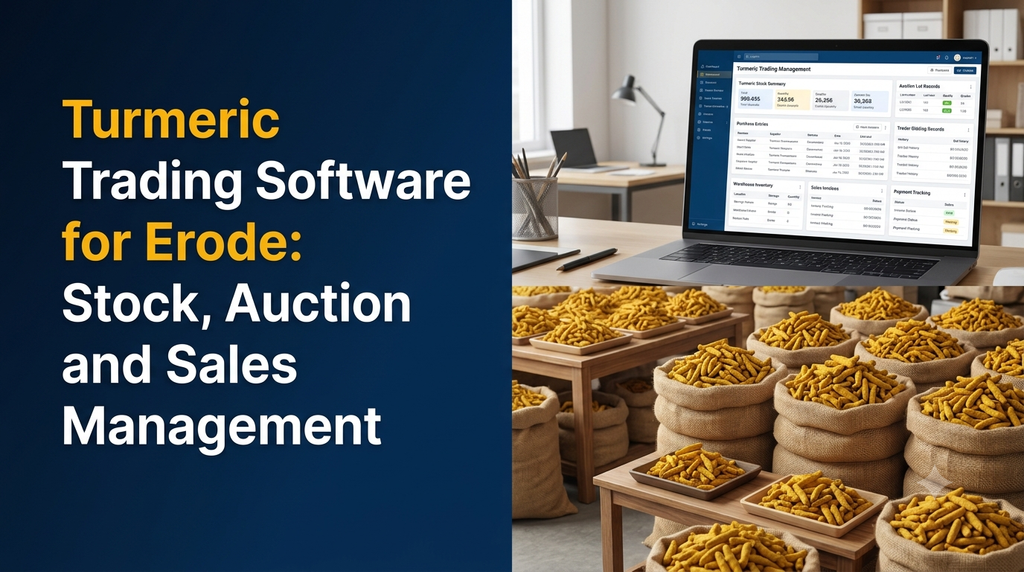
Erode is widely associated with turmeric trading, with a business ecosystem that includes farmers, traders, commission agents, wholesalers, processors, transporters and warehouse operators. Managing turmeric purchases, auction transactions, stock movements and customer sales requires accurate records across multiple business activities.
When these operations are handled through paper registers, spreadsheets and separate billing applications, traders may find it difficult to track lot-wise stock, verify purchase quantities, calculate commissions, monitor payments and understand the actual position of their business.
Turmeric trading software is a business management application that helps traders organise purchases, auction records, stock, warehouse operations, sales, payments and reports in one connected system. A customised solution can be designed around the workflows of turmeric trading businesses in Erode.
What Is Turmeric Trading Software?
Turmeric trading software is a specialised stock and transaction management system for businesses that purchase, store, trade, process or sell turmeric. It connects the commercial activities involved in moving turmeric from suppliers and auction transactions to warehouses and buyers.
A typical system can maintain records for:
- Farmers, suppliers and commission agents.
- Turmeric varieties, grades and product descriptions.
- Purchase entries and received weights.
- Auction lots and bidding transactions.
- Trader-wise purchase records.
- Warehouse stock and lot movements.
- Cleaning, drying, processing and grading records where applicable.
- Wholesale sales and customer invoices.
- Commission, expenses and payment settlements.
- Business performance and stock reports.
The exact modules depend on whether the business operates as a trader, commission agent, wholesaler, stockist, processor or a combination of these.
Why Turmeric Traders in Erode Need Trading Management Software
Turmeric trading involves multiple parties and transactions. A business may receive turmeric from different suppliers, maintain separate lots, conduct or participate in auction transactions, store stock and sell products to buyers at different rates.
As transaction volumes increase, manual records can make reconciliation and reporting more difficult.
1. Centralised transaction records
Purchase, auction, sales and payment information can be maintained in a single system. This helps authorised employees access consistent records instead of checking multiple registers.
2. Lot-wise stock visibility
Traders can identify which turmeric lots are available, their recorded quantities, grades, warehouse locations and related purchase transactions.
3. Better auction transaction tracking
Auction records can capture lot details, participating traders, bid values, accepted transactions and applicable charges according to the business workflow.
4. More organised payment follow-up
The system can track amounts payable to suppliers and amounts receivable from customers, including payment dates and outstanding balances.
5. Easier warehouse reconciliation
Stock inward, outward, transfers, adjustments and physical verification can be recorded to help identify differences between system quantities and actual stock.
6. Faster management reports
Business owners can review purchase volumes, sales, available stock, outstanding payments, expenses and transaction summaries without manually combining separate records.
Essential Features of Turmeric Trading Software
1. Farmer and supplier management
A supplier management module stores the details of farmers, aggregators, traders and other parties from whom turmeric is purchased.
- Supplier name and contact details.
- Supplier identification and business details where required.
- Address and location information.
- Purchase history.
- Supplier-wise outstanding payments.
- Bank or settlement details with appropriate access controls.
- Supplier ledger and transaction statements.
This helps traders review previous transactions and maintain organised supplier records.
2. Turmeric variety and grade management
Turmeric stock may need to be classified by product type, variety, grade, physical condition or other commercially relevant characteristics. A custom application can provide configurable categories instead of relying on one fixed classification for every business.
Possible product attributes include:
- Turmeric fingers or bulbs.
- Product variety or locally used trade description.
- Grade or quality category.
- Moisture reading, where measured.
- Curcumin-related test information, where available.
- Purchase and storage condition notes.
- Lot-specific remarks and inspection details.
The business should define its own accepted grading rules and inspection procedures. Software records should not be treated as a substitute for appropriate testing.
3. Purchase management
The purchase module records turmeric received from farmers, suppliers and other traders.
- Purchase date and transaction number.
- Supplier details.
- Turmeric product and grade.
- Gross weight and tare weight.
- Net accepted weight.
- Purchase rate and calculated amount.
- Applicable deductions or adjustments.
- Transport and handling expenses.
- Payment status.
The software can calculate purchase values using the configured units and rate rules. Any deductions should be clearly defined and visible in the transaction record.
4. Auction lot management
Auction management is an important feature for businesses whose purchasing or selling activities involve lot-based bidding. The system can register each lot and connect its details with the auction transaction.
Useful features include:
- Unique auction lot number.
- Lot registration date.
- Supplier or owner details.
- Product description and grade.
- Recorded quantity and weight.
- Lot inspection remarks.
- Bidder or trader details.
- Bid entries and bid history.
- Accepted bid and transaction status.
- Commission and applicable charges.
- Settlement and payment references.
The software can support the specific auction workflow used by the business. It should not be assumed that every turmeric trading location uses the same auction process or fee structure.
5. Trader bidding and transaction management
For businesses that manage bids from multiple traders, the application can record bidder information and the bids submitted for each lot.
- Trader registration.
- Bidder-wise transaction history.
- Lot-wise bid records.
- Bid amount and timestamp.
- Accepted or unsuccessful bid status.
- Transaction confirmation.
- Settlement records.
If the auction requires live bidding, the system may need additional real-time functionality, user permissions and transaction controls. A basic auction register and a live online auction platform are different development scopes.
6. Weighment and stock entry
Accurate weight records are essential for commodity trading. The software can record gross weight, tare weight, net weight and accepted quantity for each purchase or stock transaction.
For example, a configurable transaction may use the following calculation:
Purchase value = Accepted net weight × Purchase rate per unit
If a business uses additional quality or commercial deductions, these should be separately configured and displayed rather than hidden inside the calculation.
7. Warehouse and stock management
Warehouse management helps traders understand how much turmeric is available and where it is stored. Stock can be tracked by product, grade, lot and warehouse.
- Warehouse and storage location setup.
- Stock inward entries.
- Stock outward entries.
- Lot-wise available quantity.
- Warehouse transfers.
- Stock adjustments with approval.
- Physical stock verification.
- Damaged or rejected stock records.
- Storage and handling expense entries.
8. Processing and stock conversion
Some trading businesses also undertake cleaning, drying, polishing, grading or other processing activities. If these operations are part of the business, the ERP can record the input quantity, processing activity, output quantity and recorded losses or by-products.
For example, a processing entry may connect the original turmeric lot with the resulting processed stock. This helps preserve the relationship between incoming and outgoing quantities.
9. Sales and wholesale billing
The sales module manages turmeric sold to wholesalers, retailers, processors, exporters and other buyers.
- Customer registration.
- Customer-specific price lists.
- Sales orders and invoices.
- Product, grade and lot selection.
- Sales quantity and unit.
- Sales rate and total value.
- Discounts and approved adjustments.
- Transport and other charges.
- Payment and outstanding status.
- Customer sales history.
10. Commission and expense management
Trading businesses may incur commissions, handling charges, transport expenses, loading costs, storage charges and other operational expenses.
A configurable module can record:
- Commission agent details.
- Commission calculation rules.
- Transaction-linked service charges.
- Loading and unloading expenses.
- Transport expenses.
- Warehouse-related expenses.
- Other approved business expenses.
- Commission and expense reports.
Commission rates and calculation rules should be based on the actual agreement and applicable business requirements. The software should not assume one universal rate.
11. Payment and settlement management
The payment module tracks money received from customers and payments made to suppliers, traders and other parties.
- Supplier payment entries.
- Customer receipt entries.
- Advance payments.
- Partial settlements.
- Cash, bank and other payment modes.
- Transaction references.
- Outstanding balance reports.
- Party-wise payment statements.
12. Business reports and dashboard
A central dashboard gives owners and authorised managers an overview of business activity.
Common reports include:
- Daily purchase report.
- Daily auction transaction report.
- Trader-wise purchase summary.
- Supplier-wise purchase statement.
- Lot-wise stock report.
- Warehouse stock report.
- Sales and billing report.
- Commission and expense report.
- Customer outstanding report.
- Supplier payment report.
- Stock movement and reconciliation report.
- Profitability reports based on configured cost data.
How Turmeric Trading Software Works: Example Workflow
Consider a turmeric trading business that receives stock from suppliers, registers lots for trading, sells the goods to wholesale buyers and maintains a warehouse.
The system may follow this workflow:
- Supplier registration: The supplier’s details are created or selected.
- Purchase entry: The received turmeric quantity, grade, rate and transaction details are recorded.
- Lot creation: A unique lot number is assigned to the stock.
- Weighment: Gross, tare and net weight details are recorded.
- Auction or trading: Bid and accepted transaction details are recorded where applicable.
- Stock inward: The accepted quantity is assigned to a warehouse or storage location.
- Sales order: A buyer’s order is entered against available stock.
- Stock allocation: The required lot or quantity is selected for the sale.
- Invoice: The system generates a sales record based on configured billing rules.
- Payment: Customer receipts and outstanding balances are updated.
- Reporting: Management reviews purchases, sales, stock and settlements.
Important Reports for Turmeric Traders
| Report | Business use |
|---|---|
| Purchase register | Review supplier-wise and date-wise purchases. |
| Auction register | Review lots, bids and accepted transactions. |
| Lot-wise stock report | Identify available quantities by lot and grade. |
| Warehouse report | Review stock across storage locations. |
| Sales register | Review customer-wise sales and invoices. |
| Commission report | Review recorded commissions and charges. |
| Supplier ledger | Track supplier transactions and payable balances. |
| Customer ledger | Track sales, receipts and outstanding balances. |
| Stock reconciliation | Compare recorded quantities with physical stock. |
| Expense report | Understand recorded trading and warehouse expenses. |
Mobile App and Web Application for Turmeric Trading
A turmeric trading management system can combine a central web application with mobile-friendly screens or dedicated Android applications.
| Platform | Typical users | Functions |
|---|---|---|
| Admin web panel | Business owners and administrators | Users, products, purchases, sales, reports and configuration. |
| Purchase interface | Purchase employees | Supplier entries, weighment and purchase records. |
| Auction interface | Auction staff and authorised traders | Lot registration, bid records and transaction status. |
| Warehouse interface | Storekeepers | Stock inward, outward, transfer and verification. |
| Sales interface | Sales and billing staff | Customer orders, invoices and payment entries. |
| Mobile application | Authorised employees and field staff | Quick entries, stock lookup and transaction updates. |
The business can begin with a responsive web application and introduce mobile applications when field operations or employee workflows justify them.
Advanced Features for Growing Turmeric Trading Businesses
Barcode and QR code lot identification
A barcode or QR label can identify a stock lot and link it to its purchase, warehouse and sales history. Scanning can make stock lookup and movement recording easier.
Weighing scale integration
Compatible weighing machines may be connected to capture weight readings. Integration depends on the device’s communication interface, supported protocols and available documentation.
Multi-warehouse management
Businesses operating more than one warehouse can maintain location-wise stock, transfers and movement history.
Approval workflows
Sensitive activities such as stock adjustments, rate changes, transaction cancellation and payment corrections can require approval from authorised users.
Accounting software integration
Where required, the trading application can exchange suitable transaction information with an existing accounting system. The integration scope should define which application is the primary source for each financial record.
Analytics and business intelligence
Dashboards can summarise purchase volumes, sales performance, stock ageing, customer balances and expense trends. Market price information should only be displayed when connected to a reliable and authorised data source.
Security and Data Management
Turmeric trading software may contain sensitive supplier information, trader details, purchase rates, customer transactions and payment records. Proper access control and data protection are important.
- Role-based access for employees.
- Secure login and password storage.
- Transaction audit logs.
- Approval for important changes.
- HTTPS communication.
- Scheduled database backups.
- Recovery planning and backup verification.
- Restricted access to financial and settlement records.
- Session management and account controls.
The business should establish clear procedures for reviewing access rights and testing data recovery.
Technology Stack for Custom Turmeric Trading Software
The technology stack depends on the number of users, transaction volume, reporting requirements and integrations.
- Frontend: React, Next.js or Vue.js for responsive business interfaces.
- Backend: Laravel or Node.js for business logic and APIs.
- Database: MySQL or PostgreSQL for structured transaction records.
- Mobile: Flutter or native Android development when dedicated mobile apps are needed.
- API integration: REST APIs for external applications and compatible devices.
- Hosting: Cloud or VPS infrastructure based on business requirements.
- Security: Role permissions, audit trails, secure authentication and backups.
The database should be designed carefully so that purchase entries, auction lots, stock movements, sales and payments remain connected and traceable.
Turmeric Trading Software Development Cost in Erode
The cost of custom turmeric trading software depends on the number of modules, auction workflow, stock tracking requirements, user roles, reporting features and hardware integrations.
The following are illustrative planning estimates only. They are not fixed Greap quotations or guaranteed market prices.
| Software scope | Illustrative development budget |
|---|---|
| Basic purchase and sales management | ₹25,000–₹45,000 |
| Purchase, sales and stock management | ₹40,000–₹70,000 |
| Lot-wise stock and warehouse management | ₹50,000–₹90,000 |
| Auction and trader transaction management | ₹60,000–₹1.1 lakh |
| Trading ERP with accounts and reports | ₹75,000–₹1.4 lakh |
| Advanced platform with mobile apps and integrations | ₹1.5 lakh–₹3.5 lakh+ |
These ranges are indicative planning figures. Actual development costs require a review of the business workflow, number of users, transaction volume, integrations and testing requirements.
Factors that influence the cost
- Number of business modules.
- Supplier, trader and customer management requirements.
- Complexity of auction and bidding workflows.
- Lot-wise and warehouse-wise stock tracking.
- Commission and settlement calculation rules.
- Billing and accounting integrations.
- Mobile application requirements.
- Barcode and weighing scale integrations.
- Data migration from existing records.
- Hosting, security, training and maintenance scope.
Hardware, cloud hosting, SMS or messaging services, paid third-party software, external integrations, taxes and ongoing maintenance may involve additional costs.
How to Choose the Right Trading Software Development Company
Before selecting a software development partner, turmeric traders should evaluate whether the proposed solution reflects their actual purchasing, auction, warehouse and sales processes.
- Can the system support the business’s specific trading workflow?
- Can it maintain lot-wise stock records?
- Are auction and bidding records traceable?
- Can purchase weights and deductions be configured?
- Can commission and settlement rules be customised?
- Are stock adjustments and cancellations recorded in audit logs?
- Can the system support multiple warehouses?
- Are reports available for suppliers, traders and customers?
- Can employees use the system on mobile devices?
- Are training, support and maintenance included in the project scope?
A documented requirement assessment and a working demonstration of the main transaction flow can help a business evaluate whether the proposed software is suitable.
Why Consider Custom Trading Software from Greap Technologies?
Greap Technologies provides website development, software development and digital growth solutions for businesses. A custom trading application can be planned around the specific requirements of turmeric traders, wholesalers, commission agents and warehouse operators.
Depending on the project scope, the solution can include:
- Turmeric purchase and supplier management.
- Auction lot and bidding records.
- Trader and commission management.
- Lot-wise stock and warehouse tracking.
- Purchase and sales billing.
- Payment and settlement records.
- Business dashboards and reports.
- Mobile-friendly employee interfaces.
- Custom integrations and ongoing software improvements.
The development plan should begin with an understanding of the trading process, the roles of each participant and the reports needed by the business.
Frequently Asked Questions
1. What is turmeric trading software?
Turmeric trading software is a business application used to manage turmeric purchases, auction lots, trader transactions, stock, warehouses, wholesale sales, payments and business reports.
2. Can turmeric trading software be customised for Erode traders?
Yes. Custom software can be developed around the purchase, auction, commission, stock and sales workflows used by individual turmeric trading businesses in Erode.
3. Can the software manage turmeric auction lots?
Yes. An auction module can maintain lot numbers, supplier details, product grades, recorded weights, bids, accepted transactions and settlement information. Live online bidding requires additional functionality.
4. Can it track turmeric stock by lot and grade?
Yes. Lot-wise inventory can connect each stock quantity with its product description, grade, warehouse location and transaction history.
5. Can the system calculate commission automatically?
Yes. Commission calculations can be configured using the business’s agreed rules, such as transaction value, quantity or another defined basis. The calculation should be visible in each relevant transaction.
6. Can turmeric trading software manage multiple warehouses?
Yes. A multi-warehouse system can track stock by location, record transfers and maintain stock movement history.
7. Can weighing machines be integrated with the software?
Compatible weighing machines may be integrated depending on their communication interfaces and available technical documentation.
8. Can the software manage supplier and trader payments?
Yes. It can maintain supplier payables, trader settlements, customer receipts, advances, partial payments and outstanding balances.
9. How much does turmeric trading software cost in Erode?
The cost depends on the modules and complexity. A basic purchase and sales system requires a smaller scope than an advanced platform with auction management, lot tracking, accounting integration and mobile applications. A detailed estimate should follow a requirement assessment.
10. Can the system be used on mobile phones?
Yes. A responsive web application can work on supported mobile browsers, and a dedicated Android application can be developed if the business requires additional mobile functionality.
Conclusion
Turmeric trading software can help businesses in Erode organise the activities involved in purchasing, auction transactions, stock management, warehouse operations, wholesale sales and payment settlements. By connecting lot-level records with purchases and sales, traders can improve transaction visibility and make stock reconciliation easier.
The right solution depends on the business model. A trader may prioritise purchase and stock management, while a commission agent may need auction and settlement records. A wholesaler may require customer billing and multi-warehouse inventory. Custom software can bring these workflows together in a system designed around actual business operations.
Looking for Custom Turmeric Trading Software in Erode?
Greap Technologies can help plan and develop trading management software for stock, auction, purchases, sales, warehouses and business reporting.
Website: www.greap.in
WhatsApp: Discuss your software requirements
Call: 70923 30168