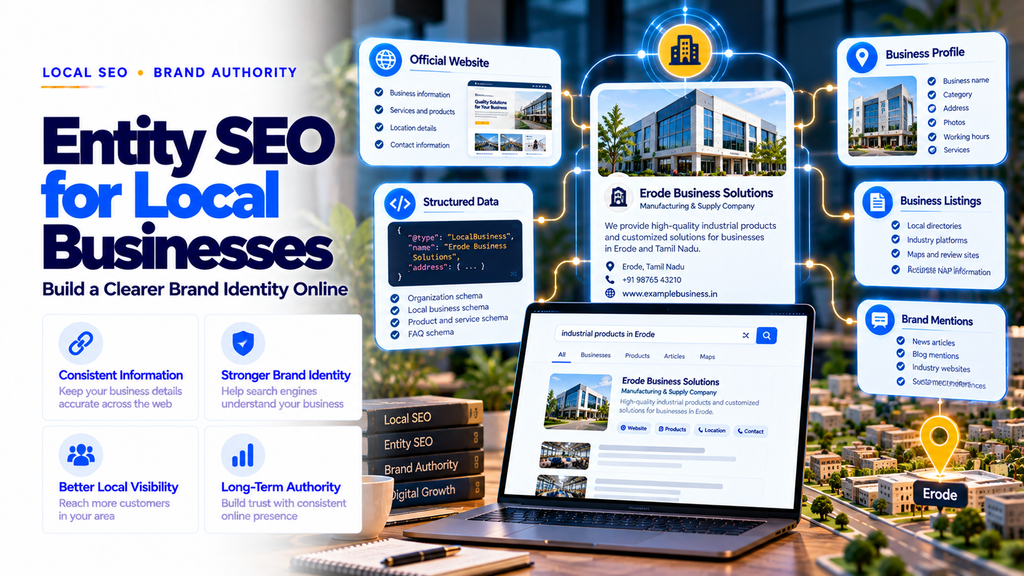
Entity SEO for Local Businesses: Building Brand Authority in Google Search
When someone searches for your business name on Google, what information do they find?
Do they see your official website, correct contact number, relevant services and consistent business details? Or do different websites show conflicting names, addresses and descriptions?
For local businesses, maintaining a clear online identity is an important part of search engine optimization.
This is where Entity SEO for local businesses becomes relevant.
Entity SEO is an industry term for improving how clearly a business, organization, person, product or other identifiable subject is represented and connected across online information sources.
For businesses in Erode and Tamil Nadu, this may involve accurate website information, Google Business Profile management, relevant structured data, genuine business citations and consistent brand references.
The objective is not to manipulate Google’s Knowledge Graph or guarantee a Knowledge Panel. It is to help customers and search systems identify the correct business and understand what it offers.
This guide explains Entity SEO, how it relates to local SEO and brand authority, and practical ways businesses can improve their online information.
What Is Entity SEO?
Entity SEO refers to optimization practices intended to make identifiable subjects and their relationships clearer to search engines.
An entity can be a business, organization, person, place, product or another distinct subject.
For a local business, important entity information may include:
- Official business name
- Website address
- Business location
- Products and services
- Contact information
- Relevant business category
- Official public profiles
- Relationships to other organizations or locations
Clear, accurate information can reduce ambiguity and improve the usefulness of a business’s online presence.
Why Entity SEO Matters for Local Businesses
Customers may discover a business through its website, Google Maps, business directories, social profiles or other online sources.
When these sources contain inconsistent information, customers may struggle to identify the correct company.
Entity-focused optimization helps businesses maintain a more coherent online identity.
Potential benefits include:
- Clearer business identification
- More consistent contact information
- Better-organized website content
- Improved local search readiness
- Stronger brand recognition among customers
- Reduced confusion between similarly named businesses
These improvements do not guarantee higher rankings or specific Google Search features.
1. Understand Entities and Keywords
Keywords are words or phrases people use when searching.
Entities are identifiable subjects that search systems may associate with information and relationships.
For example, “website development in Erode” is a search phrase.
A particular website development company is an identifiable business entity with its own name, website, contact details and services.
Both keyword relevance and clear business identity matter for a comprehensive SEO strategy.
2. Entity SEO vs Traditional SEO
| Factor | Traditional SEO | Entity SEO |
|---|---|---|
| Primary Focus | Search visibility for relevant queries | Clear identification and relationships |
| Important Information | Content, links and technical SEO | Business identity and consistent references |
| Typical Activities | Keyword research, content and technical optimization | Business information, profiles and structured data |
| Relationship | Broad SEO discipline | Complementary approach within SEO |
Entity SEO should complement established SEO practices rather than replace them.
3. Entity SEO vs Local SEO
Local SEO focuses on helping relevant businesses become discoverable in location-based searches.
Entity SEO focuses on the clarity and consistency of identifiable business information.
The two approaches overlap in several areas:
- Business names
- Addresses and service areas
- Contact details
- Google Business Profile
- Relevant citations
- LocalBusiness structured data
A practical local SEO strategy can include entity-focused improvements.
4. What Is Google’s Knowledge Graph?
Google’s Knowledge Graph is a system used to organize information about entities and their relationships.
It can help Google understand subjects such as people, organizations, places and other identifiable things.
Businesses cannot simply submit a schema file and guarantee that Google will create a Knowledge Graph entity or display a Knowledge Panel.
5. What Is a Google Knowledge Panel?
A Knowledge Panel is an information display that Google may show for certain entities.
It may contain information such as a name, description, website or related details.
Knowledge Panels are generated through Google’s systems, and not every business qualifies for one.
Businesses should not confuse a Google Business Profile with a guaranteed Knowledge Panel.
6. Establish Your Official Business Identity
Start by documenting your business’s correct public information.
Important details include:
- Official business name
- Primary website domain
- Business contact number
- Verified business address or service area
- Business category
- Products and services
- Official social profiles
Use this information consistently across relevant online properties.
7. Keep Business Name, Address and Phone Information Accurate
Name, Address and Phone information is commonly abbreviated as NAP in local SEO.
NAP consistency helps customers recognize and contact the correct business.
Businesses should review important listings for:
- Outdated telephone numbers
- Old office addresses
- Incorrect business names
- Duplicate profiles
- Conflicting operating hours
Use accurate details rather than forcing every listing into identical formatting.
8. Optimize Your Website’s About Page
The About page is an important place to explain your business identity.
Useful information includes:
- Who operates the business
- What the business provides
- Which industries it serves
- Relevant company history
- Business location or genuine service area
- How customers can contact the company
Only publish factual information that the business can support.
9. Create a Clear Contact Page
A contact page should help visitors find the correct way to reach the business.
Include relevant information such as:
- Business name
- Phone number
- Email address
- Verified address where applicable
- Contact form
- Operating hours if relevant
Service-area businesses should follow applicable Google Business Profile rules and avoid displaying misleading addresses.
10. Use Consistent Brand Descriptions
A business should describe its services accurately across its website and relevant public profiles.
For example, a software development company might explain that it provides business websites, ecommerce development and custom software solutions.
Descriptions can be adapted for each platform while preserving the same underlying facts.
Avoid adding unsupported claims simply to make descriptions sound more impressive.
11. Optimize Google Business Profile
Google Business Profile allows eligible businesses to manage information appearing in Google Search and Maps.
Important fields include:
- Business name
- Primary category
- Relevant additional categories
- Address or service area
- Phone number
- Website
- Business hours
- Business description
Choose categories and service areas that accurately reflect the business.
12. Avoid Misleading Business Profile Information
Businesses should not create fake locations or use keyword-stuffed business names that violate platform guidelines.
A service-area business should not claim physical offices in towns where it has no eligible location.
Accurate business information is more sustainable than misleading listing practices.
13. Understand Organization Structured Data
Organization structured data can help describe an organization in a machine-readable format.
Relevant properties may include:
- name
- url
- logo
- sameAs
- contactPoint
Only include properties that accurately describe the organization.
14. Understand LocalBusiness Structured Data
LocalBusiness structured data is used to describe eligible local business information.
Depending on the business, relevant properties may include:
- name
- url
- telephone
- address
- openingHoursSpecification
- geo
- sameAs
The selected schema type and properties should reflect the business’s actual characteristics.
Adding LocalBusiness schema does not guarantee improved rankings or a Knowledge Panel.
15. What Is the sameAs Property?
The Schema.org sameAs property can reference pages that unambiguously identify the same entity.
Examples may include verified official profiles on relevant platforms.
Do not use sameAs to connect unrelated businesses, competitors or profiles that are not clearly associated with your organization.
16. Avoid Duplicate or Conflicting Structured Data
Some websites contain structured data generated by multiple SEO plugins, themes or custom code.
Review whether the markup contains:
- Conflicting business names
- Incorrect URLs
- Outdated addresses
- Duplicate entity identifiers
- Unrelated sameAs references
Validate relevant structured data and keep it consistent with visible website content.
17. Use Stable Entity Identifiers
Schema.org JSON-LD can use an @id property to identify a described entity within structured data.
For example, a business may use a stable URL-based identifier associated with its official website.
Using consistent identifiers can help maintain clear relationships within your own structured data.
It does not automatically create an official Google Knowledge Graph identifier.
18. Build Relevant Business Citations
A business citation is an online reference to a company, often including its name and contact information.
Relevant citation sources may include:
- Industry directories
- Professional associations
- Business organizations
- Legitimate local directories
- Partner websites
Focus on accurate, useful listings instead of submitting to hundreds of unrelated websites.
19. Audit Existing Business Listings
Before creating new citations, review existing listings.
Look for:
- Duplicate entries
- Incorrect phone numbers
- Old domains
- Outdated addresses
- Misleading categories
Correct information where the platform allows it.
20. Understand Brand Mentions
A brand mention occurs when another source refers to a business or brand.
Mentions may appear in articles, directories, interviews, partner websites or industry publications.
Not every brand mention is a ranking signal, and unlinked mentions should not be treated as equivalent to backlinks.
Relevant, genuine mentions can nevertheless help people discover and recognize a business.
21. Build Legitimate Industry Relationships
Industry relationships can create opportunities for useful public references.
Examples include:
- Professional associations
- Relevant partnerships
- Industry events
- Original research collaborations
- Verified project announcements
These activities should reflect real relationships rather than artificial link-building schemes.
22. Publish Original Business Information
Original information can help distinguish a business from competitors with similar service descriptions.
Examples include:
- Real project workflows
- Verified product capabilities
- Detailed service explanations
- Technical implementation guides
- Authentic business experience
Avoid fabricated achievements, customer results or testimonials.
23. Create Dedicated Service Pages
Each important service should have a useful, clearly focused page when it serves a distinct customer need.
For a technology company, this may include:
- Website development
- Ecommerce development
- SEO services
- Mobile app development
- Custom software development
- Website maintenance
Each page should describe the actual offering, process and relevant customer requirements.
24. Connect Related Services Through Internal Links
Internal links help visitors and search crawlers navigate related website content.
For example, an ecommerce development page may link to:
- Shopify development
- WooCommerce development
- Payment gateway integration
- Website security
- Store maintenance
Use descriptive anchor text and avoid excessive repetition.
25. Create Industry-Specific Content
Businesses can explain how their products or services apply to particular industries.
For example, a software company may publish information about:
- Textile ERP software
- Manufacturing management systems
- Warehouse management
- School management software
- Retail billing systems
Industry pages should contain meaningful information rather than only changing the industry name.
26. Entity SEO and Topical Authority
Topical authority is an informal SEO concept referring to a website’s depth, quality and credibility within a subject area.
Businesses can build useful topical coverage by publishing accurate information around their genuine expertise.
For example, an ecommerce development company may cover platform comparisons, integrations, maintenance and store performance.
Topical authority is not a single official Google score.
27. Entity SEO and E-E-A-T
Experience, Expertise, Authoritativeness and Trustworthiness are concepts described in Google’s Search Quality Rater Guidelines.
They are useful for evaluating whether information is credible and helpful.
Clear business identity, accurate claims and genuine experience can support trustworthiness.
E-E-A-T is not a single numerical Entity SEO ranking factor.
28. Entity SEO and AI Search
AI-powered search products may use different retrieval systems and sources to answer user questions.
Accurate public business information and accessible website content can support broader discoverability.
However, structured data, brand mentions and business citations do not guarantee that ChatGPT, Google AI Overviews or another AI product will recommend a business.
29. Entity SEO for Google AI Overviews
Google AI Overviews may display generated summaries and supporting links for eligible searches.
Businesses should follow established Google Search practices:
- Maintain indexable pages
- Publish useful information
- Use appropriate structured data
- Keep business details accurate
- Improve website usability
No special entity markup guarantees inclusion in an AI Overview.
30. Entity SEO for Local Businesses in Erode
Local businesses in Erode can improve their online identity by maintaining accurate business information and explaining their services clearly.
Examples include:
- Textile manufacturers publishing verified product information
- Software companies describing their development services
- Retailers maintaining accurate store details
- Healthcare providers publishing verified professional information
- Educational institutions explaining courses and admissions
The approach should reflect the needs and characteristics of each business.
31. Entity SEO Across Erode District
Businesses may serve customers in Erode, Perundurai, Bhavani, Anthiyur, Gobichettipalayam, Sathyamangalam, Modakkurichi, Kodumudi, Nambiyur, Chennimalai, Kavindapadi, Ammapettai, Arachalur, Sivagiri and surrounding areas.
Location-specific content should describe genuine service coverage.
Do not create fake office addresses or misleading location pages to target more keywords.
32. Entity SEO for Businesses Across Tamil Nadu
Businesses operating across Tamil Nadu may serve customers in Coimbatore, Tiruppur, Salem, Karur, Namakkal, Chennai, Madurai and Tiruchirappalli.
Regional website content should explain actual services, delivery capabilities or customer support coverage.
A business serving multiple locations does not necessarily need a separate Google Business Profile for each location.
33. Entity SEO for Textile Businesses
Textile manufacturers and traders can publish accurate information about:
- Company identity
- Fabric categories
- Manufacturing capabilities
- Product specifications
- Relevant certifications where verified
- Enquiry procedures
Clear product and business information helps buyers evaluate suppliers.
34. Entity SEO for Manufacturing Companies
Manufacturing businesses can improve website clarity through:
- Detailed company information
- Verified production capabilities
- Technical product specifications
- Industry applications
- Quality procedures
- Accurate contact information
35. Entity SEO for Ecommerce Businesses
Ecommerce companies should maintain clear merchant identity and accurate product information.
Important areas include:
- Business contact details
- Product descriptions
- Pricing and availability
- Shipping information
- Return policies
- Relevant product structured data
Product structured data should reflect the actual product information shown to customers.
36. Entity SEO for Healthcare Businesses
Healthcare websites should prioritize verified information about providers, services and qualifications.
Medical claims require appropriate professional review and reliable evidence.
Do not publish unsupported treatment outcomes or misleading credentials.
37. Entity SEO for Educational Institutions
Educational institutions can maintain clear information about:
- Institution name
- Courses
- Admissions
- Accreditations where verified
- Facilities
- Contact information
Institutional claims should be current and verifiable.
38. Entity SEO for Service-Area Businesses
Some businesses visit customers or serve clients remotely instead of operating a public storefront.
These businesses should explain their genuine service areas and follow applicable Google Business Profile eligibility rules.
A service area should not be confused with a verified physical office.
39. Multi-Location Business Entity SEO
Businesses with multiple legitimate branches may need to manage location-specific information carefully.
Important considerations include:
- Correct branch names
- Accurate addresses
- Location-specific contact details
- Operating hours
- Relevant location pages
- Eligible business profiles
Each location should represent a genuine business operation.
40. Avoid Duplicate Business Profiles
Duplicate or misleading listings can confuse customers.
Review whether multiple profiles refer to the same business location.
Use the platform’s supported procedures to correct or resolve duplicate entries where appropriate.
41. Entity SEO and Website Architecture
A clear website structure helps visitors understand how business information is organized.
A practical structure may include:
- Home
- About
- Services
- Industries
- Projects
- Resources
- Contact
Use meaningful navigation and internal links.
42. Technical SEO Requirements
Entity-focused improvements should be supported by technical SEO.
Review:
- Crawlability
- Indexability
- Canonical URLs
- XML sitemaps
- Server response codes
- Mobile usability
- Structured data validation
Technical problems can prevent important business information from being accessible to search crawlers.
43. Mobile-Friendly Business Information
Business information should be easy to access on mobile devices.
Important elements include:
- Readable contact information
- Usable navigation
- Accessible buttons
- Responsive layouts
- Clear enquiry forms
44. Keep Business Information Updated
Businesses should review public information when important changes occur.
Examples include:
- Phone number changes
- Business relocation
- Website domain changes
- New services
- Changed operating hours
- Branch closures
Update the official website and relevant external profiles as appropriate.
45. How to Audit Your Brand’s Search Presence
Start by searching for your exact business name.
Review the results for:
- Official website visibility
- Correct contact information
- Relevant business profiles
- Outdated listings
- Unrelated businesses with similar names
- Incorrect descriptions
Document issues before making changes.
46. Monitor Branded Search Performance
Google Search Console can help website owners review search queries related to their business name.
Useful measurements include:
- Branded search impressions
- Branded search clicks
- Relevant landing pages
- Indexing status
Search Console does not provide a complete standalone Entity SEO authority score.
47. Measure Local SEO Outcomes
Businesses should measure outcomes that relate to customer needs.
Examples include:
- Qualified enquiries
- Website contact submissions
- Relevant organic traffic
- Business Profile interactions where available
- Customer calls
Do not treat a third-party authority metric as an official Google ranking score.
48. Common Entity SEO Mistakes
- Using inconsistent business names
- Publishing outdated phone numbers
- Creating fake business locations
- Using inaccurate structured data
- Linking unrelated profiles through sameAs
- Submitting to low-quality directories
- Publishing fabricated reviews
- Claiming unsupported certifications
- Ignoring website indexing
- Expecting guaranteed Knowledge Panels
- Confusing brand mentions with guaranteed rankings
49. Entity SEO Checklist for Local Businesses
- Confirm your official business name.
- Verify your primary website domain.
- Update contact information.
- Review your About page.
- Review your Contact page.
- Check Google Business Profile eligibility.
- Maintain accurate profile categories.
- Correct outdated business listings.
- Resolve duplicate listings where appropriate.
- Identify genuine official profiles.
- Review Organization structured data.
- Review LocalBusiness markup where applicable.
- Use accurate sameAs references.
- Maintain stable structured data identifiers.
- Validate structured data.
- Publish clear service pages.
- Improve internal linking.
- Publish original business information.
- Review technical SEO.
- Check important page indexing.
- Monitor branded search queries.
- Measure qualified enquiries.
50. Entity SEO Implementation Process
- Business Identity Review: Confirm the company’s official information.
- Website Audit: Review About, Contact and service pages.
- Business Profile Review: Check eligibility and accuracy.
- Citation Audit: Identify outdated or inconsistent listings.
- Structured Data Review: Inspect relevant entity markup.
- Content Improvements: Clarify services and business expertise.
- Internal Linking: Connect related content.
- Technical SEO: Resolve accessibility and indexing problems.
- Monitoring: Review branded searches and business enquiries.
- Maintenance: Update information as the business changes.
51. How Much Does Entity SEO Cost?
Entity SEO costs depend on the website’s condition, number of business locations, listing problems and required optimization work.
Potential cost factors include:
- Business identity audit
- Website content updates
- Google Business Profile optimization
- Citation corrections
- Structured data implementation
- Technical SEO
- Monitoring and reporting
Businesses should request clearly defined deliverables rather than guaranteed Knowledge Panel or ranking promises.
52. How to Choose an Entity SEO Company in Erode
Before selecting an SEO provider, evaluate:
- Local SEO knowledge
- Technical SEO capabilities
- Structured data experience
- Understanding of Google Business Profile guidelines
- Business listing management
- Content quality
- Transparent reporting
- Realistic expectations
A responsible provider should explain that Google controls its search results and Knowledge Panel generation.
53. How Greap Technologies Can Help
Greap Technologies helps businesses discuss website development, SEO and digital growth requirements.
For companies interested in entity-focused optimization, potential work may include:
- Business information audits
- Local SEO improvements
- Google Business Profile reviews
- Website About and Contact page improvements
- Structured data implementation
- Business citation reviews
- Service page optimization
- Technical SEO audits
- Internal linking improvements
- Search performance monitoring
Project deliverables should be agreed according to the business’s actual requirements.
Visit Greap Technologies to explore website development, SEO and digital marketing services.
Conclusion
Entity SEO for local businesses focuses on creating a clearer, more accurate and consistent online business identity.
For businesses in Erode and across Tamil Nadu, important steps include maintaining correct contact information, optimizing eligible business profiles, using appropriate structured data, publishing helpful service content and reviewing relevant public listings.
Entity SEO works alongside technical SEO, local SEO and content optimization.
There is no guaranteed method to obtain a Google Knowledge Panel or a particular ranking. The sustainable approach is to provide reliable information that helps customers and search systems identify the business correctly.
Want to Improve Your Business’s Online Identity and Local SEO?
Greap Technologies can help you discuss entity-focused SEO, website improvements, structured data and local search optimization.
Frequently Asked Questions About Entity SEO
1. What is Entity SEO?
Entity SEO is an industry term for practices intended to make identifiable subjects, such as businesses and organizations, clearer and more consistent across online information sources.
2. How is Entity SEO different from traditional SEO?
Traditional SEO covers search visibility broadly. Entity SEO emphasizes clear business identification, structured information and relevant relationships between online references.
3. Does Entity SEO improve Google rankings?
Accurate business information and relevant content can support broader SEO efforts, but no Entity SEO technique guarantees improved rankings.
4. What is Google’s Knowledge Graph?
Google’s Knowledge Graph organizes information about entities and their relationships to help Google’s systems understand identifiable subjects.
5. Can I create a Google Knowledge Panel using schema markup?
No. Structured data does not guarantee that Google will create or display a Knowledge Panel.
6. What is LocalBusiness schema?
LocalBusiness is a Schema.org type used to describe relevant information about eligible local businesses in structured data.
7. What does sameAs mean in structured data?
The sameAs property can reference another page that unambiguously identifies the same entity.
8. Are business citations important for Entity SEO?
Accurate citations can help customers identify a business across relevant online sources. Their impact varies, and directory quantity alone is not a reliable measure of SEO success.
9. Can small businesses in Erode benefit from Entity SEO?
Yes. Small businesses can improve their online identity through accurate website information, eligible business profiles and relevant local SEO practices.
10. Does Entity SEO help with AI search?
Clear business information may support broader discoverability, but it does not guarantee inclusion in AI-generated answers or recommendations.
11. How much do Entity SEO services cost in Erode?
Costs depend on the number of business locations, existing listing issues, technical requirements and the agreed optimization scope.
12. Can Greap Technologies help with Entity SEO?
Greap Technologies can discuss local SEO, structured data, business information improvements and technical SEO based on an agreed project scope.