Shopify website development for businesses in Erode
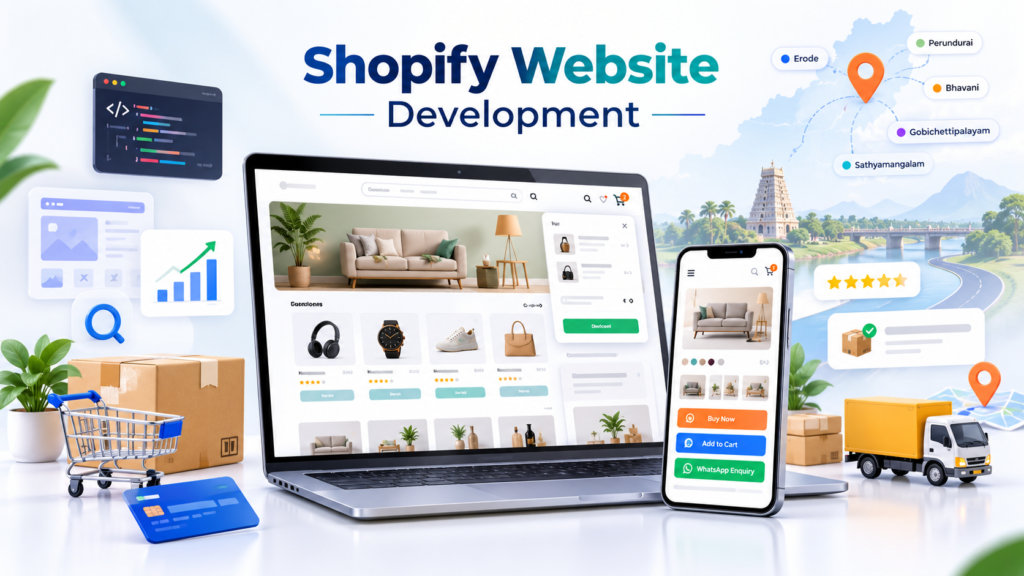
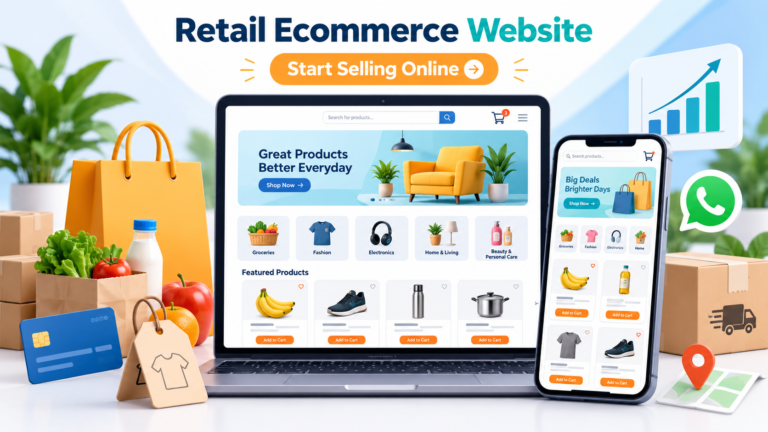
Shopify website development for businesses in Erode is useful for retailers, textile stores, fashion brands, gift businesses, beauty brands, food companies, home décor sellers and other product-based businesses that want to build a professional online selling system.
Customers increasingly discover products through Google, Instagram, Facebook, online advertisements, WhatsApp recommendations and other digital channels before visiting a store or placing an order.
A professional ecommerce website can help an Erode business present products clearly, accept orders, manage inventory, collect payments, organize customer information and sell beyond only walk-in customers.
Shopify is an ecommerce platform that provides tools for managing products, collections, orders, customers, inventory, checkout, shipping and online-store content from a centralized admin.
At Greap Technologies, we provide Shopify website development for businesses in Erode, helping product-based companies build mobile-friendly, SEO-ready and conversion-focused ecommerce stores.
Quick Answer: Shopify Website Development for Businesses in Erode
Shopify website development means planning, designing, configuring and launching an ecommerce store using the Shopify platform.
A professional Shopify project can include:
- Store setup
- Theme customization
- Custom homepage design
- Collection setup
- Product-page design
- Variant configuration
- Inventory setup
- Payment-provider configuration
- Shipping setup
- Local delivery configuration where suitable
- Policy pages
- WhatsApp integration
- SEO configuration
- Google Analytics integration
- Meta and Google marketing integrations where eligible
- Conversion tracking
- Launch testing
For many small and growing ecommerce businesses, Shopify provides a relatively structured way to launch and manage an online store without building the complete ecommerce infrastructure from scratch.
Shopify Website Development in Erode: Service Overview
| Service | Shopify Website Development |
|---|---|
| Company | Greap Technologies |
| Location | Erode, Tamil Nadu |
| Suitable For | Retail, textile, fashion, gifts, beauty, food, home décor and other ecommerce businesses |
| Main Goal | Build an easy-to-manage ecommerce store for product discovery, orders and customer growth |
| Core Features | Products, collections, cart, checkout, payments, shipping, inventory, SEO and analytics |
| Service Area | Erode District and businesses selling across wider markets |
Why Erode Businesses Are Moving to Ecommerce
Many local businesses still depend heavily on:
- Physical shop visits
- Phone orders
- WhatsApp messages
- Instagram DMs
- Dealer networks
- Existing customer referrals
These channels remain valuable, but managing a growing product business only through messages and phone calls can become difficult.
A structured ecommerce store can help customers:
- Browse available products
- Compare variants
- Check prices
- Review product details
- Check delivery information
- Add products to cart
- Complete checkout
- Receive order confirmation
For the business, it can provide a more organized process for products, customers and orders.
Which Erode Businesses Can Use Shopify?
1. Textile and Saree Businesses
Shopify can be used for:
- Sarees
- Dress materials
- Fabrics
- Garments
- Uniforms
- Fashion collections
2. Fashion Brands
Suitable products include:
- Women’s wear
- Men’s wear
- Kids wear
- Accessories
- Boutique collections
3. Gift Stores
Shopify can organize gifts by:
- Birthday
- Anniversary
- Wedding
- Housewarming
- Corporate gifting
- Personalized products
4. Beauty and Cosmetics Brands
Stores can organize products by:
- Skincare
- Makeup
- Haircare
- Beauty tools
- Personal care
5. Home Décor Brands
Useful for:
- Wall décor
- Table décor
- Spiritual décor
- Lighting products
- Handmade products
- Lifestyle collections
6. Food Product Businesses
Suitable products can include:
- Packaged snacks
- Sweets
- Regional foods
- Health foods
- Homemade products
- Gift packs
7. Grocery Businesses
Shopify can support structured online ordering where the catalogue, stock and delivery workflow are suitable.
8. Manufacturers Selling Directly to Customers
Some manufacturers can use Shopify for:
- D2C products
- Sample orders
- Small-quantity orders
- Product catalogue visibility
- Customer enquiries
Businesses with complex dealer pricing, distributor workflows, manufacturing logic or ERP requirements may need a more customized solution.
Benefits of Shopify Website Development
1. Structured Ecommerce Administration
Shopify provides an admin system where merchants can manage:
- Products
- Variants
- Collections
- Inventory
- Orders
- Customers
- Discounts
- Store content
This is generally easier than managing orders manually across WhatsApp, spreadsheets and social media messages.
2. Professional Product Presentation
A properly designed store can present:
- Product images
- Prices
- Variants
- Specifications
- Benefits
- Shipping information
- Policies
- Reviews
- Related products
3. Mobile-Friendly Shopping
A large part of ecommerce browsing happens on smartphones.
A Shopify theme should therefore be optimized for:
- Mobile navigation
- Product browsing
- Variant selection
- Cart access
- Checkout
- Product filters
- Fast interaction
Mobile usability depends heavily on theme quality, custom development, apps, images and overall store configuration.
4. Payment Gateway Integration
Shopify supports third-party payment providers, but payment options vary depending on the merchant’s country, store configuration and provider availability.
For an Indian ecommerce business, the payment setup should be chosen after checking currently supported providers for that store.
Depending on the selected provider, customer payment methods may include options such as:
- UPI
- Credit cards
- Debit cards
- Net banking
- Other supported payment methods
Cash on delivery can also be configured where it makes sense for the business.
5. Shipping and Local Delivery
A Shopify store can be configured around different delivery models.
Depending on business requirements, this can include:
- Shipping zones
- Shipping rates
- Free-shipping rules
- Third-party shipping applications
- Local delivery
For stores serving nearby Erode customers, Shopify’s local-delivery functionality can be configured using eligible delivery distances or postal-code zones.
6. Ecommerce SEO Capabilities
Shopify includes several built-in SEO features.
The platform automatically handles elements such as:
- XML sitemap generation
- robots.txt generation
- Canonical tags
- SSL certificates
Store owners and developers can also optimize:
- Page titles
- Meta descriptions
- Product URLs
- Collection URLs
- Image alt text
- Product descriptions
- Collection content
- Blog content
- Internal linking
You can also explore Greap Technologies’ SEO services for ongoing organic-search strategy.
7. Marketing Integrations
Eligible Shopify stores can connect with marketing platforms and sales channels.
For example, integrations can include:
- Google Analytics 4
- Google Ads
- Google Merchant Center
- Google & YouTube sales channel
- Facebook and Instagram by Meta
- Meta Pixel
Eligibility and individual features depend on store location, product type and platform requirements.
8. Abandoned Checkout Recovery
Customers may start checkout but leave before completing payment.
Shopify provides abandoned-checkout management and recovery capabilities for supported sales channels.
A recovery strategy can help reconnect with customers who showed strong purchase intent but did not complete the transaction.
Important Features of a Professional Shopify Store
Custom Homepage Design
A Shopify homepage can include:
- Hero banner
- Featured collections
- Best sellers
- New arrivals
- Offer sections
- Brand story
- Customer reviews
- Shipping information
- Trust elements
- Newsletter or customer retention CTA
Collection Pages
Collections help organize the store.
Examples include:
- Sarees
- Dress Materials
- Birthday Gifts
- Anniversary Gifts
- Home Décor
- Beauty Products
- Best Sellers
- New Arrivals
Collections should reflect how customers naturally browse products rather than being created only around SEO keywords.
Product Detail Pages
Product pages should reduce customer uncertainty.
Important content can include:
- Product name
- High-quality images
- Price
- Variants
- Availability
- Short product summary
- Detailed description
- Material
- Dimensions
- Care instructions
- Shipping information
- Return/replacement information
- Reviews where available
- Related products
Cart and Checkout
The shopping journey should minimize unnecessary friction.
Before launch, review:
- Cart behavior
- Variant correctness
- Discount functionality
- Shipping calculations
- Payment behavior
- Mobile checkout
- Order confirmation
WhatsApp Support
WhatsApp can be useful for businesses whose customers commonly need help before purchasing.
Examples:
- Size clarification
- Bulk enquiry
- Product customization
- Delivery questions
- Product availability
Example pre-filled message:
Hi, I am interested in this product. Please share more details.
Recommended Shopify Website Structure
- Home
- Shop / All Products
- Collection Pages
- Product Pages
- Cart
- Checkout
- About
- Contact
- Shipping Policy
- Return / Replacement Policy
- Privacy Policy
- Terms of Service
- FAQ
- Blog
- Order Tracking where required
Shopify Website Development Process
Step 1: Business Requirement Analysis
Before creating the store, identify:
- Product type
- Product count
- Number of variants
- Target market
- Delivery coverage
- Payment requirements
- Inventory process
- Marketing channels
- Growth plan
Step 2: Platform Suitability Check
Shopify should be chosen because it suits the business, not simply because it is popular.
Evaluate:
- Catalogue complexity
- Custom workflow requirements
- Integrations
- Subscription/app costs
- Payment requirements
- Reporting requirements
- B2B requirements
Step 3: Store Architecture Planning
Plan:
- Main navigation
- Collections
- Subcollections
- Product relationships
- Filters
- Policies
- Customer journey
Step 4: UI/UX Design
The design should reflect the brand while keeping shopping simple.
Focus on:
- Clear navigation
- Strong product photography
- Readable typography
- Consistent spacing
- Simple product cards
- Mobile-responsive layouts
- Easy cart access
- Clear product CTAs
Step 5: Shopify Theme Development
Depending on the project, development can include:
- Theme configuration
- Theme customization
- Custom sections
- Homepage layouts
- Collection templates
- Product templates
- Navigation
- Footer
- Required applications
Avoid installing unnecessary apps because each additional app can increase maintenance complexity and potentially affect performance.
Step 6: Product and Collection Setup
Each product should have accurate:
- Title
- Images
- Price
- SKU where applicable
- Variants
- Inventory
- Description
- Collection assignment
- SEO information
Step 7: Payment and Shipping Setup
Configure currently supported providers and delivery methods based on the business’s actual operational requirements.
Step 8: SEO Setup
Optimize:
- Homepage title and description
- Product titles
- Product descriptions
- Collection content
- URLs where appropriate
- Image alt text
- Internal linking
- Blog structure
Shopify automatically generates the store sitemap, which can then be submitted through Google Search Console.
Step 9: Analytics and Conversion Tracking
Depending on marketing requirements, configure:
- Google Analytics 4
- Google Ads measurement
- Meta Pixel
- Relevant conversion events
- Campaign attribution
Step 10: Store Testing
Before launch, test:
- Desktop
- Mobile
- Tablet
- Search
- Filters
- Products
- Variants
- Add to Cart
- Checkout
- Payment provider
- Shipping rules
- Discounts
- Contact forms
- WhatsApp links
- Order emails
- Policy pages
- Broken links
Shopify SEO Strategy for Erode Businesses
SEO strategy should reflect where the business actually sells.
If Your Customers Are Mainly in Erode
Local relevance can include:
- Accurate Erode business information
- Local-delivery information
- Google Business Profile where eligible
- Local category or service content where useful
- Customer reviews
If You Sell Across Tamil Nadu or India
Do not force “Erode” into every product and collection page.
Focus on broader commercial product searches such as:
- Buy cotton sarees online
- Anniversary gifts online
- Premium home décor online
- Kids clothing online
Your location can still establish the company’s business identity while product SEO targets the real customer market.
Product Page SEO
Product pages can be optimized with:
- Accurate product titles
- Original descriptions
- Relevant search terminology
- Image alt text
- Internal links
- Related products
- Useful product details
Avoid copying manufacturer or competitor descriptions across hundreds of products.
Collection Page SEO
Important category-level collections can become useful organic landing pages.
For example:
- Cotton Sarees
- Anniversary Gifts
- Kids Dresses
- Table Décor
- Organic Snacks
Each important collection should contain helpful introductory information rather than only a product grid where practical.
Blog SEO for Shopify Stores
Supporting blog content can help answer customer questions and internally link to products and collections.
Examples:
- How to Choose an Anniversary Gift
- How to Select the Right Saree Fabric
- Best Home Décor Ideas for Small Spaces
- How to Choose Kids Clothing Sizes Online
Shopify + Google Marketing
Shopify provides a Google & YouTube channel for eligible stores.
Depending on eligibility and configuration, it can connect with:
- Google Merchant Center
- Google Ads
- Google Analytics 4
- Product feed synchronization
The store and its products must meet Google’s Merchant Center and sales-channel requirements before product listings or related functionality can be used.
Shopify + Meta Marketing
Shopify also provides Facebook and Instagram by Meta integration for eligible businesses.
Depending on eligibility and account configuration, businesses can connect product catalogue information and marketing tools with Meta.
Paid campaigns should still be planned around:
- Product profitability
- Creative quality
- Target market
- Tracking quality
- Website conversion rate
Explore Greap’s digital marketing services for ecommerce campaign strategy and advertising support.
Shopify Conversion Funnel
Customer Discovers Product
Google, Meta, Instagram, referral or direct visit
↓
Collection Page
Customer browses suitable products
↓
Product Page
Checks photos, price, details, delivery and reviews
↓
Add to Cart
↓
Checkout
↓
Payment
↓
Order
↓
Delivery & Repeat Purchase
Shopify Website Design Checklist
| Element | Priority |
|---|---|
| Store architecture | Essential |
| Responsive design | Essential |
| Product collections | Essential |
| Product pages | Essential |
| Product photography | Essential |
| Variants and inventory | Business dependent |
| Payment provider | Essential for online payments |
| Shipping configuration | Essential |
| Policy pages | Important |
| WhatsApp support | Business dependent |
| SEO titles and descriptions | Important |
| Image alt text | Important for meaningful images |
| GA4 | Recommended |
| Meta tracking | Relevant when using Meta Ads |
| Google Merchant Center | Relevant for eligible Google product marketing |
| Abandoned checkout recovery | Recommended |
Common Shopify Website Mistakes
1. Choosing a Theme Only by Appearance
The theme should also work well for your catalogue, filters, mobile experience and conversion journey.
2. Installing Too Many Apps
Apps can add useful functionality, but unnecessary apps can increase complexity and affect performance.
3. Weak Product Images
Customers rely heavily on product photographs when buying online.
4. Copying Product Descriptions
Write original information that accurately explains each product.
5. Confusing Collections
Category structure should reflect how customers actually browse.
6. No Delivery Clarity
Shipping timelines and charges should be easy to understand.
7. Choosing Unsupported Payment Options
Always verify current payment-provider availability for the merchant’s country and Shopify store configuration.
8. Ignoring Mobile UX
Test the complete purchase journey on smartphones before launch.
9. No Analytics
Without tracking, it is difficult to identify problems between product view, cart, checkout and purchase.
10. Sending Every Ad to the Homepage
Ads should normally send visitors to the most relevant product, collection or campaign page.
Shopify vs WooCommerce vs Custom Ecommerce
| Factor | Shopify | WooCommerce | Custom Ecommerce |
|---|---|---|---|
| Store management | Structured hosted platform | WordPress-based management | Built around custom requirements |
| Hosting | Managed by Shopify platform | Merchant manages hosting | Depends on architecture |
| Customization | Strong, but within platform architecture | Highly flexible through WordPress ecosystem | Maximum workflow flexibility |
| Platform cost | Subscription plus possible app/payment costs | Hosting, development and extension costs | Development, hosting and maintenance costs |
| Best suited for | Standard to growing ecommerce operations | Businesses wanting WordPress flexibility | Complex workflows and unique business models |
There is no single ecommerce platform that is best for every business.
Greap Technologies works with Shopify, WooCommerce and custom ecommerce development so the platform can be selected based on actual business requirements.
When Shopify Is a Good Choice
Shopify can be a strong option when you need:
- Professional online store
- Standard ecommerce workflow
- Product and inventory management
- Managed platform infrastructure
- Theme-based customization
- Fast store launch
- Marketing integrations
- Scalable product catalogue
When Custom Ecommerce May Be Better
A custom platform may be more suitable when the business needs:
- Complex B2B pricing
- Advanced dealer management
- Custom quotation workflow
- Unique billing logic
- Special inventory workflows
- ERP integration
- Multiple internal approval processes
- Highly specialized checkout logic
Shopify Development Portfolio at Greap Technologies
Greap Technologies has worked on Shopify ecommerce stores across different product categories.
Examples in our current portfolio include:
- Zambbo Kids Fashion Store
- RJ Enterprises Store
- JDR Water Technologies Store
- Lil Zaytooni Dress Store
Erode District Shopify Development Strategy
Greap Technologies supports businesses across Erode and surrounding areas including:
Erode, Perundurai, Bhavani, Anthiyur, Gobichettipalayam, Sathyamangalam, Modakkurichi, Kodumudi, Nambiyur, Thalavadi, Chennimalai, Kavindapadi and nearby areas.
However, a Shopify business is not necessarily limited to Erode.
Stores that can reliably ship throughout Tamil Nadu or India should build their SEO, product catalogue, advertising and shipping strategy around the wider customer market.
Do not create near-identical “Shopify Development in Perundurai”, “Shopify Development in Bhavani” and similar pages automatically.
Create additional location pages only when there is genuine service coverage, useful local information and enough unique content.
How Greap Technologies Helps with Shopify Website Development
Greap Technologies provides ecommerce strategy, design, development and digital marketing support for growing product businesses.
Our Shopify development services can include:
- Business requirement analysis
- Platform suitability consultation
- Store architecture
- Shopify setup
- Theme customization
- Custom homepage design
- Collection-page setup
- Product-page development
- Product upload
- Variant setup
- Inventory configuration
- Cart configuration
- Checkout settings
- Compatible payment-provider setup
- Shipping configuration
- Local delivery configuration where suitable
- Policy pages
- WhatsApp integration
- Shopify SEO
- Google Analytics
- Google marketing integration where eligible
- Meta integration where eligible
- Conversion tracking
- Testing
- Launch support
- Ecommerce marketing support
Planning to Start a Shopify Store in Erode?
Tell Greap Technologies about your products, catalogue size, payment requirements, delivery locations and ecommerce goals. We can help determine whether Shopify is the right platform and plan your store accordingly.
Why Choose Greap Technologies?
Real Ecommerce Development Experience
Greap works with Shopify, WooCommerce and custom ecommerce technologies across different product categories.
Business-First Platform Selection
We evaluate the catalogue, operations and growth plan before recommending a platform.
Conversion-Focused Store Design
Product discovery, product pages, mobile browsing and checkout journeys are considered during store development.
SEO-Friendly Store Structure
Collections, products, content and internal linking can be structured around real search intent.
Marketing Integration
Stores can be prepared for Google Ads, Meta Ads, analytics and ecommerce tracking where relevant.
Complete Ecommerce Support
Greap also provides SEO, digital marketing, custom development and ecommerce optimization services.
Shopify Website Development for Businesses in Erode – Conclusion
Shopify can be a practical ecommerce platform for businesses that need structured product management, online checkout, payment integrations, shipping configuration and marketing connectivity.
A successful Shopify store needs more than installing a theme.
It should combine:
Product Strategy + Store Architecture + UI/UX + Product Content + Payments + Shipping + SEO + Tracking + Marketing.
For businesses selling mainly within Erode, local delivery and local digital marketing can be important.
For businesses selling throughout Tamil Nadu or India, the website should be planned around the wider ecommerce market rather than restricting every page to Erode keywords.
Greap Technologies provides Shopify website development for businesses in Erode, helping product brands build professional, mobile-friendly and growth-ready ecommerce stores.
Start Selling Online with the Right Ecommerce Platform
Talk to Greap Technologies about Shopify, WooCommerce or custom ecommerce development based on your business requirements.
Frequently Asked Questions
1. What is Shopify website development?
Shopify website development is the process of planning, configuring, designing and launching an ecommerce store using Shopify, including products, collections, checkout, payments, shipping and store content.
2. Is Shopify suitable for businesses in Erode?
Yes. Shopify can be suitable for product-based businesses in Erode that need a structured ecommerce store. The final platform choice should depend on catalogue size, workflows, integrations and business goals.
3. Which businesses can use Shopify?
Textile stores, fashion brands, gift businesses, beauty brands, home décor sellers, food businesses, retailers and many other product-based businesses can use Shopify.
4. Can Shopify websites be SEO-friendly?
Yes. Shopify provides built-in SEO capabilities including automatically generated sitemaps, robots.txt and canonical tags, while titles, meta descriptions, URLs, image alt text and store content can also be optimized.
5. Can I accept online payments through Shopify in India?
Shopify supports third-party payment providers, but exact provider and payment-method availability depends on the merchant’s region and store configuration. The available options should be verified during store setup.
6. Can WhatsApp be added to Shopify?
Yes. WhatsApp contact options can be added through suitable theme customizations or applications when this matches the customer’s shopping journey.
7. Shopify or WooCommerce: which is better?
Shopify offers a hosted and structured ecommerce environment, while WooCommerce provides greater WordPress and hosting-level flexibility. The better option depends on the business’s catalogue, customization, budget and operational requirements.
8. Do I need digital marketing after launching a Shopify store?
Usually yes. An ecommerce store still needs product demand, SEO, advertising, content, customer retention and other acquisition channels to generate sustainable sales.
9. Can Greap Technologies develop Shopify stores in Erode?
Yes. Greap Technologies provides Shopify store strategy, design, development, product setup, ecommerce SEO, analytics and marketing support for businesses in Erode.
10. Can Shopify help an Erode business sell outside Erode?
Yes. Businesses that can fulfill and ship orders to wider markets can use Shopify to sell beyond Erode, subject to payment, shipping, tax and operational requirements.