Ecommerce Website Development for Grocery Shops in Erode
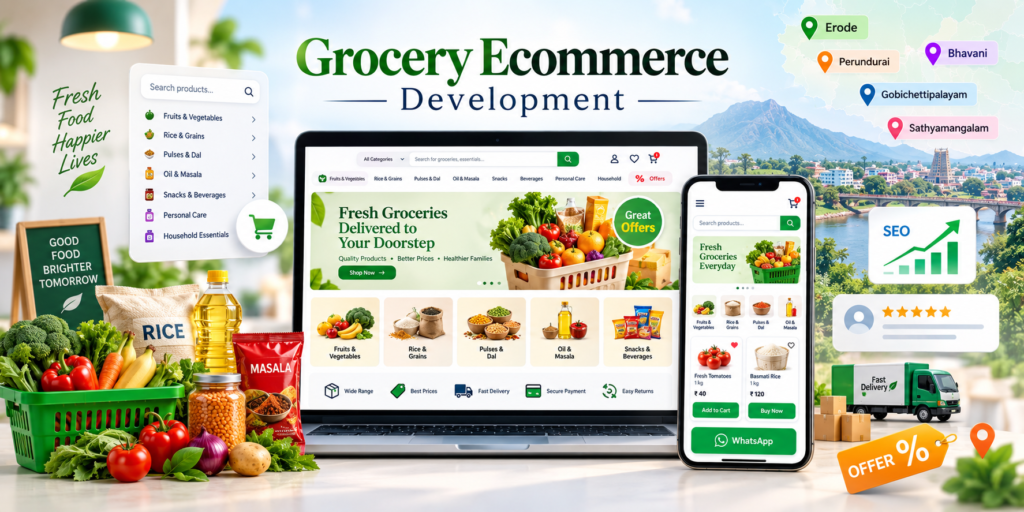
Ecommerce website development for grocery shops in Erode helps grocery stores, provision stores, supermarkets, mini marts, organic grocery shops, departmental stores and wholesale grocery suppliers accept online orders, manage products, support local delivery and provide customers with a more convenient shopping experience.
Grocery is a high-frequency purchase category. Customers may need rice, oil, pulses, vegetables, snacks, cleaning products and other household essentials every week or month. Instead of depending only on store visits or manually sending grocery lists through WhatsApp, a well-planned ecommerce website can make ordering easier for both customers and shop owners.
A professional grocery ecommerce website can allow customers to search products, browse categories, check prices, add items to cart, choose delivery or store pickup, make payments and contact the business through WhatsApp when they need assistance.
At Greap Technologies, we provide ecommerce website development for grocery shops in Erode, helping local retailers build mobile-friendly, SEO-ready and order-focused online stores based on their products, delivery model and business requirements.
Quick Answer: Ecommerce Website Development for Grocery Shops in Erode
Ecommerce website development for grocery shops means creating an online grocery store where customers can browse products, search for daily essentials, add items to cart, choose quantity, select delivery or pickup, complete checkout and pay through supported payment methods.
A grocery ecommerce website can include:
- Professional homepage
- Product categories
- Powerful product search
- Product detail pages
- Brand and price filters
- Cart and checkout
- Online payment
- Cash on delivery, where suitable
- Store pickup
- Delivery-area management
- Delivery-slot selection
- WhatsApp ordering
- Offer banners
- Coupon codes
- Customer accounts
- Repeat orders
- Stock management
- Order management
- Admin panel
- SEO setup
- Analytics and conversion tracking
The right grocery ecommerce setup depends on the number of products, delivery area, daily order volume, stock-management process, payment requirements and whether the business operates from one store or multiple locations.
Grocery Ecommerce Website Development in Erode: Service Overview
| Detail | Information |
|---|---|
| Service | Ecommerce Website Development for Grocery Shops |
| Company | Greap Technologies |
| Location | Erode, Tamil Nadu |
| Main Audience | Grocery shops, supermarkets, provision stores, mini marts, organic stores and departmental stores |
| Main Goal | Generate online grocery orders and improve customer convenience |
| Core Features | Search, categories, cart, checkout, payments, delivery, inventory and WhatsApp ordering |
| Management | Products, stock, pricing, orders, customers, offers and delivery areas |
| SEO Goal | Improve visibility for relevant grocery and local searches |
| Service Area | Erode District and relevant nearby locations |
Why Grocery Shops in Erode Need an Ecommerce Website
Grocery customers value convenience, speed and product availability. A digital ordering system can make it easier for customers to buy regular household products without repeatedly calling the store or manually sending long lists.
1. Receive Grocery Orders Online
An ecommerce website gives customers a structured way to place orders whenever the store’s ordering system is available.
Customers can:
- Browse products
- Search for specific items
- Select pack size
- Choose quantity
- Add products to cart
- Apply available offers
- Select delivery or pickup
- Choose a payment option
- Submit the order
This creates a more organized ordering experience than manually receiving every item through phone calls or chat messages.
2. Make Repeat Grocery Shopping Easier
Unlike many other ecommerce categories, grocery purchases happen frequently.
Customers may repeatedly order:
- Rice
- Cooking oil
- Dal and pulses
- Masala
- Milk and dairy
- Snacks
- Beverages
- Personal care products
- Cleaning products
- Baby products
Customer accounts, order history, saved addresses and repeat-order features can reduce the time needed to place future orders.
3. Support Home Delivery
A grocery ecommerce website can support local home delivery based on the shop’s actual delivery capacity.
Delivery settings may include:
- Eligible delivery locations
- Postal-code or area validation
- Minimum order amount
- Delivery charges
- Free-delivery threshold
- Same-day delivery where operationally possible
- Scheduled delivery
- Delivery slots
- Store pickup
These details should match the grocery store’s real delivery process.
4. Reduce Repeated Product Enquiries
Customers often contact grocery stores to ask:
- Is this product available?
- What is the price?
- Which pack sizes are available?
- Do you deliver to my area?
- What offers are available?
- Can I pay online?
A properly maintained ecommerce catalogue can answer many of these questions before the customer contacts the business.
5. Promote Grocery Offers More Effectively
Grocery stores can create offer sections for:
- Monthly grocery packs
- Rice and oil combos
- Festival offers
- Weekend deals
- Household combo packs
- Organic product offers
- Free-delivery promotions
- Coupon campaigns
Offers should always reflect the actual store pricing and availability.
6. Improve Local Online Visibility
An SEO-friendly website can help a grocery business build visibility around relevant searches such as:
- grocery shop in Erode
- online grocery store in Erode
- grocery delivery in Erode
- supermarket in Erode
- provision store in Erode
- organic grocery shop in Erode
- rice shop in Erode
- grocery store near me
SEO cannot guarantee a specific Google ranking, but a properly structured website gives the business a stronger foundation for organic and local search visibility.
Learn more about SEO services from Greap Technologies.
Which Grocery Businesses Can Use Ecommerce?
Local Grocery Shops
Local grocery stores can start with a simple ecommerce or catalogue-based ordering system focused on nearby customers.
Provision Stores
Provision stores can sell rice, oil, pulses, flour, spices, snacks, cleaning supplies, personal care products and household essentials.
Supermarkets
Supermarkets may need a larger ecommerce setup with hundreds or thousands of products, advanced search, inventory controls, multiple categories, offers and delivery management.
Mini Marts
Mini marts can provide a simple mobile-first ordering experience for nearby customers and regular purchases.
Organic Grocery Stores
Organic stores can showcase:
- Millets
- Organic rice
- Pulses
- Cold-pressed oils
- Natural foods
- Healthy snacks
- Organic vegetables
Fruits and Vegetable Stores
Fresh-produce businesses can accept daily orders based on actual stock and delivery availability.
Departmental Stores
Departmental stores can combine grocery, personal care, home care, stationery and daily essentials in one online store.
Wholesale Grocery Suppliers
Wholesale businesses may prefer a B2B catalogue with bulk quantity enquiry, dealer enquiry and quotation requests instead of a normal retail checkout.
Rice and Oil Stores
Rice and oil businesses can sell pack-based products directly or provide bulk-order enquiry options.
Important Features of a Grocery Ecommerce Website
1. Mobile-Friendly Grocery Homepage
The homepage should allow customers to start shopping quickly.
Important sections can include:
- Search bar
- Popular categories
- Daily essentials
- Best sellers
- Monthly grocery packs
- Rice and grains
- Fruits and vegetables
- Organic products
- Current offers
- Delivery information
- Customer reviews
- WhatsApp CTA
- Store location
2. Clear Grocery Category Structure
Customers should not have to scroll through hundreds of unrelated products.
Recommended categories include:
- Rice and Grains
- Dal and Pulses
- Flour
- Cooking Oil
- Ghee
- Masala and Spices
- Sugar and Salt
- Snacks
- Biscuits
- Beverages
- Dairy Products
- Fruits and Vegetables
- Personal Care
- Home Cleaning
- Baby Care
- Organic Products
- Pooja Items
- Monthly Grocery Packs
- Offers
3. Fast Product Search
Product search is one of the most important grocery ecommerce features because customers often already know what they want.
A customer may search directly for:
- 5 kg rice
- sunflower oil
- toor dal
- coffee powder
- dishwashing liquid
- baby soap
- biscuits
The search experience should be fast, easy to use on mobile and tolerant of common search variations where technically feasible.
4. Grocery Product Pages
A product page can include:
- Product name
- Product image
- Brand
- Pack size
- Quantity
- Price
- Offer price
- Availability
- Short description
- Add to Cart
- Buy Now
- WhatsApp enquiry
- Delivery information
- Related products
Product details should be updated accurately, especially for availability and price.
5. Product Variants
Some grocery products are available in different pack sizes.
For example:
- 500 g
- 1 kg
- 5 kg
- 10 kg
- 1 litre
- 5 litres
The website can display pack-size variants without creating unnecessary duplicate products.
6. Product Filters
Useful filters can include:
- Category
- Brand
- Price range
- Pack size
- Organic
- Available products
- Offers
- Best sellers
7. Cart and Checkout
The checkout should remain simple because grocery customers usually want to complete an order quickly.
Checkout can include:
- Customer name
- Phone number
- Delivery address
- Delivery location
- Order summary
- Coupon
- Payment method
- Delivery charge
- Delivery or pickup option
- Delivery slot
- Order notes
8. Delivery Area Validation
Local grocery stores should avoid accepting delivery orders to places they cannot serve.
The website can validate delivery based on:
- PIN code
- Selected area
- Configured delivery zone
- Distance rules, where suitable
The exact setup should reflect actual delivery coverage.
9. Delivery Slot Selection
Businesses that handle scheduled deliveries can allow customers to choose from available slots.
For example:
- Morning
- Afternoon
- Evening
- Same-day slot
- Next-day slot
The available number of orders per slot can also be controlled in more advanced systems.
10. Store Pickup
Customers who do not want delivery can place an order online and collect it from the store.
This can help:
- Reduce delivery load
- Reduce waiting time in store
- Prepare orders before customer arrival
- Serve nearby customers quickly
11. Payment Gateway Integration
Depending on the payment provider and business setup, supported payment options may include:
- UPI
- Cards
- Net banking
- Other supported online payment methods
Cash on delivery or payment at pickup can also be configured where suitable for the business.
12. WhatsApp Grocery Ordering
WhatsApp can remain an additional ordering and support channel even when full ecommerce is available.
Useful WhatsApp actions include:
- Ask about a product
- Ask about delivery
- Send a monthly grocery list
- Bulk order enquiry
- Ask about substitutions
- Ask about offers
A WhatsApp click should be tracked as a WhatsApp interaction unless the business can later verify that it became a confirmed order.
13. Stock Management
Grocery stores typically handle many fast-moving products, so stock management is important.
An inventory workflow can help manage:
- Available quantity
- Out-of-stock products
- Low-stock alerts
- Stock adjustments
- Product availability
- Order deduction
Businesses with more complex inventory requirements can also connect ecommerce with a dedicated inventory or POS system.
Read more about inventory management software for Erode businesses.
14. Order Management
The admin panel should provide a structured order workflow.
Typical statuses can include:
- New Order
- Confirmed
- Preparing
- Ready for Pickup
- Out for Delivery
- Delivered
- Cancelled
15. Customer Accounts and Repeat Orders
For repeat customers, the website can provide:
- Customer login
- Saved address
- Order history
- Previous-order details
- Repeat order
- Saved grocery list
This can be particularly useful for monthly grocery purchasing.
Recommended Grocery Ecommerce Website Structure
Local Grocery Store
- Home
- Shop
- Categories
- Monthly Grocery Packs
- Offers
- Delivery Areas
- About
- Contact
Supermarket Ecommerce Website
- Home
- Categories
- Daily Essentials
- Fresh Products
- Organic Products
- Offers
- Cart
- Checkout
- My Account
- Delivery Information
- Store Location
- Contact
Wholesale Grocery Website
- Home
- About
- Product Catalogue
- Bulk Supply
- Hotel and Restaurant Supply
- Dealer Enquiry
- Request Quote
- Contact
Organic Grocery Store
- Home
- Organic Products
- Millets
- Organic Rice
- Cold-Pressed Oils
- Natural Foods
- Healthy Snacks
- Offers
- Blog
- Contact
Grocery Ecommerce Website Design Style
A grocery ecommerce website should prioritize usability rather than unnecessary visual complexity.
| Business Type | Recommended Design Direction |
|---|---|
| Local Grocery Shop | Simple, fast and order-focused |
| Supermarket | Category-rich and ecommerce-focused |
| Organic Store | Fresh, natural and clean |
| Fruits & Vegetables | Bright, fresh and availability-focused |
| Wholesale Supplier | Catalogue-focused and B2B-friendly |
| Departmental Store | Practical, clean and product-focused |
SEO Strategy for Grocery Ecommerce Websites in Erode
SEO for grocery ecommerce should be planned around product categories, local intent and useful customer content.
Primary Keyword
ecommerce website development for grocery shops in Erode
Supporting Keywords
- grocery ecommerce website development in Erode
- online grocery website development in Erode
- grocery shop website development in Erode
- supermarket ecommerce website in Erode
- grocery delivery website in Erode
- online grocery store in Erode
- grocery website design in Erode
Customer-Facing Grocery Keywords
For an actual grocery shop website, useful keywords may include:
- grocery shop in Erode
- online grocery in Erode
- grocery delivery in Erode
- supermarket in Erode
- provision store in Erode
- organic grocery in Erode
Category SEO
Important grocery categories can have their own SEO-friendly URLs and unique content.
For example:
- /rice/
- /pulses/
- /cooking-oil/
- /snacks/
- /organic-products/
Product SEO
Product SEO can include:
- Descriptive product titles
- SEO-friendly URLs
- Useful descriptions
- Image ALT text
- Category links
- Breadcrumbs
- Relevant structured data
Structured data should match the actual product information displayed on the page.
Local SEO
For local grocery businesses, important local elements can include:
- Accurate business name
- Address
- Phone number
- Store timing
- Google Map
- Delivery areas
- Google Business Profile
- Genuine reviews
Blog Ideas for Grocery Ecommerce Websites
- Monthly Grocery Shopping Checklist for Families
- How to Save Money on Monthly Grocery Shopping
- Benefits of Ordering Groceries Online
- How to Plan a Monthly Grocery Budget
- Best Grocery Products to Buy in Bulk
- Organic Grocery Buying Guide
- Kitchen Essentials Checklist for New Homes
- How Local Grocery Delivery Works
- How to Choose a Grocery Store in Erode
- Why Grocery Shops Need Ecommerce Websites
Grocery Ecommerce Lead and Order Flow
A typical direct ecommerce flow can look like:
Google / Social Media / Ads → Grocery Website → Search or Browse Products → Add to Cart → Select Delivery → Checkout → Payment / COD → Order Confirmation
A WhatsApp-assisted flow may look like:
Website → Product or Grocery List → WhatsApp → Availability Confirmation → Order Confirmation
Useful tracking events include:
- Product views
- Search usage
- Add to cart
- Begin checkout
- Completed purchase
- WhatsApp clicks
- Call clicks
- Coupon usage
Landing Pages for Grocery Marketing Campaigns
Separate campaign pages can be created for specific promotions.
Examples include:
- Online Grocery Store in Erode
- Grocery Delivery in Erode
- Monthly Grocery Packs in Erode
- Supermarket Offers in Erode
- Organic Grocery Products in Erode
- Rice and Oil Offers in Erode
- Fruits and Vegetables Delivery in Erode
A good landing page can include:
- Clear offer
- Relevant categories
- Popular products
- Delivery information
- Customer reviews
- Order CTA
- WhatsApp CTA
- FAQ
Admin Panel Features for Grocery Ecommerce Websites
| Module | Purpose |
|---|---|
| Dashboard | View orders, sales and important alerts |
| Product Management | Add and update grocery products |
| Category Management | Organize grocery categories |
| Brand Management | Manage product brands |
| Price Management | Update normal and offer prices |
| Inventory | Manage availability and stock |
| Order Management | Process grocery orders |
| Customer Management | Manage customer information |
| Delivery Areas | Manage serviceable locations |
| Delivery Charges | Configure delivery pricing |
| Delivery Slots | Manage available time slots |
| Coupons | Create promotional codes |
| Offers | Manage promotional products and banners |
| Payments | Track payment status |
| Reports | Review order and product performance |
| Settings | Manage store configurations |
Advanced Features for Grocery Ecommerce Websites
Growing grocery businesses can later add:
- Repeat order
- Saved grocery lists
- Wishlist
- Subscription orders
- Scheduled recurring orders
- Customer wallet
- Loyalty points
- Referral rewards
- Advanced coupons
- Abandoned-cart recovery
- WhatsApp cart enquiry
- Low-stock alerts
- Barcode management
- POS integration
- Inventory integration
- Delivery staff panel
- Multiple branches
- Multiple warehouses
- Customer mobile app
Advanced functionality should be added only when it solves a real operational or customer requirement.
Ecommerce Website vs Grocery Delivery Mobile App
| Requirement | Website | Mobile App |
|---|---|---|
| Google discovery | Strong option | Limited compared with website |
| Easy first access | Yes | Requires installation |
| Online ordering | Yes | Yes |
| Repeat orders | Yes | Strong option |
| Push notifications | Limited compared with native app | Yes |
| Customer retention | Good | Potentially stronger for frequent users |
| Initial development scope | Usually simpler | Usually broader |
For many grocery shops, starting with an ecommerce website is practical. A dedicated grocery delivery app can be considered later when order frequency, repeat users and delivery operations justify it.
See our guide to grocery delivery app development in Erode.
POS and Ecommerce Integration for Grocery Stores
Businesses operating both a physical grocery shop and an ecommerce store may eventually need their online and offline systems to work together.
Possible integrations include:
- Shared product catalogue
- Central inventory
- Barcode data
- Online orders
- Store billing
- Customer data
- Sales reports
This becomes particularly useful for supermarkets and stores with significant daily sales volume.
Read more about POS software development for retail shops in Erode.
Grocery Ecommerce Website Development Process
Step 1: Requirement Analysis
Important questions include:
- How many grocery products do you sell?
- How many categories are needed?
- Do you need online payment?
- Do you need cash on delivery?
- Do you offer home delivery?
- Which areas can you deliver to?
- Do you need store pickup?
- Do you need delivery slots?
- Do you need customer login?
- Do you need repeat orders?
- How is stock currently managed?
- Do you already use billing or POS software?
Step 2: Ecommerce Architecture Planning
Plan:
- Categories
- Product structure
- Navigation
- Search
- Checkout
- Delivery areas
- Payments
- Inventory
- Admin workflow
Step 3: UI/UX Design
The grocery shopping experience should prioritize speed and simplicity.
Focus on:
- Mobile usability
- Large search bar
- Clear categories
- Easy quantity controls
- Visible Add to Cart
- Simple checkout
- Clear delivery information
Step 4: Ecommerce Development
Development can include:
- Homepage
- Product categories
- Product pages
- Search
- Filters
- Cart
- Checkout
- Payment integration
- Delivery setup
- Customer accounts
- WhatsApp integration
- Admin panel
Step 5: Product Data Setup
Grocery product data can include:
- Product name
- Category
- Brand
- Pack size
- Price
- Offer price
- Stock status
- SKU
- Product image
- Short description
Clean product data is especially important when hundreds or thousands of grocery products are involved.
Step 6: SEO and Analytics Setup
This can include:
- SEO titles
- Meta descriptions
- Image ALT text
- Category SEO
- Sitemap
- Google Search Console
- Google Analytics
- Add-to-cart tracking
- Checkout tracking
- Purchase tracking
- WhatsApp click tracking
Step 7: Testing and Launch
Before launch, test:
- Mobile view
- Desktop view
- Product search
- Filters
- Product pricing
- Stock status
- Cart
- Checkout
- Coupons
- Payment gateway
- Cash on delivery rules
- Delivery areas
- Delivery charges
- Store pickup
- Order notifications
- WhatsApp buttons
- Page speed
- Analytics
Grocery Ecommerce Website Features Checklist
| Feature | Recommendation |
|---|---|
| Professional Homepage | Required |
| Mobile Responsive Design | Required |
| Product Categories | Required |
| Product Pages | Required |
| Product Search | Required |
| Product Filters | Recommended |
| Cart and Checkout | Required |
| Online Payment | Based on business model |
| Cash on Delivery | Based on business model |
| Delivery Areas | Required for delivery businesses |
| Delivery Charges | Required where applicable |
| Delivery Slots | Based on operational needs |
| Store Pickup | Recommended where available |
| Recommended | |
| Customer Login | Recommended for repeat ordering |
| Order Management | Required |
| Inventory | Strongly Recommended |
| Coupons | Optional |
| Reviews | Recommended |
| SEO Setup | Required |
| Admin Panel | Required |
| Analytics | Recommended |
Common Grocery Ecommerce Mistakes to Avoid
1. Poor Product Search
Customers should be able to find products quickly without browsing multiple pages.
2. Poor Category Structure
Daily essentials should be organized into clear categories.
3. Incorrect Stock Information
Customers may become frustrated when the website shows an item as available but the store cannot fulfil it.
4. Missing Delivery Rules
Delivery areas, charges and minimum-order requirements should be clearly communicated.
5. Complicated Checkout
A grocery checkout should minimize unnecessary steps.
6. Poor Mobile Performance
Customers should be able to search, add items and checkout comfortably on a smartphone.
7. Slow Product Images
Large catalogues require properly optimized product imagery.
8. No Order Management Workflow
The store team should know which orders are new, preparing, ready and delivered.
9. No Inventory Planning
A large online catalogue becomes difficult to manage without a clear stock process.
10. No Analytics
Without tracking, the business cannot clearly understand which products, categories or campaigns are generating sales.
Erode District Grocery Ecommerce Strategy
Greap Technologies supports businesses across Erode district, including:
Erode, Perundurai, Bhavani, Anthiyur, Gobichettipalayam, Sathyamangalam, Modakkurichi, Kodumudi, Nambiyur, Chennimalai, Kavindapadi, Ammapettai, Arachalur, Sivagiri, Punjai Puliampatti and relevant nearby areas.
Businesses should create location-specific SEO pages only when those pages represent genuine service or delivery relevance.
A good location page can include:
- Actual delivery coverage
- Local store information
- Delivery timings
- Relevant products
- Pickup information
- Local customer questions
- Unique content
Avoid publishing large numbers of nearly identical pages that simply change the town name.
How Greap Technologies Helps Grocery Shops in Erode
Greap Technologies helps grocery stores plan and develop ecommerce systems based on real store operations.
Our grocery ecommerce development services can include:
- Ecommerce requirement planning
- Store architecture
- Homepage design
- Product category setup
- Product page development
- Product search
- Filters
- Cart and checkout
- Payment gateway integration
- Cash-on-delivery configuration
- Delivery-area setup
- Delivery-charge configuration
- Delivery-slot setup
- Store pickup
- WhatsApp integration
- Customer account setup
- Order management
- Inventory setup
- Admin panel
- SEO-friendly structure
- Product SEO
- Local SEO
- Analytics integration
- Conversion tracking guidance
- Maintenance and improvement support
Explore our ecommerce development services.
Useful Greap Resources for Grocery Ecommerce Businesses
- Ecommerce Website Development Services in Erode
- How to Build an Ecommerce Business in Erode
- Shopify Website Development for Businesses in Erode
- Inventory Management Software for Erode Businesses
- POS Software Development for Retail Shops in Erode
- Grocery Delivery App Development in Erode
- SEO Services
Why Choose Greap Technologies?
Grocery-Focused Ecommerce Planning
We plan product structure, search, checkout, inventory and delivery based on how the grocery business actually operates.
Local Erode Business Understanding
Local grocery stores often need practical solutions around nearby delivery, WhatsApp enquiries, repeat customers and store pickup rather than unnecessary features.
SEO-Friendly Ecommerce Development
We can structure categories, product pages, metadata and internal links with search visibility in mind.
Inventory and Admin Management
We can create or configure systems to help manage products, orders, stock, offers, customers and delivery settings.
Shopify, WooCommerce and Custom Ecommerce
The platform can be selected based on catalogue size, delivery workflow, integrations, management requirements, budget and future scalability.
Development + Digital Growth Support
Greap Technologies can also support SEO, Google Business Profile optimization, landing pages, Google Ads, Meta Ads and analytics after launch.
Conclusion
Ecommerce website development for grocery shops in Erode can help grocery stores move beyond only walk-in sales by giving customers a convenient way to search products, place orders, choose delivery, make payments and reorder regular household essentials.
A good grocery ecommerce website should focus on practical features such as fast product search, clear categories, accurate stock information, simple checkout, delivery management, WhatsApp support, order tracking, admin management and mobile performance.
For small shops, a simple online catalogue with ordering may be enough initially. Growing supermarkets and delivery businesses may require advanced inventory, delivery slots, repeat ordering, POS integration and mobile apps later.
The right system should be built around the actual store workflow rather than adding unnecessary ecommerce features from the beginning.
Need an Ecommerce Website for Your Grocery Shop in Erode?
Greap Technologies can help you build a professional grocery ecommerce website with product categories, search, cart, checkout, online payments, delivery setup, WhatsApp integration, inventory management, SEO and an easy-to-use admin panel.
Frequently Asked Questions
1. Why do grocery shops in Erode need an ecommerce website?
A grocery ecommerce website can help shops receive online orders, support local delivery, display products and offers, improve customer convenience and reduce dependence on only walk-in customers.
2. What should a grocery ecommerce website include?
A grocery ecommerce website can include product categories, search, product pages, cart, checkout, payment integration, delivery configuration, WhatsApp support, order management, inventory, SEO and an admin panel.
3. Can grocery shops receive WhatsApp orders from the website?
Yes. A grocery website can include product-specific WhatsApp buttons, general ordering support, monthly grocery-list enquiries and delivery enquiries.
4. Can grocery shops accept online payments?
Yes. A grocery ecommerce website can be connected to a suitable payment gateway. Cash on delivery or payment during store pickup can also be offered where appropriate.
5. Is SEO important for grocery ecommerce websites?
Yes. SEO can help grocery websites compete for relevant searches related to grocery stores, supermarkets, grocery delivery and local products in Erode.
6. Can a grocery website include home delivery?
Yes. Delivery configuration can include serviceable areas, delivery charges, minimum order values, delivery slots and store pickup based on the shop’s operating model.
7. Which platform is suitable for grocery ecommerce websites?
Shopify and WooCommerce can work well for many grocery ecommerce stores. Custom development may be more suitable when the business needs complex delivery rules, custom inventory workflows, multi-store management, POS integration or other specialized functionality.
8. Can a grocery ecommerce website include stock management?
Yes. The website can track product availability and inventory, while more advanced grocery businesses can integrate ecommerce with dedicated inventory or POS systems.
9. Can Greap Technologies build grocery ecommerce websites in Erode?
Yes. Greap Technologies provides ecommerce development for grocery shops in Erode, including product catalogues, search, cart, checkout, payment setup, delivery workflows, WhatsApp integration, inventory management and SEO.
10. Can a grocery ecommerce website help increase repeat orders?
It can make repeat ordering easier through customer accounts, previous orders, saved addresses, offers, saved lists and other convenience features when properly implemented.