If your website is not generating the search visibility, traffic or enquiries you expected, immediately adding more blog articles or keywords may not be the best first step.
The website may already have problems that need to be identified first.
Important pages may not be indexed correctly.
Multiple pages may compete for the same search intent.
Internal links may be weak.
Service pages may have unclear content.
The website may be slow on mobile devices.
Local SEO signals may be incomplete.
Analytics may not even be measuring enquiries correctly.
This is where professional SEO audit services in Erode can help.
A proper SEO audit should not simply generate a long automated report containing hundreds of warnings.
It should answer three important questions:
What is wrong?
What actually matters?
What should be fixed first?
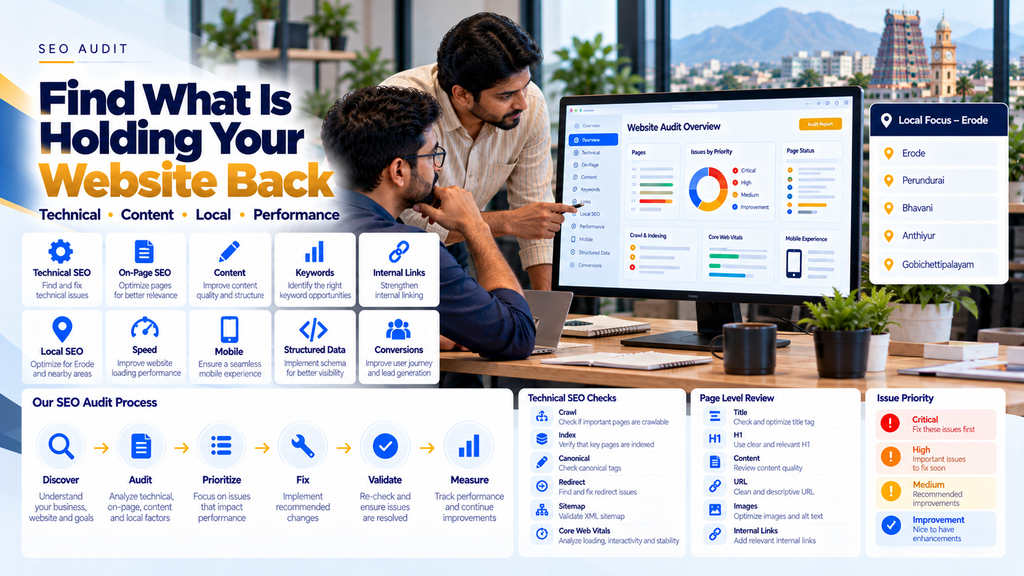
A practical SEO audit process can be represented as:
Discover → Audit → Diagnose → Prioritize → Implement → Validate → Measure
This guide explains what a professional SEO audit should include and what businesses in Erode should check before paying for an SEO audit.
What Is an SEO Audit?
An SEO audit is a structured review of a website to identify issues and opportunities that may affect its organic search performance.
A complete audit can examine multiple areas rather than looking at only keywords.
These can include:
- Technical SEO
- Crawlability
- Indexability
- Website architecture
- On-page SEO
- Keyword targeting
- Search intent
- Content quality
- Internal linking
- Website speed
- Core Web Vitals
- Mobile usability
- Structured data
- Local SEO
- Backlink profile where relevant
- Search performance
- Conversion paths
- Analytics and measurement
Why Does Your Business Need an SEO Audit?
An SEO audit helps businesses understand the current condition of their website before making major SEO changes.
Without an audit, businesses may spend time solving the wrong problems.
For example, a company may publish more blog articles when its main service pages are poorly structured.
Another company may rewrite its content even though an important page is accidentally set to noindex.
An ecommerce store may create additional category pages while uncontrolled filters are already generating large numbers of duplicate URLs.
The audit helps replace assumptions with a structured diagnosis.
An SEO Audit Should Not Be Just an Automated Score
Many SEO tools can crawl a website and generate scores or lists of warnings.
These tools are useful for collecting data.
However, a professional SEO audit requires interpretation.
For example, an audit tool may report:
200 pages with missing meta descriptions.
That sounds serious.
But the auditor still needs to determine:
- Are all 200 URLs important?
- Should all of them be indexed?
- Are some parameter URLs?
- Are some duplicate pages?
- Are some intentionally excluded?
- Which pages actually need optimization first?
Professional auditing is therefore about diagnosis and prioritization, not simply exporting software reports.
What Should a Professional SEO Audit Include?
A comprehensive SEO audit can be divided into several major areas:
Technical SEO Audit
+
On-Page SEO Audit
+
Content & Keyword Audit
+
Internal Linking & Architecture Audit
+
Performance & Mobile Audit
+
Local SEO Audit
+
Authority / Backlink Review Where Relevant
+
Analytics & Conversion Review
↓
Prioritized SEO Action Plan
1. Technical SEO Audit
The technical audit examines whether search engines can access and process the website as intended.
Important areas can include:
- HTTP status codes
- Crawlability
- Indexability
- robots.txt
- Meta robots directives
- XML sitemaps
- Canonical tags
- Redirects
- Duplicate URLs
- HTTPS
- JavaScript rendering
- Structured data
- Website architecture
- Server errors
Read Technical SEO Services in Erode: Why Your Website Needs Them.
2. Crawlability Audit
Important pages should be accessible to search-engine crawlers when they are intended to participate in organic search.
The audit should review:
- robots.txt restrictions
- Internal-link accessibility
- Redirect behavior
- Server responses
- JavaScript-dependent navigation where relevant
- Blocked resources where relevant
Look for Accidental Crawl Blocks
A website can accidentally retain development or staging configurations after launch.
This should be checked rather than assumed.
3. Indexability Audit
A page being crawlable does not automatically mean it is indexable or indexed.
The audit should examine:
- Meta robots directives
- X-Robots-Tag headers where relevant
- Canonical tags
- HTTP status
- Redirects
- Duplicate content
- Search Console indexing information
Identify Accidental Noindex Pages
Important service, category or product pages should not unintentionally carry noindex directives.
Identify Unwanted Indexed Pages
The reverse can also happen.
A website may expose low-value internal search pages, filter combinations, test pages or other URLs that were never intended to become search landing pages.
4. robots.txt Audit
The robots.txt file should be reviewed for rules that affect crawler access.
Common problems can include:
- Blocking important directories
- Old staging rules
- Overly broad wildcard rules
- Blocking resources required for rendering
- Misunderstanding robots.txt as an index-removal tool
5. XML Sitemap Audit
An XML sitemap should generally help search engines discover the website’s important canonical URLs.
The audit should check whether the sitemap contains:
- Important live pages
- Correct canonical URLs
- Only intended indexable URLs
It should also identify unnecessary entries such as:
- 404 URLs
- Redirected URLs
- Noindex URLs
- Duplicate URLs
- Test pages
6. HTTP Status Code Audit
The audit should review how the server responds to important URLs.
Common responses include:
| Status | General Meaning |
|---|---|
| 200 | Successful response |
| 301 | Permanent redirect |
| 302 | Temporary redirect |
| 404 | Resource not found |
| 5xx | Server-side error |
The goal is not to eliminate every 404 from the internet. The goal is to identify incorrect responses, broken internal journeys and important URLs that are not behaving as intended.
7. Redirect Audit
Redirects are normal parts of website maintenance and migrations, but they should be implemented deliberately.
Redirect Chains
Example:
Old URL → Older URL → New URL → Final URL
Unnecessary chains should be simplified where appropriate.
Redirect Loops
Loops can prevent users and crawlers from reaching the intended destination.
Irrelevant Redirects
Deleted URLs should not automatically be redirected to unrelated pages simply to avoid a 404.
8. Canonical Tag Audit
Canonical tags help communicate preferred URLs among duplicate or substantially similar versions.
The audit should identify:
- Missing canonicals where relevant
- Incorrect canonical targets
- Canonicals pointing to redirected URLs
- Canonicals pointing to error pages
- Important pages canonicalized elsewhere
- Conflicting sitemap and canonical signals
9. HTTPS and Security Configuration Review
An SEO audit should verify that the preferred website version uses HTTPS correctly.
Review areas can include:
- HTTP-to-HTTPS redirects
- Mixed-content problems
- Internal HTTP links
- Canonical URL protocol
- Sitemap URL protocol
10. Website Architecture Audit
Website architecture determines how pages are organized and connected.
A business website may follow a structure such as:
Homepage → Main Services → Specific Services → Supporting Content → Contact
An ecommerce website may use:
Homepage → Category → Subcategory → Product
The audit should determine whether important pages are logically connected rather than buried deep within the website.
11. Internal Linking Audit
Internal links help users and search engines discover related pages.
An internal-link audit can identify:
- Orphan pages
- Broken internal links
- Important pages with very few internal links
- Old URLs still used in links
- Excessive irrelevant links
- Poor anchor-text context
- Missing relationships between service and supporting content
12. Orphan Page Audit
An orphan page is a page with no meaningful internal-link path from the rest of the website.
An important SEO landing page should normally be part of the website’s logical structure rather than relying only on an XML sitemap for discovery.
13. Broken Link Audit
The audit should identify internal links pointing to missing or incorrect destinations.
This can include:
- Deleted pages
- Changed URLs
- Old product pages
- Broken images
- Incorrectly typed links
14. On-Page SEO Audit
Technical health alone does not make a page relevant to a search.
A professional audit should therefore review page-level SEO.
This can include:
- Title tags
- Meta descriptions
- H1 headings
- H2/H3 structure
- Page content
- URLs
- Images
- ALT text
- Internal links
- Search intent
- Keyword targeting
Read On-Page SEO Services in Erode: Complete Business Guide.
15. Title Tag Audit
Important pages should have titles that accurately describe their purpose.
The audit should identify issues such as:
- Missing titles
- Duplicate titles
- Generic titles
- Unnecessarily repetitive titles
- Titles that do not match page intent
16. Meta Description Audit
Meta descriptions can help communicate page value to potential search visitors.
The audit can identify:
- Missing descriptions on priority pages
- Duplicate descriptions
- Generic descriptions
- Keyword-stuffed descriptions
- Descriptions that no longer match page content
Not every automated warning needs the same priority. Priority pages should be addressed according to business and search importance.
17. Heading Structure Audit
Headings should help organize content logically.
The audit should review:
- Missing H1 headings
- Unclear main headings
- Duplicate template headings
- Illogical hierarchy
- Headings used only for visual styling
18. Search Intent Audit
A technically optimized page can still perform poorly if it does not satisfy the intended search.
The audit should ask:
What is the user searching for?
What does this page provide?
Are those two things aligned?
19. Keyword Mapping Audit
A keyword map assigns important topics and search intents to appropriate website pages.
The audit should identify:
- Important services without dedicated pages
- Multiple pages targeting the same intent
- Pages targeting unrelated keyword groups
- Important topics missing from the site
- Blog articles competing unnecessarily with service pages
20. Keyword Cannibalization Review
Businesses sometimes create several pages with nearly identical purposes.
For example:
SEO Company in Erode
Best SEO Agency in Erode
SEO Experts in Erode
SEO Services in Erode
If each page provides essentially the same information and targets the same search intent, the website may need consolidation or clearer differentiation.
21. Content Quality Audit
A content audit should examine whether important pages genuinely help the intended audience.
Review areas can include:
- Accuracy
- Originality
- Depth where needed
- Business-specific information
- Search-intent alignment
- Outdated information
- Thin pages
- Duplicate content
- Unnecessary filler
- Conversion relevance
22. Thin Content Review
Thin content is not simply a page with a low word count.
A short page can still be useful.
The real question is whether the page provides enough information for its purpose.
A product page may need concise specifications and purchase information, while a complex B2B service may require considerably more explanation.
23. Duplicate Content Audit
Duplicate or substantially similar content can appear because of:
- CMS-generated URLs
- Product variants
- Filters
- Location-page duplication
- Copied manufacturer descriptions
- HTTP/HTTPS variations
- URL parameters
- Print versions
- Staging copies
The correct solution depends on why the duplication exists.
24. Location Page Audit
Local businesses should be particularly careful with location pages.
Creating dozens of pages by copying the same content and changing only the town name provides little unique value.
A professional audit should review whether location pages contain meaningful local relevance.
Check for Genuine Local Value
Useful location content may include actual service coverage, relevant business context, genuine project examples and appropriate contact information.
Avoid Mass-Generated Doorway-Style Pages
The objective should be to help customers in the location, not simply create another URL containing a place name.
25. Image SEO Audit
Images affect both SEO context and website performance.
The audit can review:
- File sizes
- Image dimensions
- Modern formats
- ALT text
- Broken images
- Lazy loading
- Critical image loading
- Layout stability
26. Website Speed Audit
Slow pages can create poor user experiences.
A performance audit can investigate:
- Large images
- Heavy JavaScript
- Unused CSS
- Third-party scripts
- Fonts
- Server response
- Caching
- Database performance
- Page-builder overhead
- Large DOM structures
Read Website Speed Optimization Services in Erode.
27. Core Web Vitals Audit
Core Web Vitals provide measurements related to important aspects of page experience.
The audit should consider:
- Largest Contentful Paint (LCP)
- Interaction to Next Paint (INP)
- Cumulative Layout Shift (CLS)
The objective should not simply be achieving a screenshot with a high test score. The website should provide a strong experience for real users.
Read Core Web Vitals Optimization for Business Websites in Erode.
28. Mobile SEO Audit
A professional SEO audit should review the website on mobile devices.
Important checks include:
- Responsive layout
- Readable text
- Touch-friendly controls
- Mobile navigation
- Horizontal overflow
- Images
- Forms
- Popups
- Page speed
- Calls to action
29. Structured Data Audit
If structured data is implemented, the audit should check whether it accurately represents the website.
Depending on the site, this may include:
- Organization
- LocalBusiness
- BreadcrumbList
- Product
- Article
Check Accuracy
Markup should correspond to legitimate website information.
Check Technical Validity
Syntax and implementation errors should be identified.
Avoid Fake Review Markup
Do not create artificial ratings or testimonials for SEO purposes.
Do Not Treat Schema as a Ranking Guarantee
Structured data can help machines understand supported information, but it does not guarantee rankings or special search-result presentation.
30. Local SEO Audit
For businesses serving Erode and surrounding areas, the audit should also examine local search foundations.
This can include:
- Business name consistency
- Address where applicable
- Phone information
- Service information
- Service areas
- Location pages
- Google Business Profile
- Customer reviews
- Review responses
- Relevant citations
- Local internal linking
31. Google Business Profile Review
For eligible local businesses, the audit can review whether the business profile contains accurate and useful information.
Areas can include:
- Business details
- Primary and additional categories where appropriate
- Hours
- Contact details
- Website destination
- Photos
- Reviews
- Review responses
Read Google Maps SEO for Service Businesses in Erode.
32. Local Citation Audit
Local citations are online references to a business.
An audit can identify:
- Incorrect business details
- Duplicate listings
- Outdated phone numbers
- Old addresses
- Relevant missing listings
Read Local Citation Building for Erode Businesses: Complete Guide.
33. Review Audit
Customer reviews can contribute to trust and local business visibility.
The audit can review:
- Review acquisition process
- Business responses
- Website testimonial presentation
- Review consistency
- Fake or suspicious review practices
Businesses should focus on genuine customer feedback rather than fabricated reviews.
Read How to Get More Google Reviews for Your Erode Business.
34. Backlink Profile Review
Depending on the SEO scope, a professional audit may also review links from external websites.
The objective is not simply to count backlinks.
Useful questions include:
- Which pages attract external links?
- Are links coming from relevant websites?
- Are important pages earning any external visibility?
- Are there suspicious link-building patterns?
- Are competitors earning relevant mentions the business lacks?
35. Competitor Search Landscape Review
An SEO audit can compare the website with businesses appearing for important searches.
The objective should not be to copy competitors.
Instead, review:
- Topics they cover
- Service-page structure
- Content depth
- Search intent
- Internal architecture
- Local relevance
- Search-result presentation
- Content gaps
36. Google Search Console Audit
Search Console can provide useful information about how Google interacts with the website.
An audit can review available information related to:
- Queries
- Pages
- Clicks
- Impressions
- Indexing
- Sitemaps
- URL inspection
- Core Web Vitals
- Enhancements where applicable
37. Search Performance Audit
The audit should identify which pages already have organic visibility before recommending major changes.
For example, review:
- Pages receiving organic clicks
- Pages receiving impressions but few clicks
- Queries associated with priority pages
- Pages gaining visibility
- Pages losing visibility
- Important pages with little visibility
38. Analytics Audit
Traffic numbers are only useful when measurement is configured properly.
An analytics audit can review whether important business actions are being measured.
Depending on the website, these may include:
- Contact-form submissions
- Quote requests
- Phone interactions
- WhatsApp interactions
- Bookings
- Product purchases
- RFQ submissions
39. Conversion Path Audit
SEO should not stop when a visitor lands on the website.
A useful customer journey can be:
Google Search → Relevant Page → Understand Service → Build Trust → CTA → Enquiry
The audit should identify unnecessary friction between organic traffic and the desired business action.
40. Call-to-Action Audit
Important SEO landing pages should provide an appropriate next step.
Depending on the business, this may include:
- Call
- Request a quote
- Book an appointment
- Send an enquiry
- Request an RFQ
- Purchase a product
SEO Audit for Service Business Websites
A service-business audit should pay particular attention to:
- Main service architecture
- Individual service pages
- Location targeting
- Search intent
- Internal links
- Business information
- Local SEO
- Contact journeys
- Lead measurement
SEO Audit for Manufacturing Websites
Manufacturing websites may require review of:
- Product categories
- Product catalogue architecture
- Technical specifications
- Industries served
- Applications
- PDF documents
- Product images
- Duplicate specifications
- RFQ pages
- B2B search intent
SEO Audit for Ecommerce Websites
Ecommerce audits can be more complex because a store may generate large numbers of URLs.
The audit can review:
- Category architecture
- Subcategories
- Product pages
- Product variants
- Pagination
- Filters
- Sorting URLs
- Internal search URLs
- Canonicalization
- Out-of-stock products
- Discontinued products
- Product structured data
- Product images
- Internal linking
- Mobile usability
- Performance
Read Ecommerce Category Page SEO: Complete Optimization Guide and Ecommerce Product Page SEO: How to Rank Products on Google.
SEO Audit for WordPress Websites
A WordPress SEO audit can additionally review:
- SEO plugin configuration
- Theme output
- Page-builder performance
- Category archives
- Tag archives
- Author archives
- Media URLs
- Sitemaps
- Canonicals
- Redirect plugins
- Caching
- Unused plugins
- Image optimization
SEO Audit for Shopify Stores
A Shopify audit can review areas such as:
- Collection architecture
- Product pages
- Internal linking
- Canonical behavior
- Theme performance
- App scripts
- Structured data
- Image performance
- Redirects
- Content duplication patterns
What Should You Receive After a Professional SEO Audit?
A business should receive more than a list of errors.
A useful SEO audit deliverable can include:
- Executive summary
- Major findings
- Technical issues
- On-page issues
- Content issues
- Local SEO findings where relevant
- Performance findings
- Example affected URLs
- Recommended fixes
- Priority level
- Implementation requirements
- Recommended next actions
Prioritizing SEO Audit Findings
Not every SEO issue has the same importance.
A useful prioritization model can be:
| Priority | Example Meaning |
|---|---|
| Critical | Major issue affecting important website access, indexing or functionality |
| High | Important issue affecting priority pages or major SEO opportunities |
| Medium | Meaningful optimization that should be scheduled |
| Improvement | Lower-priority enhancement that can be addressed after major issues |
Priority should be determined by the actual website and business impact rather than blindly assigning severity based on an automated tool.
A Practical SEO Audit Workflow
A professional audit process can follow:
1. Understand the Business
↓
2. Identify Priority Services and Pages
↓
3. Crawl and Review the Website
↓
4. Review Search and Analytics Data
↓
5. Review Technical SEO
↓
6. Review On-Page SEO
↓
7. Review Content and Keywords
↓
8. Review Local SEO Where Relevant
↓
9. Review User and Conversion Journey
↓
10. Prioritize Findings
↓
11. Create an Implementation Plan
↓
12. Fix, Validate and Monitor
Common SEO Audit Mistakes
- Using only an automated SEO score
- Treating every warning as equally important
- Auditing without understanding the business
- Looking only at keywords
- Ignoring technical SEO
- Ignoring search intent
- Ignoring current search performance
- Ignoring existing high-performing pages
- Changing URLs unnecessarily
- Ignoring internal links
- Ignoring mobile experience
- Ignoring website speed
- Ignoring conversion tracking
- Ignoring local SEO for local businesses
- Creating recommendations without implementation instructions
- Fixing low-priority warnings before major problems
- Guaranteeing rankings after the audit
SEO Audit vs Technical SEO Audit
| Complete SEO Audit | Technical SEO Audit |
|---|---|
| Technical SEO | Crawlability |
| On-page SEO | Indexability |
| Keywords | HTTP status codes |
| Search intent | Canonicals |
| Content | Redirects |
| Internal links | Sitemaps |
| Local SEO | Rendering |
| Performance | Performance |
| Search data | Technical structured data |
| Conversions | Server/technical issues |
A technical audit is therefore one major component of a broader SEO audit.
SEO Audit vs On-Page SEO Audit
An on-page audit focuses primarily on individual page optimization, while a complete SEO audit looks at the entire organic-search system.
On-page areas can include:
Search Intent → Keyword → Title → H1 → Content → URL → Images → Internal Links → CTA
A complete audit adds technical, architecture, local, authority, performance and measurement considerations.
How Much Do SEO Audit Services Cost in Erode?
The cost of an SEO audit depends on the size and complexity of the website.
Factors can include:
- Number of website URLs
- Business website vs ecommerce
- Website platform
- Number of locations
- Keyword research requirements
- Technical complexity
- JavaScript requirements
- Content volume
- Competitor research
- Local SEO requirements
- Analytics review
- Implementation support
A small local-business website and an ecommerce website containing thousands of product and filter URLs should not be expected to require the same audit scope.
How Long Does an SEO Audit Take?
The required time depends on website size, complexity and audit depth.
A professional audit involves more than running a crawler and exporting a PDF.
Time may be required for:
- Business understanding
- Website crawling
- Manual page review
- Search-data analysis
- Keyword review
- Technical investigation
- Content analysis
- Local SEO review
- Prioritization
- Documentation
When Should You Get an SEO Audit?
An SEO audit can be especially useful:
- Before starting a new SEO campaign
- When organic traffic has declined
- When important pages are not being indexed
- After a website redesign
- Before a website migration
- After a platform migration
- When expanding into new services
- When adding many ecommerce products
- When changing website architecture
- When SEO work has produced unclear results
- When the business wants a structured SEO roadmap
SEO Audit Services Across Erode District
Greap Technologies works with businesses in Erode and surrounding areas, including:
- Erode
- Perundurai
- Bhavani
- Anthiyur
- Gobichettipalayam
- Sathyamangalam
- Modakkurichi
- Kodumudi
- Nambiyur
- Chennimalai
- Kavindapadi
- Ammapettai
- Arachalur
- Sivagiri
- Punjai Puliampatti
- Thalavadi
- Nasiyanur
- Surampatti
- Veerappanchatram
Local SEO should reflect genuine business coverage. A website does not need to repeat every location on every page or create a near-identical page for every town.
How Greap Technologies Approaches SEO Audits
Greap Technologies can review the website across SEO, development, performance and conversion-related areas rather than treating SEO as keyword placement alone.
Depending on the website and agreed audit scope, the review can include:
- Technical SEO audit
- Crawlability review
- Indexability review
- robots.txt review
- XML sitemap review
- Canonical review
- Redirect analysis
- Broken-link analysis
- Website architecture review
- Internal-link analysis
- On-page SEO audit
- Keyword research
- Keyword mapping
- Search-intent analysis
- Content audit
- Duplicate-content review
- Location-page review
- Local SEO audit
- Website speed review
- Core Web Vitals review
- Mobile usability review
- Structured-data review
- Search Console review
- Analytics review
- Conversion-path review
- Prioritized SEO recommendations
- Implementation planning
Explore Greap Technologies SEO Services, Website Development Services, Digital Marketing Services or visit Greap Technologies.
What a Useful SEO Audit Report Should Tell You
At the end of the audit, a business should be able to understand:
What problems exist?
Which pages are affected?
Why does the issue matter?
What should be fixed?
Who needs to fix it?
Which problems should be handled first?
How will the fix be validated?
This makes the audit actionable rather than simply informative.
Conclusion
SEO audit services in Erode should provide businesses with a clear understanding of their website’s current organic-search foundation.
A professional audit should look beyond keywords and automated scores.
It should connect:
Technical SEO → On-Page SEO → Content → Keywords → Internal Links → Local SEO → Performance → Search Data → Conversions
The audit